
Pulp Fiction, 1886 · page 16 of 32
Beadle's New York Dime Library No. 383 — page 16: what you’re looking at
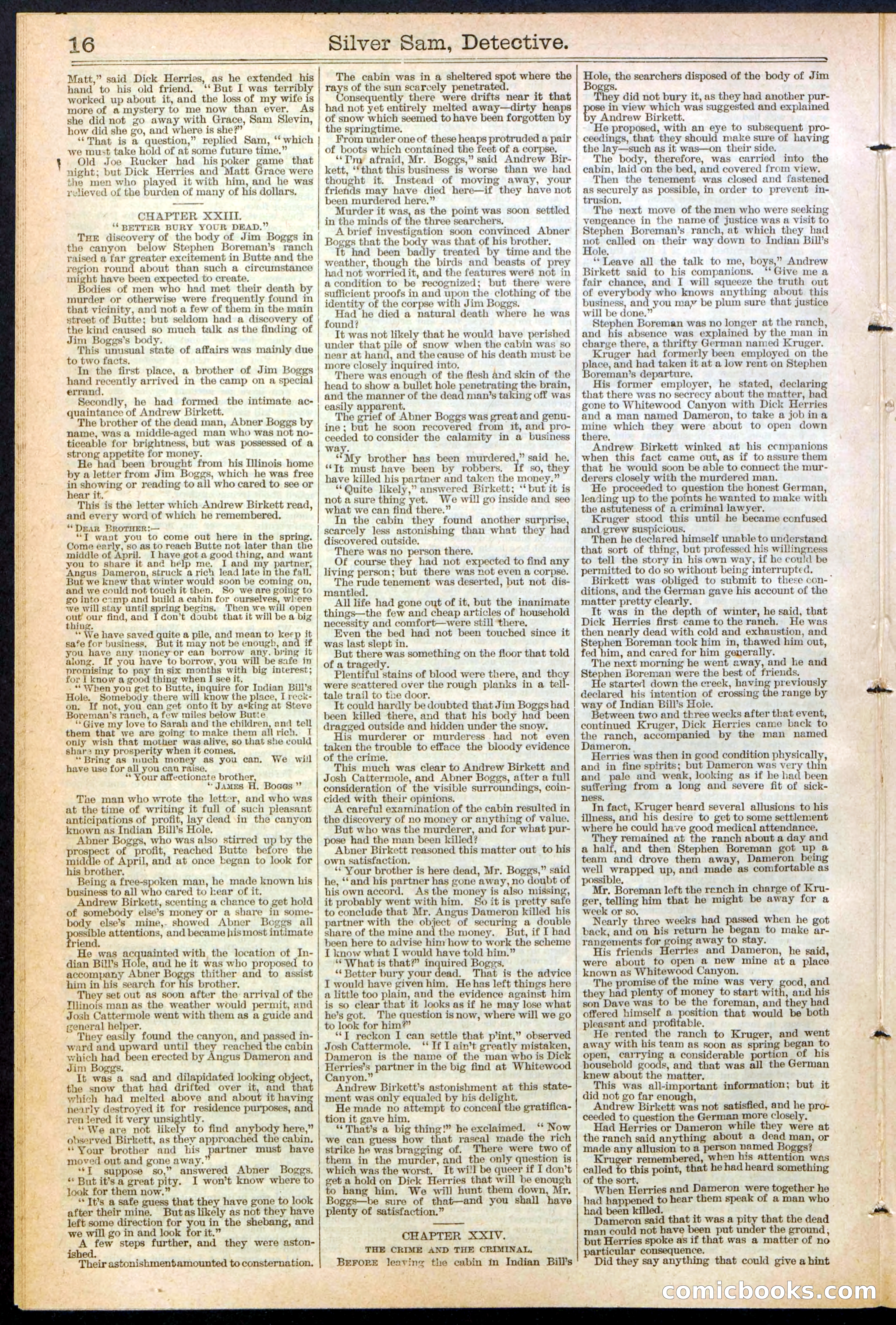
A restored page from Pulp Fiction, 1886. Page through the whole issue in the reader above.
📄 Transcribed text from this page (OCR, searchable)
Machine-transcribed from the original scan — historical spelling and the odd misread are preserved.
ae a - orem & —— SAS SS ne — - 2 — = a mo el ora —— —— —— 16 Matt,” said Dick Herries, as he extended his hand to his old friend. ‘‘ But I was terribly worked up about it, and the loss of my wife is more of a mystery to me now than ever, As she did not zo away with Grace, Sam Slevin, how did she go, and where is she?” ‘That is a question,” replied Sam, ‘* which we must take hold of at some future time.” Old Joe Rucker had his poker game that night; but Dick Herries and Matt Grace were the men who played it with him, and he was relieved of the burden of many of his dollars, —_———-- --- CHAPTER XXIII. ‘BETTER BURY YOUR DEAD.” THE peeoreey of the body of Jim Boggs in the canyon below Stephen Boreman’s ranch raised a far greater excitement in Butte and the region round about than such a circumstance might have been expected to create. Bodies of men who had met their death by murder or otherwise were frequently found in that vicinity, and not a few of ems in the main street of Butte; but seldom had a discovery of the kind caused so much talk as the finding of Jim Boggs’s body. This unusual state of affairs was mainly due to two facts. In the first place, a brother of Jim Boggs hand recently arrived in the camp on a special errand. Secondly, he had formed the intimate ac- quaintance of Andrew Birkett. The brother of the dead man, Abner Boggs by name, was a middle-aged man who was not no- ticeable for brightness, but was possessed of a strong appetite for money. He had been brought from his Ulinois home by a letter from Jim Boggs, which he was free in showing or reading to all who cared to see or hear it.” This is the letter which Andrew Birkett read, and every word of which he remembered. “DEAR BROTHER:— “T want you to come out here in the spring. Come early, so as to reach Butte not later than the middle of April. I have got a good thing, and want you to share it and help me, I and my partner, ‘Angus Dameron, struck a rich lead late in the fall, But we knew that winter would soon be coming on, and we could not touch it then. So we are going to go into exmp and build a cabin for ourselves, where we will stay until spring begins. Then we will open ae our find, and Taon't doubt that it will be a biz ng. ** We have saved quite a pile, and mean to keep it safe for business, But it may not be enough, and if you have any money or can borrow any, bring it along. If you have to borrow, you will be safe in promising to pay in six months with big interest; for | know a good thing when I see it. . ** When you get to Butte, inquire for Indian Bill’s Hole. Somebody there will know the place, I reck- on. If not, you can get ontoit by asking at Steve Boreman’s ranch, a few miles below Butte **Give my love to Sarah and the children, and tell them that we are going to make them allrich. I only wish that mother was alive, so that she could share my prosperity when it comes, “ Bring as much money as you can. We will have use for all you can raise. * Your affectionate brother, * James H. Boces ”’ The man who wrote the letter, and who was at the time of writing it full of such pleasant anticipations of profit, lay dead in the canyon known as Indian Bill’s Hole. Abner Boggs, who was also stirred up by the prospect of profit, reached Butte before the middle of April, and at once began to look for his brother. Being a free-spoken man, he made known his business to all who cared to Lear of it. Andrew Birkett, scenting a chance to get hold of somebody else’s money or a share in some- body else’s mine,- showed Abner Boggs all pat attentions, and became hiismost intimate en He was acquainted with the location of In- dian Bill’s Hole, and he it was who proposed to accompany Abner Boggs thither and to assist him in his search for his brother. They set out as soon after the arrival of the Tilinois man as the weather would permit, and Josh Cattermole went with them as a guide and general helper. - They easily found the canyon, and passed in- ward and ny bing until they reached the cabin ag ot on erected by Angus Dameron and m Boggs. It iar & sad and dilapidated looking object the snow that had drifted over it, and that which had melted above and about it havin nearly destroyed it for residence purposes, an ren lered it very unsightly. “We are not likely to find anybody here,” observed Birkett, as they approached the cabin. ‘Your brother and his partner must have moved out and gone away.’ ‘+I suppose so,” answered Abner Boggs. ‘* But it’s a great pity. I won’t know where to look for them now.” _ Ts a safe guess that they have gone to look after their mine. Butas likely as not they have left some direction for you in the shebang, and we will go in and look for it.” A few steps further, and they were aston- Silver Sam, Detective. me The cabin was in a sheltered rays of the sun scarcely penetrated. Consequently there were drifts near it that had not yet entirely melted away—dirty heaps of snow which seemed to have been forgotten by the springtime. From under one of these heaps protruded a pair of boots which contained the feet of a corpse, “Try afraid, Mr. Boggs,” said Andrew Bir- kett, ‘that this business is worse than we had thought it. Instead of moving away, your friends may have died here—if they have not been murdered here.” Murder it was, as the point was soon settled in the minds of the three searchers. A brief investigation soon convinced Abner Boggs that the body was that of his brother. It had been badly treated by time and the weather, though the birds and beasts of prey had not worried it, and the features weré not in a condition to be recognized; but there were sufficient proofs in and upon the clothing of the identity of the corpse with Jim Boggs. Had he died a natural death where he was found? It was not likely that he would have perished under that pile of snow when the cabin was so near at hand, and the cause of his death must be more closely inquired into, There was enough of the flesh and skin of the head to show a bullet hole penetrating the brain, and the manner of the dead man’s taking off was easily apparent. The grief of Abner Boggs was great and genu- ine; but he soon recovered from it, and pro- ceeded to consider the calamity in a business way. ity brother has been murdered,” said he. ‘Tt must have been by robbers. if so, they have killed his partner and taken the money.” “Quite likely,” answered Birkett; ‘‘ but it is not a sure thing yet. We will go inside and see what we can find there.” In the cabin they found another surprise, scarcely less astonishing than what they had discovered outside, There was no person there. Of course they had not expected to find any living person; but there was not even a corpse. The rude tenement was deserted, but not dis- mantled. All life had gone out of it, but the inanimate things—the few and cheap articles of household necessity and comfort—were still ‘there. Even the bed had not been touched since it was last slept in. But there was something on the floor that told of a tragedy. Plentiful stains of blood were there, and the were scattered over the rough planks in a tell- tale trail to the door. It could hardly be doubted that Jim Boggs had been killed there, and that his body had been dragged outside and hidden under the snow. His murderer or murderess had not even taken the trouble to efface the bloody evidence of the crime. This much was clear to Andrew Birkett and t where the | Josh Cattermole, and Abner Boggs, atter a full consideration of the visible surroundings, coin- cided with their opinions. A careful examination of the cabin resulted in the discovery of no money or anything of value, But who was the murderer, and for what pur- pose had the man been killed? Abner Birkett reasoned this matter out to his own satisfaction. ‘Your brother is here dead, Mr. Boggs,” said he, ‘‘and his partner has gone away, no doubt of his own accord. As the money is also missing, it probably went with him. So itis pretty safe to conclade that Mr. Angus Dameron killed his partner with the object of securing a double share of the mine and the money. But, if I had been here to advise him how to work the scheme I know what I would have told him.” ‘What is that?” ws bee Boggs. ‘* Better bury your dead. That is the advice IT would have given him. He has left things here a little too plain, and the evidence against him is so clear that it looks as if he may lose what he’s got. The question is now, where will we go to look for him?” **T reckon I can settle that p’int,” observed Josh Cattermole. “If I ain’t greatly mistaken, Dameron is the name of the man who is Dick Herries’s partner in the big find at Whitewood Canyon.” Andrew Birkett’s astonishment at this state- ment was only equaled by his 5 lo He made no attempt to conceal the gratifica- tion it gave him. “That’s a big thing!” he exclaimed. “ Now we can guess how that raseal made the rich strike he was bragging of. There were two of them in the murder, and the only question is which was the worst. It wi!l be queer if I don’t get a hold on Dick Herries that will be enough to hang him. We will hunt them down, Mr, Bog be sure of that—and you shall ve Start Ot satisfaction.” CHAPTER XXIV. Hole, the searchers disposed of the body of Jim Boggs. hey did not bury it, as they had another pur- in view which was suggested and explained y Andrew Birkett. He proposed, with an eye to subsequent pro- ceedings, that they should make sure of having the lay—such as it was—on their side. The body, therefore, was carried into the cabin, laid on the bed, and covered from view. Then the tenement was closed and fastened as securely as possible, in order to prevent in- trusion. The next move of the men who were seeking vengeance in the name of justice was a visit to Stephen Boreman’s ranch, at which they had oe called on their way down to Indian Bill’s ole. ‘*Teave all the talk to me, boys,” Andrew Birkett said to his companions. ‘‘Give me a fair chance, and I will squeeze the truth out of everybody who knows anything about this business, and you may be plum sure that justice will be done.” Stephen Boreman was no longer at the ranch, and his absence was explained by the man in charge there, a thrifty German named Kruger. Kruger had formerly been employed on the place, and had taken it at a low rent on Stephen Boreman’s departure. His former employer, he stated, declarin that there was no secrecy about the matter, ha gone to Whitewood Canyon with Dick Herries and a man named Dameron, to take a jobina a which they were about to open down there, Andrew Birkett winked at his ccmpanions when this fact came out, as if to assure them that he would soon be able to connect the mur- derers closely with the murdered man. He proceeded to question the honest German, leading up to the points he wanted to make with the astuteness of a criminal lawyer. Kruger stood this until he became confused and grew suspicious. Then he declared himself unable to understand that sort of thing, but professed his willingness to tell the story in his own way, if he could be permitted to do so without being interrupted. Birkett was obliged to submit to these con-’ ditions, and the German gave his account of the matter pretty clearly. It was in the depth of winter, he said, that Dick Herries first came to the ranch. He was then nearly dead with cold and exhaustion, and Stephen Boreman took him in, thawed him out, fed him, and cared for him generally. The next morning he went away, and he and Stephen Boreman were the best of friends. He started down the creek, having previously declared his intention of crossing the range by bid of Indian Bill’s Hole. etween two and three weeks after that event, continued Kruger, Dick Herries came back to the ranch, accompanied by the man named Dameron. Herries was then in good condition physically, and in fine spirits; but Dameron was very thin and pale and weak, looking as if he had been suffering from a long and severe fit of sick- ness. In fact, Kruger heard several allusions to his ilIness, and his desire to get to some settlement where he could have good medical attendance. They remained at the ranch about a day and a half, and then Stephen Boreman got up a& team and drove them away, Dameron being well kag pee up, and made as comfortable as possible, Mr. Boreman left the rench in charge of Kru- ger, telling him that he might be away for a week or so, Nearly three weeks had passed when he got back, and on his return he began to make ar- rangements for going away to stay. His friends Herries and Dameron, he said, were about to open a new mine ata place known as Whitewood Canyon. The promise of the mine was very good, and they had plenty of money to start with, and his son Dave was to be the foreman, and they had offered himself a position that would be both pleasant and profitable, He rented the ranch to Kruger, and went away with his team as soon as spring began to open, carrying a considerable portion of his household goods, and that was all the German knew about the matter. ‘This was all-important information; but it did not go far enough, Andrew Birkett was not satisfied, and he pro- ceeded to question the German more closely, Had Herries or Dameron while they were at the ranch said anything about a dead man, or made any allusion to a person named Boggs? r remembered, when his attention was called to this point, that he had heard something of the sort. When Herries and Dameron were together he had happened to hear them speak of a man who had been killed Dameron said that it was a pity that the dead man could not have been put under the ground, but Herries spoke as if that was a matter of no ee icular consequence. | Their astonishmenbamounted to consternation. BEFORE lenvinge the cabin in Indian Bill’s ] Did they say anything that could give a hint ’ migbooks.com — - *