
Pulp Fiction, 1886 · page 18 of 32
Beadle's New York Dime Library No. 383 — page 18: what you’re looking at
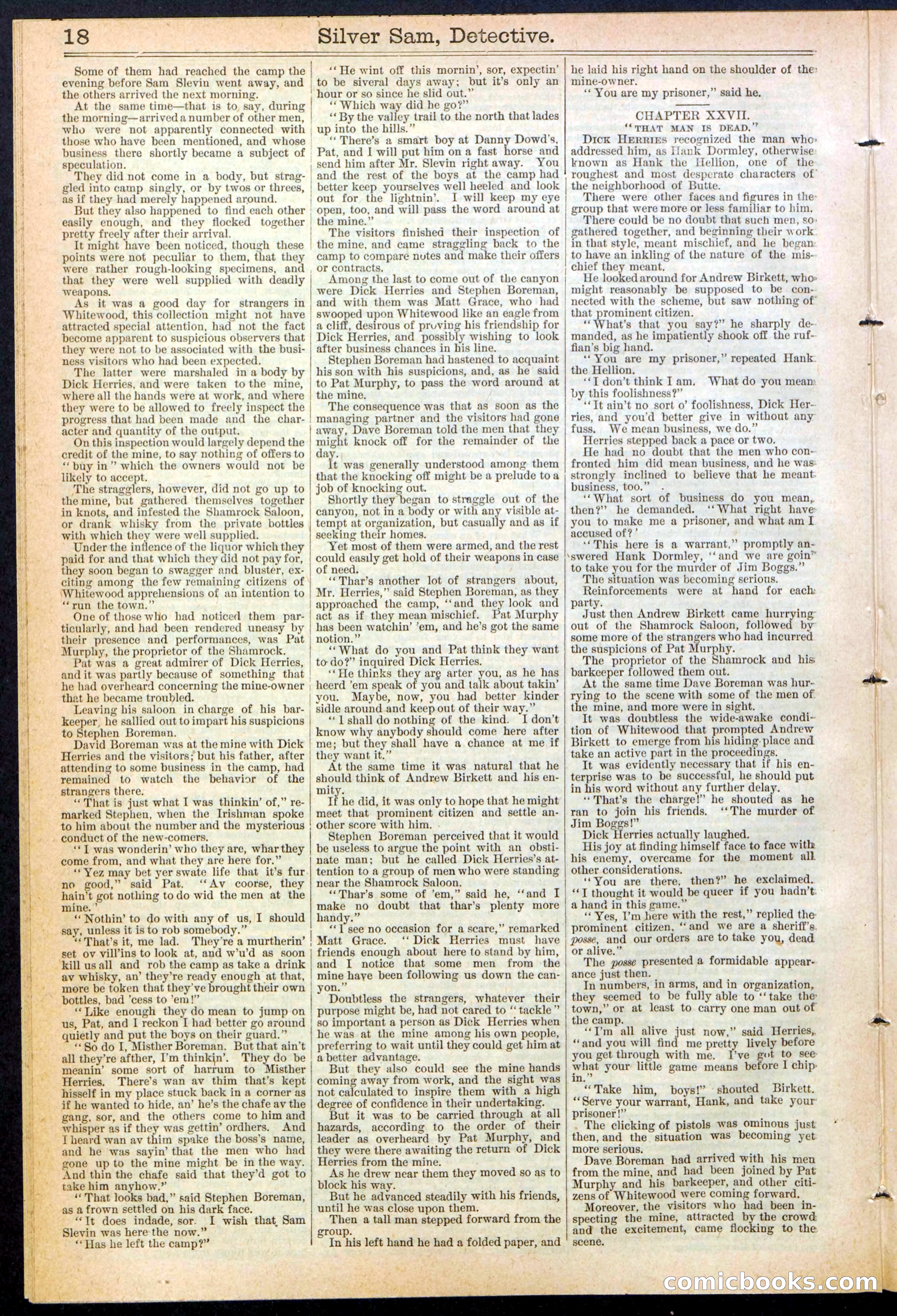
A restored page from Pulp Fiction, 1886. Page through the whole issue in the reader above.
📄 Transcribed text from this page (OCR, searchable)
Machine-transcribed from the original scan — historical spelling and the odd misread are preserved.
i QO Pt sas an ee ee Some of them had reached the camp the evening before Sam Slevin went away, and the others arrived the next morning. At the same time—that is to, say, during a a as ae Te Se those who have been mentioned, and whose business there shortly became a subject of speculation. —_t- —- gled into camp singly, or by twos or threes, as if they had merely happened around. But they also happened to find each other a a ee pretty freely after their arrival. It might have been noticed, though these points were not peculiar to them, that they were rather rough-looking specimens, and that they were well supplied with deadly weapons. As it was a good day for strangers in Whitewood, this collection might not have attracted special attention, had not the fact become apparent to suspicious observers that they were not to be associated with the busi- ness visitors who had been expected. The latter were marshaled in a body by Dick Herries, and were taken tothe mine, where all the hands were at work, and where they were to be allowed to freely inspect the a ee - ae toe —— ee ot —— sh Set Hi acter and quantity of the output. ae On this inspection would largely depend the credit of the mine, to say nothing of offers to “buy in’? which the owners would not be i likely to accept. The stragglers, however, did not go up to if the mine, but gathered themselves together ; in knots, and infested the Shamrock Saloon, i or drank whisky from the private bottles iw with which they were well supplied. | ~ Under the inflence of the liquor which they paid for and that which they did not pay for, | they soon began to swagger and bluster, ex- Bh, citing among the few remaining citizens of ‘ ‘Whitewood apprehensions of an intention to ‘‘run the town.” One of those who had noticed them par- ¥ ticularly, and had been rendered uneasy by |. their presence and performances, was Pat |. Murphy, the proprietor of the Shamrock. ae Pat was a great admirer of Dick Herries, and it was partly because of something that he had overheard concerning the mine-owner ‘|. that he became troubled. Leaving his saloon in charge of his bar- i | keeper, he sallied out to impart his suspicions Lia to Stephen Boreman. a David Boreman was at the mine with Dick Herries and the visitors; but his father, after | f attending to some business in the camp, had he remained to watch the behavior of the | __ strangers there. “That is just what I was thinkin’ of,” re- marked Stephen, when the Irishman spoke to him about the number and the mysterious -. . conduct of the new-comers. | ‘*T was wonderin’ who they are, whar they | come from, and what they are here for.” a ‘*Yez may bet yer swate life that it’s fur. no good,” said Pat. ‘Av coorse, they . hain’t got nothing todo wid the men at the “}, maine.” : ‘‘ Nothin’ to do with any of us, 1 should ' gay, unless it is to rob somebody.” ‘*That’s it, me lad. They're a murtherin’ set ov vill’ins to look at, and w’u’d as soon kill usall and rob the camp as take a drink -. av whisky, an’ they’re ready enough at that, . + more be token that they’ve brought their own | bottles, bad ’cess to ’em!” Tike enough they do mean to jump on » us, Pat, and I reckon I had better go around | quietly and put the boys on their guard.” —. ~ “§ 6 do I, Misther Boreman. But that ain't all they’re afther, I’m thinkin’. gat meanin’ some sort of harrum to Misther Herries. There’s wan av thim that’s kept __ hisself in my place stuck back in a corner as if he wanted to hide, an’ he’s the chafe ay the . gang, sor, and the others come to him and whisper as if they was gettin’ ordhers. And - Jheard wan av thim spake the boss’s name, and he was sayin’ that the men who had * gone up to the mine might be in the way. And thin the chafe said that they’d got to take him anyhow.” Pe ‘That looks bad,” said Stephen Boreman, as a frown settled on his dark face. ~ “Tt does indade, sor. I wish that, Sam Bet Slevin was here the now.” €* las he left the camp?” the morning—arrived a number of other men, | who were not apparently connected with | They did not come in a body, but strag- | easily enough, and they flocked together progress that had been made and the char- | They do be | Silver Sam, Detective. | ‘He wint off this mornin’, sor, expectin’ ' to be siveral days away; but it’s only an ' hour or so since he slid out.” ‘‘ Which way did he go?” ‘‘ By the valley trail to the north that lades up into the hills.” ‘There’s a smart boy at Danny Dowd’s, Pat, and I will put him on a fast horse and | send him after Mr. Slevin right away. You and the rest of the boys at the camp had | better keep yourselves well heeled and look 'out for the lightnin’. I will keep my eye open, too, and will pass the word around at the mine.” The visitors finished their inspection of the mine, and came straggling back to the camp to compare nutes and make their offers , or contracts. | Among the last to come out of the canyon | were Dick Herries and Stephen Boreman, and with them was Matt Grace, who had | swooped upon Whitewood like an eagle from | a cliff, desirous of pruving his friendship for | Dick Herries, and possibly wishing to look after business chances in bis line. | Stephen Boreman had hastened to acquaint his son with his suspicions, and, as he said to Pat Murphy, to pass the word around at | the mine. | The consequence was that as soon as the managing partner and the visitors had gone away, Dave Boreman told the men that they ' might knock off for the remainder of the | day. It was generally understood among them | that the knocking off might be a prelude toa job of knocking out. | Shortly they began to straggle out of the canyon, not in a body or with any visible at- tempt at organization, but casually and as if seeking their homes. Yet most of them were armed, and the rest could easily get hold of their weapons in case of need. ‘‘Thar’s another lot of strangers about, Mr. Herries,” said Stephen Boreman, as they approached the camp, ‘‘and they look and act as if they mean mischief. Pat Murphy has been watchin’ ’em, and he’s got the same notion.” ‘“What do you and Pat think they want | to do?” inquired Dick Herries. ‘*He thinks they are arter you, as he has _heerd ’em speak of you and talk about takin’ | vou. Maybe, now, you had better kinder _Sidle around and keep out of their way.” | ‘1 shall do nothing of the kind. I don’t know why anybody should come here after | me; but they shall have a chance at me if they want it.” At the same time it was natural that he should think of Andrew Birkett and his en- mity. td he did, it was only to hope that he might meet that prominent citizen and settle an- | other score with him. . Stephen Boreman perceived that it would be useless to argue the point with an obsti- nate man; but he called Dick Herries’s at- tention to a group of men who were standing near the Shamrock Saloon. ‘“‘Thar’s some of ’em,” said he, ‘‘and I make no doubt that thar’s plenty more handy.” | ‘‘T see no occasion for a scare,” remarked ' Matt Grace. ‘‘ Dick Herries must have friends enough about here to stand by him, and I notice that some men from the mine haye been following us down the can- yon.” Doubtless the strangers, whatever their purpose might be, had not cared to ‘‘ tackle” | so important a person as Dick Herries when he was at the mine among his own people, _ preferring to wait until they could get him at a better advantage. But they also could see the mine hands coming away from work, and the sight was ' not calculated to inspire them with a high degree of confidence in their undertaking. But it was to be carried through at all hazards, according to the order of their leader as overheard by Pat Murphy, and they were there awaiting the return of Dick Herries from the mine. : As he drew near them they moved so as to block his way. But he advanced steadily with his friends, until he was close upon them. Then a tall man stepped forward from the group. In his left hand he had a folded paper, and roughest and most desperate characters of’ he laid his right hand on the shoulder of the: mine-owner. ‘* You are my prisoner,” said he, CHAPTER XXVII. ‘(THAT MAN IS DEAD,” Dick HERRIES recoenized the man who addressed him, as liank Dormley, otherwise known as Hank the Hellion, one of the the neighborhood of Butte. There were other faces and figures in the group that were more or less familiar to him. There could be no doubt that such men, so: gathered together, and beginning their work in that style, meant mischief, and he began to have an inkling of the nature of the mis- chief they meant, He looked around for Andrew Birkett, who ' might reasonably be supposed to be con- ' nected with the scheme, but saw nothing of that prominent citizen. ‘““What’s that you say?” he sharply de- manded, as he impatiently shook off the ruf- fian’s big hand. ‘“You are my prisoner,” repeated Hank the Hellion. ‘*T don’t think I am. by this foolishness?” ‘‘Tt ain’t no sort o’ foolishness, Dick Her- ries, and you'd better give in without any fuss. We mean business, we do.” Herries stepped back a pace or two. He had no doubt that the men who con- fronted him did mean business, and he was What do you mean strongly inclined to believe that he meant. business, too.” ‘‘What sort of business do you mean, then?” he demanded. ‘‘ What right have you to make me a prisoner, and what am I accused of?’ ‘‘This here is a warrant,” promptly an- ‘swered Hank Dormley, ‘‘and we are goin” to take you for the murder of Jim Boggs.” The situation was becoming serious. Reinforcements were at hand for each party. Just then Andrew Birkett came hurrying out of the Shamrock Saloon, followed by some more of the strangers who had incurred the suspicions of Pat Murphy. The proprietor of the Shamrock and his barkeeper followed them out. At the same time Dave Boreman was hur- rying to the scene with some of the men of the mine, and more were in sight. It was doubtless the wide-awake condi- tion of Whitewood that prompted Andrew Birkett to emerge from his hiding. place and take an active part in the proceedings. It was evidently necessary that if his en- terprise was to be successful, he should put in his word without any further delay. ‘That's the charge!” he shouted as he ran to join his friends. ‘‘The murder of Jim Boggs!” Dick Herries actually laughed. His joy at finding himself face to face with his enemy, overcame for the moment all other considerations. ‘‘You are there, then?” he exclaimed. ‘*T thought it would be queer if you hadn't. a hana in this game.” ‘‘-Yes, I’m here with the rest,” replied the prominent citizen, ‘‘and we are a sheriff's. posse, and our orders are to take you, dead or alive.” The posse presented a formidable appear- ance just then. In numbers, in arms, and in organization, they seemed to be fully able to ‘‘take the town,” or at least to carry one man out of the camp. ‘‘T’m all alive just now,” said Herries, ‘‘and you will find me pretty lively before you get through with me. Ive got to see what your little game means before I chip. in. “Take him, boys!” shouted Birkett. ‘Serve your warrant, Hank, and take your prisoner!” : . The clicking of pistols was Ominous just then, and the situation was becoming yet more serious. , Dave Boreman had arrived with his men from the mine, and had been joined by Pat Murphy and his barkeeper, and other citi- zens of Whitewood were coming forward. Moreover, the visitors who had been in- specting the mine, attracted by the crowd and the excitement, came flocking to the scene. ee eee a ~ 4 ah 7 - ~ x) See . ra m (E (E(o) JOO! i wy - —