
Pulp Fiction, 1886 · page 9 of 32
Beadle's New York Dime Library, No. 378 — page 9: what you’re looking at
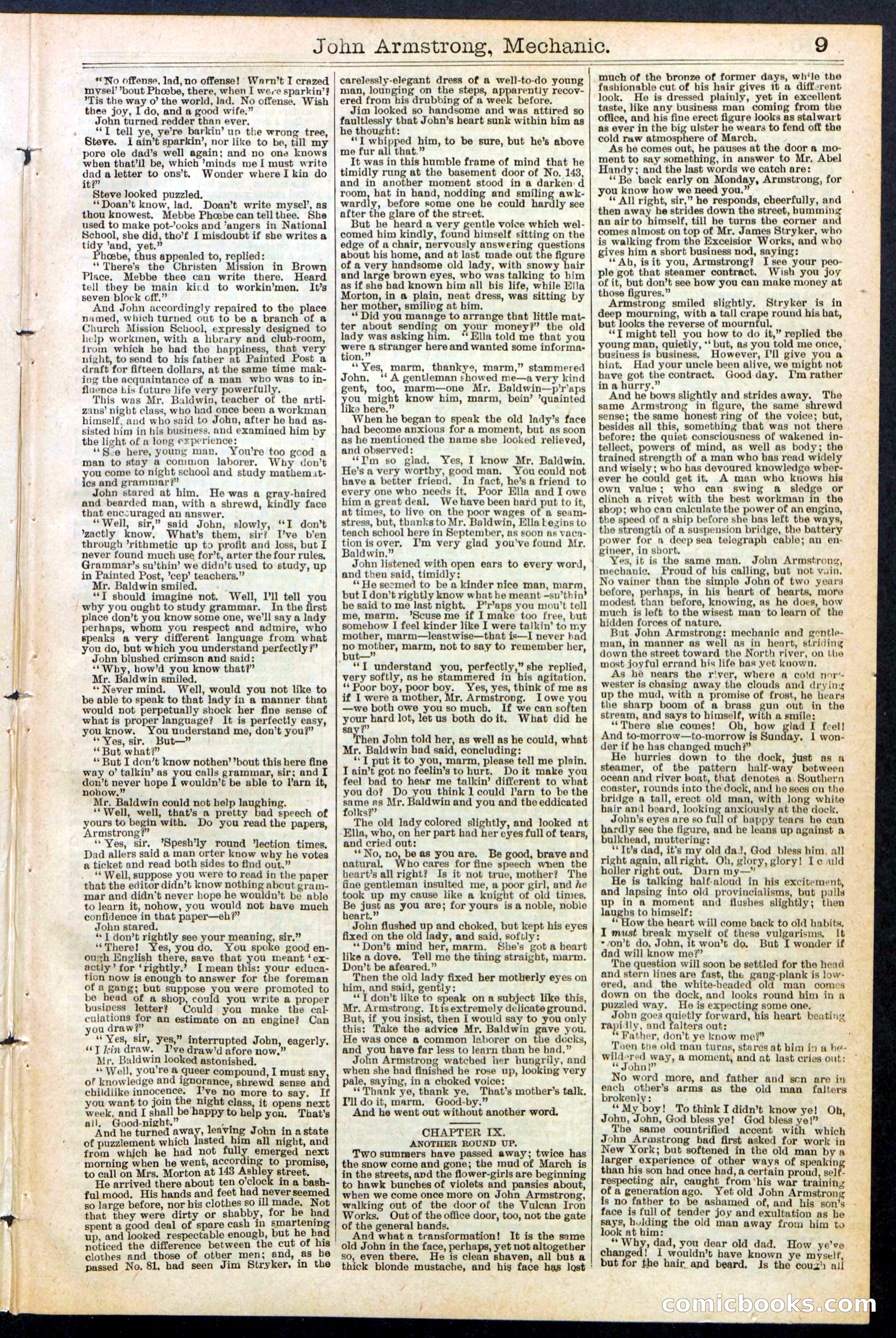
A restored page from Pulp Fiction, 1886. Page through the whole issue in the reader above.
📄 Transcribed text from this page (OCR, searchable)
Machine-transcribed from the original scan — historical spelling and the odd misread are preserved.
a - . ee - - = a ey esters — . a . & 7 ae we ee wee -_-- - mysel’ bout Phoebe, there, when I were sparkin’? *Tis the way o’ the world, lad. No offense, Wish thee joy, I do, and a good wife.” John turned redder than ever. “I tell ye, ye’re barkin’ up the wrong tree, Steve. i ain’t sparkin’, nor like to be, till my pore ole dad’s well again; and no one knows when that’ll be, which ’minds mel must write dad a letter to ons’t. Wonder where! kin do it? Steve looked puzzled. **Doan’t know, lad. Doan’t write mysel’, as thou knowest. Mebbe Phoebe can tell thee. She used to make pot-’ooks and ‘angers in National School, she did, tho’f I misdoubt if she writes a tidy ’and, yet.” Phoebe, thus appealed to, replied: ‘*There’s the Christen Mission in Brown Place. Mebbe thee can write there. Heard tell they be main ki:d to workin’men, It’s seven block off.” And John accordingly repaired to the place named, which turned out to be a branch of a Church Mission School, expressly designed to help workmen, with a hbrary and club-room, {from which he bad the happiness, that very night, to send to his father at Painted Post a draft for fifteen dollars, at the same time mak- ing the acquaintance of a man who was to in- fluence his future life very powerfully. This was Mr. Baldwin, teacher of the arti- zans’ night class, who had once been a workman himself, and who said to John, after he had as- sisted him in his business, and examined him by the light of a long experience: ‘‘Sce here, young man. You're too good a man to stay a com:imon laborer. Why don’t ou come to night school and study mathemat- hs and grammar?” John stared at him, He was a gray-haired and bearded man, with a shrewd, kindly face that enccuraged an answer. “Well, sir,” said John, slowly, ‘I don’t wactly know. What’s them, sir? I’ve b’en through ’rithmetic up to profit and loss, but I never found much use for’t, arter the four rules, Grammar’s su’thin’ we didn’t used to study, up in Painted Post, ’cep’ teachers,” Mr. Baldwin smiled. “T should imagine not. Well, lll tell you why you ought to study grammar. In the first place don’t you know some one, we'll say a lady perhaps, whom you respect and admire, who speaks a very different language from what you do, but which you understand perfectly?” Jobn blushed crimson and said: ‘*Why, how’d you know that?” Mr. Baldwin smiled. **Never mind. Well, would you not like to be able to speak to that lady in a manner that would not perpetually shock her fine sense of what is proper language? It is perfectly easy, you know. You understand me, don't you?” ‘Yes, sir. But—” ‘But what?” ‘** But I don’t know nothen’ ’bout this here fine way 0’ talkin’ as tos calls grammar, sir; and I don’t never hope I wouldn’t be able to larn it, nobow.” Mr. Baldwin could not help laughing. ‘* Well, well, that’s a pretty bad speech of yours to begin with. Do you read the papers, Armstrong?” ‘‘Yes, sir. ’Spesh’ly round ‘lection times. Dad allers said a man orter know why he votes a ticket and read both sides to find out,” . ** Well, suppose you were to read in the paper that the editor didn’t know nothing about gram- mar and didn’t never hope he wouldn’t be able to learn it, nohow, you would not have much confidence in that paper—eh?” John stared. ** | don’t rightly see your meaning, sir,” ‘‘There! Yes, youdo, You spoke good en- ouzh English there, save that you meant ‘ex- actly’ for ‘rightly.’ [mean this: your educa- tion now is enough to answer for the foreman of a gang; but suppose you were promoted to be head of a shop, could you write a proper business letter? Could you make the cal- culations for an estimate on an engine? Can you draw?” ‘Yes, sir, yes,” interrupted Jobn, eagerly. “T kin draw. Dvedraw’d afore now,” Mr. Baldwin looked astonished. ‘* Well, youre & queer compound, I must say of knowledge and ignorance, shrewd sense and childlike innocence. I’ve no more to say. If you want to join the night class, it opens next week, and I shall be happy to help you. That's all. Good-night.” And he turned aways leaving John in astate of puzzlement which lasted him all night, and from whjch he had not fully emerged next morning when he went, according to promise, to call on Mrs. Morton at 143 Ashley street. He arrived there about ten o’clock in a bash- ful mood. His hands and feet had never seemed so large before, nor his clothes so ill made, Not that they were dirty or shabby, for he had spent a good deal of spare cash in smartenin up, and looked respectable enough, but he ha noticed the difference between the cut of his | lothes and those of otber men; and, as he ileal No. 81, bad seen Jim Stryker, in the **No offense, lad, no offense! Warn’t I crazed | carelessly-elegant dress of a well-to-do young John Armstrong, Mechanic. 9 man, lounging on the steps, apparently recov- ered from bis drubbing of a week before. Jim looked so handsome and was attired so epi ap cd that John’s heart sunk within him as he thought: “IT whipped him, to be sure, but he’s above me fur all that.” It was in this humble frame of mind that he timidly rung at the basement door of No. 143, and in another moment stood in a darken d room, hat in hand, nodding and smiling awk- wardly, before some one he could hardly see after the glare of the street. But he heard a very gentle voice which wel- comed him kindly, found himself sitting on the edge of a chair, nervously answering questions about his home, and at last made out the figure of a very handsome old lady, with snowy hair and large brown eyes, who was talking to him as if she had known bim all bis life, while Ella Morton, in a plain, neat dress, was sitting by her mother, smiling at him. ‘* Did you manage to arrange that little mat- ter about sending on your money?” the old lady was asking him. “‘ Ella told me that you vere, a stranger here and wanted some informa- ion. ‘*Yes, marm, thankye, marm,” stammered John. ‘‘ A gentleman showed me—a very kind gent, too, marm—one Mr. Baldwin—p’r’aps roe might know him, marm, bein’ ’guainted ike here.” When he began to speak the old lady’s face had become anxious for a moment, but as soon as he mentioned the name she looked relieved, and observed: ‘“‘I'm so glad. Yes, I know Mr. Baldwin. He’s a very worthy, good man. You could not have a better friend. In fact, he’s a friend to every one who needs it, Poor Ella and I owe him a great deal. We have been hard put to it, at times, to live on the poor wages of a seam- stress, but, thanks to Mr. Baldwin, Ella kezins to teach school here in September, as soon as vaca- tion isover. I’m very glad you've found Mr. Baldwin.” John listened with open ears to every word, and then said, timidly: ** He seemed to be a kinder nice man, marm but I don’t rightly know what be meant -su’thin? he said to me last night. P’r’aps you mou’t tell me, marm. ’Scuse me if I make too free, but somehow I feel kinder like I were talkin’ to my mother, marm—leastwise—that is—I never had no mother, marm, not to say to remember her, but—” ‘‘T understand you, perfectly,” she replied, very softly, as he stammered in his agitation. ‘* Poor boy, poor boy. Yes, yes, think of me as if I were a mother, Mr. Armstrong. I owe you —we both owe you so much, If we can soften your hard lot, let us both doit, What did he sa ?” Then John told her, as well as he could, what Mr. Baldwin had said, concluding: ‘*T put it to you, marm, please tell me plain. I ain’t got no feelin’s to hurt. Doit make you feel bad to hear me talkin’ different to what you do? Do you think 1 could l’arn to be the me pas Mr. Baldwin and you and the eddicated olks? The old lady colored slightly, and looked at Ella, who, on her part had her eyes full of tears, and cried out: ‘* No, no, be as you are. Be good, brave and natural, Who cares for fine speech when the beart’s all right? Is it not true, mother? The fine gentleman insulted me, a poor girl, and he took up my cause like a knight of old times. Be just as you are; for yours is a noble, noble heart.” John flushed ig? and choked, but kept his eyes fixed on the old lady, and said, softly: ‘*Don’t mind her, marm. She’s got a heart likeadove. Tell me the thing straight, marm. Don’t be afeared.” Then the old lady fixed her motherly eyes on him, and said, gently; “T don’t like to speak on a subject like this, Mr. Armstrong. Itisextremely delicate ground, But, if you insist, then I would say to you only this: Take the advice Mr. Baldwin gave you. He was once a common leborer on the docks, and you have far less to learn than he had,” John Armstrong watched her bhungrily, and when she bad finished he rose up, looking very pale, saying, in a choked voice: ‘*Thank ye, thank ye. That’s mother’s talk. I'll do it, marm, Good-by.” And he went out without another word. CHAPTER IX. ANOTHER ROUND UP. Two summers have passed away; twice has the snow come and gone; the mud of March is in the streets, and the flower-girls are beginning to hawk bunches of violets and pansies about, when we come once more on John Armstrong, walking out of the doorof the Vulcan Iron Works. Out of the office door, too, not the gate of the general bands. And what a transformation! It is the same old John in the face, poem yet not altogether so, even there. He is clean shaven, all but a thick blonde mustache, and his face has last ' much of the bronze of former days, wh'le the —-— 2. fashionable cut of his hair gives it a different look. He is dressed plainly, yet in excellent taste, like any business man coming from the office, and his fine erect figure looks as stalwart as ever in the big ulster he wears to fend off the cold raw atmosphere of March. As he comes out, he pauses at the door a mo- ment to say something, in answer to Mr. Abel Handy; and the last words we catch are: ‘*Be back early on Monday, Armstrong, for you know how we need you.” ‘* All right, sir,” he responds, cheerfully, and then away he strides down the street, hom ng an air to himself, till he turns the corner anc comes almost on top of Mr. James Stryker, who is walking from the Excelsior Works, and who gives him a short business nod, saying: ‘*Ah, is it you, Armstrong? I see your peo- ple got that steamer contract. Wish you joy of it, but don’t see how you can make money at those figures.” Armstrong smiled slightly. Stryker is in deep mourning, with a tall crape round his hat, but looks the reverse of mournful, ‘“‘T might tell you how to do it,” replied the oung man, quietly, *‘ but, as you told me once, yusiness is business, However, Pll give you a hint. Had your uncle been alive, we might not have got the contract. Good day. I’m rather in a hurry.” And he bows slightly and strides away. The same Armstrong in figure, the same shrewd sense; the same honest ring of the voice; but, besides all this, something that was not there before: the quiet consciousness of wakened in- tellect, powers of mind, as well as body; the trained strength of a man who bas read widely and wisely; who bas devoured knowledge wher- ever he could get it. A man who knows his own value; who can swing a sledge or clinch a rivet with the best workman in the shop; who can calculate the power of an engine, the speed of a ship before she bas left the ways, the strength of a suspension bridge, the battery power for a deep sea telegraph cable; an en- gineer, in short, Yes, ib is the same man. Jolin Armstrong, mechanic, Proud of his calling, but not yuin,. No vainer than the simple John of two years before, perhaps, in his heart of hearts, more modest than before, knowing, as he does, bow much is left to the wisest man to learn of the hidden forces of nature. But John Armstrong: mechanic and gentle- man, in manner as well as in heart, striding down the street toward the North river, on the most joyful errand his life has vet known. As hé nears the r‘ver, where a cold nor wester is chasing away the clouds and drying up the mud, with a promise of frost, he hears the sharp boom of a brass gun out in the stream, and says to himself, with a smile: “There slie comes! Oh, how glad I feel! And to-morrow—to-morrow is Sunday, I won- der if he has changed much?” He hurries down to the dock, just as a steamer, of the pattern half-way between ocean and river boat, that denotes a Southern coaster, rounds into the dock, and he sees on the bridge a tall, erect old man, with long white bair and beard, looking anxiously at the dock, John’s eyes are so full of happy tears he can hardly see the figure, and he leans up against a bulkhead, muttering: _‘* Tt’s dad, it’s my old dal, God bless him, all right again, allright. Oh, glory, glory! Ic vuld holler right out, Darn my—” He is talking half-aloud in his excitement, and lapsing into old provincialisms, but palls up in a moment and flushes slightly; then laughs to himself; ‘** How the heart will come back to old habits, I must break myselt of these vulgarisms, It ~/on’t do, John, it won’t do. But I wonder if dad will know me?’ The question will soon be settled for the head and stern lines are fast, the gang-plank is low- ered, and the white-headed old man comes down on the dock, and looks round him in a puzzled way. He is expecting some one, Jobn goes quietly forward, bis heart heating rapidly, and falters out: ‘Father, don’t ye know me?” >" Toen tie old man turns, stares at him in a he- Wildered way, a moment, and at last cries ont: John)” No word more, and father and scn are in each other’s arms as the old man falters OT r y boy! To think I didn’t know ye! O John, John, God bless ye! God bless nA \ i The same countrified accent with which John Armstrong bad first asked for work in New York; but softened in the old man by a larger experience of other ways of speakin than his son had once had, a certain proud, self- respecting air, caught from ‘his war training of a generationago. Yet old John Armstrong is no fatber to be ashamed of, and his son’s - face is full of tender joy and exultation as he says, hviding the old man away from him to _ look at bim: vd Wars dad, you dear old dad. How ye’ve changed! 1 wouldn’t have known ye myself, but for the hair and beard. the couz ail COMME OOO — <SiEO