
Pulp Fiction, 1886 · page 8 of 32
Beadle's New York Dime Library, No. 378 — page 8: what you’re looking at
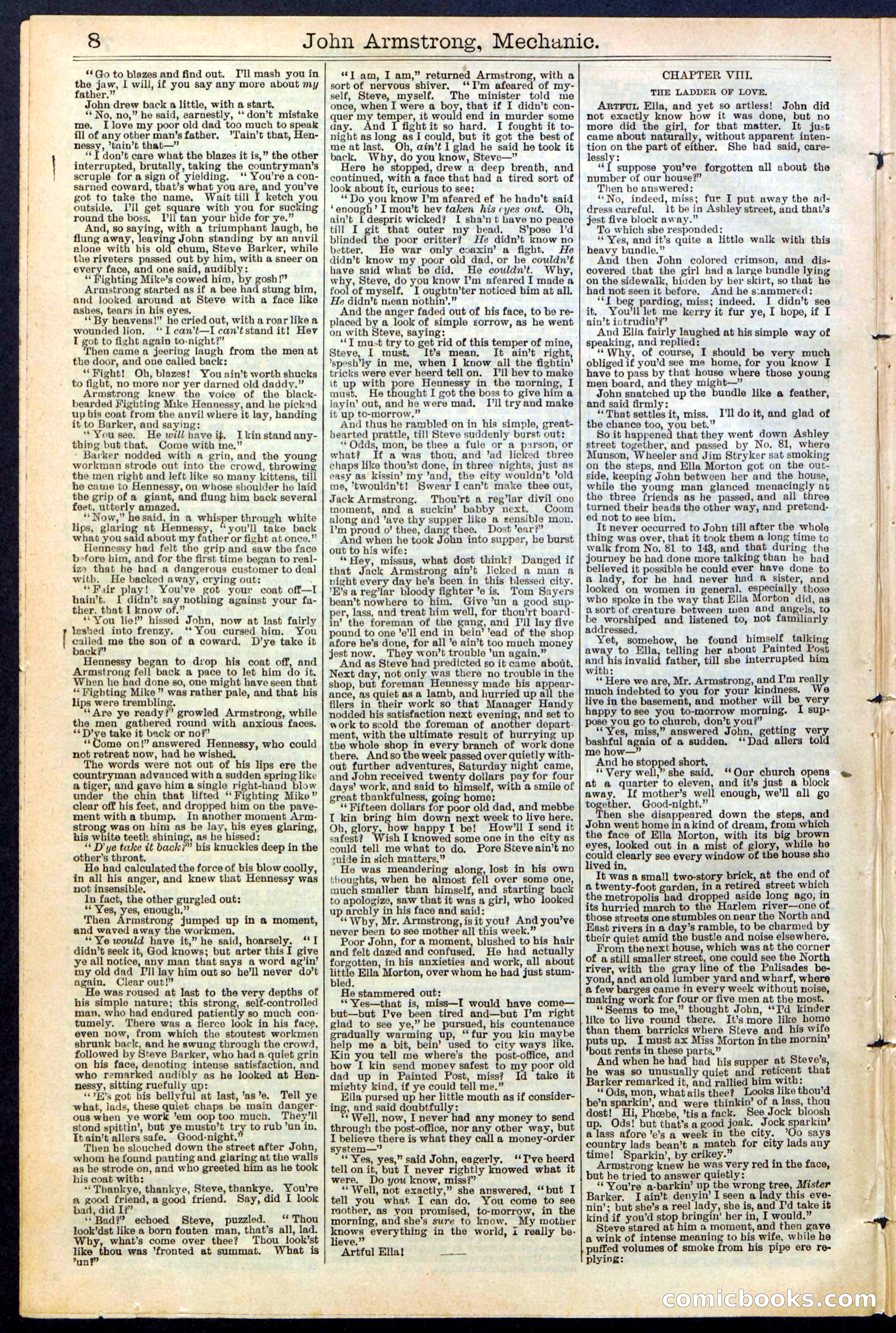
A restored page from Pulp Fiction, 1886. Page through the whole issue in the reader above.
📄 Transcribed text from this page (OCR, searchable)
Machine-transcribed from the original scan — historical spelling and the odd misread are preserved.
———-s & John Armstrong, Mechanic. a es **Go to blazes and find out. I'll mash you in the jaw, Ll will, if you say any more about my father.” John drew back a little, with a start, ‘* No, no,” he said, earnestly, ‘‘ don’t mistake me. I love my poor old dad too much to speak ill of any other man’sfather. ‘*Tain’t that, Hen- nessy, ’tain’t that—” ‘*T don’t care what the blazes it is,” the other interrupted, brutally, taking the countryman’s scruple for a sign of yielding. ‘* You’re a con- sarned coward, that’s what you are, and you’ve got to take the name. Wait till I ketch you outside, Vil get square with you for sucking round the boss. Ill tan your hide for ye.” And, so saying, with a triumphant laugh, he flung peered eaving John standing by an anvil alone with bis old chum, Steve Barker, while the riveters passed out by him, with a sneer on every face, and one said, audibly: “ Vighting Mike’s cowed him, by gosh!” Armstrong started as if a bee had stung bim, and looked around at Steve with a face like ashes, tears in his eyes. ‘* By heavens!” he cried out, with a roar like a wounded lion. ‘I can’t—I can’tstand it! Hev I got to fight again to-night?” Lhen came a jeering laugh from the men at the door, and one called back: Wight! Oh, blazes! You ain’t worth shucks to fight, no more nor yer darned old daddy.” Armstrong knew the voice of the black- bearded Fighting Mike Hennessy, and he picked up his coat from the anvil where it lay, banding it to Barker, and saying: ‘You see. He will have if. I kin stand any- thing but that. Come with me.” ‘ Barker nodded with a grin, and the young workman strode out into the crowd, throwing the men right and left like so many kittens, till he came to Hennessy, on whose shoulder he laid the grip of a giant, and flung him back several feet, utterly amazed. _ “Now,” he said, in a whisper through white lips, glaring at Hennessy, “you'll take back what you said about my father or fight at once.” Hennessy had felt the grip and saw the face before him, and for the first time began to real- ize that be had a dangerous customer to deal with. He backed away, crying out: “Pair play! You’ve got your coat off—I hain’t. I didn’t say nothing against your fa- ther. that I know of.” ‘‘' You lie!’ hissed John, now at last fairly lashed into frenzy. ‘*‘ You cursed him. You called me the son of a coward. D’ye take it back?” Hennessy began to drop his coat off, and Armstrong fell back a pace to let him do it, When he had done so, one might have seen that “Vighting Mike ” was rather pale, and that his lips were trembling. ‘Are ye ready?” growled Armstrong, while the men gathered round with anxious faces. **D’ve take it beck or no?’ ‘*Come on!” answered Hennessy, who could not retreat now, had he wished, The words were not out of his lips ere the countryman advanced with a sudden spring like a tiger, and gave him a single right-hand blow under the chin that lifted “ Fighting Mike” clear off his feet, and dropped him on the pave- ment witha thump. In another moment Arm- strong was on him as he lay, his eyes glaring, his white teeth shinin ) as he hissed: ** D' ye take it back?” bis knuckles deep in the other’s throat. He had calculated the force of bis blow coolly, in all his anger, and knew that Hennessy was not insensible. In fact, the other gurgled out: xX, Kes enough,” Then Armstrong jumped up in a moment, and waved away the workmen. “Ye would have it,” he said, hoarsely, ‘I didn’t seek it, God knows; but arter this I give ye all notice, any man that says a word ag’in’ my old dad [ll lay him out so be’ll never do’t again. Clear out!” © was roused at last to the very depths of his simple nature; this strong, self-controlled man, who had endured patiently so much con- tumely. There was a fierce look in his face, even now, from which the stoutest workmen shrunk back, and he swung through the crowd, followed by Steve Barker, who had a quiet grin on his face, denoting intense satisfaction, and who remarked audibly as he looked at Hen- nessy, sitting ruefully up: “Fs got bis bellvful at last, ’as’e. Tell ye what, lads, these quiet chaps be main danger- ous when ye work ’em oop too much, They'll stond spittin’, but ye mustn’t try to rub ’un in. Tt ain’t allers safe. Good-night.’ Then he slouched down the street after John, whom he found panting and glaring at the walls as he strode on, and who greeted him as he took his coat with: “Thankye, thankye, Steve, thankye. You're e. good friend, a good friend. Say, did I look bad, did I?” ‘‘ Bad?? echoed Steve, puzzled. ‘ Thou look’dst like a born fouten man, that’s all, lad. Why, what’s come over thee? Thou _look’st like, thou was fronted at summat. What is un ‘“T am, I am,” returned Armstrong, with a sort of nervous shiver. ‘‘I’m afeared of my- self, Steve, myself. The minister told me once, when I were a Bey, that if I didn’t con- quer my temper, 1t wou d end in murder some day. And I fightit so hard. I fought it to- night as long as I could, but it got the best of me at last. Oh, ain’t I glad he said he took it back. Why, do you know, Steve—” Here he stopped, drew a deep breath, and continued, with a face that had a tired sort of look about it, curious to see: **PDo you know I’m afeared ef he hadn't said ‘enough’ I mou’t hev taken his cyes out. Oh, ain’t | desprit wicked? I sha’n t have no peace till I git that outer my bead. S’pose l’d blinded the poor critter? He didn’t know no better. He war only coaxin’ a fight. He didn’t know my poor old dad, or he couldn’t have said what be did. He couldn't. Why, why, Steve, do you know I’m afeared I made a fool of myself. I oughtn’ter noticed him at all. He didn’t mean nothin’,” And the anger faded out of his face, to be re- placed by a look of simple sorrow, as he went on with Steve, saying: ‘*T must try to get rid of this temper of mine, Steve, I must. Its mean. It ain’t right, ’spesh’ly in me, when I know all the fightin’ tricks were ever beerd tellon. Ill hev to make it up with pore aaa in the morning, I must. He thought I got the boss to give him a layin’ out, and he were mad, I'll try and make it up to-morrow.” And thus he rambled on in his simple, great- hearted prattle, till Steve suddenly burst out: ‘* Odds, mon, be thee a fule or a parson, or what? If a was thou, and ’ad licked three chaps like thou’st done, in three nights, just as easy as kissin’ my ’and, the city wouldn’t ’old me, ‘twouldn’t! Swear I can’t make thee out, Jack Armstrong, Thou'rt a reg’lar divil ono moment, and a suckin’ babby next. Coom along and ’ave thy supper like a sensible mon. i’m proud o’ thee, dang thee. Dost ’ear?” And when he took John into supper, be burst out to his wife: * Hey, missus, what dost think? Danged if that Jack Armstrong ain’t licked a man a night every day he’s been in this. blessed city. "P's a reg’lar eg fighter ’e is. Tom Sayers bean’t nowhere to him. Give’un a good sup- per, lass, and treat him well, for thou’rt board- in’ the foreman of the gang, and [ll lay five pound to one ’e’ll end in bein’ ’ead of the shop afore he’s done, for all ’e ain’t too much money jest now. They won’t trouble ’un again.” And as Steve had predicted so it came about. Next day, not only was there no trouble in the shop, but foreman Hennessy made his appear- ance, as quiet as a lamb, and hurried up all the filers in their work so that Manager Handy nodded his satisfaction next evening, and set to work to scold the foreman of another depart- ment, with the ultimate result of hurrying up the whole shop in every branch of work done there. Andso the week passed over quietly with- out further adventures, Saturday night came, and John received twenty dollars pay for four days’ work, and said to himself, with a smile of great thankfulness, going home: ‘* Fifteen dollars for poor old dad, and mebbe I kin bring him down next week to live here. Oh, Risky, HOW happy I be! How’ll I send it safest? ish I knowed some one in the city as could tell me what to do, Pore Steve ain’t no rnide in sich matters,” He was meandering along, lost in his own thoughts, when he almost fell over some one, much smaller than himself, and starting back to apologize, saw that it was a girl, who looked up archly in his face and said: ‘““Why, Mr. Armstrong, is it you? And you’ve never been to see mother all this week.” Poor John, for a moment, blushed to his hair and felt dazed and confused. He had actually forgotten, in his anxieties and work, all about ory Ella Morton, over whom he had just stum- ed. He stammered out: ** Yes—that is, miss—I would have come— but—but I’ve been tired and—but I’m right glad to see ye,” he pursued, his countenance gradually warming up, “‘fur you kin maybe help me a bit, bein’ used to city ways like. Kin you tell me where’s the post-office, and how I kin send money safest to my poor old dad up in Painted Post, miss? Id take it mighty kind, if ye could tell me.” Ella pursed up her little mouth as if consider- ing, and said doubtfully: ‘Well, now, I never had any money to send through the post-office, nor ct Mage way, but I believe there is what they @ money-order system—” “Yes, yes,” said John, eagerly. ‘I’ve heerd tell on it, but I never rightly knowed what it were. Do you know, miss?” ‘Well, not exactly,” she answered, ‘but I tell you what I can do. You come to see mother, as you promised, to-morrow, in the morning, and she’s sure to know. My mother knows everything in the world, i really be- eve. Artful Ella! —-- CHAPTER VIII. THE LADDER OF LOVE, ARTFUL Ella, and yet so artless! John did not exactly know how it was done, but no more did the girl, for that matter. It just came about naturally, without apparent inten- tion on the part of either. She had said, care- lessly: af suppose you’ve forgotten all about the number of our house?” Then he answered: ‘*No, indeed, miss; fur I put away the ad- dress careful. it be in Ashley street, and that’s jest five block away.” To which she responded; “Yes, and it’s quite a little walk with this heavy bundle.” And then John coljored crimson, and dis- covered that the girl had a large bundle lying on the sidewalk, bidden by her skirt, so that he had not seen it before. And he s:ammered: ‘*f beg parding, miss; indeed. I didn’t see it. You'll let me kerry it fur ye, I hope, if I ain’t intrudin’?” And Ella fairly laughed at his simple way of speaking, and replied: ‘Why, of course, I should be very much obliged if you’d see me home, for ie know I have to pass by that house where those young men board, and they might—” John snatched up the bundle like a feather, and said firmly: “That settles it, miss. I'll do it, and glad of the chance too, you bet.” So it happened that they went down Ashley street together, and passed by No. 81, where Munson, Wheeler and Jim Stryker sat smoking on the steps, and Ella Morton got on the out- side, keeping John between her and the house, while the young man glanced menacingly at the three friends as he passed, and all three turned their heads the other way, and pretend- ed not to see bim. It never occurred to Jobn till after the whole thing was over, that it took them a long time to walk from No, 81 to 148, and that during the journey he had done more talking than he had believed it possible he could ever have done to a lady, for he had never had & sister, and looked on women in general, especially those who spoke in the way that Ella Morton did, as a sort of creature between wen and angels, to be worshiped and listened to, not familiarly addressed. ; Yet, somehow, he found himself talking dese to Ella, telling her about Painted Post and his invalid father, till she interrupted bim with: ‘* Here we are, Mr. Armstrong, and I’m reall much indebted to you for your kindness. 8 live in the basement, and mother will be very happy tosee you to-morrow morning. I sup- pose you go to church, don’t you?” ‘‘' Yes, miss,” answered John, getting very bashful again of a sudden, ‘Dad allers told me how—” And he stopped short, ‘‘ Very well,” she said. “Our church opens at a quarter to eleven, and it’s just a block away. If mother’s well enough, we'll all go together, Good-night.” hen she disappeared down the steps, and John went home in akind of dream, from which the face of Ella Morton, with its big brown eyes, looked out in a mist of glory, while he crus clearly see every window of the house she ved in, It was a small two-story brick, at the end of a twenty-foot garden, in a retired street which the metropolis had dropped aside long ago, in its hurried march to the Harlem river—one of those streets one stumbles on near the North and East rivers in a day’s ramble, to be charmed by their quiet amid the bustle and noise elsewhere, From the next house, which was at the corner of astill smaller street, one could see the North river, with the gray line of the Palisades be- yond, and anold lumber yard and wharf, where a few barges came in every week without noise, making work for four or five men at the most. “Seems to me,” thought John, ‘Td kinder like to live round there. It’s more like home than them barricks where Steve and his wife puts up. I must ax Miss Morton in the mornin’ bout rents in these parts,” : And when he had had his supper at Steve's he was sO unusually quiet an reticent that Barker remarked it, and rallied him with: ‘‘Ods, mon, whatails thee? Looks like thou’d be’n sparkin’, and were thinkin’ of a lass, thou dost! Hi, Phoebe, ’tisa fack. See Jock bloosh up. Ods! but that’s a good joak. Jock sparkin’ a lass afore ’e’s a week in the city. ’Oo says country lads bean’t a match for city lads any time! ‘Sparkin’, by crikey.” Armstrong knew he was very red in the face, but he tried to answer quietly: ; ‘‘You’re a-barkin’ up the wrong tree, Mister Barker. I ain’t denyin’ I seen a lady this eve- nin’; but she’s a reel lady, she is, and Td take it kind if you'd stop bringin’ her in, I would.” Steve stared at him a moment, and then gave a wink of intense meaning to his wife, while he puffed volumes of smoke from his pipe ere re- plying: Gomichdoo a eA eee