
Pulp Fiction, 1886 · page 10 of 32
Beadle's New York Dime Library, No. 378 — page 10: what you’re looking at
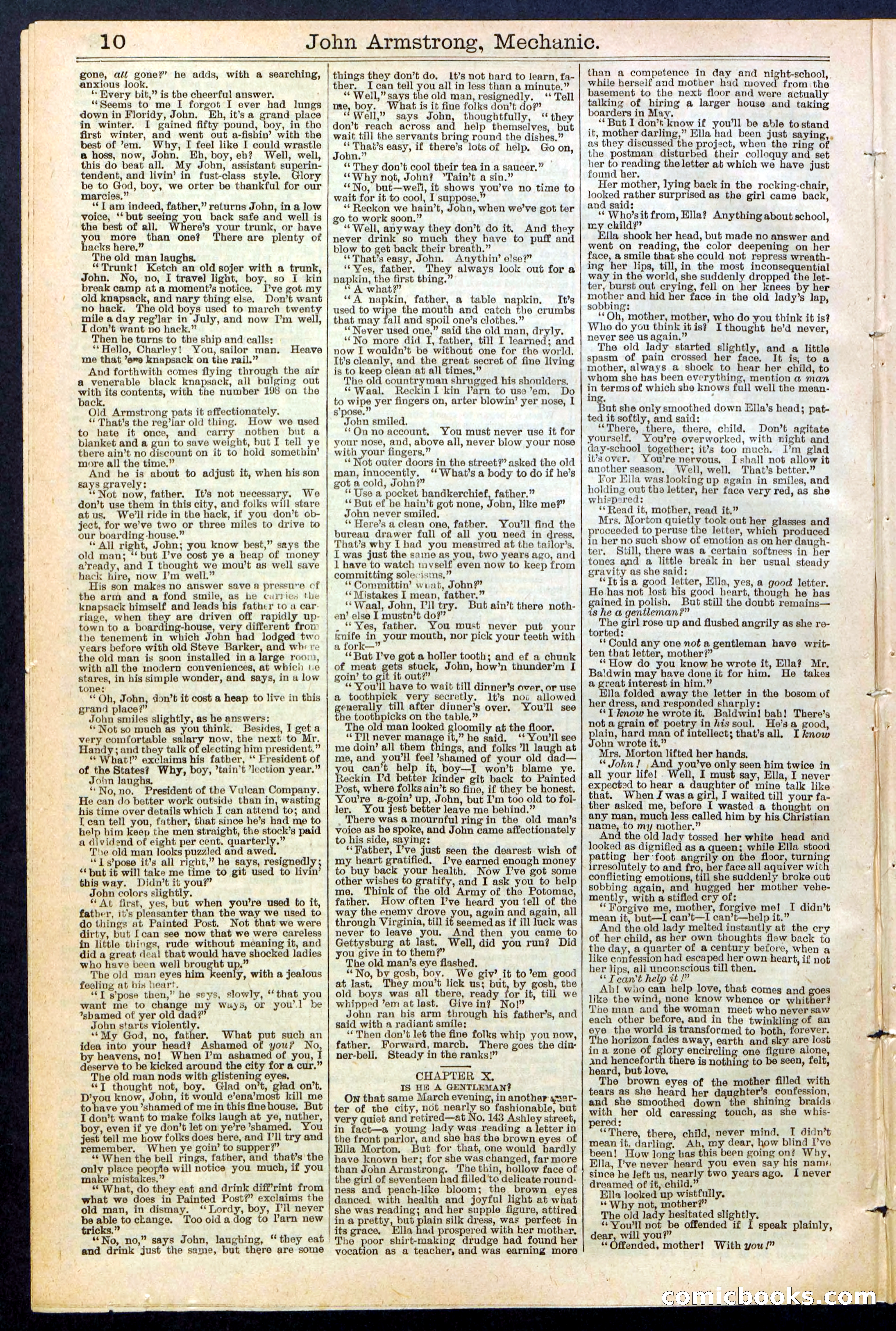
A restored page from Pulp Fiction, 1886. Page through the whole issue in the reader above.
📄 Transcribed text from this page (OCR, searchable)
Machine-transcribed from the original scan — historical spelling and the odd misread are preserved.
10 gone, ali gone?” he adds, with a searching, anxious look. ‘Every bit,” is the cheerful answer. ‘Seems to me I forgot I ever had lungs down in Floridy, John. Eh, it’s a grand place in winter. I gained fifty pound, boy, in tho first winter, and went out a-fishin’ with the best of ’em. Why, I feel like I could wrastle e hoss, now, John. Eh, boy, eh? Well, well, this do beat all. My John, assistant superin- tendent, and livin’ in fust-class style. Glory be to God, boy, we orter be thankful for our marcies.” ‘Tl am indeed, father,” returns John, in a low voice, ‘‘ but seeing you back safe and well is the best of all. Where’s your trunk, or have ou more than one? There are plenty of acks here,” The old man laughs. “Trunk! Ketch an old sojer with a trunk, John. No, no, I travel light, boy, so I kin break camp at a moment’s notice. I’ve got my old knapsack, and nary thing else. Don’t want no hack. The old boys used to march twenty mile a day reg’lar in July, and now I’m well, I don’t want no hack.” Then he turns to the ship and calls: ** Hello, Charley! You, sailor man. me that ’ere knapsack on the rail.” And forthwith comes flying through the air a venerable black knapsack, all bulging out with its contents, with the number 198 on the Heave ack, Old Armstrong pats it affectionately. ‘‘ That’s the reg’lar old thing. How we used to hate it once, and carry nothen but a blanket and a gun to save weight, but I tell ye there ain’t no discount on it to hold somethin’ more all the time.” And he is about to adjust it, when his son says gravely: ‘*Not now, father. It’s not necessary, We don’t use them in this city, and folks will stare at us. We'll ride in the hack, if you don’t ob- ject, for we’ve two or three miles to drive to our boarding -house.” * All right, John; you know best,” says the old man; *‘ but I’ve cost ye a beap of money a’ready, and I thought we mou’t as well save hack hire, now I’m well.” His son makes no answer save a pressure of the arm and a fond smile, as he Curries the knapsack bimself and leads his father to a car. riage, when they are driven off rapidly up- town to a boarding-house, very different from the tenement in which John had lodged two years before with old Steve Barker, and wh: re the old man is soon installed in a large room, with all the modern conveniences, at which |.¢ stares, in his simple wonder, and says, in a low tone: ‘Oh, John, don’t it cost a heap to live in this grand place?” Jobin smiles slightly, as he answers: ** Not so much as you think. Besides, I get a very comfortable salary now, the next to Mr. Handy; and they talk of electing him president.” " What !” exclaims his father, ‘‘ Fresident of of the States? Why, boy, ’tain’t ‘lection year.” John laughs. “No,no. President of the Vulcan Company. He can do better work outside than in, rearing his time over details which I can attend to; an I can tell you, father, that since he’s had me to help him keep the men straight, the stock’s paid a dividend of eight per cent. quarterly.” The old man looks puzzled and awed. “1 s’pose it’s all right,” he says, resignedly ; “‘ but it will take me time to git used to livin this way. Didn’t it you?’ John colors slightly. “At first, yes, but when you’re used to it, father, it’s pleasanter than the way we used to do things at Painted Post. Not that we were dirty, but [can see now that we were careless in little things, rude without meaning it, and did a great deal that would have shocked ladies who have been well brought up,” The old man eyes him keenly, with a jealous feeling at bis heart. ‘‘T s’pose then,” he seys, slowly, “that you want me to change my Wuys, or you’.l be *shbamed of yer old dad? John starts violently. ‘*My God, no, father. What put such an idea into your head? Ashamed of you? No, by heavens, no! When I’m ashamed of you, I deserve to be kicked around the city for a cur.” The old man nods with glistening eyes. “T thought not, boy. Glad on’t, glad on’t. D’you know, John, it would e’ena’most kill me re (sake you shamed of me in this fine house. But I don’t want to make folks laugh at ye, nuther, boy, even if ye don’t let on ye’re’shamed. You jest tell me how folks does here, and [ll try and remember. When ye goin’ to supper?” ‘¢ When the bell rings, father, and that’s the only place peopie will notice you much, if you make mistakes,” : eB ““ What, do they eat and drink diff’rint from what we does in Painted Post?’ exclaims the old man, in dismay. ‘Lordy, boy, Pll never be able to ckange. Too old adog to arn new tricks.” ‘‘No, no,” says John, laughing, “ they eat | and drink just the same, but there are some = eS a — a =a John Armstrong, Mechanic. things they don’t do, Lt’s not hard to learn, fa- ther. I can tell you all in less than a minute.” ** Well,” says the old man, resignedly. ‘ Tell me, boy. What is it fine folks don’t do?” Well,” says John, thoughtfully, ‘ they don’t reach across and help themselves, but wait till the servants bring round the dishes,” ‘* That’s easy, if there’s lots of help. Go on, Jobn.” | ‘* They don’t cool their tea in a saucer,” ‘Why not, John? "Tain’t a sin.” ‘‘No, but—weli, it shows you’ve no time to wait for it to cool, I suppose.” ‘‘Reckon we hain’t, John, when we've got ter go to work soon.” ‘Well, anyway they don’t do it. And they never drink so much they have to puff and blow to get back their breath.” “‘That’s easy, John. Anythin’ else?” ‘‘'Yes, father. They always look out for a napkin, the first thing.” * A what?” ‘*A napkin, father, a table napkin. It’s used to wipe the mouth and catch the crumbs that may fall and spoil one’s clothes.” ‘Never used one,” said the old man, dryly. ‘*No more did I, father, till I learned; and now I wouldn’t be without one for the world. It’s cleanly, and the great secret of fine living is to keep clean at all times,” The old countryman shrugged his shoulders. ‘“ Waal. Reckin I kin Varn to use’em, Do to wipe yer fingers on, arter blowin’ yer nose, l spose. John smiled, ‘‘On no account. You must never use it for your nose, and, above all, never blow your nose with your fingers,” ‘‘ Not outer doors in the street?” asked the old man, innocently. ‘‘What’s a body to do if he’s got a cold, John?” **'Use a pocket handkerchief, father.” ‘** But ef be hain’t got none, John, like me” John never smiled, ** Here’s a clean one, father. You'll find the bureau drawer full of all you need in dress. That’s why I had you measured at the tailor’s, I was just the caine as you, two years ago, and 1 have to watch myself even now to keep from committing solecisms,” ** Committin’ wont, John?’ ‘* Mistakes I mean, father.” ‘‘Waal, John, Pll try. But ain’t there noth- en’ else I mustn’t do?” . ‘Yes, father. You must never put your arate in. your mouth, nor pick your teeth with a fork— ‘¢But I’ve got a holler tooth; and ef a chunk of meat gets stuck, John, how’n thunder’m [ goin’ to git it out?’ “You'll have to wait till dinner’s over, or uso a toothpick very secretly. lt’s not allowed generally till after diuner’s over. You'll see the toothpicks on the table,” The old man looked gloomily at the floor, ‘*Tll never manage it,” he said. ‘‘ You’ll see me doin’ all them things, and folks "Il laugh at me, and you'll feel ’shamed of your old dad— ou can’t help it, boy—I won’t blame ye. eckin I'd better kinder git back to Painted Post, where folks ain’t so fine, if they be honest. You're a-goin’ up, John, but I’m too old to fol- ler. You jest better leave me behind.” _ There was a mournful ring in the old man’s voice as he spoke, and John came affectionately to his side, saying: “Father, I’ve just seen the dearest wish of my heart gratified. I’ve earned enough money to buy back your health. Now I’ve got some other wishes to gratify, and I ask you to help me. Think of the old Army of the Potomac, father. How often I’ve heard you tell of the way the enemv drove you, again and again, all throngh Virginia, till it seemed as if ill luck was never to leave you. And then you came to Gettysburg at last. Well, did you run? Did you give in to them?” The old man’s eye flashed. ‘“‘No, by gosh, boy. We giv’ it to’em good at last, They mou’t lick us; but, by gosh, the old boys was all there, ready for it, till we whipped ’em at last. Givein? No!” John ran his arm through his father’s, and said with a radiant smile; ‘Then don’t let the fine folks whip you now, father. Forwurd, march. There goes the dia- ner-bell. Steady in the ranks!” CHAPTER X, IS HE A GENTLEMAN? On that same March evening, in another 4zer- ter of the city, nob nearly so fashionable, but very quiet and retired—at No, 143 money street, in fact—a young lady was reading a letter in the front parlor, and she has the brown eyes of Ella Morton. But for that, one would bardly have known her; for she was changed, far more than John Armstrong. The thin, hollow face of the girl of seventeen had filled to delicate round- ness and peach-like bloom; the brown eyes danced with health and joyful light at what she was reading; and her supple figure, attired in a pretty, but plain silk dress, was perfect in its grace, Ella had prospered with her mother, The poor shirt-making drudge had found her vocation as a teacher, and was earning more Pet ee shar =t than a competence in day and night-school, while herself and mother had moved from the basement to the next floor and were actually talking of hiring a larger house and taking boarders in May, ‘* But I don’t know if you'll be able tostand it, mother darling,” Ella had been just saying,, as they discussed the project, when the ring of the postman disturbed their colloquy and set her to reading the letter at which we have just found her. Her mother, lying back in the rocking-chair, looked rather surprised as the girl came back, and said: ‘“‘ Who’sit from, Ella? Anything about school, my child?” Ella shook her head, but made no answer and went on reading, the color deepening on her face, a smile that she could not repress wreath- ing her lips, till, in the most inconsequential way in the world, she suddenly dropped the let- ter, burst out crying, fell on her knees by her py and hid her face in the old lady’s lap, sobbing: ‘Oh, mother, mother, who do you think it is? Who do you think itis? I thought he’d never, never see us again,” The old lady started slightly, and a little spasm of pain crossed her face. It is, to a mother, always a shock to hear her child, to whom she has been everything, mention a man in terms of which she knows full well the mean- Ing, But she only smoothed down Ella’s head; pat- ted it softly, and said: ‘There, there, there, child. Don’t agitate yourself, You’re overworked, with night and day-school together; it’s too much. I’m glad i’sover. You're nervous, I shall not allow it another season. Well, well. That’s better.” lor Ella was.looking up again in smiles, and holding out the letter, her face very red, as she whispered: ‘* Read it, mother, read it,” Mrs. Morton quietly took out her glasses and proceeded to peruse the letter, which produced in her no such show of emotion as on her daugh- ter, Still, there was a certain softness in her tones and a little break in her usual steady gravity as she said; “Ttisa good letter, Ella, yes, a good letter, He has not lost his good heart, though he has gained in polish, But still the doubt remains— is he a gentleman?” The girl rose up and flushed angrily as she re- torted: ‘*Could any one nof a gentleman have writ- ten that letter, mother?” ‘“‘How do you know he wrote it, Ella? Mr, Baldwin may have done it for him. He takes a great interest in him.” Ella folded away the letter in the bosom of her dress, and responded sharply: ‘I know he wrote it. Baldwin! bah! There’s not a grain of poetry in hissoul. He’s a good, lain, hard man of intellect; that’s all, I know ohn wrote it,” Mrs. Morton lifted her hands. ‘John! , And you've only seen him twice in all your life! ell, I must say, Ella, I never expected to hear a daughter of mine talk like that. When J wasa girl, I waited till your fa- ther asked me, before I wasted a thought on any man, much less called him by his Christian name, to my mother.” And the old lady tossed her white head and looked as dignified as a queen; while Ella stood patting her‘foot angrily on the floor, turning irresolutely to and fro, her face all aquiver with conflicting emotions, till she suddenly broke out sobbing again, and hugged her mother vehe- mently, with a stifled cry of: “forgive me, mother, forgive me! I didn’t mean it, but—I can’t—I can’t—help it.” And the old lady melted instantly at the cry of her child, as her own thoughts flew back to the day, a quarter of a century before, when a like confession had escaped her own heart, if not her Jips, all unconscious till then, “ Teawt help it !” \ Ab! who can help love, that comes and goes like the wind, none know whence or whither? Tae man avd the woman meet who never saw each other before, and in the twinkling of an eye the world is transformed to both, forever. he horizon fades away, earth and sky are lost ina zone of glory encircling one figure alone, and henceforth there is nothing to be seen, felt, heard, but love, The brown eyes of the mother filled with tears as she heard her daughter’s confession, and she smoothed down the shining braids ats her old caressing touch, as she whis- red: Pee There, there, child, never mind, I didn’t mean it, darling, Ah, my dear, how blind I’ve been! How long has this been going on? Why, Ella, I’ve never heard you even say his name, since he left us, nearly two years ago. I never dreamed of it, child.’ Ella looked up wistfully. ‘* Why not, mother?” The old lady hesitated igi ‘You'll not be offended if I speak plainly, coats will you?” ‘Offended, mother! With you!” a comicbooks.« G —_ — ~ —r aA