
Pulp Fiction, 1886 · page 7 of 32
Beadle's New York Dime Library, No. 378 — page 7: what you’re looking at
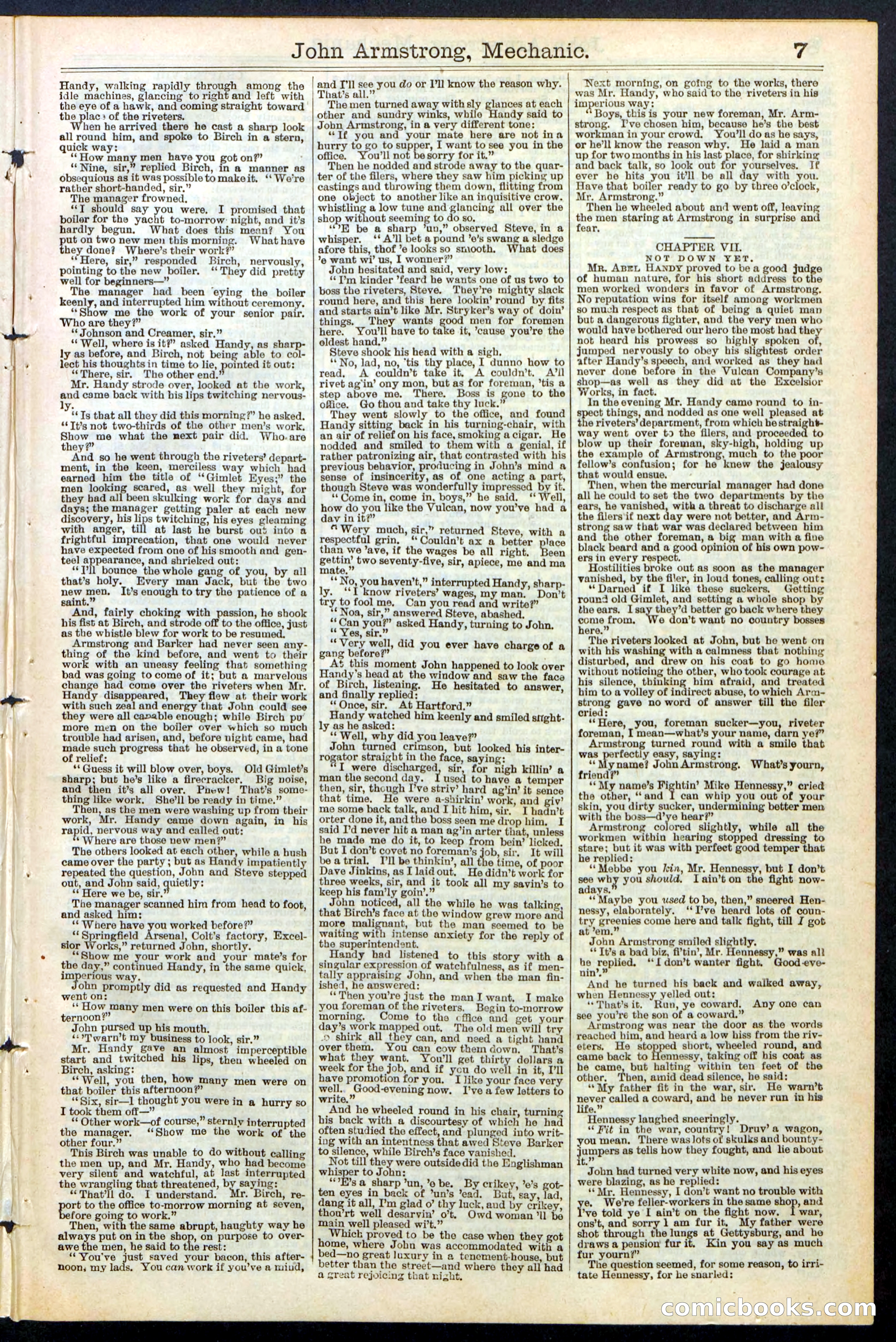
A restored page from Pulp Fiction, 1886. Page through the whole issue in the reader above.
📄 Transcribed text from this page (OCR, searchable)
Machine-transcribed from the original scan — historical spelling and the odd misread are preserved.
——— ae oe John Armstrong, Mechanic. Handy, walking rapidly through among the idle machines, glancing to right and left with the eye of a hawk, and coming straight toward the plac: of the riveters. hen he arrived there he cast a sharp look all round him, and spoke to Birch in a stern, quick way: ** How many men. have you got on?” ‘‘ Nine, sir,” replied Birch, in a manner as obsequious as it was possible to makeit, ‘‘ We're rather short-handed, sir,” The manager frowned, “‘T should say you were, I promised that boiler for the yacht to-morrow: night, and it’s hardly begun. What does this mean? You Ne on two new men this morning. What have hey done? Where’s their work?’ ‘Here, sir,” responded Birch, nervously, pointing to the new boiler. ‘ They did pretty well for beginners—” The manager had been ‘eying the boiler wf and interrupted him without ceremony. “Show me the work of your senior pair. Who are they?” ‘** Johnson and Creamer, sir.” ** Well, where is it?” asked Handy, as sharp- ly as before, and Birch, not being able to col- lect his thoughts in time to lie, pointed it out: ‘There, sir. The other end.’ Mr. Handy strode over, looked at the work, and came back with bis lips twitching nervous- ly. ‘Ts that all they did this morning?” he asked. ‘‘Tt’s not two-thirds of the other men’s work, Show me what the next pair did. Who.are they?” And so he went through the riveters’ depart- ment, in the keen, merciless way which had earned him the title of “Gimlet Eyes;” the men looking scared, as well they might, for they had all been skulking work for days and days; the manager getting paler at each new discovery, his lips twitching, his eyes gleaming with anger, till at last he burst out into a frightful imprecation, that one would never have expected from one of his smooth and gen- tee] appearance, and shrieked out: ‘Tl bounce the whole gang of you, by all that’s holy. Every man Jack, but the two new men. It’s enough to try the patience of a saint.” And, fairly choking with passion, he shook his fist at Birch, and strode off to the office, just as the whistle blew for work to be resumed. Armstrong and Barker had never seen any- thing of the kind before, and went to their work with an uneasy feeling that something bad was going to come of it; but a marvelous change had come over the riveters when Mr. Handy disappeared, They flew at their work with such zeal and energy that John could see they were all capable enough; while Birch pv’ more men on the boiler over which so much trouble had arisen, and, before night came, had made such progress that he observed, in a tone of relief: ** Guess it will blow over, boys. Old Gimlet’s sharp; but he’s like a firecracker. Big noise, and then it’s all over. Phew! That’s some- thing like work. She’ll be ready in time.” Then, as the men were washing up from their work, Mr. Handy came down again, in his rapid, nervous way and called out: ‘Where are those new men?” The others looked at each other, while a hush came over the party; but as Handy impatiently repeated the question, John and Steve stepped out, and John said, quietly: ‘* Here we be, sir.’ The manager scanned him from head to foot, and asked him: ** Where have you worked before?” ** Springfield Arsenal, Colt’s factory, Excel- sior Works,” returned John, shortly. “Show me your work and your mate’s for the day,” continued Handy, in the same quick, imperious way, ohn promptly did as requested and Handy went on: ‘How many men were on this boiler this af- ternoon?” John pursed up his mouth. ‘‘’Twarn’t my business to look, sir.” Mr. Handy gave an almost imperceptible start and twitched his lips, then wheeled on Birch, asking: ‘““Well, you then, how that boiler this afternoon? ‘Six, sir—l thought you were in a hurry so I took them off—” “ Other work—of course,” sternly interrupted the manager. ‘Show me the work of the other four.” ’ This Birch was unable to do without calling the men up, and Mr, Handy, who had become very silent and watchful, af last interrupted the wrangling that threatened, by saying: “That'll do. I understand. Mr. Birch, re- por to the office to-morrow morning at seven, fore going to work.” Then, with the same abrupt, haughty way he always put on in the shop, on purpose to over- awe the men, he said to the rest: re Sia Bia saved your bacon, this after- noon, my lads. You can work if you’ve a miud, many men were on | and I’ll see you do or I'll know the reason why. | That’s all.” The men turned away withsly glances at each other and sundry winks, while Handy said to John Armstrong, in a very different tone: “Tf you and your mate here are not ina hurry to go to supper, I want to see you in the office. “You'll not besorry for it.” Then he nodded and strode away to the quar- ter of the filers, where they saw him picking up castings and throwing them down, flitting from one object to another like an inquisitive crow. whistling a low tune and glancing all over the shop without seeming to do so, ‘OF be a sharp ’un,” observed Steve, in a whisper. ‘‘ A’ll bet a pound ’e’s swang a sledge afore this, thof ’e looks so smooth. What does ’e want wi’ us, I wonner?” John hesitated and said, very low: ‘‘’m kinder ’feard he wants one of us two to boss the riveters, Steve. They’re mighty slack round here, and this here lookin’ round by fits and starts ain’t like Mr, Stryker’s way of doin’ things. They wants good men for foremen here. You'll have to take it, cause you’re the oldest hand,” Steve shook his head with a sigh. ‘* No, lad, no, ‘tis thy place, I dunno how to read, A couldn’t take it, A couldn’t. A’ll rivet ag'in’ ony mon, but as for foreman, "tis a step above me. There. Boss is gone to the office. Go thou and take thy luck.” They went slowly to the office, and found Handy sitting back in his turning-chair, with an air of relief on his face, smoking acigar, He nodded and smiled to them with a genial, if rather patronizing air, that contrasted with his previous behavior, producing in John’s mind a sense of insincerity, as of one acting a part, though Steve was wonderfully impressed by it. ‘‘Come in, come in, boys,” he said. ‘* Well, how do you like the Vulcan, now you’ve had a day in it?” “Wery much, sir,” returned Steve, with a respectful grin. ‘ Couldn’t ax a better place than we ’ave, if the wages be all right. Been gettin’ two seventy-five, sir, apiece, me and ma mate,” ‘* No, you haven’t,” interrupted Handy, sharp- ly. ‘I know riveters’ wages, my man. Don’t try to fool me, Can you read and write?” ‘* Noa, sir,” answered Steve, abashed. “Can you?” asked Handy, turning to John. “* Yes, air.” ‘* Very well, did you ever have gang before?” 3 A‘ this moment John happened to look over Handy’s head at the window and saw the face of Birch, listening. He hesitated to answer, and finally replied: “Once, sir. At Hartford.” Handy watched him keenly and smiled siight- ly as he asked: ** Well, why did you leave?” John turned crimson, but looked his inter- rogator straight in the face, saying: I were discharged, sir, for nigh killin’ a man the second day. I used to have a temper then, sir, though I’ve striv’ hard ag’in’ it sence that time. He were a-shirkin’ work, and giv’ me some back talk, and I hit him, sir, I hadn’t orter done it, and the boss seen me drop him, I said I'd never hit a man ag’in arter that, unless he made me do it, to keep from bein’ licked. But I don’t covet no foreman’s job, sir. It will be a trial. Ill be thinkin’, all the time, of poor Dave Jinkins, as Ilaidout. He didn’t work for three weeks, sir, and it took all my savin’s to keep his fam’ly goin’.” John noticed, all the while he was talking, that Birch’s face at the window grew more and more malignant, but the man seemed to be waiting with intense anxiety for the reply of the superintendent. _Handy had listened to this story with a singular expression of watchfulness, as if men- tally appraising John, and when the man fin- ished, he answered: “Then you're just the manI want, I make you foreman of the riveters. Begin to-morrow morning. Come to tho cffice and get your day’s work mapped out, The old men will try +) shirk all they can, and need a tight hand over them. You can cow them down. That's what wer want, You'll get thirty dollars a week for the job, and if you do well in it, Pl have promotion for you. I like your face very well.. Good-evening now. I’ve a few letters to write.” And he wheeled round in his chair, turning his back with a discourtesy of which he had often studied the effect, and plunged into writ- ing with an intentness that awed Steve Barker to silence, while Birch’s face vanished. Not till they were outside did the Englishman bir Sg to John: ‘°K’s a sharp ’un, ’e be. By crikey, ’e’s got- ten eyes in back of ’un’s ’ead. But, say, lad, dang it all, ’'m glad o’ thy luck, and by crikey, thou’rt well desarvin’ o’t Owd woman ’ll be main well pleased wi’t.” ck proved to be the case when they got home, where John was accommodated with a bed—no great luxury in a tenement-house, but better than the street—and where they all had a creat rejoicing that nicht, charge of a 7 - eS sé Next morning, on going to the works, there was Mr. Handy, who said to the riveters in his imperious way: * Boys, thisis your new foreman, Mr. Arm- strong. Ive chosen him, because he’s the best workman in your crowd. You’ll doas he says, or he’ll know the reason why. He laid a man up for two months in his last place, for shirking and back talk, so look out for yourselves. If ever he hits you itll be all day with you. Have that boiler ready to go by three o’clock, Mr. Armstrong.” Then he wheeled about and went off, leaving so men staring at Armstrong in surprise and ear. CHAPTER VII. NOT DOWN YET. Mr. Apri Hanpy proved to be a good judge of human nature, for his short address to the men worked wonders in favor of Armstrong. No reputation wins for itself among workmen so much respect as that of being a quiet man but a dangerous fighter, and the very men who would have bothered our hero the most had the not heard his prowess so highly spoken of, jumped nervously to obey his slightest order after Handy’s aes and worked as they had never done before in the Vulcan Company’s shop—as well as they did at the Excelsior Works, in fact. In the evening Mr. Handy came round to in- eee things, and nodded as one well pleased at the riveters’ department, from which he straight- way went over to the filers, and proceeded to blow up their foreman, sky-high, holding up the example of Armstrong, much to the poor fellow’s confusion; for he knew the jealousy that would ensue, Then, when the mercurial manager had done all he could to set the two departments by the ears, he vanished, with a threat to discharge all the filers if next day were not better, and Arm- strong saw that war was declared between him and the other foreman, a big man with a five black beard and a good opinion of his own pow- ers in every respect, Hostilities broke out as soon as the manager vanished, by the filer, in loud tones, calling out: “Darned if I like these suckers. Getting roun3 old Gimlet, and setting a whole shop by the ears, I ep fe better go back where they come from. e don’t want no country bosses here. The riveters looked at John, but he went on with his washing with a calmness that nothing disturbed, and drew on his coat to go home without noticing the other, who took courage at his silence, thinking him afraid, and treated him to a volley of indirect abuse, to which Arm-~ sale 4 gave no word of answer till the filer cried: ‘Here, you, foreman sucker—you, riveter foreman, I mean—what’s your name, darn ye?” Armstrong turned round with a smile that was perfectly easy, saying: ‘“‘Myname? John Armstrong. What’s yourn, friend?” ‘* My name’s ty ror Mike Hennessy,” cried the other, ‘and I can whip you out of your skin, you dirty sucker, undermining better men with the eek be hear?” Armstrong colored slightly, while all the workmen within hearing stopped dressing to stare; but it was with perfect good temper that he ae ‘*Mebbe you iin, Mr. Hennessy, but I don’t see why you should. Lain’t on the fight now- adays. ‘Maybe you used to be, then,” sneered Hen- nessy, elaborately. ‘I’ve heard lots of coun- try greenies come here and talk fight, till J got at ’em.” John Armstrong smiled slightly. ** Tt’s a bad biz, fi’tin’, Mr. Hennessy,” was al! in replied, ‘“[ don’t wanter fight. Good-eve- nin’. And he turned his back and walked away, when Hennessy yelled out: “That's it. Run, ye coward. Any one can see you're the son of a coward,” Armstrong was near the door as. the words reached him, and heard a low hiss from the riv- eters. He sto short, wheeled round, and came back to Hennessy, taking off his coat as he came, but halting within ten feet of the other. Then, aiid dead silence, he said: ‘“My father fit in the war, sir. He warn’t never called a coward, and he never run in his life.” Hennessy laughed sneeringly. “Fit in the war, country! Druv’a wagon, ou mean, There was lots of skulks and bounty- jumpers as tells how they fought, and lie about ” Jobn had turned very white now, and his eyes were blazing, as he replied: ; ‘‘Mr. Hennessy, I don’t want no trouble with e. We're feller-workers in the same shop, and ’ve told ye I ain’t on the fight now. I war, ons’t, and sorry 1 am fur it, My father were shot through the lungs at Gettysburg, and he draws a pension furit. Kin you say as much fur yourn?” hs The question seemed, for some reason, to irri- tate Hennessy, for he snarled: Eboo Goim S cor