
Pulp Fiction, 1886 · page 6 of 32
Beadle's New York Dime Library, No. 378 — page 6: what you’re looking at
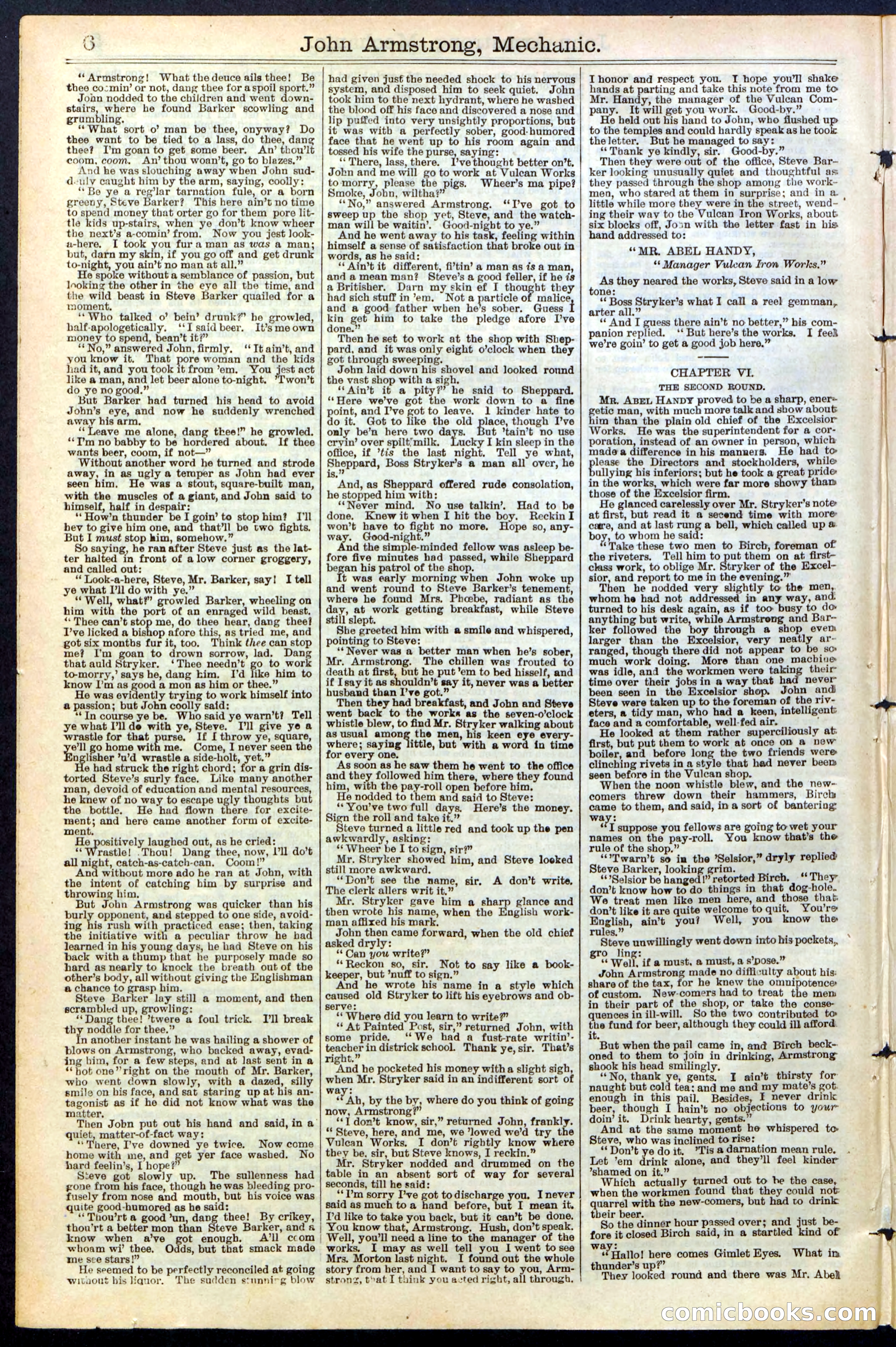
A restored page from Pulp Fiction, 1886. Page through the whole issue in the reader above.
📄 Transcribed text from this page (OCR, searchable)
Machine-transcribed from the original scan — historical spelling and the odd misread are preserved.
> 4 - ‘Armstrong! What the deuce ails thee! Be thee comin’ or not, dang thee for aspoil sport.” John nodded to the children and went down- stairs, where he found Barker scowling and grumbling, “What sort o’ man be thee, onyway? Do thee want to be tied to a lass, do thee, dang thee? I’m goan to get some beer. An’ thou’lt coom, coom. An’ thou woan’t, go to blazes,” And he was slouching away when John sud- duly caught him by the arm, saying, coolly: ‘Bo ye a reg’lar tarnation fule, or a born greeny, Steve Barker? This here ain’t no time to spend money that orter go for them pore lit- tle kids up-stairs, when ye don’t know wheer the next’s a-comin’ from. Now you jest Jook- u-here, I took you fur a man_as was a man; but, darn my skin, if you go off and get drunk to-night, you ain’t no man at all.” He spoke without a semblance of passion, but Inoking the other in the eye all the time, and the wild beast in Steve Barker quailed for a moment, ‘* Who talked o’ bein’ drunk?’ he growled, half-apologetically. ‘‘Isaidbeer. It’smeown ei to spend, bean’t it?” ** No,” answered John, firmly, ‘ It ain’t, and you know it. That pore woman and the kids had it, and you took it from ’em. ‘You jest act like a man, and let beer alone to-night. "I'won’t do ye no good.” But Barker had turned his head to avoid John’s eye, and now he suddenly wrenched away his arm, ‘“Teave me alone, dang thee!” he growled. **T’m no babby to be hordered about. If thee wants beer, coom, if not—” Without another word he turned and strode away, in as ugly a temper as John had ever seen him. He was a stout, square-built man, with the muscles of a giant, and John said to himself, half in despair: ‘* How’n thunder beI goin’ to stop him? I'll hev to give him one, and that’ll be two fights. But I must stop him, somehow.” So saying, he ran after Steve just as the lat- ter halted in front of alow corner groggery, and called out: “‘ Look-a-here, Steve, Mr. Barker, say! I tell ye what I'll do with ye.” ‘Well, what?’ growled Barker, wheeling on him with the port of an enraged wild beast, “* Thee can’t stop me, do thee hear, dang thee? I’ve licked a bishop afore this, as tried me, and got six months fur it, too. Think thee can stop me? I'm goan to drown sorrow, lad. Dang that auld Stryker. ‘Thee needn’t go to work to-morry,’ says he, dang kim, I'd like him to know I’m as good a mon as him or thee.” He was evidently trying to work himself into a passion; but John coolly said: ‘*In course ye be. Who said ye warn’t? Tell ye what I'llde with ye, Steve. Ill give yea wrastle for that purse. If I throw ye, square, At go home with me. Come, I never seen the nglisher ’u’d wrastle a side-holt, By e had struck the right chord; for a grin dis- torted Steve’s surly face. Like many another man, devoid of education and mental resources, he knew of no way to escape ugly thoughts but the bottle. He had flown there for excite- ment; and here came another form of excite- ment. ao eerie laughed out, as he cried: ‘““Wrastle! Thou! Dang thee, now, Ill do’t all night, catch-as-catch-can. Coom!” : And without more ado he ran at John, with the intent of catching him by surprise and throwing him. . But John Armstrong was quicker than his burly opponent, and stepped to one side, avoid- ing his rush with practiced ease; then, taking the initiative with a peculiar throw he had learned in his young days, he had Steve on his back with a thump that he purposely made so hard as nearly to knock the breath out of the other’s body, all without giving the Englishman a chance to grasp him. Steve Barker lay still a moment, and then scrambled up, growling: ‘* Dang thee! ’twere a foul trick. Tl break sa noddle for thee.” n another instant he was hailing a shower of blows on Armstrong, who backed away, evad- ing him, for a few steps, and at last sent in a ‘‘hot one” right on the mouth of Mr. Barker, who went down slowly, with a dazed, silly smile on bis face, and sat staring up at his an- tagonist as if he did not know what was the matter, Then Jobn put out his hand and said, in a quiet, matter-of-fact way: ‘There, I’ve downed ye twice. Now come home with me, and get yer face washed. No hard feelin’s, I hope?’ Steve got slowly up. The sullenness had gone from his face, though he was bleeding pro- fusely from nose and mouth, but his voice was quite good-humored as he said: . ‘*Thou’rt a good un, dang thee! By crikey, thou’rt a better mon than Steve Barker, and & know when a’ve t enough. A’ll ccom whoam wi’ thee. Odds, but that smack made me see stars!” : He seemed to be perfectly reconciled at going wituout his iqnor. The sudden stunnirg blow had given jusf the needed shock to his nervous system, and disposed him to seek quiet. John took him to the next hydrant, where he washed the blood off his face and discovered a nose and lip puffed into very unsightly proportions, but it was witb a perfectly sober, good-humored face that he went up to his room again and tossed his wife the purse, saying: ‘There, lass, there. I’vethought better on’t. Jobn and me will go to work at Vulean Works to morry, please the pigs. Wheer’s ma pipe? Smoke, Jobn, wiltha?” **No,” answered Armstrong. “I’ve got to sweep up the shop yet, Steve, and the watch- man will be waitin’. Good-night to ye.” And he went away to his task, feeling within himself a sense of satisfaction that broke out in words, as he said: *‘Aimtit different, fi’tin’ a man as is a man, and a mean man? Steve’s a good feller, if he is a Britisher. Darn my skin ef I set pb they had sich stuff in ’em, Nota particle of malice and a good father when he’s sober. Guess I Pe get him to take the pledge afore I’ve one.” Then he set to work at the shop with Shep- pard, and it was only eight o’clock when they got through sweeping. John laid down his shovel and looked round the vast shop with a sigh, ‘*Ain’t it a pity?’ be said to Sheppard. ‘‘Here we've got the work down to a fine point, and I’ve got to leave. 1 kinder hate to do it. Got to like the old — though I’ve only be’n here two days. But ’tain’t no use cryin’ over spilt}milk. Lucky I kin sleep in the office, if ’tis the last night. Tell ye what, Sheppard, Boss Stryker’s a man all over, he 1s, And, as Sheppard offered rude consolation, he stopped him with: ‘*Never mind. No use talkin’. Had to be done. Knew it when I hit the boy. ReckinI won’t have to fight no more, Hope so, any- way. Good-night.” And the simple-minded fellow was asleep be- fore five minutes had passed, while Sheppard began his patrol of the shop. t was early morning when John woke up and went round to Steve Barker’s tenement, where he found Mrs, Phcebe, radiant as the eri at work getting breakfast, while Steve still slept. She greeted him with a smile and whispered, pointing to Steve: ‘* Never was a better man when he’s sober, Mr. Armstrong. The chillen was frouted to death at first, but he put ’em to bed hisself, and if Isay it as shouldn’t say it, never was a better husband than I’ve got.” Then they had breakfast, and John and Steve went back to the works as the seven-o’clock whistle blew, to find Mr. Stryker walking about as usual ping the men, his keen eye every- where; saying little, but with a word in time for every one. As soon as he saw them he went to _ the office and they followed him there, where they found him, with the a Sd open before bim. He nodded to them and said to Steve: ‘You've two full days. Here’s the money. Sign the roll and take it.” Steve turned a little red and took up the pen awkwardly, asking: ‘* Wheer be I to sign, sir?” Mr. Stryker showed him, and Steve loeked still more awkward. “Don’t see the name, sir. A don’t write, The clerk allers writ it.” Mr. Stryker gave him a sha then wrote his name, when the man affixed his mark. John then came forward, when the old chief asked dryly: “Can you write?’ *“Reckon so, sir. Not to say like a book- keeper, but ’nuff to sign.” And he wrote his name in a style which caused old Stryker to lift his eyebrows and ob- serve: ‘‘ Where did you learn to write?” ‘‘ At Painted Post, sir,” returned John, with some pride, ‘We had a fust-rate writin’- teacher in districk school. Thank ye, sir. That’s right. And he pocketed his money witha slight sigh, when Mr. Stryker said in an indifferent sort of way: ao Ah, by the by, where do you think of going now, Armstrong ‘‘T don’t know, sir,” returned John, frankly. ** Steve, here, and me, we lowed we'd try the Vulean Works, I don’t rightly know where they be, sir, but Steve knows, I reckin.” Mr. Stryker nodded and drummed on the table in an absent sort of way for several seconds, till he said: ‘*’m sorry I’ve got todischarge you, Inever said as much toa hand before, but I mean it, I'd like to take you back, but it can’t be done. You know that, Armstrong. Hush, don’t speak. glance and nglish work- | Well, you’ll need a line to the manager of the works. I may as well tell you I went to see Mrs. Morton last night. I found out the whule story from her, and I want to say to you, Arm- strong, toat I think you acted right, all through. O John Armstrong, Mechanic. IT honor and respect you. TI hope you'll shake hands at parting and take this note from me to Mr. Handy, the manager of the Vulcan Com- pany. It will get you work. Good-by.” He held out his hand to John, who flushed up to the temples and could hardly speak as he took theletter. But he managed to say: ‘‘Thank ye kindly, sir. Good-by.” Then they were out of the office, Steve Bar- ker looking unusually quiet and thoughtful as they passed through the shop among the work- men, who stared at them in surprise; and in a little while more they were in the street, wend- * ing their way to the Vulcan Iron Works, about six blocks off, Join with the letter fast in his hand addressed to: “MR. ABEL HANDY, ‘“* Manager Vulcan Iron Works,” As they neared the works, Steve said in a low one: ‘* Boss Stryker’s what I call a reel gemman, arter all.” ‘* And I guess there ain’t no better,” his com- papion replied. ‘‘ But here’s the works, I feek we're goin’ to get a good job here,” CHAPTER VI. THE SECOND ROUND. Mr. AneL Hanpy proved to be a sharp, ener getic man, with much more talk and show about him than the plain old chief of the Excelsior Works. He was the superintendent for a cor- poration, instead of an owner in person, which made a difference in his manners. He had to lease the Directors and stockholders, while ullying his inferiors; but he took a pe pride in the works, which were far more showy thap those of the Excelsior firm. He glanced carelessly over Mr. Stryker’s note at first, but read it a secend time with more care, and at last rung a bell, which called up @ boy, to whom he said: ‘Take these two men to Birch, foreman of the riveters. Tell him to put them on at first- class work, to oblige Mr. Stryker of the Excel- sior, and report to me in the evening.” Then he nodded very slightly to the men, whom he had not addressed in any way, and turned to his desk again, as if too busy to do anything but write, while Armstreng and Bar- ker followed the boy through a shop evem larger than the Excelsior, very a ar- ranged, though there did not appear to be so much work doing. More than one machine was idle, and the workmen were taking their time over their jobs in a way that had never been seen in the Excelsior shop. John andi Steve were taken up to the foreman of the riv- eters, a tidy man, who had a keen, intelligent face and a comfortable, well-fed air. He looked at them rather superciliously at: first, but put them to work at once op a new boiler, and before long the two friends were clinching rivets in a style that hed never beer seen before in the Vulcan shop. When the noon whistle blew, and the new- comers threw down their hammers, Bircl» came to them, and said, ina sort of bantering way: ay suppose you fellows are going to wet your names on the pay-roll. You know that’s the rule of the shop.” Sec marae so in the "Selstor,” dryly replied eve Barker, looking grim. ‘“Selsior be hanged!” retorted Bireb, “They don’t know how to do things in that dog-hole. We treat men like men here, and those that don’t like it are quite welcome to quit, You're English, ain’t you? Well, you know the rules.” ; lésen unwillingly went down into his pockets,, gro ling: ‘‘ Well. if a must, a must, a s’pose.” John Armstrong made no difficulty about his: share of the tax, for he knew the omnipotence of custom. New-comers had to treat the mem in their part of the shop, or take the conse- quences in ill-will. So the two contributed to the fund for beer, although they could ill afford. it. But when the pail came in, and Birch beck- oned to them to join in drinking, Armstrong shook his head smilingly, ‘‘No, thank ye, gents. I ain’t thirsty for naught but cold tea: and me and my mate’s got. enough in this pail, Besides, Ef never drink beer, though [ hain’ no objections to your doin’ it. Drink hearty, gents.” ; And at the same moment he whispered to Steve, who was inclined to rise: _ “Don’t ye doit. "Tis a darnation mean rule, Let ’em drink alone, and they’ll feel kinder ’shamed on it.” Which actually turned out to be the case, when the workmen found that they could not uarrel with the new-comers, but had to drink their beer. So the dinner hour passed over; and just _be- fore it closed Birch said, in a startled d of be Hallo! here comes Gimlet Eyes. What in thunder’s up?’ They looked round and there was Mr. Abe} a > Gomicboo (C ‘S;com