
Pulp Fiction, 1886 · page 5 of 32
Beadle's New York Dime Library, No. 378 — page 5: what you’re looking at
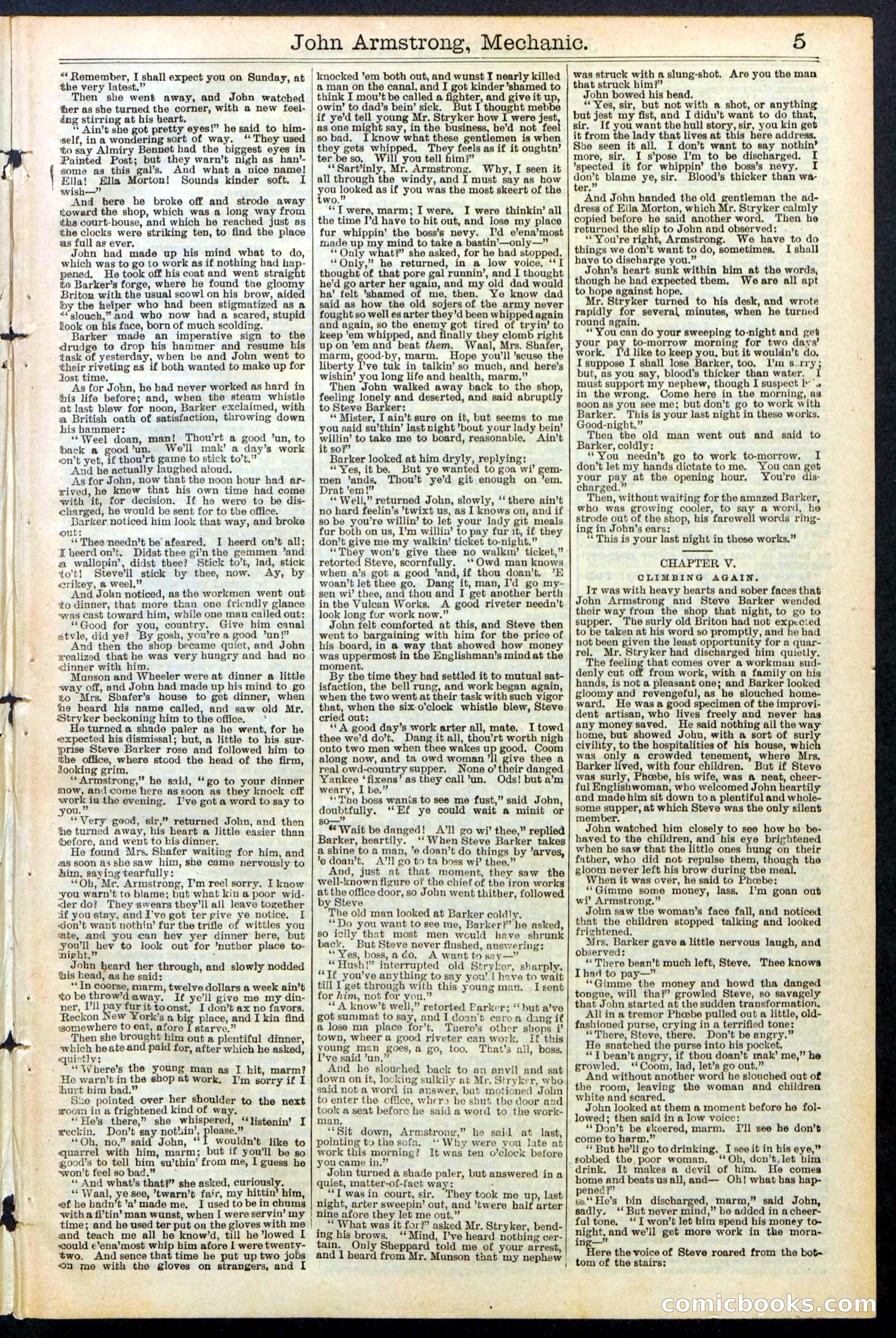
A restored page from Pulp Fiction, 1886. Page through the whole issue in the reader above.
📄 Transcribed text from this page (OCR, searchable)
Machine-transcribed from the original scan — historical spelling and the odd misread are preserved.
8 - John Armstrong, Mechanic. ** Remember, I shall expect you on Sunday, at the very latest.” Then she went away, and John watched her as she turned the corner, with a new feel- ding stirring at his heart. : * Ain’t she got pretty eyes!” he said to him- self, in a wondering sort of way. “They used ‘to say Almiry Bennet bad the biggest eyes in Painted Post; but they warn’t nigh as han’- some as this gal’s. And what a nice name! Ella! f#lla Morton! Sounds kinder soft. I wish-—” And here he broke off and strode away toward the shop, which was a long way from ithe court-house, and which he reached just as the clocks were striking ten, to find the place as full ag ever. John had made up his mind what to do, which was to go to work as if nothing had BaP. pened. He took off his coat and went straight to Barker’s forge, where he found the gloomy Briton with the usual scowl on his brow, aided oy the helper who had been stigmatized as a “slouch,” and who now had a scared, stupid look on his face, born of much scolding. Barker made an imperative sign to the drudge to drop his hammer and resume his task of yesterday, when be and John went to their riveting es if both wanted to make up for Jost time. As for John, he had never worked as hard in his life before; and, when the steam whistle at last blew for noon, Barker exclaimed, with a British oath of satisfaction, throwing down his hammer: : ‘‘ Weel doan, man! Thou’rt a good ’un, to back a good’un. We'll mak’ a day’s work on’t yet, if thou’rt game to stick to’t.” And he actually laughed aloud, As for John, now that the noon hour had ar- wived, he knew that his own time had come with it, for decision. If he were to be dis- charged, he would be sent for to the office. Barker noticed him look that way, and broke ub: ‘‘ Thee needn’t be afeared. I heerd on’t all; Z heerd on’t. Didst thee gi’n the gemmen ’and a wallopin’, didst thee? Stick to’t, lad, stick to’t! Steve’ll stick by thee, now, Ay, by erikey, a weel,” And John noticed, as the workmen went out to dinner, that more than one friendly glance “was cast toward him, while one man called out: “Good for you, country. Give him canal etvle, did ye? By gosh, you’re a good ’un!” And then the shop became quiet, and John wealized that he was very hungry and had no ‘dinner with him. Munson and Wheeler were at dinner a little “way off, and John had made up his mind to go to Mrs. Shafer’s house to get dinner, when fos beard his name called, and saw old Mr, Stryker beckoning him to the office. ~° He turned a shade paler as he went, for he expected his dismissal; but, a little to his sur- rise Steve Barker rose and followed him to he office, where stcod the head of the firm, ooking grim, ** Armstrong,” he said, ‘go to your dinner snow, and come here as soon as they knock off work in the evening. I’ve got a word to say to ou. ‘“Very geod, sir,” returned John, and then the turned away, his heart a Jittle easier than before, and went to his dinner. He found Mrs. Shafer waiting for him, and as soon as she saw him, she came nervously to him, saying tearfully: “ Mr. Armstrong, I’m reel sorry. I know ‘you warn’t to blame; but what kin a poor wid- «ler do? They swears they’ll all leave together if youstay, and I've got ter give ye notice, I don’t want nothin’ fur the trifle of wittles you “ate, and you can hev yer dinner bere, but you'll hev to look out for ’nuther pluce to- might.” John heard her through, and slowly nodded this head, as he said: ** In coorse, marm, twelve dollars a week ain’t to be throw’daway. If ye'll give me my din- ner, ll pay fur it toonst, I don’t ax no favors. Reckon New York's a big place, and I kin find somewhere to eat, afore [ starve.” Then she brought him out a plentiful dinner, which heate and paid for, after which he asked, quictly: ‘“Where’s the young man as I hit, marm? He warn’t in the shop at work, I’m sorry if I ‘hurt bim bad.” She pointed over her shoulder to the next woo in a frightened kind of = ‘‘He’s there,” she whispered, ‘listenin’ I weckin. Don’t say notuin’, please.” **Oh, no,” said John, ‘1 wouldn't like to quarrel with him, marm; but if you'll be so good’s to tell him su’thin’ from me, I guess he ‘won't feelsobad.” — . ‘‘ And what’s that?” she asked, curiously. ** Waal, ye see, ’twarn’t fair, my hittin’ him, ef he badn’t ’a’ made me, I used to be in chums with a fi’tin’ man wunst, when I were servin’ my time; and he used ter put on the gloves with me aand teach me all he know’d, till he lowed I could ¢’ena’most whip him afore | were twenty- two. And sence that time he put up two jobs ©2 me with the gloves on strangers, and I ‘knocked ’em both out, and wunst I nearly killed a man on the canal, and I got kinder ’shamed to think I mou’t be called a fighter, and give it up, owin’ to dad’s bein’ sick. But I thought mebbe if ye’d tell young Mr. Stryker how I were jest, as one might say, in the business, he’d not feel so bad. I know what these gentlemen is when they gets whipped. They feels as if it oughtn’ ter be so, Will you tell him?” “*Sart?inly, Mr. Armstrong. Why, I seen it all through the windy, and I must say as how ou looked as if you was the most skeert of the wo. ‘*T were, marm; I were. I were thinkin’ all the time I’d have to hit out, and lose my place fur whippin’ the boss’s nevy. I'd e’ena’most ruade up my mind to take a bastin’—only—” ‘*Only what?” she asked, for he had stopped. ‘“Only,” he returned, in a low voice, ‘I thought of that pore gal runnin’, and I thought he’d go arter her again, and my old dad would ha’ felt ’shamed of me, then. Ye know dad said as how the old sojers of the army never fought so well es arter they’d been whipped again and again, so the re | got tired of tryin’ to keep ’em whipped, and finally they clomb right up on ’em and beat them. Waal, Mrs. Shafer, marm, eoepee & marm. Hope you'll ’scuse the liberty I’ve tuk in talkin’ so much, and here’s wishin’ you long life and health, marm,” Then John walked away back to the shop, feeling lonely and deserted, and said abruptly to Steve Barker: ‘* Mister, I ain’t sure on it, but seems to me you said su’thin’ last night ’bout your lady bein’ willin’ to take me to board, reasonable. Ain’t it so?” Barker looked at him dryly, replying: ‘“Yes, it be. But ye wanted to goa wi’ gem- men ’ands, Thou’t ye’d git enough on ’em. Drat ’em!” ‘* Well,” returned John, slowly, ‘‘ there ain’t no hard feelin’s ’twixt us, as I knows on, and if so be you’re willin’ to let your lady git meals fur both on us, I’m willin’ to pay fur it, if they don’t give me my walkin’ ticket to-night.” ‘*They won’t give thee no walkin’ ticket,” retorted Steve, scornfully. ‘‘Owd man knows when a’s got a good ’and, if thou doan’t. ’E woan’t let thee go. Dang it, man, ’d go my- sen wi’ thee, and thou and I get another berth in the Vulcan Works. A good riveter needn’t look long for work now,” John felt comforted at this, and Steve then went to bargaining with him for the price of his board, in a way that showed how money was uppermost in the Englishman’s mind at the moment, By the time they had settled it to mutual sat- isfaction, the bell rung, and work began again, when the two went at their task with such vigor that, when the six-o'clock whistle blew, Steve cried out: ‘‘ A good day’s work arter all, mate. I towd thee we'd do’t. Dang it all, thou’rt worth nigh onto two men when thee wakes ce good. Coom along now, and ta owd woman ’ll give thee a real owd-country supper. None o’ their danged Yankee ‘fixens’ as they call’un, Ods! but a’m weary, I be,” ‘‘™he boss wanis to see me fust,” said John, doubtfully. “Ef ye could wait a minit or so— Wait be danged! A’ll go wi’ thee,” replied Barker, heartily. ‘‘ When Steve Barker takes a shine to a man, ’e doan’t do things by ’arves, ’e doan’t, A’!] ¢o to ta boss wi? thee.” And, just at that moment, they saw the well-known figure of the chief of the iron works at the office door, so John went thither, followed by Steve The old man looked at Barker coldly. **Do you want to see me, Barker?’ he asked, so icily that most men would have shrunk back. But Steve never flushed, answering: ** Yes, boss,ado. A want to say—” ** Hush!” interrupted old Stryl:er, sharply. ‘If you’ve anything to say you’| heve to wait till 1 get through with this young man. I sent for him, not for vou,” ‘* A know’t well,” retorted Parker: “but a’ve got summat to say, and I doan’t caroa dangit a lose ma place for’t, There’s other shops i’ town, wheer a good riveter can work. If this young man goes, a go, too. That's all, boss, I’ve said ’un.” And he slouched back to an anvil and sat down on it, looking sulkily at Mr. Stryker, who said not a word in answer, but motioned John to enter the office, wher) he shut the door and took a seat beforo he said a word to the work- man, ‘Sit down, Armstrong,” he sail at last, pointing tv the sofa. ‘‘Why were vou late at work this morning? It was ten o’clock before you came in.” John turned a shade paler, but answered in a quiet, matter-of-fact way: “*T wasin court, sir. They took me up, last night, arter sweepin’ out, and *twere half arter nine afore they let me out.” _ . What was it for?” asked Mr. Stryker, bend- ing his brows. ‘Mind, I’ve heard nothing cer- tain, Only Sheppard told me of your arrest, and 1 heard from Mr. Munson that my nephew | 5 ———s — —— - -—e was struck with a slung-shot. Are you the man that struck him?” John bowed his head. ‘Yes, sir, but not with a shot, or anything but jest my fist, and I didu’t want to do that, sir. If you want the hull story, sir, you kin get it from the lady that lives at this here address. he seen it all. I don’t want to say nothin’ more, sir. I s’pose I’m to be discharged. I ’spected it for whippin’ the boss’s nevy. don’t blame ye, sir. Blood’s thicker than wa- ter. And John handed the old gentleman the ad- dress of Ella Morton, which Mr. al hae calmly copied before he said another word, Then he returned the slip to John and observed: ‘You're right, Armstrong. We have to do things we don’t want to do, sometimes, I shall have to discharge you.” John’s heart sunk within him at the words, though he had expected them, Weare all apt to hope against hope, Mr. Stryker turned to his desk, and wrote rapidly for several minutes, when he turned round again. ‘** You can do your sweeping to-night and get your pay to-morrow morning for two days’ work, d like to keep you, but it wouldn’t do, I suppose I shall lose Barker, too. I’m s_rry; but, as you say, blood’s thicker than water. 7 must support my nephew, though I suspect bh » in the wrong. Come here in the morning, as soon as you see me; but don’t go to work with Barker. This is your last night in these works, Good-night,” Then the old man went out and said to Barker, coldly: “You needn’t go to work to-morrow. I don’t let my hands dictate tome. You can get your pay at the opening hour, You're dis- charged.” Then, without waiting for the amazed Barker, who was growing cooler, to say a word, he strode out of the shop, his farewell words ring- ing in John’s ears: ‘* This is your last night in these works.” CHAPTER V. CLIMBING AGAIN. It was with heavy hearts and sober faces that John Armstrong and Steve Barker wended their way from the shop that night, to go to supper. The surly old Briton had not expected to be taken at his word so promptly, and he had not been given the least a for a quar- rel, Mr. Stryker had discharged him quietly. The feeling that comes over a workman sud- denly cut off from work, with a family on his hands, is not a pleasant one; and Barker looked gloomy and revengeful, as he slouched home- ward, He was a good specimen of the improvi- dent artisan, who lives freely and never has any money saved. He said nothing all the way home, but showed John, with a sort of sur] civility, to the hospitalities of his house, whic was only a crowded tenement, where Mrs, Barker lived, with four children. But if Steve was surly, Phosbe, his wife, was a neat, cheer- ful Englishwoman, who welcomed John heartily and made him sit down toa plentiful and whole- some supper, at which Steve was the only silent member. John watched him closely to see how he be- haved to the children, and his eye brightened when he saw that the little ones be) on their father, who did not repulse them, though the gloom never left his brow during the meal, When it was over, he said to Phoebe: ‘Gimme some money, lass, I’m goan out wi’ Armstrong.” John saw the woman’s face fall, and noticed that the children stopped talking and looked frightened, Mrs. Barker gave a little nervous laugh, and observed: ‘* There bean’t much left, Steve. Thee knows Thad to pay—” ‘Gimme the money and howd tha danged tongue, will tha?’ growled Steve, so wavencey that John started at the sudden transformation. All in a tremor Phoebe pulled out a little, old- fashioned purse, crying in a terrified tone: ‘*There, Steve, there. Don’t be angry.” He snatched the purse into his pocket, “T bean’t angry, if thou doan’t mak’ me,” he growled. ‘*Coom, lad, let’s go out.” And without another word he slouched out of the room, leaving the woman and children white and scared. John looked at them a moment before he fol- lowed; then said in a low voice: ‘‘Don’t be ekeered, marm, I'll see he don’t come to harm.” ‘* But he’ll go todrinking. I seeit in his eye,” sobbed the poor woman, ‘Oh, don’t. let bim drink. It makes a devil of him. He comes ea) oe beats us all, and— Oh! what has hap- ened? we‘‘He’s bin discharged, marm,” said John, sadly. ‘‘ But never mind,” he added in acheer- ful tone. ‘I won’t let bim spend his money to- night, and we’ll get more work in the morn- ing—” Make the voice of Steve roared from the bo tom of the stairs: (a(@) IOO MUS gs) GOr