
Pulp Fiction, 1886 · page 4 of 32
Beadle's New York Dime Library, No. 378 — page 4: what you’re looking at
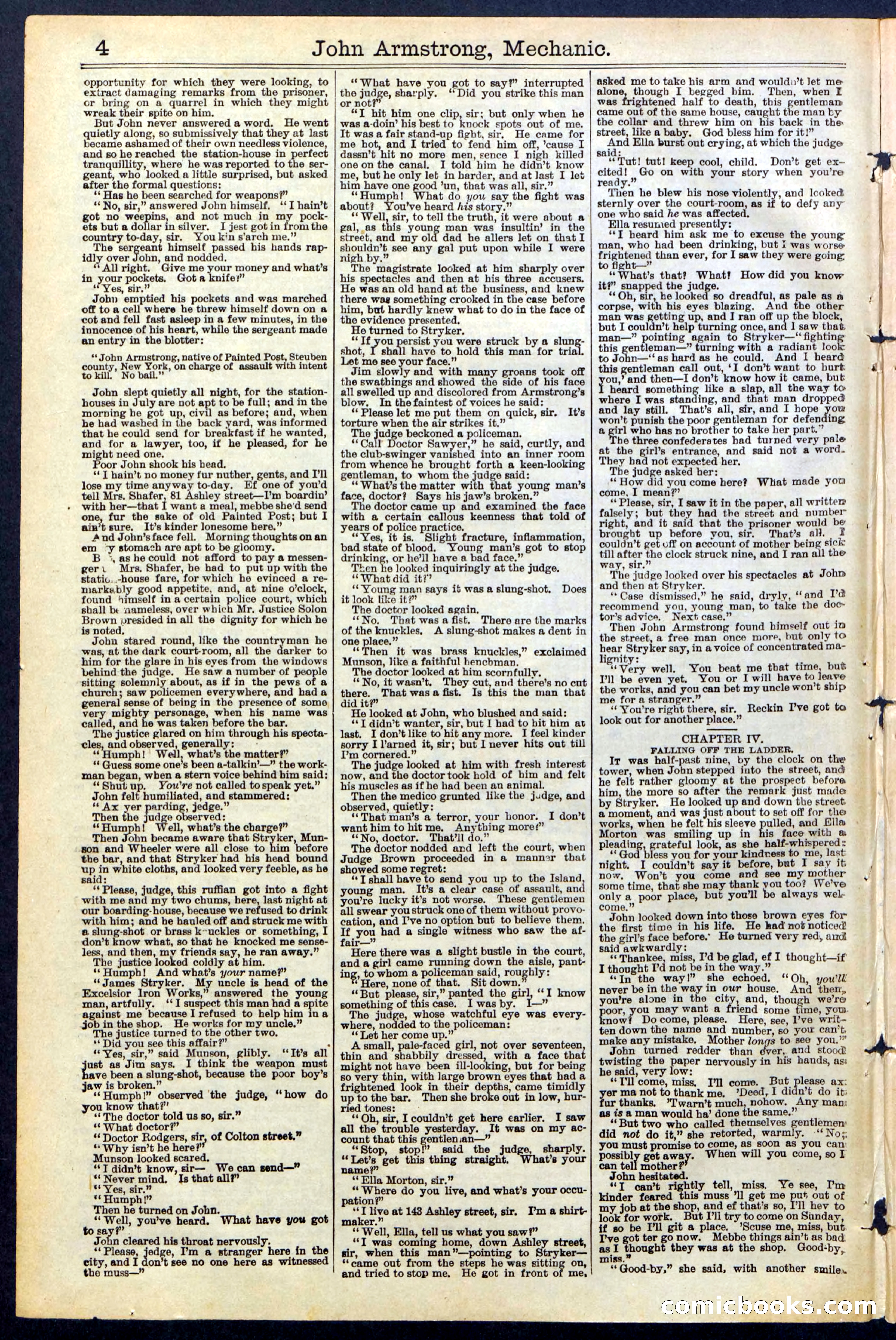
A restored page from Pulp Fiction, 1886. Page through the whole issue in the reader above.
📄 Transcribed text from this page (OCR, searchable)
Machine-transcribed from the original scan — historical spelling and the odd misread are preserved.
A John Armstrong, Mechanic. opportunity for which they were looking, to extract damaging remarks from the prisoner, or bring on a quarrel in which they might wreak their spite on him. But John never answered a word. He went quietly along, so submissively that they at last became ashamed of their own needless violence, and so he reached the station-house in perfect tranquillity, where he was reported to the ser- geant, who looked a little surprised, but asked after the formal questions: ‘* Has he been searched for weapons?” ‘* No, sir,” answered John himself, ‘‘I hain’t got no weepins, and not much in my pock- ets but a dollar in silver. I jest gotin fromthe country to-day, sir. You kin s’arch me.” The sergeant himself passed his hands rap- idly over John, and nodded. “Allright. Give me your money and what’s in your pockets, Got a knife?’ Yes, sir.” Johy emptied his pockets and was marched off to a cell where he threw himself down on a cot and fell fast asleep in a few minutes, in the innocence of his heart, while the sergeant made an entry in the blotter: ** John Armstrong, native of Painted Post, Steuben county, New York, on charge of assault with intent to kill. No bail.” John slept quietly all night, for the station- houses in July are not apt to be full; and in the morning be got up, civil as before; and, when he had washed in the back yard, was informed that he could send for breakfast if he wanted, and for a lawyer, too, if he pleased, for he might need one, oor John shook his head. ‘¢T hain’t no money fur nuther, gents, and I'll lose my time anyway to-day. Ef one of you'd tell Mrs. Shafer, 81 Ashley street—I’m boardin’ with her—that I want a meal, mebbe she'd send one, fur the sake of old Painted Post; but I ain’t sure. It’s kinder lonesome here,” And John’s face fell. Morning thoughts on an em ‘y stomach are apt to be gloomy. B +, as hecould not afford to pay a messen- geri Mrs. Shafer, be had to put up with the static..-house fare, for which he evinced a re- markebly good appetite, and, at nine o’clock, found 4imself in a certain police court, which shall be nameless, over which Mr. Justice Solon Brown presided in all the dignity for which he is noted, John stared round, like the countryman he was, at the dark court-room, all the darker to him for the glare in his eyes from the windows behind the judge. He saw a number of people sitting solemnly about, as if in the pews of a church; saw policemen everywhere, and hada general sense of being in the presence of some, very mighty personage, when his name was called, and he was taken before the bar. The justice glared on him through his specta- cles, and observed, generally: - “* Humph! Well, what’s the matter?” ‘* Quess some one’s been a-talkin’—” the work- man began, when a stern voice behind him said: “Shut up. You're not called tospeak yet.” J 9 fel pre eg stammered: x yer parding, jedge. Then the Jad e pe Fob Humph! ell, what’s the charge?” Then John became aware that rf ae Mun- son and Wheeler were all close to him before the bar, and that Stryker had his head bound up an white cloths, and looked very feeble, as he said: ‘* Please, judge, this ruffian got into a fight with me and my two chums, here, last night at our boarding- house, because we refused to drink with him; and he hauled off and struck me with a slung-shot or brass k»uckles or something, I don’t know what, so that he knocked me sense- less, and then, my friends say, he ran away.” The justice looked coldly at him. ‘*Humph! And what’s your name?” ‘* James Stryker. My uncle is head of the Excelsior lron Works,” answered the young man, artfully. ‘‘ 1 suspect this man had a i a aaotnet me because I refused to help him ina job in the shop. He works for my uncle.” The justice turned to the other two, ‘Did you see this affair?” ‘Yes, sir,” said Munson, glibly. — as Jim says. I think the weapon must ve been a slung-shot, because the poor boy’s jaw is broken.” ‘‘Humph!” observed the judge, “how do you know that?” ‘‘The doctor told us so, sir.” ‘¢ What doctor?” “Doctor Rodgers, sir, of Colton street.” “ Why isn’t he here? Munson looked scared, ‘“‘T didn’t know, sir— Wecan send—” be Never mind, Is that all?” fo '¥os air.” ** Humph!” Then he turned on John. s Well, you’ve heard. What have you got to say?” . J pin cleared his throat nervously. ** Please, dodge, I’m a stranger here in the city, and I don’t see no one here as witnessed the muss—” “Tis all “What have you got to say?” interrupted the judge, sharply. “Did you strike this man no *“T hit him one clip, sir; but only when he was a-doin’ his best to knock spots out of me. It was a fair stand-up fight, sir. He came for me hot, and I tried to fend him off, ’cause I dassn’t hit no more men, sence I nigh killed one on the canal. I told him he didn’t know me, but he only let in harder, and at Jast I let him have one good ’un, that was all, sir.” “Humph! What do you say the fight was about? You’ve heard his story.” ‘** Well, sir, to tell the truth, it were about a gal, as this young man was insultin’ in the street, and my old dad he allers let on that I shouldn’t see any gal put upon while I were nigh by.” The magistrate looked at him sharply over his spectacles and then at his three accusers. He was an old hand at the business, and knew there wag something crooked in the case before him, but hardly knew what to do in the face of the evidence presented, He turned to Stryker. “Tf you persist you were struck by a slung- shot, I shall have to hold this man for trial. Let me see your face.” Jim slowly and with many groans took off the swatbings and showed the side of his face all swelled up and discolored from Armstrong’s blow. In the faintest of voices he said: ‘* Please let me put them on quick, sir. It’s torture when the air strikes it.” The jud e beckoned a policeman. **Call Doctor Sawyer,” he said, curtly, and the club-swinger vanished into an inner room from whence he brought forth a keen-looking gentleman, to whom the judge said: “What's the matter with that young man’s face, doctor? Says his jaw’s broken.” The doctor came up and examined the face with a certain callous keenness that told of years of police practice. “Yes, it is. Slight fracture, inflammation, bad state of blood. Young man’s got to stop drinking, or he’ll have a bad face.” Then he looked inquiringly at the judge. “What did it?’ ‘Young man says it wasaslung-shot. Does it look like it?” The doctor looked again, ‘‘No. That was a fist. of the knuckles, one place.” “Then it was brass knuckles,” exclaimed Munson, like a faithful hencbman. The doctor looked at him scornfully. No, it wasn’t. They cut, and there’s no cut there. That wasa fist. Is this the man that did it?” He looked at John, who blushed and said: ‘*T didn’t wanter, sir, but I had to bit him at last. I don’t like to hit any more. I feel kinder sorry I ’arned it, sir; but I never hits out till I’m cornered.” The judge looked at him with fresh interest now, and the doctor took hold of him and felt his muscles as if he had been an animal. Then the medico grunted like the judge, and observed, quietly: ‘‘That man’s a terror, your honor. I don’t want him to hitme. Anything more?” ‘No, doctor. That’ll do.” The doctor nodded and left the court, when Judge Brown proceeded in a manner that showed some regret: ‘‘T shall have to send you up to the Island young man. It’s a clear case of assault, an youre lucky it’s not worse. These gentlemen all swear youstruck one of them without provo- cation, and I’ve no option but to believe them. If you had a single witness who saw the af- fair—” Here there was a slight bustle in the court, and a girl came running down the aisle, pant- ing, to whom a policeman said, roughly: ‘Here, none of that. Sit down. ‘But please, sir,” panted the girl, ‘I know something of this case. I was by. I—” The judge, whose watchful eye was every- where, nodded to the policeman: ‘(Let her come up.” A small, pale-faced girl, not over seventeen thin and shabbily dressed, with a face that might not have been ill-looking, but for being so very thin, with large brown eyes that had a frightened look in their depths, came timidly up to the bar. Then she broke out in low, bur- ried tones: ** Oh, sir, I couldn’t get here earlier. I saw all the trouble y ay. It was on my ac- count that this gentlenian—” “Stop, stop!” said the judge ‘*Let’s get this thing straight. name?” ** Ella Morton, sir.” nS Where do you live, and what’s your occu- pation MI live at 143 Ashley street, sir. I’m a shirt- ker. ‘Well, Ella, tell us what you saw?” “T was coming home, down se ag A street, sir, when this man”—pointing to Stryker— ‘“‘came out from the steps he was sitting on, and tried to stop me. He got in front of me, There are the marks A slung-shot makes a dent in sharply. t’s your asked me to take his arm and wouldi’t Jet me alone, though I begged bim. Then, when I was frightened half to death, this gentlemam came out of the same house, caught the man ky the collar and threw him on his back in the street, like a baby. God bless him for it!” And Ella burst out crying, at which the judge said: ‘*Tut! tut! keep cool, child. Don’t get ex- cited! Go on with your story when you're ready.” Then he blew his nose violently, and looked sternly over the court-room, as if to defy any one who said he was affected, Ella resumed presently: ‘*T heard him ask me to excuse the young man, who had been drinking, but i was worse frightened than ever, for I saw they were going to fight—” ‘*What’s that? What! How did you know it?’ snapped the judge. ** Oh, sir, he looked so dreadful, as pale as a corpse, with his eyes blazing. And the other man was getting up, and I ran off up the block, but I couldn’t help turning once, and | saw that. man—” pointing again to Stryker—‘ fighting this gentleman—” turning with a radiant loo to John—‘‘ as hard as he could. And I heard this gentleman call out, ‘I don’t want to burt ou,’ and then—I don’t know how it came, but heard something like a slap, all the way to where I was standing, and that man droppe@ and lay still. That’s all, sir, and I hope yow won’t punish the poor gentleman for defending a girl who has no brother to take her part.” he three confederates had turned very pale at the girl’s entrance, and said not a word. They had not expected her, The judge asked her: “* How did you come here? What made you come, I mean?’ ‘Please, sir, I saw it in the paper, all writtem falsely; but they had the street and number right, and it said that the prisoner would be brought up before you, sir. That’s all. 2 couldn’t get off on account of mother being sick till after the clock struck nine, and I ran all the way, sir.” The judge looked over his spectacles at Johp and then at Stryker. ‘Case dismissed,” he said, dryly, ‘and Ia recommend you, young man, to take the doc tor’s advice, Next case,” ‘ Then John Armstrong found himself out 10 the street, a free man once more, but only to hear Stryker say, in a voice of concentrated ma- lignity : a Very well. You beat me that time, but I'll be even yet. You or I will have to eave the works, and you can bet my uncle won t ship me for a stranger.” “You're right there, sir. Reckin I’ve got to look out for another place.” CHAPTER IV. FALLING OFF THE LADDER. It was half-past nine, by the clock on the tower, when John stepped into the street, and he felt rather gloomy at the prospect before him, the more so after the remark just made by Stryker. He looked up and down the street, a moment, and was just about to set off for the works, when he felt his sleeve pulled, and Lila Morton was smiling up in his face with @ at ys | grateful look, as she half-whispered : “God bless you for your kindress to me, last night. I couldn’t say it before, but I say it now, Won’t you come and see my mother some time, that she may thank you too? We've only a poor place, but you'll be always wel- come,” John looked down into those brown eyes for the first time in his life. He had not noticed the girl’s face before. He turned very red, and said awkwardly: ‘‘Thankee, miss, I’d be glad, ef I thought—if I thought I'd not be in the way.” “In the way!” she echoed. ‘Oh, you'll’ never be in the way in owr house. And ther, you're alone in the ae and, though we're oor, you may want a rie fnows Do come, please. Here, see, ’ve writ- ten down the name and number, so you can’t, make any mistake. Mother longs to see you.” John turned redder than ever, and stood twisting the paper nervously in his hands, asi he said, very low: “I'll come, miss, I'll come. But please ax: er ma not tothank me. ’Deed,I didn’t do it: ur thanks. "Twarn’t much, nohow. Any mani as is @ man would ha’ done the same.” ‘But two who called themselves gentlemen did not do it,” she retorted, warmly. ‘ No; you must promise to come, as soon as you Can: Sart get away. When will you come, so I John hecttetat fo) : “T can’t rightly tell, miss. Ye see, I’m kinder feared this muss ’ll get me put out of my job at the shop, and ef that’s so, I'll hev to look for work. But I’li try to come on Sunday if so be I'll git a place. ’Scuse me, miss, but. I’ve got ter gonow. Mebbe things ain’t as bad as I though they was at the shop. Good-by, miss iss. ‘““Good-by,” she said, with another smile. nd some time, you. IO ——oe - ee GOmic cS “t Pat uf 4 S a *