
Pulp Fiction, 1886 · page 26 of 32
Beadle's New York Dime Library, No. 378 — page 26: what you’re looking at
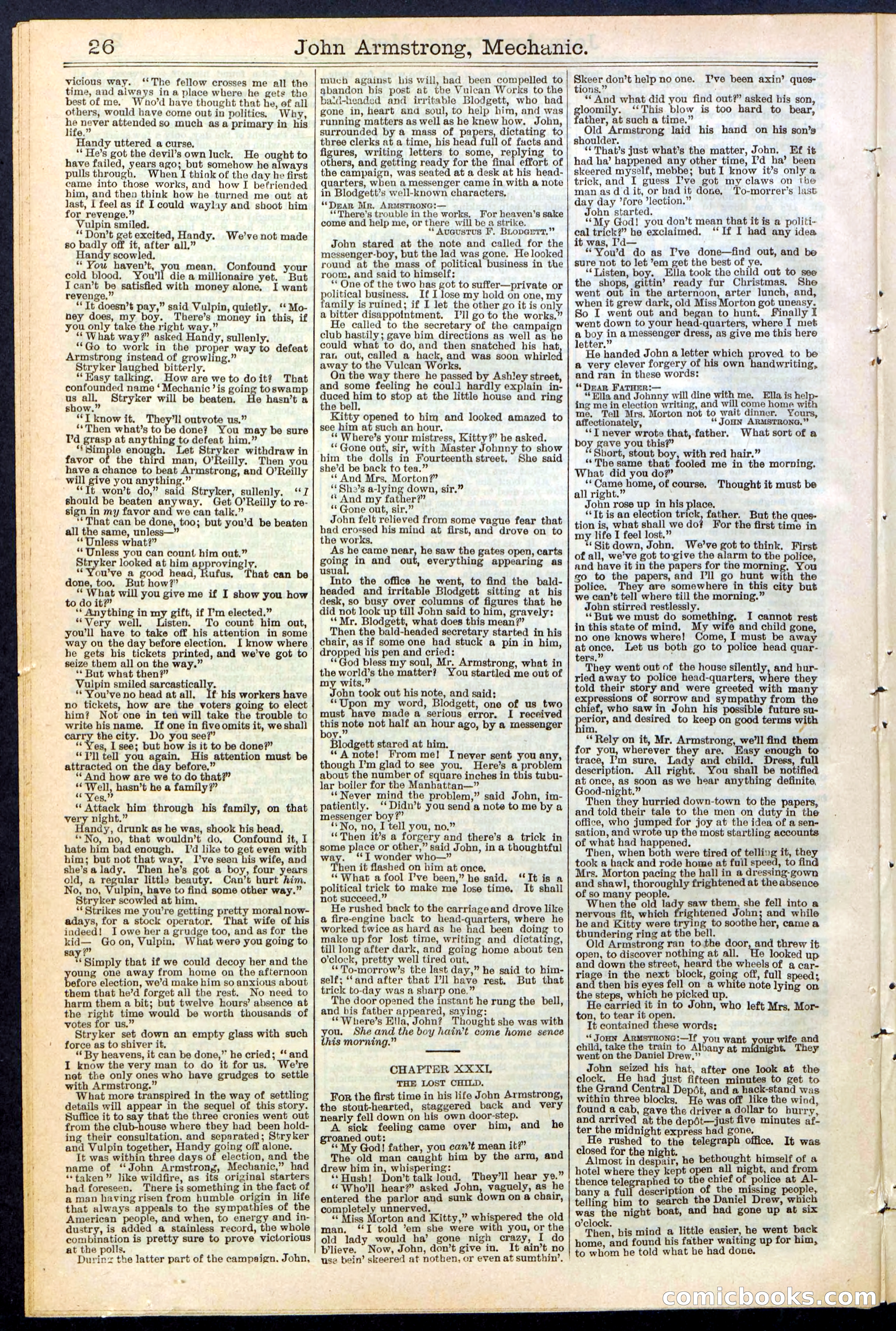
A restored page from Pulp Fiction, 1886. Page through the whole issue in the reader above.
📄 Transcribed text from this page (OCR, searchable)
Machine-transcribed from the original scan — historical spelling and the odd misread are preserved.
a eS SES -_ 20 vicious way. ‘The fellow crosses me all the time, and always ina place where he gets the best of me. Who'd have thought that he, of all others, would have come out in polities, Why, 2 never attended so much as a primary in his ife,’ Handy uttered a curse, ‘* He’s got the devil’s own luck. He ought to have failed, years ago; but somehow hea ways pulls through. When I thiok of the day he first came into those works, and how I befriended him, and then think how he turned me out at last, | feel as if I could waylay and shoot him for revenge.” Vulpin smiled. ** Don’t get excited, Handy. We've not made 80 badly off it, after all.” Handy scowled, * You haven’t, her mean. Confound your cold blood. You'll die a millionaire yet. “But I can’t be satisfied with money alone, I want revenge,” “It doesn’t pay,” said Vulpin, quietly. ‘‘ Mo- ney does, my boy. There’s money in this, if you only take the right way.” “What way?” asked Handy, sullenly. ““Go to work in the proper way to defeat Armstrong instead of growling.” Stryker laughed bitterly. *“‘Kasy talking. How are we to doit? That confounded name ‘ Mechanic’ is going toswamp us all. Stryker will be beaten. He hasn’t a show.” “T know it. They'll outvote us.” ‘Then what’s to be done? You may be sure I'd grasp at anything to defeat him,” ‘‘simple enough. Let Stryker withdraw in favor of the third man, O’Reilly. Then you have a chance to beat Armstrong, and O’Reilly will give you anything.” “It won’t do,” said Stryker, sullenly, ‘J should be beaten anyway. Get O’Reilly to re- sign in my favor and we can talk.” ‘* That can be done, too; but you’d be beaten all the same, unless—” “Unless what?” “Unless you can count him out.” ri a looked at him approvingly. ““You’ve a good head, Rufus, That can be aris ene ce how?” eT at will you give me i show you how to do it?” me " ‘* Anything in my gift, if ’'m elected,” “Very well. isten. To count him out, you'll have to take off his attention in some way ou the day before election. I know where he gets his tickets printed, and we’ve got to seize them all on the way.” ‘** But what then?” Vulpin smiled TP ate **'You’ve no head at all, If his workers have no tickets, how are the voters going to elect him? Not one in ten will take the trouble to write his name. If one in five omits it, we shall oe the city. Do you see?” ** "Yes, I see; but how is it to be done?” “Tl tell you again. His attention must be attracted on the day before,” ‘** And how are we to do that?” “Well, hasn’t he a family?” 4 Yes.” “Attack him through his family, on that ver. night.” andy, drunk as he was, shook his head, ** No, no, that wouldn’t do, Confound it, I hate him bad enough. Id like to get even with him; but not that way. I’ve seen his wife, and she’salady. Then he’s got a boy, four years old, a 2 ined little beauty. Can’t hurt him. No, no, Vulpin, have to find some other way.” Stryker scowled at him, ‘Strikes me you're getting pretty moral now- adays, for a stock operator. That wife of his indeed! I owe her a grudge too, and as for the kid— Goon, Vulpin. What wero you going to say?” f Simply that if we could decoy her and the oung one away from home on the afternoon Satire election, we’d make him so anxious about them that he’d forget all the rest. No need to harm them a bit; but twelve hours’ absence at the right time would be worth thousands of votes for us.” . Stryker set down an empty glass with such force as to shiver it. ‘“‘ By heavens, it can be done,” he cried; ‘‘ and I know the very man to do it for us. We’re net the only ones who have grudges to settle with Armstrong.” What more transpired in the way of settling details will appear in the sequel of this story. Suffice it to say that the three cronies went out from the aie house where they had been hold- ing their consultation, and separated; Stryker and Vulpin together, Handy going off alone. It was within three days of election, and the name of “John Armstrong, Mechanic,” had ‘‘taken” like wildfire, as its original starters had foreseen. There is something in the fact of a man having risen from bumble origin in life that always appeals to the sympathies of the American people, and when, to energy and in- dustry, is added a stainless record, the whole combination is pretty sure to prove victorious at the polls. , Durin the latter part of the campaign. John, ee ee ed name ene John Armstron much against his will, had been compelled to abandon his post at the Vulcan Works to the batd-headed and irritable Blodgett, who had gone in, heart and soul, to help him, and was running matters as well as he knew how. John, surrounded by a mass of papers, dictating to three clerks at a time, his head full of facts and figures, writing letters to some, replying to others, and getting ready for the final effort of the campaign, was seated at a desk at his head- quarters, when a messenger came in with a note in Blodgett’s well-known characters, “Dear Mr, ARMSTRONG:— ‘‘There’s trouble in the works. For heaven’s sake come and help me, or there will be a strike. ** Aucustus I’. BLoparrr,” John stared at the note and called for the essenger-boy, but the lad was gone. He looked round at the mass of political business in the room, and said to himself: ** One of the two has got to suffer—private or political business. If I lose my hold on one, my family is ruined; if I let the other go it is only a bitter disappointment. IT’ll go to the works.” He called to the secretary of the campaign club hastily; gave him directions as well as he could what to do, and then snatched his hat ran out, called a hack, and was soon whirle away to the Vulcan Works, On the way there he passed by Ashley street, and some feeling he could hardly explain in- duced him to stop at the little house and ring the bell. Kitty opened to him and looked amazed to see him at such an hour. ** Where’s your mistress, Kitty?’ he asked. “Gone out, sir, with Master Johnny to show him the dolls in Fourteenth street, She said she’d be back to tea.” ‘* And Mrs, Morton?” ‘*Sho’s a-lying down, sir.” ** And my father?’ ‘Gone out, sir,” John felt relieved from some vague fear that had crossed his mind at first, and drove on to the works, As he came near, he saw the gates open, carts going in and out, everything appearing as usual, Into the office he went, to find the bald- headed and irritable Blodgett sitting at his desk, so busy over columns of figures that he did not look up till John said to him, gravely: ‘Mr. Blodgett, what does this mean?’ Then the bald-headed secretary started in his chair, as if some one had stuck a pin in him, dropped his pen and cried: “God bless my soul, Mr. Armstrong, what in the world’s the matter? You startled me out of my wits.” John took out his note, and said: ‘Upon my word, Blodgett, one of us two must have made a serious error. I received this note not half an hour ago, by a messenger Blodgett stared at him. **A note! Fromme! I never sent you any, though I’m glad to see you. Here’s a problem about the number of square inches in this tubu- lar boiler for the Manhattan—” ‘* Never mind the problem,” said John, im- patiently. ‘‘Didn’t you send a note to me by a messenger boy?’ ‘* No, no, I tell you, no.” ‘‘Then it’s a forgery and there’s a trick in some place or other,” said John, in a thoughtful way. ‘I wonder who—” Then it flashed on him at once. ‘What a fool I’ve been,” he said. ‘It is a political trick to make me lose time, It shall not succeed.” He rushed back to the carriageand drove like a fire-engine back to head-quarters, where he worked twice as hard as he had been doing to make up for lost time, writing and dictating, till long after dark, and going home about ten o'clock, pretty well tired out, “'To-morrow’s tke last day,” he said to him- self; ‘and after that I'll have rest. But that trick to-day was a sharp one.” The door opened the instant he rung the bell, and bis father appeared, saying: ‘“Where’s Ella, John? Thought she was with ou. She and the boy hain’t come home sence is morning.” CHAPTER XXXL THE LOST CHILD. For the first time in his life John Armstrong, the stout-hearted, staggered back and very nearly fell down on his own door-step. A ‘sick feeling came over him, and he groaned out: ‘ ae “My God! father, you can’t mean it? The -, an caught him by the arm, and drew him in, whispering: ‘Hush! Don’t talk loud. They’ll hear ye.” ‘‘ Who'll hear?’ asked John, vaguely, as he enone — perlor Sne sunk down ona chair, mpletely unnerved, st iss Morton and Kitty,” whispered the old man, “I told ’em she were with you, or the old lady would ha’ gone nigh crazy, I do b’lieve. Now, John, don’t give in. It ain’t no use bein’ skeered at nothen, cr even at sumthin’, | —~—_-—me - sees ee Se g, Mechanic. Skeer don’t help no one. I’ve been axin’ quos- tions. ** And what did you find out?” asked his son, gloomily. ‘‘This blow is too hard to bear father, atsuchatime,” | Old Armstrong laid his hand on his son’s shoulder. ‘'That’s just what’s the matter, John. Ef it had ha’ happened any other time, I’d ha’ been skeered myself, mebbe; but I know it’s only a trick, and I guess ve got my claws on the man asd dit, or bad it done, To-morrer’s last day day ’fore ’lection,” John started. ‘‘My God! you don’t mean that it is a politi- cal trick?” he exclaimed. ‘If I had any idea it was, ’d— “You'd do as I’ve done—find out, and be sure not to let ’°em get the best of ye. ‘Listen, boy. Ella took the child out to see the shops, gittin’ ready fur Christmas. She went out in the arternoon, arter lunch, and, when it grew dark, old Miss Morton got uneasy. So I went out and began to hunt. Finally I went down to your head-quarters, where I met a boy in a messenger dress, as give me this here letter.” He handed John a letter which proved to be a very clever forgery of his own handwriting, and ran in these words: “Dear Faturr:— “Ella and Johnny will dine with me. Ella is hel ing me in election writing, and will come home with me. Tell Mrs. Morton not to wait dinner, Yours, affectionately, ‘* JoHN ARMSTRONG.” ‘‘T never wrote that, father. What sort of a boy gave you this?” ‘Short, stout boy, with red hair.” “The same that fooled me in the morning, What did you do?” ‘* Came home, of course, all right.” John rose up in his place. **Tt is an election trick, father. But the ques- tion is, what shall we dof For the first time in my life I feel lost.” “Sit down, John. We've got to think, First of all, we’ve got to- give the alarm to the police, and have it in the papers for the morning, You go to the papers, and I'll go hunt with the police. They are somewhere in this city but we can’t tell where till the morning.” Jobn stirred restlessly. ‘‘But we must do something. I cannot rest in this state of mind, My wife and child gone, no one knows where! Come, I must be away at once. Let us both go to police head quar- ters.” : They went out of the house silently, and bur- ried away to police head-quarters, where they told their story and were greeted with many expressions of sorrow and sympathy from the chief, who saw in John his possible future su- erior, and desired to keep on good terms with / m. “‘Rely on it, Mr. Armstrong, we'll find them for you, wherever they are. Easy enough to trace, I’m sure, Lady and child. Dress, full description. All right. You shall be notified at once, as soon as we hear anything definite, Good-night.” Then they hurried down-town to the papers, and told their tale to the men on duty in the office, who jumped for joy at the idea of a sen- sation, and wrote up the most startling accounts of what had happened. Then, when both were tired of verti g it, they took a hack and rode home at full speed, to fin Mrs. Morton pacing the hall in a dressing-gown and shawl, thoroughly frightened at the absence of so many people. When the old lady saw them, she fell into a nervous fit, which frightened John; and while he and Kitty were trying to soothe her, came a thundering ring at the bell. Old Armstrong ran tothe door, and threw it open, to discover nothing at all. ‘He looked up and down the street, heard the wheels of a car- riage in the next block, going off, full speed; and then bis eyes fell on a white note lying on the steps, which he picked up. He carried it in to John, who left Mrs. Mor- ton, to tear it open. It contained these words: “Joun ArMsrrone:—If yor child, take the train to ‘Albany ta went on the Daniel Drew,” John seized his hat, after one look at the clock, He had just fifteen minutes to get to the Grand Central Dep6t, and a hack-stand was within three blocks, 6 was off like the wind, found a cab, gave the driver a dollar to hurry, and arrived at the depét—just five minutes af- ter the midnight express had gone, He rushed to the telegraph office, It was closed for th ht. . Almost in Salen he bethought himself of a hotel where they kept open all night, and from thence teles aphed to the chief of police at Al- bany a full description of the missing people, telling him to search the Daniel Drew, which was the night boat, and had gone up at six ? 7 Then, his mind a little easier, he went back home, and found his father waiting up for him, to whom he told what be had done. ? Thought it must be our wife and bt, They Comichboo “S (@ PO FT OS Se