
Pulp Fiction, 1886 · page 25 of 32
Beadle's New York Dime Library, No. 378 — page 25: what you’re looking at
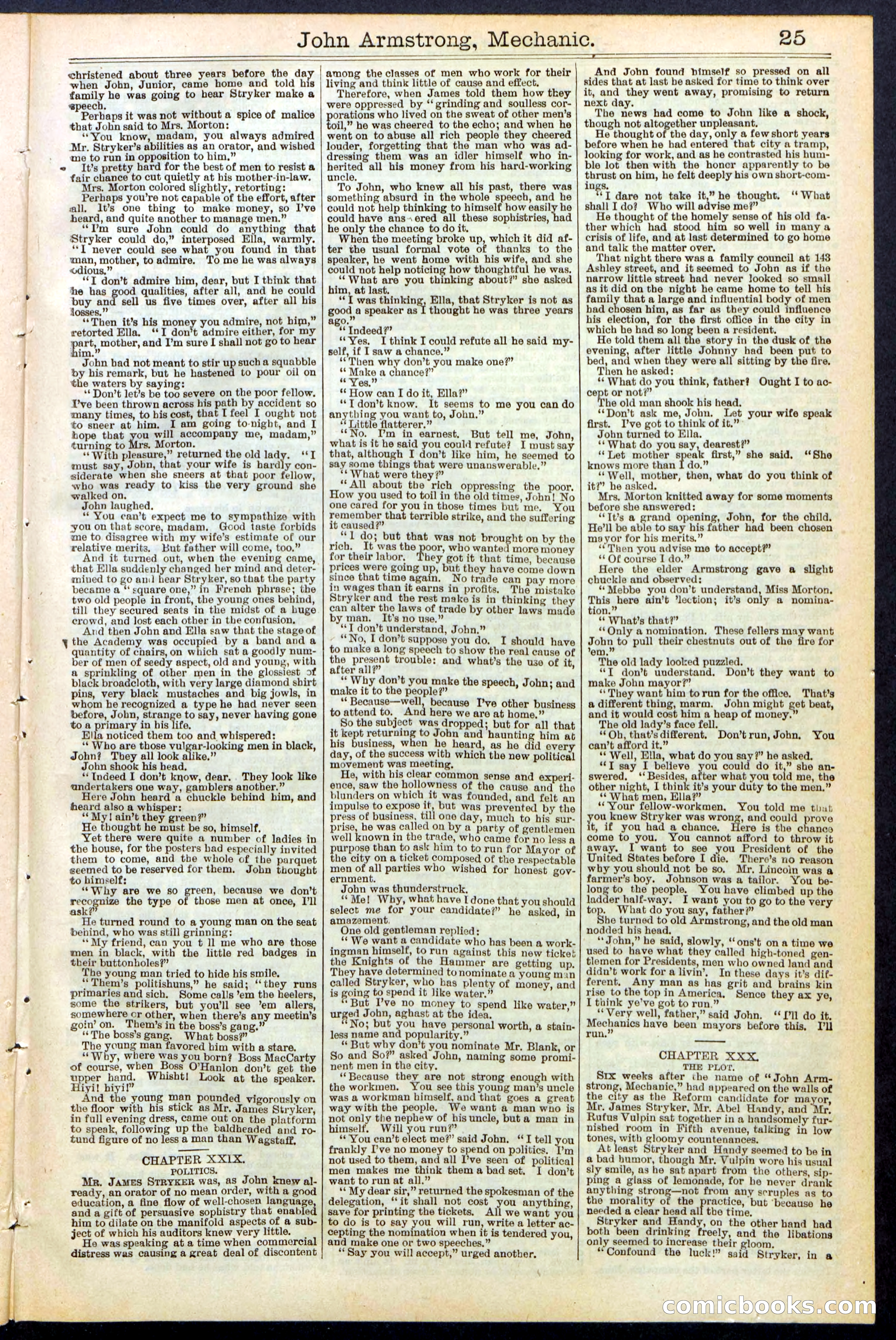
A restored page from Pulp Fiction, 1886. Page through the whole issue in the reader above.
📄 Transcribed text from this page (OCR, searchable)
Machine-transcribed from the original scan — historical spelling and the odd misread are preserved.
John Armstrong, Mec christened about three years before the day when John, Junior, came home and told his family he was going to hear Stryker make a wpeech., ; : Perhaps it was not without a spice of malice that John said to Mrs. Morton: “You know, madam, you always admired Mr. Stryker’s abilities as an orator, and wished ame to run in opposition to him,” It’s pretty hard for the best of men to resist a fair chance to cut quietly at his mother-in-law. Mrs. Morton colored slightly, retorting: Perhaps you’re not capable of the effort, after all, lt’s one thing to make money, so I’ve heard, and quite another to manage men.” ‘““!’m sure John could do anything that Stryker could do,” interposed Ella, warmly. ‘**IT never could see what you found in that man, mother, to admire. To me he was always odious,” ‘*T don’t admire him, dear, but I think that he has ees qualities, after all, and he could buy an sell us five times over, after all his losses “Then it’s his money you admire, not him,” retorted Ella. ‘I don’t admire either, for my art, mother, and I’m sure [ shall not go to hear im. John bad not meant to stir up such a squabble by his remark, but he hastened to pour oil on the waters by saying: ‘‘ Don’t let’s be too severe on the poor fellow. Y’ve been thrown across his path by accident so many times, to his cost, that I feel I ought not to sneer at him. ie am going to-night, and I hope that you will accompany me, madam, edenn to Mrs. Morton. ‘With pleasure,” returned the old lady. ‘TI must say, Jobn, that your wife is hardly con- siderate when she sneers at that poor fellow, who was ready to kiss the very ground she walked on, John laughed, ** You can’t expect me to sympathize with you on that score, madam. Good taste forbids me to disagree with my wife’s estimate of our relative merits. But father will come, too,” And it turned out, when the evening came, that Ella suddenly changed her mind and deter- mined to go ani hear Stryker, so that the party became a “ square one,” in French phrase; the two old people in front, the young ones behind, till they secured seats in the midst of a huge crowd, and lost each other in the confusion, And then John and Ella saw that the stage of y the Academy was occupied by a band and a quantity of chairs,on which sat a goodly num- ber of men of seedy aspect, old and young, with a sprinkling of other men in the glossiest of black broadcloth, with very large diamond shirt pins, very black mustaches and big jowls, in whom he recognized a type he had never seen before, John, strange to say, never having gone to a primary in bis life, Bila noticed them too and whispered: ‘* Who are those vulgar-looking men in black, John? They all look alike,” John shook his head, ** Indeed I don’t know, dear. . They Jook like andertakers one way, gamblers another.” Here John heard a chuckle behind him, and heard also a whisper: ** My! ain’t they green?’ He thought he must be so, himself, Yet there were quite a number of ladies in the house, for the posters had especially invited them to come, and the whole of the parquet seemed to be reserved for them. Jobn thought to himself: ‘“Why are we so green, because we don’t recognize the type of those men at once, I'll ask? He turned round to a young man on the seat behind, who was still grinning: ‘* My friend, can you t 1l me who are those men in black, with the little red badges in their buttonholes?” The young man tried to hide his smile. ‘**Them’s politishuns,” he said; ‘‘they runs primaries and sich. Some calls ’em the heelers, some the strikers, but you'll see ’em allers, somewhere or other, when there’s any meetin’s goin’ on. Them’s in the boss’s gang.” ‘The boss’s gang. What boss?” The young man favored him with a stare. “Why, where was you born? Boss MacCarty of course, when Boss O’Hanlon don’t get the upper hand. Whisht! Look at the speaker. Hiyi! hiyi!” And the young man pounded vigorously on the floor with his stick as Mr, James Stryker, in full evening dress, came out on the platform to speak, following up the baldheaded anda ro- tund figure of no less a man than Wagstaff, CHAPTER XX1X. POLITICS. Mr. James STRYKER was, as John knew al- ready, an orator of no mean order, with a good education, a fine flow of well-chosen language and a gift of persuasive sopbistry that enable him to dilate on the manifold aspects of a sub- ject of which his auditors knew very little. _ He was speaking at a time when commercial distress was causing a great deal of discontent | among the classes of men who work for their living and think little of cause and effect, Therefore, when James told them how they were oppressed by ‘‘ grinding and soulless cor- orations who lived on the sweat of other men’s oil,” he was cheered to the echo; and when he went on to abuse all rich people they cheered louder, forgetting that the man who was ad- dressing them was an idler himself who in- herited all his money from his hard-working uncle, To John, who knew all his past, there was something absurd in the whole speech, and he could not help thinking to himself how easily he could have ans»ered all these sophistries, had he only the chance to do it, When the meeting broke up, which it did af- ter the usual formal vote of thanks to the speaker, he went home with his wife, and she could not help noticing how thoughtful he was. “What are you thinking about?” she asked him, at last. “T was thinkin Ella, that Stryker is not as good a speaker as | thought he was three years ) ‘* Indeed?” ‘Yes. I think I could refute all he said my- self, if I saw a chance.” ‘“Then why don’t you make one?” ** Make a chance?” ere.” ** How can I do it, Ella?” “T don’t know. It seems to me you can do anything you want to, John,” ‘* Little flatterer,” ! ‘*No. I’m in earnest, But tell me, John, what is it he said you could refute? I must say that, although I don’t like him, he seemed to say some things that were unanswerable,” ‘** What were they?” ‘‘All about the rich oppressing the poor. How you used to toil in the old times, John! No one cared for youin those times but me. You remember that terrible strike, and the suffering it caused?” “1 do; but that was not brought on by the rich. It was the poor, who wanted more money for their labor, They got it that time, because prices were going up, but they have come down since that time again. No trade can pay more in wages than it earns in profits. The mistake Stryker and the rest make is in thinking they can alter the laws of trade by other laws made by man. It’s no use.” ‘*T don’t understand, John.” ** No, I don’t suppose you do, I should have to make a long speech to show the real cause of the present trouble: and what's the use of it arte ‘i ‘** Why don’t you make the speech : make it to the people?” r 0 SOS a ‘“‘ Because—well, because I’ve other business to attend to. And here we are at home.” So the subject was dropped; but for all that it kept returning to John and haunting him at his business, when he heard, as he did every day, of the success with which the new political movement was meeting, He, with his clear common sense and experi- ence, saw the hollowness of the cause and tho blunders on which it was founded, and felt an impulse to expose it, but was prevented by the press of business, till one day, much to his sur- prise, he was called on by a party of gentlemen well known in the trade, who came for no less a purpose than to asi him to to run for Mayor of the city on a ticket composed of the respectable men of all parties who wished for honest gov- ernment. John was thunderstruck, ‘* Me! Why, what have I done that you should select me for your candidate?” he’ asked, in amazement, One old gentleman replied: ‘¢ We want a candidate who has been a work- ingman himself, torun against this new ticket the Knights of the Hammer are getting up. They have determined tonominate a young man called Stryker, who has plenty of money, and is going to spend it like water,” “But I’ve no money to spend like water,” urged John, aghast at the idea. No; but yon have personal worth, a stain- less name an popularity.” “But why don’t you nominate Mr. Blank, or So and So?” asked John, naming some promi- nent men in the city, ‘*Because they are not strong enough with the workmen. You see this young man’s uncle was a workman himself, and that goes a great way with the people. We want a man wno is not only the nephew of his uncle, but a man in bimself. Will you run?’ ‘*’'You can’t elect me?” said John. “TI tell you frankly [’'ve no money to spend on politics. I’m not used to them, and all I’ve seen of political men makes me think them a bad set. I don’t want to run at all,” ‘* My dear sir,” returned the spokesman of the delegation, “it shall not cost you anything, save for printing the tickets. All we want you to do is to say you will run, write a letter ac- cepting the nomination when it is tendered you, and make one or two speeches,” ‘*Say you will accept,” urged another. \ hanic. 25 ——$—— ee —- eee And John found himself so pressed on all sides that at last be asked for time to think over it, and they went away, promising to return next day. The news had come to John like a shock, though not altogether unpleasant, He thought of the day, only a fewshort years before when he had entered that city a tramp, looking for work, and as he contrasted his hum- ble lot then with the honer apparently to be thrust on him, he felt deeply his own short-com- ings. ‘I dare not take it,” he thought, ‘ What shall Ido? Who will advise me?” He thought of the homely sense of his old fa- ther which had stood him so well in many a crisis of life, and at last determined to go home and talk the matter over, That night there was a family council at 143 Ashley street, and it seemed to John as if the narrow little street had never looked so small as it did on the night he came home to tell his pe that a large and influential body of men bad chosen him, as far as they could influence his election, for the first office in the city in which he had so long been a resident. He told them all the story in the dusk of the evening, after little Johnny had been put to bed, and when they were all sitting by the fire. Then he asked: ** What do you think, father? Ought I to ac- cept or not?” ‘he old man shook his head. ‘Don’t ask me, John. Let your wife speak first. I’ve got to think of it.” John turned to Ella. ‘What do you say, dearest?” ‘‘Let mother speak first,” she said, ‘‘She knows more than I do,” ‘‘ Well, mother, then, what do you think of it?” he asked. Mrs. Morton knitted away for some moments before she answered: ‘It’s a grand opening, John, for the child, He’ll be able to say his father had been chosen mayor for his merits.” ‘*Then you advise me to accept?” ** Of course I do.” Here the elder Armstrong gave a slight chuckle and observed: *‘Mebbe you don’t understand, Miss Morton, This here ain’t ‘lection; it’s only a nomina- tion. ** What’s that?” **Only a nomination. These fellers may want John to pull their chestnuts out of the fire for em, The old lady loolzed puzzled. *T don’t understand. Don’t they want to make John mayor?” **They want him torun for the office. That's a different thing, marm. John might get beat, and it would cost him a heap of money.” The old lady’s face fell. “Oh, that’sdiferent. Don’trun, John, You can’t afford it.” ‘Well, Ella, what do you say?” he asked, “*T say I believe you could do it,” she an- swered, ‘ Besides, after what you told me, the other night, I think it’s your duty to the men,” ‘What men, Ella?’ ‘Your fellow-workmen, You told me that yon knew Stryker was wrong, and could prove t, if you had a chance, Here is the chanco come to you. You cannot afford to throw it away. I want to see you President of the United States before I die. There’s no reason why you should not be so. Mr, Lincoln was a farmer’s boy. Jobnson was a tailor. You be- long to the people. You have climbed up the ladder half-way. I want you to go to the very eB. What do you say, father?” he turned to old Armstrong, and the old man ene his goer “John,” he said, slowly, ‘ons't on a time we used to have what they called high-toned gen- tlemen for Presidents, men who owned Jand and didn’t work for a livin’, In these days it’s dit- ferent, Any man as has grit and brains kin rise to the top in America, Sence they ax ye I think ye’ve got to run.” ? ‘Very well, father,” said John, ‘Ll do it, Mechanics have been mayors before this, Ill run. | CHAPTER XxX, THE PLOT. Srx weeks after the name of “John Arm- strong, Mechanic,” had appeared on the walls of the city as the Reform candidate for ma or, Mr. James Stryker, Mr. Abel Handy, and ; Rufus Vulpin sat together in a handsomely fur- nished room in Fifth avenue, talking in low tones, with gloomy countenances. At least Stryker and Handy seemed to be in a bad humor, though Mr, Vulpin wore his usual sly smile, as he sat apart from the others, sip- ping a glass of lemonade, for he never drank anything strong—not from any scruples as to the morality of the foe but ‘because he needed a clear head all the time, Stryker and Handy, on the other hand had both been drinking freely, and the libations only seemed to increase their gloom. *Confound the luck!” said Stryker, in a. EOMIGDOOKS.G