
Pulp Fiction, 1886 · page 27 of 32
Beadle's New York Dime Library, No. 378 — page 27: what you’re looking at
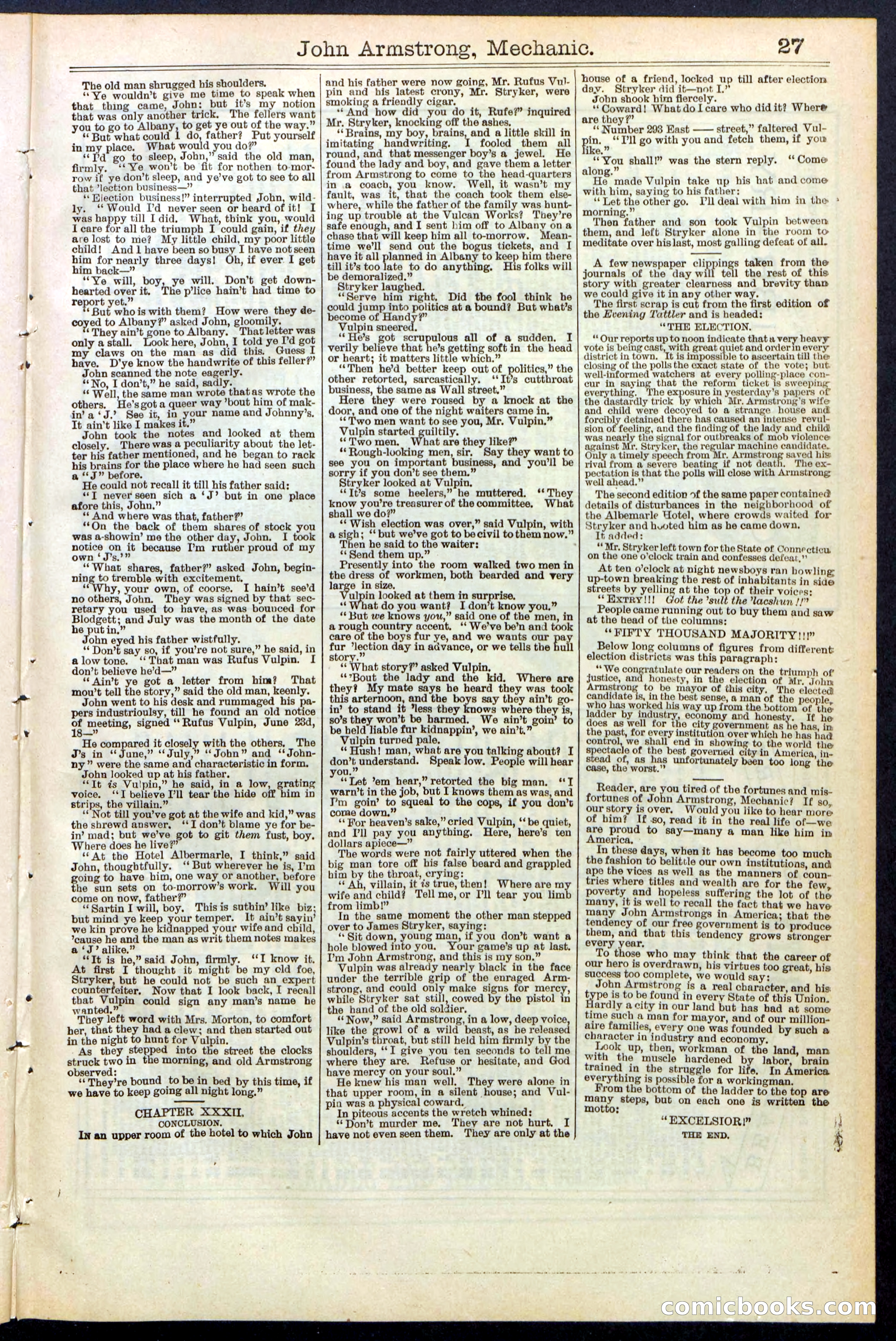
A restored page from Pulp Fiction, 1886. Page through the whole issue in the reader above.
📄 Transcribed text from this page (OCR, searchable)
Machine-transcribed from the original scan — historical spelling and the odd misread are preserved.
= eee -— 5 John Armstrong, Mechanic. The old man shrugged bis shoulders. ““Ye wouldn’t give me time to speak when that thing came, John: but it’s my notion that was only another trick. The fellers want you to go to Albany, to get ye out of the way.” ‘¢ But what could i do, father? Put yourself in my place. What would you do?” “Td go to sleep, John,” said the old man, firmly. ‘‘ Ye won’t be fit for nothen to-mor- row if ye don’t sleep, and ye’ve got to see to all that ’lection business—” ‘*Wiection business!” interrupted John, wild- ly. ‘Would Id never seen or heard of it! I was happy till Idid. What, think you, would I care for all the triumph I could gain, if they are lost to me? My little child, my poor little child! And 1 have been so busy I have not seen him for nearly three days! Oh, if ever. I get him back—” ‘“Ye will, boy, ye will. Don’t get down- hearted over it. The p’lice hain’t had time to report yet.” ‘But whois with them? How were they de- coyed to Albany?” asked John, gloomily. ‘They ain’t gone to Albany. That letter was only a stall. Lookhere, John, I told ye I'd got my claws on the man as did this. Guess i have. D'ye know the handwrite of this feller? John scanned the note eagerly. ‘‘No, I don’t,” he said, sadly. ‘“ Well, the same man wrote thatas wrote the others. He’sgot a queer way ’bout him of mak- in’a‘J.’ See it, et ke name and Johnny’s, It ain't like I makes it.” John took the notes and looked at them closely. There was a peculiarity about the let- ter his father mentioned, and he began to rack his brains for the place where he had seen such a ‘* J” before. He could not recall it till his father said; “‘T never seen sich a ‘J’ but in one place afore this, John,” ** And where was that, father?’ "On the back of them shares of stock you was a-showin’ me the other day, John. I took notice on it because I’m ruther proud of my own ‘J’s,’” ‘“What shares, father?” asked John, begin- ning to tremble with excitement. ‘Why, your own, of coorse. I hain’t see’d no others, John. They was signed by that sec- retary you used to have, as was bounced for Blodgett; and July was the month of the date he putin,” John eyed his father wistfully. a ‘‘ Don’t say so, if you’re not sure,” he said, in alow tone. ‘‘Tbat man was Rufus Vulpin, I don’t believe he’d—” ; ‘‘ Ain’t ye got a letter from him? That mou’t tell the story,” said the old man, keenly. John went to his desk and rammaged his pa- pers industrioulsy, till he found an old notice “a meeting, signed “Rufus Vulpin, June 23d, 1a He compared it closely with the others, The J’s in “June,” “July,” John” and ‘ John- ny” were the same and characteristic in form. John looked up at his father. ‘‘It is Vu'pin,” he said, in a low, voice. ‘‘I believe ’ll tear the hide off strips, the villain.” ‘* Not till you’ve got at the wife and kid,” was the shrewd answer, ‘‘I don’t blame ye for be- in’ mad; but we’ve got to git them fust, boy. Where does he live?” ‘‘At the Hotel Albermarle, I think,” said John, thougbtfully. ‘‘ But wherever he is, ’m going to have him, one way or another, before the sun sets on to-morrow’s work. Will you come on now, father?” ’ : ‘“Sartin I will, boy, This is suthin’ like biz; but mind ye ag ey? temper. It ain’t sayin’ we kin prove he kidnapped your wife and child, *cause he and the man as writ them notes makes a ‘J’ alike.” “Tt is he,” said John, firmly. ‘‘I know it. At first I thought it might be my cld foe, Stryker, but he could not be such an expert counterfeiter, Now that I look back, I reeall that Vulpin could sign any man’s name he wanted,” They left word with Mrs. Morton, to comfort her, that they had a clew; and then started out in the night to hunt for Vulpin. As they stepped into the street the clocks struck two in the morning, and old Armstrong observed: ; ‘They're bound to bein bed by this time, if we have to keep going all night long.” CHAPTER XXXII, CONCLUSION, In an upper room of the hotel to which John grating im in and his father were now going, Mr. Rufus Vul- pin and his latest crony, Mr. Stryker, were smoking a friendly cigar. ‘“*And how did you do it, Rufe?’ inquired Mr, Stryker, knocking off the ashes, ‘‘ Brains, my boy, brains, and a little skill in imitating handwriting. I fooled them all round, and that messenger boy’s a jewel. He found the lady and boy, and gave them a letter from Armstrong to come to the head-quarters in a coach, you know. Well, it wasn’t my fault, was it, that the coach took them else- where, while the father of the family was hunt- ing up trouble at the Vulcan Works? They’re safe enough, and I sent him off to Albany ona chaso that will keep him all to-morrow. ean- time we’ll send out the bogus tickets, and I have it all planned in Albany to keep him there till it’s too late to do anything. His folks will be demoralized.” Stryker laughed. “Serve him right, Did the fool think he could jump into politics at a bound? But what’s become of Handy?” Vulpin sneered, ‘*He’s got scrupulous all of a sudden, I verily believe that he’s getting soft in the head or heart; it matters little which.” “Then he’d better keep out of politics,” the other retorted, sarcastically. ‘‘It’s cutthroat business, the same as Wall street,” Here they were roused by a knock at the door, and one of the night waiters came in. ‘*T wo men want to see you, Mr. Vulpin,” Vulpin started guiltily. ‘Two men, hat are they like?” ‘‘Rough-looking men, sir, Say they want to see you on important business, and you'll be sorry if you don’t see them.” Stryker looked at Vulpin, ‘‘Tt’s some heelers,” he muttered. ‘* They know you’re treasurer of the committee, What shall we do?” ‘* Wish election was over,” said Vulpin, with a sigh; *‘ but we’ve got to becivil tothem now.” Then he said to the waiter: ‘¢ Send them up.” Presently into the room walked two men in the dress of workmen, both bearded and very large in size, ane looked at them in surprise, ‘*What do you want? I don’t know you,” ** But we knows you,” said one of the men, in a rough country accent. ‘‘ We've be’n and took care of the boys fur ye, and we wants our pa fur ‘lection day in advance, or we tells the hu story.” ‘What story?” asked Vulpin, “‘*Bout the lady and the kid. Where are they? My mate says he heard they was took this arternoon, and the bere say they ain’t go- in’ to stand it "less they knows where they is, so’s they won’t be harmed. We ain’t goin’ to be held liable fur kidnappin’, we ain’t.” Vulpin turved pale, ‘Hush! man, what are oi balBing about? I don’t understand. Speak low. People will hear ou. - ‘‘Let ’em hear,” retorted the big man. ‘T warn’t in the job, but I knows them as was, and I’m goin’ to squeal to the cops, if you don’t come down.” ‘or heaven’s sake,” cried Vulpin, ‘‘ be quiet, and Pll pay you anything. Here, here’s ten dollars apiece—” : The words were not fairly uttered when the big man tore off his false beard and grappled him by the throat, crying: ‘¢ Ah, villain, it ts true, then! Where are os wife and child# Tell me, or I'll tear you lim from limb!” In the same moment the other man stepped over to James Stryker, saying: ‘* Sit down, young man, if you don’t want a hole blowed into you. Your game’s up at last. I’m John Armstrong, and this is my son.” Vulpin was already nearly black in the face under the terrible grip of the enraged Arm- strong, and could only make signs for ar while Stryker sat still, cowed by the pistol in the hand of the old soldier, ‘‘ Now,” said Armstrong, in a low, deep voice like the growl of a wild beast, as he release Vulpin’s throat, but still held him firmly by the shoulders, ‘‘I give you ten seconds to tell me where they are. Refuse or hesitate, and have mercy on your soul,” He knew his man well. They were alone in that upper room, in a silent house; and Vul- pin was a physical coward. In piteous accents the wretch whined: “Don’t murder me, They are not burt. I have not even seen them, They are only at the a7 EE - = > house of a friend, locked up till after election day. Stryker did it—not LL” Jobn shook him fiercely. iz ‘Coward! What dolcare who didit? Where are they?” ‘* Number 293 East street,” faltered Vul- in. “Dll go with you and fetch them, if you ike,” ‘“You shall!” was the stern reply. along.” He made Vulpin take up his hat and come with him, saying to his father: ' ‘‘ Let the other go. Dll deal with him in the morning.” Then father and son took Vulpin between them, and left Stryker alone in the room to meditate over hislast, most galling defeat of all. * Come A few newspaper clippings taken from the journals of the day will tell the rest of this story with greater clearness and brevity than we could give it in any other way. The first scrap is cut from the first edition of the Evening Tattler and is headed: “THE ELECTION, **Our reports up to noon indicate that a very heavy vote is being cast, with great quiet and order in every district in town, It is impossible to ascertain till the closing of the polls the exact state of the vote; but well-informed watchers at every polling-place con- cur in saying that the reform ticket is sweeping everything. The exposure in yesterday's papers of the dastardly trick by which Mr. Armstrong's wife and child were decoyed to a strange house and forcibly detained there has caused an intense revul- sion of feeling, and the finding of the lady and child was nearly the signal for outbreaks of mob violence against Mr. Stryker, the regular machine candidate, Only a timely speech from Mr. Armstrong saved his rival from a severe beating if not death. The ex- pectation is that the polls will close with Armstrong: well ahead,”’ The second edition of the same paper contained details of disturbances in the neighborhood of the Albemarle Hotel, where crowds waited for Stryker and huoted him as he came down, It added: * Mr. Stryker left town for the State of Connecticu, on the one o’clock train and confesses defeat,” At ten o'clock at night newsboys ran howling; up-town breaking the rest of inhabitants in side streets by yelling at the top of their voices: - a pc Got the ’sult the "lacshun !!” eople came running out to buy them anc at the head of the columns: ‘ hese “FIFTY THOUSAND MAJORITY!!!” Below long columns of figures from differe election districts was this paragranh seer’ “We congratulate our readers on the triump) justice, and honesty, in the election of Mr. sated Armstrong to be mayor of this city, The elected candidate is, in the best sense, a man of the people who has worked his way up from the bottom of the ladder by industry, economy and honesty. If he does as well for the city government as te has, in the past, for every institution over which he has had control, we shall end in showing to the world the spectacle of the best governed city in America, in- 8 of, as has unfort case, the worst.” Segmeteyy. ew 00 bag: Ae Reader, are you tired of the fortunes and mis- fortunes of John Armstrong, Mechanic? If a our story is over, Would you like to hear more of bim? If.so, read it in the real life of—we are proud to say—many a man like him in sn thieek Miva: Weare n these days, when it has become the fashion to belittle our own foativctione ae ape the vices as well as the manners of coun- tries where titles and wealth are for the few poverty and hopeless suffering the lot of the many, it is well to recall the fact that we have many John Armstrongs in America; that the ie “Sad vam al pera is to produce , an a is ten every year, ency grows stronger 0 those who may think that the car our hero is overdrawn, his virtues too great, This success too complete, we would say: John Armstrong is a real character, and bis: type is to be found in every State of this Union. lardly a city in our land but has had at some time such a man for mayor, and of our million- aire families, every one was founded by such a character in industry and econom Look up, then, workman of the land, man with the muscle hardened by labor, brain trained in the struggle for life, In America everything is possible for a workingman. From the bottom of the ladder to the top are many steps, but i = y ps, on each one is written the “EXCELSIOR!” iJ THE END, - JOO (E(0) S) (E(@)