
Pulp Fiction, 1886 · page 22 of 32
Beadle's New York Dime Library, No. 378 — page 22: what you’re looking at
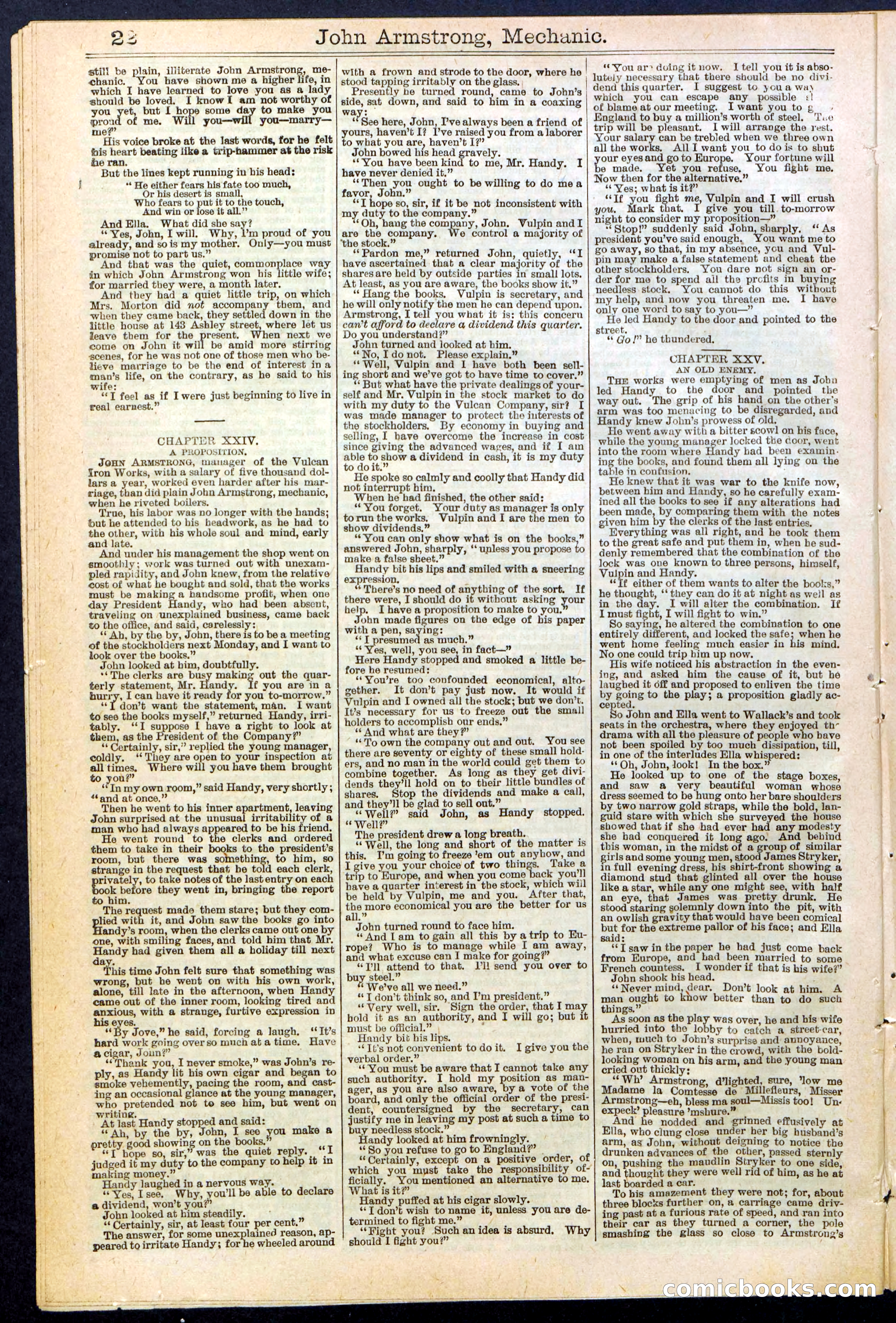
A restored page from Pulp Fiction, 1886. Page through the whole issue in the reader above.
📄 Transcribed text from this page (OCR, searchable)
Machine-transcribed from the original scan — historical spelling and the odd misread are preserved.
eee ES = es —— - = a - —— om = ——s —— EO, — —— - pretty good showin jud ma peared to irritate Handy; for still be plain, illiterate John Armstrong, me- ehanic. You have shown me a higher life, in which I have learned to love you as a lady should be loved. I knowI am not worthy of you yet, but [ hope some ar to make you prow of me. Will you—will you—marry— me? His voice broke at the last words, for he felt i heart beating like a trip-hammer at the risk 6 Tran, But the lines kept running in his head: ** He either fears his fate too much, Or his desert is small, Who fears to put it to the touch, And win or lose it all.” And Ella. What did she say? “Yes, John, I will. Why, l’m proud of you already, and sois my mother. Only—you must promise not to part us.” And that was the quiet, commonplace way in which John Armstrong won his little wife; for married they were, a month later. And they had a quiet little trip, on which Mrs. Morton did not pine Ne them, and when they came back, they settled down in the little house at 143 Ashley street, where let us eave them for the present. When next we come on John it will be amid more stirring ‘scenes, for he was not one of those men who be- lieve marriage to be the end of interest ina man’s life, on the contrary, as he said to his wife: “T feel as if I were just beginning to live in real earnest.” CHAPTER XXIV, A PROPOSITION, JOHN ARMSTRONG, manager of the Vulcan Yron Works, with a salary of five thousand dol- lars a year, worked even harder after his mar- riage, than did plain John Armstrong, mechanic, when he riveted boilers. True, his labor was no longer with the hands; but he attended to his headwork, as he had to the other, with his whole soul and mind, early and late. And under his management the shop went on smoothly; work was turned out with unexam- pled rapidity, and John knew, from the relative cost of what he bought and sold, that the works must be making a bandsome profit, when one day President Handy, who had been absent, traveling on unexplained business, came back to the office, and said, carelessly: ‘* Ah, by the by, John, there is to be a meeting of the stockholders next Monday, and I want to look over the books.” John looked at bim, doubtfully. ‘‘ The clerks are busy making out the quar- terly statement, Mr. Handy. If you are ina burry, I can bave it ready for you to-morrew.” ‘“‘] don’t want the statement, man. I want to seo the books myself,” returned Handy, irri- tably. ‘I suppose I have a right to look at them, as the President of the Company?” 4g Certainly, sir,” replied the young manager, coldly. ‘‘ They are open to your inspection at all times. Where will you have them brought to you?” ‘“In my own room,” said Handy, very shortly ; “Cand at once,” Then he went to his inner apartment, leaving John surprised at the unusual irritability of a man who had always appeared to be his friend. He went round to the clerks and ordered them to take in their ks to the president’s room, but there was something, to him, so strange in the request that be told each clerk, rivately, to take notes of the lastentry on each k before they went in, bringing the report to him. The request mado them stare; but they com- lied with it, and John saw the books go into dy’s room, when the clerks came out one by one, with smiling faces, and told him that Mr. Handy had given them all a holiday till next day. This time John felt sure that something was wrong, but he went on with his own work, alone, till late in the afternoon, when Handy came out of the inner room, looking tired and anxious, with a strange, furtive expression in his bing ‘By Jove,” he said, forcing a laugh, ‘‘It’s hard work going overso much atatime, Have a cigar, Joun?” | “Thank you, I never smoke,” was John’s re- ply, as Handy lit his own cigar and began to smoke vehemently, pacing the room, and cast- ing an occasional glance at the young manager, who pretended not to see him, but went on writing. 4 At aes Hig * eng said: ee * Ah, the ohn, 1 see you £ f eo on the eka “T° hope so, sir,” was the quiet reply. “ I ed it my duty to the company to help it in Ie Pichia nervous way n aughed in a nervous way. wvos I oan Why, you'll be able to declare a dividend, won’t you?” John looked at him steadily. “ Certainly, sir, at least four per cent.” The answer, for some unexplained reason, ap- e wheeled around with a frown and strode to the door, where he | stood tapping irritably on the glass. Presently be turned round, came to John’s side, sat down, and said to him in a coaxing way: O S26 here, John, ve always been a friend of yours, haven’t I? lve raised you from a laborer to what you are, haven’t 1?” John bowed his head gravely. **' You have been Pe to me, Mr. Handy. I have never denied it,” ‘Then you ought to be willing to do mea favor, John.” **T hope so, sir, if it be not inconsistent with my duty to the company.” *“Oh, hang the company, John. VWulpin andI are the company. e control a majority of ‘the stock.” **Pardon me,” returned John, quietly, ‘I have ascertained that a clear majority of the shares are held by outside parties in small lots. At least, as you are aware, the books show it.” ‘“‘ Hang the books, Vulpin is secretary, and he will only notify the men he can depend upon. Armstrong, I tell you what it is: this concern can't afford to declare a dividend this quarter. Do you understand?” John turned and looked at him. “No, Ido not. Please explain,” ‘Well, Vulpin and I have both been sell- ing short and we’ve got to have time to cover.” ‘* But what have the private dealings of your- self and Mr. Vulpin in the stock market to do with my duty to the Vulcan Company, sir? [ was made manager to protect the interests of the stockholders. By economy in buying and selling, I have overcome the increase in cost since giving the advanced wages, and if [ am able to show a dividend in cash, it is my duty to do it.” He spoke so calmly and coolly that Handy did not interrupt him. When he had finished, the other said: ‘You forget. Your duty as manager is only torun the works, Vulpin and I are the men to show dividends.” “You can only show what is on the books,” answered John, sharply, ‘‘ unless you propose to make a false sheet.” Handy bit his lips and smiled with a sneering expression, ; ** There’s no need of anything of the sort. If there were, I should do it without asking your help. I have a proposition to make to you. ohn made figures on the edge of bis paper with a pen, saying: ‘‘T presumed as much.” ‘* Yes, well, you see, in fact—” Here Handy stopped and smoked a little be- fore he resumed: **You’re too confounded economical, alto- gether. It don’t pay just now. It would if Vulpin and I owned all the stuck; but we don’t. It’s necessary for us to freeze out the small holders to accomplish our ends.” ‘¢ And what are they?” ‘To own the company out and out. ‘You see there are seventy or eighty of these small hold- ers, and no man in the world could get them to combine together. As long as they get divi- dends they’ll hold on to their little bundles of shares. Stop the dividends and make a call, and they’ll be glad to sell out.” “Weil?” said John, as Handy stopped. Well?” The president drew a long breath. ‘‘ Well, the long and short of the matter is this. I’m going to freeze em out anyhow, and I give you your choice of two things. Take a trip to Europe, and when you come back you'll have a quarter interest in the stock, which will be held by Vulpin, me and you. After that, the more economical you are the better for us all.” John turned round to face him. “ And Lam to gain all this by a trip to Eu- rope? Who is to manage while I am away, and what excuse can I make for going?” “TI1 attend to that. Ill send you over to buy steel.” ‘We've all we need.” “T don’t think so, and I’m president.” ‘Very well, sir. Sign the order, that I may bold it as an authority, and I will go; but it must be official.” , < Handy bii his lips. ‘‘Tt’s not convenient to do it. verbal order.” ‘‘You must be aware that I cannot take any such authority. I hold my position as man- ager, as you are also aware, by a vote of the board, and only the official order of the presi- dent, countersigned by the secretary, can quatl fy me in leaving my post at such a time to uy needless stock.” Handy looked at him frowningly. ‘So you refuse to go to England?” _ “Certainly, except on a positive order, of which you myst take the responsibility of- ficially. You mentioned an alternative to me. I give you the What is it?’ Handy puffed at his cigar slowly. ‘‘T don’t wish to name it, unless you are de- termined to fight me.” / ‘‘Right you? Such an idea is absurd, Why ' should I fight you?” John Armstrong, Mechanic. ‘You ar? duing it now. I tell you it is abso- lutely necessary that there should be no divi- dend this quarter. I suggest to youa way which you can escape any possible :! of blame at our meeting. I want you to England to buy a million’s worth of steel. trip will be pleasant. Tue I will arrange the rest. Your salary can be trebled when we three own all the wor All I want you to dois to shut our eyesand goto Europe. Your fortune will e made. Yet you refuse, You fight me, Now then for the alternative.” ‘Yes; what is it?” “Tf you fight me, Vulpin and I will crush you. Mark that. I give you till. to-morrow night to consider my proposition—” “Stop!” suddenly said Jobn, sharply. ‘ As president you’ve said enough, You want me to go away, so that, in my absence, you and Vul- pin may make a false statement and cheat the other stockholders. You dare not sign an or- der for me to spend ail the profits in buying needless stock, You cannot do this without my help, and now you threaten me. I have only one word to say to you—” He led Handy to the door and pointed to the reet. “ Go!” he thundered, CHAPTER XXYV. AN OLD ENEMY. Tum works were emptying of men as Jobn led Handy to the door and pointed the way out. The grip of his hand on the other's arm was too menacing to be disregarded, and Handy knew John’s prowess of old, He went away with a bitter scowl on his face, while the young manager locked the coor, went into the room where Handy had been examin. ing the books, and found them all lying on the table in confusion. He knew that it was war to the knife now, between him and Handy, so he carefully exam- ined all the books to see if any alterations had been made, by comparing them with the notes given him by the clerks of the last entries. Everything was all right, and he took them to the great safe and put them in, when he sud- denly remembered that the combination of the lock was one known to three persons, himself, Vulpin and Handy. “Tf either of them wants to alter the books,” he thought, ‘*‘ they can do it at night as we!l as in the day. I will alter the combination. If I must fight, I will fight to win.” So saying, he altered the combination to one entirely different, and locked the safe; when he went home feeling much easier in his mind. No one could trip him up now. _ His wife noticed his abstraction in the even- ing, and asked him the cause of it, but he laughed it off and proposed to enliven the time by going to the play; a proposition gladly ac- cepted. o John and Ella went to Wallack’s and took seats in the orchestra, where they enjoyed th~ drama with all the pleasure of people who have not been spoiled by too much dissipation, till, in one of the interludes Ella whispered: ‘¢Oh, Jobn, look! In the box.” He looked up to one of the stage boxes and saw a very beautiful woman whose dress seemed to be hung onto her bare shoulders by two narrow gold straps, while the bold, lan- guid stare with which she surveyed the house showed that if she had ever had any modesty she had conquered it long ago. And behind this woman, in the midst of a group of similar girls and some young men, James Stryker, in full evening dress, bis sbirt-front showing a diamond stud that glinted all over the house like a star, while any one might see, with half an eye, that James was pretty drunk, He stood staring solemnly down into the pit, with an owlish gravity that would have been comical but for the extreme pallor of his face; and Ella st said: ‘‘T saw in the paper he had just come back from Europe, and had been murried to some French countess. I wonder if that is bis wife?” Jobn shook bis head. ‘‘ Never mind, dear. Don’t look at him. A man ought to khow better than to do such things.” As soon as the play was over, he and his wife hurried into the lobby to catch a street-car, when, wuch to John’s surprise and annoyance, Be hg on Stryker *, the crowd, with the bold- ooking woman on his arm, and the young m Tees a beh zg pen eee rmstrong, d’lighted, sure, ‘low me Madame la Comintee a ‘Millefleurs, Misser Armstrong—eh, bless ma soul—Missis too! Unx expeck’ pleasure ’mshure.” And he nodded and grinned effusively at Ella, who clung close under her big husband’s arm, as John, without deigning to notice the drunken advances of the other, passed sternly on, pushing the maudlin ee to one side, and thought they were well rid of him, as he at last boarded a car. To his amazement they were not; for, about three blocks further on, a carriage came driv- ing past at a furious rate of speed, and ran into their car as they turned a corner, the pole smashing the glass so close to Armstrong’s 7 ae CON a | tm