
Pulp Fiction, 1886 · page 21 of 32
Beadle's New York Dime Library, No. 378 — page 21: what you’re looking at
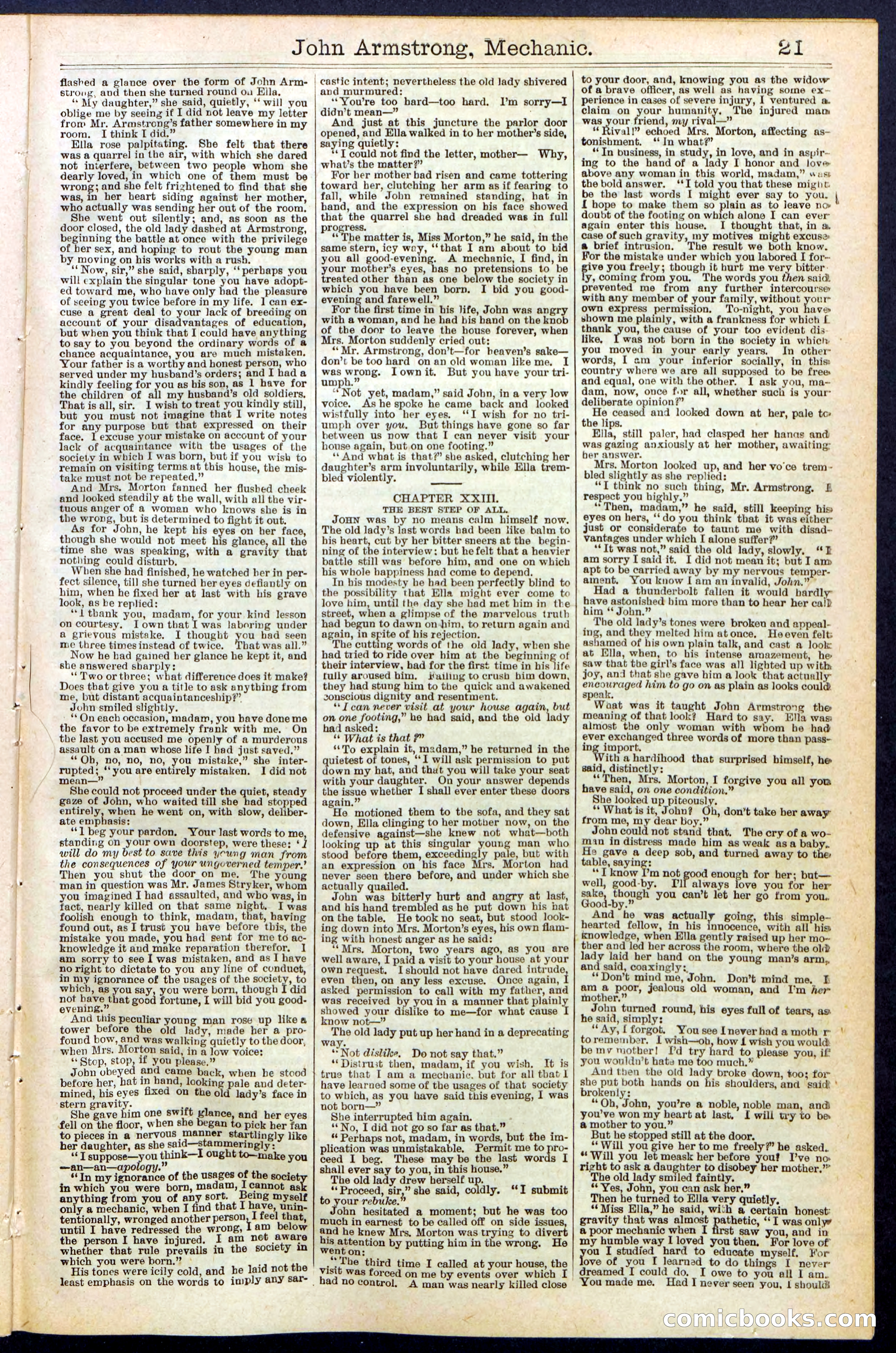
A restored page from Pulp Fiction, 1886. Page through the whole issue in the reader above.
📄 Transcribed text from this page (OCR, searchable)
Machine-transcribed from the original scan — historical spelling and the odd misread are preserved.
. 8 sy - — ee a John Armstrong, flashed a glance over the form of John Arm- | castic intent; nevertheless the old lady shivered stroug, and then she turned round ou Hila, ‘“My daughter,” she said, quietly, ‘‘ will you oblige me by seeing if I did not leave my letter frow Mr. Armstrong’s father somewhere in my room. I think I did,” Ella rose palpitating. She felt that there was a quarrel in the air, with which she dared not inierfere, between two people whom she dearly loved, in which one of them must be wrong; and she felt frizhtened to find that she was, in her heart siding against her mother, who actually was sending her out of the room. She went out silently; and, as soon as the door closed, the old lady dashed at Armstrong, beginning the battle at once with the privilege of her sex, and hoping to rout the young man by moving on his works with a rush. Now, sir,” she said, sharply, ‘‘perhaps you will explain the singular tone you have adopt- ed toward me, who have only had the pleasure of seeing you twice before in my life. 1 can ex- cuse a great deal to your lack of breeding on account of your disadvantages of education, but when you think that I could have anything to say to you beyond the ordinary words of a chance acquaintance, you are much mistaken, Your father is a worthy and honest person, who served under my husband’s orders; and I hada kindly feeling for you as bis son, as 1 have for the children of all my husband’s old soldiers, That is all, sir. I wish to treat you kindly still, but you must not imagine that I write notes for any purpose but that expressed on their face. I excuse your mistake on account of your lack of acquaintance with the usages of the society in which I was born, but if you wish to remain on visiting terms.at this house, the mis- take must not be repeated,” And Mrs. Morton fanned her flushed cheek and looked steadily at the wall, with all the vir- tuous anger of a woman who knows she is in the wrong, but is determined to fight it out. As for Jobn, he kept his eyes on her face, though she would not meet his glance, all the time she was speaking, with a gravity that nothing could disturb, When she had finished, he watched ber in per- fect silence, till she turned her eyes defiantly on him, when he fixed her at last with his grave look, as be replied: ‘““! thank you, madam, for your kind lesson on courtesy. Iown that I was laboring under a grievous mistake, I thought you had seen me three timesinstead of twice. That was all.” Now he had gained her glance he kept it, and she answered sbarply: ‘Two or three; had difference does it make? Does that give you a title to ask anything from me, but distant acquaintanceship?” John smiled slightly. **On each occasion, madam, you have done me the favor to be extremely frank with me. On the Jast you accused me openly of a murderous assault on a man whose life I had just saved.” ‘Oh, no, no, no, you mistake,” she inter- rupted; ‘‘you are entirely mistaken. I did not mean—” She could not proceed under the quiet, steady gaze of John, who waited till she had stopped entirely, when he went on, with slow, deliber- ate emphasis: ‘“‘] beg your pardon, ‘Your last words to me standing on your own doorstep, were these: ‘] will do my best to save this yeung man from the consequences of your ungoverned temper.’ Then you shut the door on me. The young man in question was Mr. James Stryker, whom you imagined I had assaulted, and who was, in fact, nearly killed on that same night, I was foolish enough to think, madam, that, having found out, as I trust you have before this, the mistake you made, you had sent for me to ac- knowledge it and make reparation therefor, I am sorry to see I was mistaken, and as | have no right to dictate to you any line of conduet, in my ignorance of the usages of the society, to which, as you say, you were born, though I did not have that good fortune, I will bid you good- evening.” And this peculiar young man rose up like a tower before the old lady, made her a pro- found bow, and was walking quietly to the door, when Mrs. Morton said, in a low voice: ‘Stop, stop, if you please,” Jobn ubeyed and came back, when he stood before her, hat in band, ogking pale and deter- mined, his eyes fixed on the old lady’s face in stern gravity. : She gave him one swift glance, and her eyes fell on the floor, when she began to pick her fan to pieces in a nervous manner startlingly like her daughter, as she said—stammeringly: ‘‘T suppose—you think—I ought to—make you —an—an—apology. ‘In my caormian of the usages of the raved in which you were born, madam, I cannot as suything from you of any sort. ae myself only a mechanic, when I find that Itech unin- tentionally, wronged another person, J feel that, until I have redressed the wrong, 1am below the person I have injured. I am net vate are whether that = prevails in the society in which you were born.” — : His nes were icily cold, and he laid not the least emphasis on the words to imply any sar-_ a and murmured: ‘“You’re too bard—too hard. didn’t mean—” And just at this juncture the parlor door opened, and Ella walked in to her mother’s side, saying quietly: ‘*T could not find the letter, mother— Why, what’s the matter?” For ber mother bad risen and came tottering toward her, clutching her arm as if fearing to fall, while John remained standing, hat in band, and the expression on his face showed that the quarrel she had dreaded was in full progress. ‘‘ The matter is, Miss Morton,” he said, in the same stern, icy way, ‘‘that I am about to bid you all good-evening. A mechanic, I find, in your mother’s eyes, has no pretensions to be treated other than as one below the society in which you have been born. I bid you good- evening and farewell.” For the first time in his life, John was angry with a woman, and he had bis band on the kno of the door to leave the house forever, when Mrs. Morton suddenly cried out: “Mr, Armstrong, don’t—for heaven’s sake— don’t be too hard on an old woman like me, I was wrong. Lownit. But you have your tri- umph.” “Not yet, madam,” said Jobn, in a very low voice. As he spoke he came back and looked wistfully into her eyes. ‘‘I wish for no tri- umph over you. But things have gone so far between us now that I can never visit your house again, but on one footing.” ‘‘ And what is that?” she asked, clutching her daughter’s arm involuntarily, while Ella trem- bled violently. CHAPTER XXIil. THE BEST STEP OF ALL. JOHN was by no means calm himself now. The old lady’s last words had been like balm to his heart, cut by her bitter sneers at the begin- ning of the interview: but he felt that a heavier battle still was before him, and one on which bis whole happiness had come to depend. In his modesty he had been perfectly blind to the possibility that Ella might ever come to love him, until the day she bad met him in the street, when a glimpse of the marvelous truth had begun to dawn on-him, to return again and again, in spite of his rejection. The cutting words of the old lady, when she had tried to ride over him at the beginning of their interview, had for the first time in his life fully aroused bim, ailing to crush bim down, they had stung him to the quick and awakened conscious dignity and resentment. “Tecan never visit at your house again, but on one footing,” he had said, and the old lady had asked: ‘* What is that ?” ‘*To explain it, madam,” he returned in the quietest of tones, ‘I will ask permission to put down my hat, and thut you will take your seat with your daughter. On your answer depends the issue whether I shall ever enter these doors again.” mer motioned them to the sofa, and they sat down, Ella clinging to her motber now, on the defensive against—she knew not what—both looking up at this singular young man who stood before them, exceedingly pale, but with an expression on his face Mrs. Morton had never seen there before, and under which she actually quailed. John was bitterly hurt and angry at last, and his hand trembled as he put down his hat on the table. He took no seat, but stood look- ing down into Mrs. Morton’s eyes, his own flam- ing with honest anger as he said: ‘*Mrs. Morton, two years ago, as you are well aware, I paid a visit to your house at your own request, Ishould not have dared intrude, even then, on any less excuse. Once again, | asked permission to call with my father, and was received by you in a manner that plainly showed your dislike to me—for what cause I know not—” The old lady put up her hand in a deprecating ay. ** Not dislike, Do not say that.” : ‘Distrust then, madam, if you wish, It is true that | am a mechanic, but for all that 1 have learned some of the usages of that society to which, as you have said this evening, I was not born—” She interrupted him again. ‘‘No, I did not go so far as that.” ‘ Perhaps not, madam, in words, but the im- plication was unmistakable. Permit me to pro- ceed I beg. These may be the last words I shall ever say to you, in this house.” The old lady drew herself up. ‘‘ Proceed, sir,” she said, coldly. “I submit to your rebuke.” ohn hesitated a moment; but he was too much in earnest to be called off on side issues and he knew Mrs. Morton was trying to divert his attention by putting him in the wrong. He went on: tbe third time I called at your house, the Visit was forced on me by events over which I had no control. A man was nearly killed close I’m sorry—I Ww echanic. ————————— me ee me te ee Sl ret to your door, and, knowing you as the widow of a brave officer, as well as having some ex~ perience in cases of severe injury, I ventured a. claim on your pee The injured mam was your friend, my rival—” ** Rival!” echoed Mrs. Morton, affecting as- tonishment. ‘ In what?” ‘In business, in study, in love, and in aspir- ing to the hand of a lady I honor and love above any woman in this world, madam,” wus: the bold answer. ‘I told you that these might be the last words I might ever say to you. { hope to make them so plain as to Jeave now doubt of the footing on which alone I can ever again enter this house. I thought that, in a. case of such gravity, my motives might excuse a brief intrusion. The result we both know. Yor the mistake under which you labored I for- ive you freely; though it hurt me very bitter: y, coming from you. The words you then sai@ prevented me from any further intercourser with any member of your family, without your own express permission. To-night, you have shown me plainly, with a frankness for which £ thank you, the cause of your too evident dis like, Iwas not born in the society in which you moved in your early years. In other’ words, [ am your inferior socially, in this: country where we are all supposed to be free and equal, one with the other. I ask you, ma- dam, now, once for all, whether such is your: deliberate opinion?” Br ceased and looked down at her, pale tc the lips. Ella, still paler, had clasped her hanas and was gazing anxiously at her mother, awaiting: ber answer. Mrs. Morton looked up, and her vo'ce trem- bled slightly as she replied: “I think no such thing, Mr. Armstrong. & respect you highly.” “Then, madam,” he said, still keeping his eyes on hers, ‘‘do you think that it was either just or considerate to taunt me with disad- vantages under which [ alone suffer?” ‘It was not,” said the old lady, slowly. “I am sorry [ said it. I did not mean it; but I am apt to be carried away by my nervous temper- aiment, You know [ am an invalid, John.” ° Had a thunderbolt fallen it would bardly have astonished bim more than to hear her calD him ‘* John.” _ The old lady’s tones were broken and appeal- ing, and they melted him atonce. Heeven felt: ashamed of his own plain talk, and cast a look: at Illa, when, to his intense amazement, he saw that the girl’s face was all lighted up with joy, and thaf she gave him a look that actually nia him to go on as plain as looks could speak, Waat was it taught John Armstrong the meaning of that look? Hard to say. Ella was: almost the only woman with whom he had ever exchanged three words of more than pass~ ing import. With a hardihood that surprised himself, he i oe : en, s. Morton, I forgive you all yom have said, on one condition,” Hae e She looked up piteously. ** What is it, John? Oh, don’t take ber away from me, my dear boy.” John could not stand that. The cry of a wo- man in distress made him as weak asa baby.. He gave a deep sob, and turned away to table, cs dag ‘I know I’m not good enough for her; buat— well, good-by. Tl always love you for her “ag er you can’t let her go trom you. Od- And he was actuall oing, this simple- hearted fellow, in his faba 58 with all his knowledge, when Ella gently raised up her mo- ther and led her across the room, where the ol® lady laid her hand on the young man’s arm, and said, coaxingly: “Don’t mind me, John. Don’t mind me. f am a poor, jealous old woman, and I’m hem mother.” John turned round, his he said, simply: “Ay, { forgot. You see [never had a moth r toremember., I wish—~ob, how f wish you would be mv mother! [d try hard to please you, if you wouldn’t hate me too much,” And then the old lady broke down, too; for she put both hands on his shoulders, and saict brokenly: “Oh, John, you’re a noble, noble man, and you’ve won my heart at last, I will a mother to you.” But he stopped still at the door. ‘Will you give her to me freely?” he asked. “Will you let meask her before you? I’ve no eyes full of tears, as _ try to be right to ask a daughter to disobey her mother,” The old lady smiled faintly. ** Yes, John, you can ask her,” Then he turned to Ella very quietly, ** Miss Ella,” he said, with a certain honest: gravity that was almost pathetic, ‘‘I was onlyv a poor mechanic when If first saw you, and in my humble way | loved you then, For love of ou I studied hard to educate myself. For ove of you [ learned to do things I never dreamed I could do. I owe to you all I am. You made me. Had I never seen you, | should (EOMMIICE Ss) (ECO) § q JOO