
Pulp Fiction, 1886 · page 23 of 32
Beadle's New York Dime Library, No. 378 — page 23: what you’re looking at
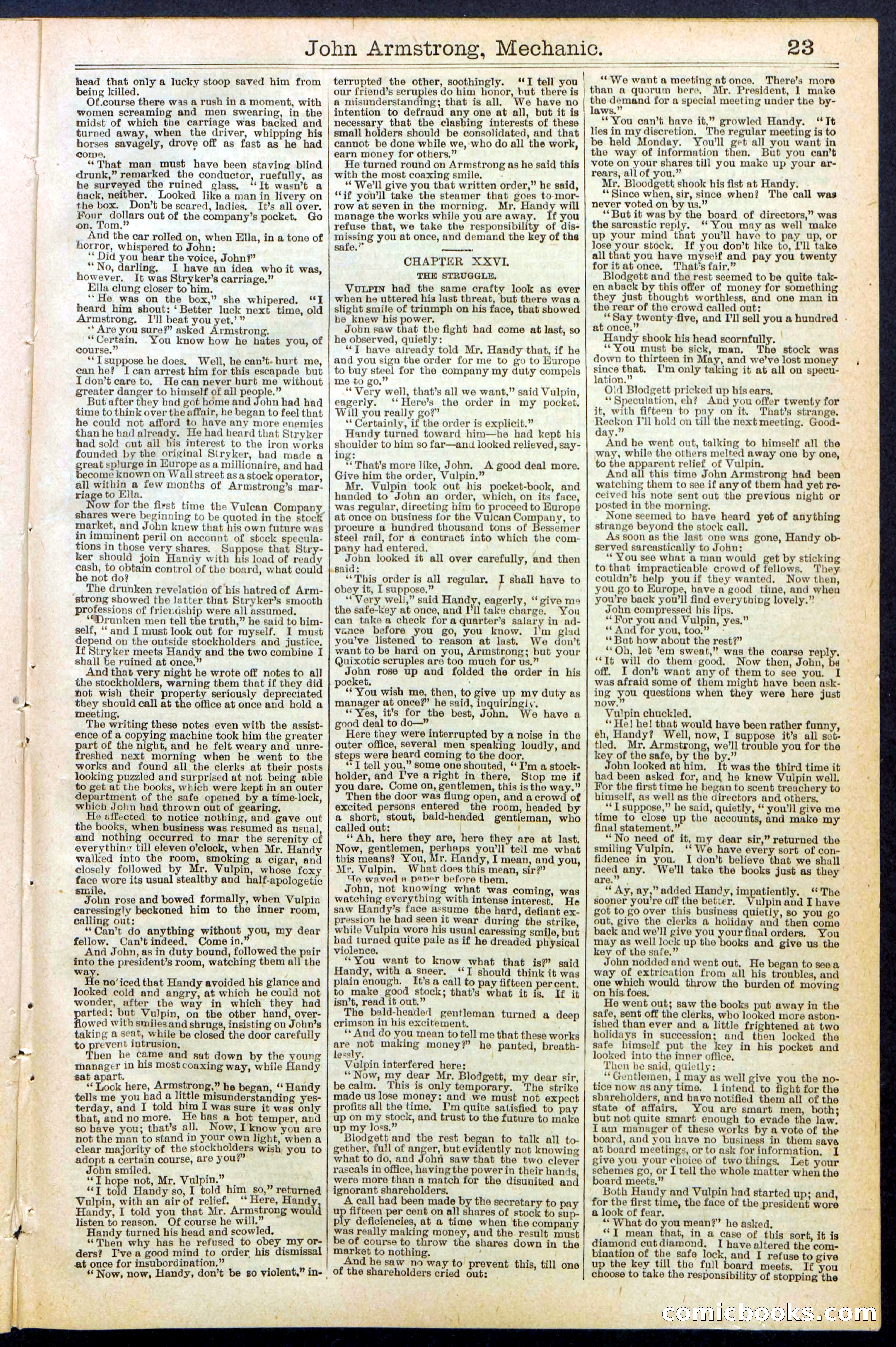
A restored page from Pulp Fiction, 1886. Page through the whole issue in the reader above.
📄 Transcribed text from this page (OCR, searchable)
Machine-transcribed from the original scan — historical spelling and the odd misread are preserved.
John Armstrong, Mechanic. head that only a lucky stoop saved him from being killed. Of.course there was a rush in a moment, with women screaming and men swearing, in the midst of which the carriage was backed and turned away, when the driver, whipping his horses savagely, drove off as fast as he had come. “That man must have been staving blind drunk,” remarked the conductor, ruefully, as he surveyed the ruined glass. “It wasn’t a back, neither. Looked like a man in livery on the box. Don’t be scared, ladies. It’s all over. Your dollars out of the company’s pocket, Go on, Tom.” _ 4A\nd the car rolled on, when Ella, in a tone of horror, whispered to John: ‘* Did you hear the voice, John?” ‘No, darling, I have an idea who it was, however. It was Stryker’s carriage.” Kila clung closer to him, ‘‘He was on the box,” she whipered, “I heard him shout: ‘ Better luck next time, old Armstrong. Ill beat you yet.’ ” *‘ Are you sure?” asked Armstrong. ‘Certain, You know how he hates you, of course.” **T suppose he does. Well, he can’t- burt me, can he? I can arrest him for this escapade but I don’t care to. Hecan never burt me without greater danger to himself of all people.” But after they had got home and John had had time to think over the affair, he began to feel that he could not afford to have any more enemies than he had already. He had heard that Stryker had sold out all his interest to the iron works founded by the original Siryker, bad made a great splurge in Europe as a millionaire, and had become known on Wallstreet asa stock operator, all within a few months of Armstrong’s mar- riage to Ella. ow for the first time the Vulean Company. shares were beginning to be quoted in the stock market, and John knew that his own future was in imminent peril on account of stock specula- tions in those very shares. Suppose that Stry- ker should join Handy with his load of ready cash, to obtain control of the board, what could he not do? } The drunken revelation of his hatred of Arm- strong showed the Jatter that Stryker’s smooth professions of friendship were all assumed. ‘Drunken men tell the truth,” he said to him- self, ‘‘ and I must look out for myself. I must depend on the outside stockholders and justice, If Stryker meets Handy and the two combine I shall be ruined at once.” And that very night he wrote off notes to all the stockholders, warning them that if they did not wish their property seriously depreciated they should call at the office at once and hold a meeting. The writing these notes even with the assist- ence of a copying machine took him the greater part of the night, and he felt weary and unre- freshed next morning when he went to the works and found all the clerks at their posts looking puzzled and surprised at not being able to get at the books, which were kept in an outer department of the safe opened by a time-lock, which John had thrown out of gearing. He affected to notice nothing, and gave out the books, when business was resumed as usual, and nothing occurred to mar the serenity of everythin: till eleven o’clock, when Mr, Handy walked into the room, smoking a cigar, and closely followed by Mr. Vulpin, whose foxy face wore its usual stealthy and half-apologetic suiile. John rose and bowed formally, when Vulpin caressingly beckoned him to the inner room, calling out: ‘““Can’t do anything without you, my dear fellow. Can’t indeed. Come in.’ And John, as in duty bound, followed the pair into the president’s room, watching them all the way. He no’ iced that Handy avoided his glance and looked cold and angry, at which he could not wonder, after the way in which they had arted; but Vulpin, on the other hand, over- owed with smiles and shrugs, insisting on John’s taking a seat, while be closed the door carefully to prevent intrusion, ben he came and sat down by the young manager in his most coaxing way, while Handy sat apart. j ‘Look here, Armstrong,” he began, ‘“‘ Handy tells me you had a little misunderstanding yes- terday, and I told him I was sure it was only that, and no more. He bas a hot temper, and so have you; that’s all. Now, I know you are not the man to stand in your own light, when a clear majority of the stockholders wish, you to adopt a certain course, are yout Jobn smiled. chai “T hope not, Mr. Vulpin.” | a told Handy so, I told him so,” returned Vulpin, with an air of relief. “‘ Here, Hand Handy, I told you that Mr. Armstrong wo listen to reason. Of course he will. Handy turned his head and scowled. “Then why has he refused to obey my or- ders? I’ve a good mind to order his dismissal at once for insubordination,” : ‘“‘ Now, now, Handy, don’t be so violent,” in- | terrupted the other, soothingly. ‘‘I tell you our friend’s scruples do him honor, but there is a misunderstanding; that is all. We have no intention to defraud any one at all, but it is necessary that the clashing interests of these small holders should be consolidated, and that cannot be done while we, who do all the work, earn money for others,” He turned round on Armstrong as he said this with the most coaxing smile. “We'll give you that written order,” he said, ‘if you'll take the steamer that goes to-mor- row at seven in the morning. Mr. Handy will manage the works while you areaway. If you refuse that, we take the responsibility of dis- ae you at once, and demand the key of the safe.’ CHAPTER XXVL THE STRUGGLE. VuLPIN had the same crafty look as ever when he uttered his last threat, but there was a slight smile of triumph on his face, that showed he knew his power. Jobn saw that the fight had come at last, so he observed, quietly: ““{] have already told Mr, Handy that, if he and you sign the order for me to go to Europe to buy steel for the company my duty compels me to go.” ‘Very well, that’s all we want,” said Vulpin, eagerly. ‘‘ Here’s the order in my pocket, Will you really go?” ‘* Certainly, if the order is explicit.” Handy turned toward him—he had kept his shoulder to him so far—andu looked relieved, say- ing: ‘* That’s more like, John. Give him the order, Vulpin.’ Mr. Vulpin took out his pocket-book, and handed to John an order, which, on its face, was regular, directing him fo proceed to Europe at once on business for the Vulcan Company, to procure a hundred thousand tons of Bessemer steel rail, for a contract into which the com- pany had entered. Jobn looked it all over carefully, and then said: ‘‘This order is all regular, I shall have to obey it, I suppose,” ‘* Very well,” said Handy, eagerly, ‘‘ give me the safe-key at once, and Pll take charge. You can take a check fora quarter’s salary in ad- vance before you go, you know. I’m glad you’ve listened to reason at last. We don’t want to be hard on you, Armstrong; but your Quixotic scruples are too much for us.” zone rose up and folded the order in his ocket. ‘You wish me, then, to give up mv duty as manager at once?” he said, inquiringly. ‘Yes, it’s for the best, John. We have a good deal to do—” Here they were interrupted by a noise in the outer office, several men speaking loudly, and steps were heard coming to the door. ‘I tell you,” some one shouted, “I’m a stock- holder, and I’ve aright in there. Stop me if you dare. Come on, gentlemen, this is the way.” Then the door was flung open, and a crowd of excited persons entered the room, headed by a short, stout, bald-headed gentleman, who called out: i ‘‘Ah, here they are, here they are at last. Now, gentlemen, perhaps you'll tell me what this means? You, Mr. Handy, I mean, and you, Mr, Vulpin. What does this mean, sir?” Te waved # p»per before them, Jobn, not knowing what was coming, was watching everything with intense interest. He saw Handy’s face assume the hard, defiant ex- pression he had seen it wear during the strike, while Vulpin wore his usual caressing smile, but bad turned quite pale as if he dreaded physical violence, “You want to know what that is?’ said Handy, with a sneer. ‘TI should think it was plain enough. It’s a call to pay fifteen per cent. to make good stock; that’s what it is. If it isn’t, read it out.” The bald-headed gentleman crimson in his excitement. ‘* And do you mean to tell me that these works not making money?’ he panted, breath- esstly. ' Wiatpib interfered here: “Now, my dear Mr. Blodgett, my dear sir, be calm. This is only temporary. The strike made us lose money: and .we must not expect profits all the time. I’m quite satisfied to pay up on my stock, and trust to the future to make up my Joss.” Blodgett and the rest began to talk all to- gether, full of anger, but evidently not knowing what to do, and John saw that the two clever rascals in office, having the power in their hands were more than a match for the disunited and ignorant shareholders, A call had been made by the secretary to pay up fifteen per cent on all shares of stock to sup- ply deficiencies, at a time when the company was really making money, and the result must be of course to throw the shares down in the market to nothing. : And he saw no way to prevent this, till one JA good deal more. turned a deep of the shareholders cried out: than a quorum bere, ——— = —— - . —— os — *“We want a meeting at once. There’s more Mr. President, 1 make the demand for a special meeting under the by- laws.” ‘You can’t have it,” growled Handy. ‘It lies in my discretion, The regular meeting is to be held Monday. You'll get all you want in the way of information then. But you can’t vote on your shares till you make up your ar- rears, all of you.” Mr. Bloodgett shook his fist at Handy. ** Since when, sir, since when? The call was never voted on by us,” ‘*But it was by the board of directors,” was the sarcastic reply. ‘You may as well make up your mind that you'll have to pay up, or lose your stock. If you don’t like to, [ll take all that you have myself and pay you twenty foritat once. That’s fair.” Blodgett and the rest seemed to be quite tak- en aback by this offer of money for something they just thought worthless, and one man in the rear of the crowd called out: “Say twenty-five, and I'll sell you a hundred . at once,” Handy shook his head scornfully. ‘You must be sick, man, The stock was down to thirteen in May, and we've lost money since that. I’m only taking it at all on specu- lation,” Old Blodgett pricked up his ears, ‘Speculation, eh? And you offer twenty for it, with fifteen to pay on it. That’s strange. Reckon I'll bold on till the next meeting. Good- day.” And be went out, talking to himself all the way, while the others melted away one by one, to the apparent relief of Vulpin. And all this time John Armstrong had been watching them to see if any of them had yet re- ceived his note sent out the previous night or posted in the morning. None seemed to have heard yet of anything strange beyond the stock call. As soon as the last one was gone, Handy ob- served sarcastically to John: ‘** You see what a man would get by sticking to that impracticable crowd of fellows. They couldn’t help youif they wanted. Now then, you go to Europe, have a good tiie, and when you're back you’ll find everything lovely.” John compressed his lips. ‘“‘For you and Vulpin, yes.” ‘* And for you, too.” - ‘* But how about the rest?” ‘*Oh, let ’em sweat,” was the coarse reply. “‘Tt will do them good, Now then, John, he off. I don’t want any of them to see you. I was afraid some of them might have been ask- ing you questions when they were here just now.” Vu!lpin chuckled. ‘‘ He! he! that would have been rather funny, eh, Handy? Well, now, I suppose it’s all sct- tled, Mr. Armstrong, we’ll trouble you for the key of the safe, by the by.” ohn looked at him. It was the third time it had been asked for, and he knew Vulpin well. For the first time he began to scent treachery to himself, as well as the directors and others. ‘IT suppose,” he said, quietly, “ you'll give me | time to close up the accounts, and make my final statement.” “No need of it, my dear sir,” returned the smiling Vulpin. ‘‘ We have every sort of con- fidence in you. I don’t believe that we shall need any. We'll take the books just as they are.” . “ Ay, ay,” added Handy, impatiently. ‘The sooner you're off the better. Vulpin and I have got to go over this business quietly, so you go out, give the clerks a holiday and then come back and we'll give you your final orders. You may as well lock up the books and give us the key of the safe.” pe ohn nodded and went out, He began to see a way of extrication from ull his troubles, and one which would throw the burden of moving on his foes. He went out; saw the books put away in the safe, sent off the clerks, who looked more aston- ished than ever and a little frightened at two holidays in succession; and then locked the safe himself put the key in his pocket and looked into the inner office, Then be said, quietly: _ ‘Gentlemen, 1 may as well give you the no- tice now asany time. lintend to fight for the shareholders, and have notified them all of the state of affairs. You are smart men, both; but not quite smart enough to evade the law. Tam manager of these works by a vote of the board, and you have no business in them save at board meetings, or to ask for information, 1 give you your choice of two things. Let your schemes go, or I tell the whole matter when the Both Haniy and Valpin h d oth Handy and Vulpin had started up: and for the first slnies the face of the preaiicht wore a look of fear. ** What do you mean?” he asked. **T mean that, in a case of this sort, it is diamond cutdiamond. I have altered the com- bination of the safe lock, and I refuse to give up the key till the full board meets. If you choose to take the responsibility of stopping the | Com Ehoo s.com 44 i aa i i est