
Pulp Fiction, 1886 · page 20 of 32
Beadle's New York Dime Library, No. 378 — page 20: what you’re looking at
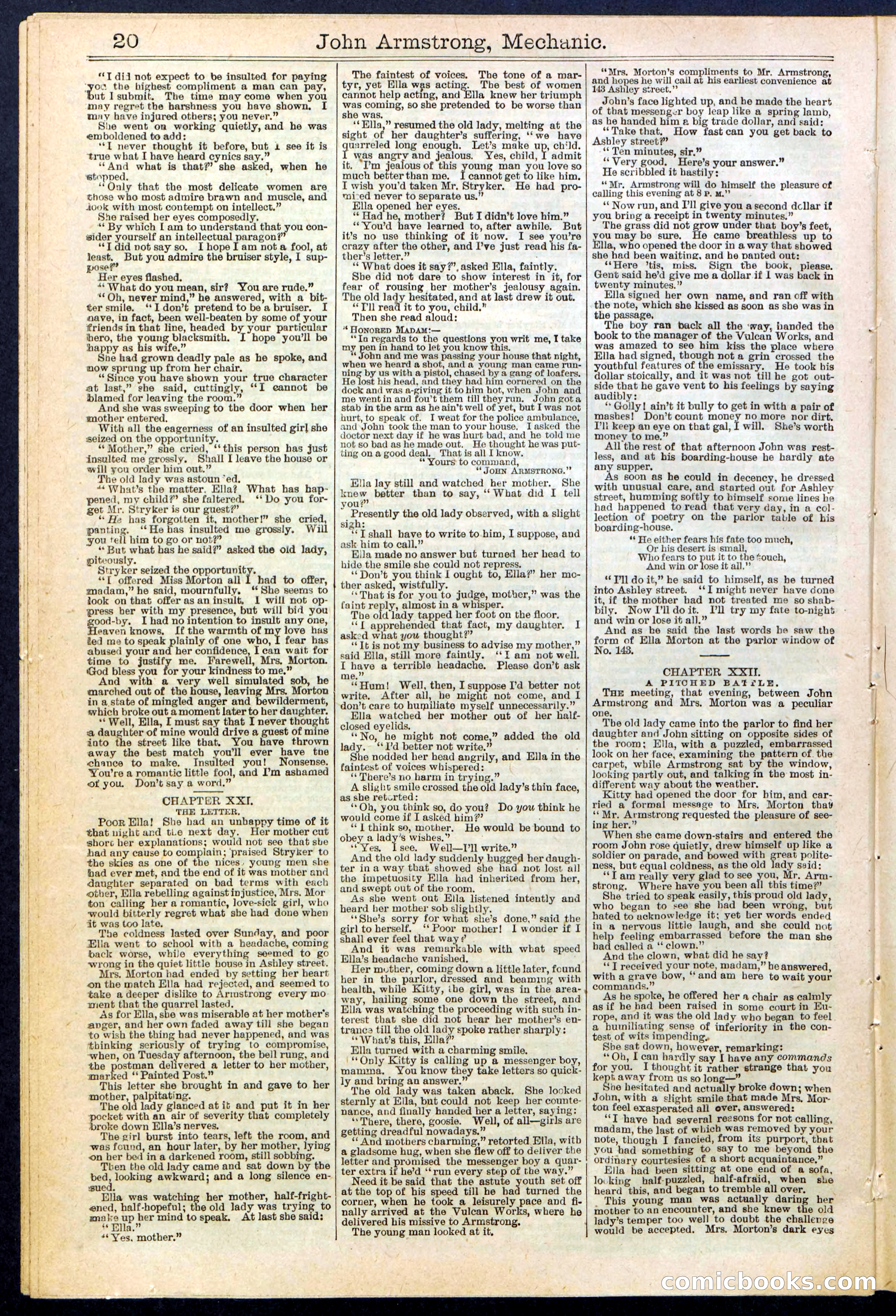
A restored page from Pulp Fiction, 1886. Page through the whole issue in the reader above.
📄 Transcribed text from this page (OCR, searchable)
Machine-transcribed from the original scan — historical spelling and the odd misread are preserved.
en ee ee ee ~_——— ——. - +s. - 20 **T dil not expect to be insulted for paying he the highest compliment a man can pay, ut Isubmit, The time may come when you may regret the harshness you have shown, I may have injured others; you never.” She went on working quietly, and he was emboldened to add: ‘*[ never thought it before, but 4 see it is ‘true what I have heard cynics say.” ‘And what is that?’ she asked, when he stopped. ‘‘Only that the most delicate women are those who most admire brawn and muscle, and dook with most contempt on intellect.” She raised her eyes composedly, ** By which [ am to understand that you con- sider yourself an intellectual paragon? “*T did not say so. I hope Iam not a fool, at meee But you admire the bruiser style, I sup- pose Her eyes flashed. “* What do you mean, sir? You are rude.” “*Oh, never mind,” he answered, with a bit- ter smile. ‘I don’t pretend to bea bruiser. I nave, in fact, been well-beaten by some of your friends in that line, headed by your particular hero, the young blacksmith. I hope you'll be happy as his wife,” he had grown deadly pale as he spoke, and mow sprung up from her chair. ‘Since you have shown your true character at last,” she said, cuttingly, ““I eannot be blamed for leaving the room.” And she was sweeping to the door when her snother entered, With all the eagerness of an insulted girl she seized on the opportunity. ** Mother,” she cried, ‘‘this person has just insulted me grossly. Shall I leave the house or will you order him out.” The old lady was astoun ‘ed. ““ What’s the matter. Ella? What has bap- pened, my child?” she faltered. ‘‘ Do you for- get Mr. Stryker is our guest?” * He has forgotten it, mother!” she cried, panting. ‘*He has insulted me grossly. Will ‘you tell him to go or not?” ‘But what has he said?’ asked the old lady, piteously. Stryker seized the Soportnn hy **{ offered Miss Morton all 1 had to offer, madam,” he said, mournfully, ‘‘ She seems to look on that offer as aninsult, 1 will not op- press ber with my presence, but will bid you ood-by. I had no intention to insult any one, eaven knows, If the warmth of my love has Zed me to speak plainly of one who, I fear has abused your and her confidence, | can wait for time to justify me. Farewell, Mrs, Morton. ‘God bless you for your kindness to me.” And with a very well simulated sob, he marched out of the house, leaving Mrs. Morton in a state of mingled anger and bewilderment, which broke out a moment later to her daughter. ‘* Well, Ella, I must say that I never thought a daughter of mine would drive a guest of mine into the street like that. You have thrown away the best match you'll ever have the chance to make, Insulted you! Nonsense, You’re a romantic little fool, and ’m ashamed ot you. Don’t say a word,” CHAPTER XXI, THE LETTER, Poor Ella! She had an unbappy time of it that night and tie next day. Her mother cut short her explanations; would not see that sbe had any cause to complain; ‘praised Stryker to the skies as one of the nices. young men she had ever met, and the end of it was mother and daughter separated on bad terms with each otber, Ella rebelling against injustice, Mrs. Mor ton calling her a romantic, love-sick girl, who ‘would bitterly regret what she had done when it was too late. The coldness lasted over Sunday, and poor Elia went to school with a headache, coming back worse, while everything seemed to go wrong in the quiet little house in Ashley street. Mrs. Morton had ended by setting her heart on the match Ella had rejected, and seemed to take a deeper dislike to Armstrong every mo ment that the quarrel lasted. As for Ella, she was miserable at her mother’s anger, and her own faded away till she began to wish the thing had never happened, and was thinking seriously of trying to compromise, -when, on Tuesday afternoon, the bell rung, and the postman delivered a letter to her mother, amarked ‘' Painted Post.” This letter she brought in and gave to her mother, pe eee j ee The old lady glanced at it and put it in her cket with an air of severity that completely Drake down Ella’s nerves, The girl burst into tears, left the room, and ‘was found, an hour later, by her mother, lying on her bed in a darkened room, still sobbing. Tben the old Jady came and sat down by the bed, looking awkward; and a long silence en- ued. Ella was watching her mother, half-fright- ened, half-hopeful; the old lady was trying to mn pane her mind to speak. At last she said: ‘* Tella. + Yes, mother.” John Armstrong, Mechanic. The faintest of voices. The tone of a mar- tyr, yet Ella was acting. The best of women cannot help acting, aaah Tita knew her triumph was coming, so she pretended to be worse than she was. ‘* Hilla,” resumed the old lady, melting at the sight of her daughter’s suffering, ‘‘we have we Nae long enough. Let’s make up, child. was angrv and jealous. Yes, child, [ admit it. “I’m jealous of this young man you love so much betterthan me. I cannot get to like him, I wish you'd taken Mr, Stryker. He had pro- iced never to separate us,” Ella opened her eyes. ‘* Had he, mother? But I didn’t love him.” “You'd have learned to, after awhile. But it’s no use thinking of it now. I see you’re crazy after the other, and [ve just read his fa- ther’s letter,” ‘“* What does it say?”, asked Ella, faintly. Sbe did not dare to show interest in it, for fear of rousing her mother’s jealousy again. The old lady hesitated, and at last drew it out. “Tl read it to you, child.” Then she read aloud: *“HonorED Mapam:— ‘*In regards to the questions you writ me, I take my pen in hand to let you know this. ** John and me was passing your house that night, when we heard a shot, and a young man came run- ning by us with a pistol, chased by a gang of loafers. He lost his head, and they had him cornered on the dock and was a-giving it to him hot, when John and me wentin and fou’t them till theyrun, John gota stab in the arm as he ain't well of yet, but Iwas not hurt, to speak of. I weat for the police ambulance, and John took the man to your house, Iasked the doctor next day if he was hurt bad, and he told me not so bad as he made out. He thought he was put- ting on a good deal. That is all I know. “Yours to command, ** JOHN ARMSTRONG.” Ella lay still and watched her mother, She knew better than to say, ‘‘ What did I tell you? _Presently the old lady observed, with a slight sigh: ‘*T shall have to write to him, I suppose, and ask him to call,” Kila made no answer but turned her head to hide the smile she could not repress. ‘Don’t you think 1 ought to, Ella?’ her mo- ther asked, wistfully. ‘That is for you to judge, mother,” was the faint reply, almost in a whisper. The old lady tapped her foot on the floor, ‘‘T apprehended that fact, my daughter. I asked what you thought?” ‘It is not my business to advise my mother,” said Ella, still more faintly. ‘‘I am not well. [ have a terrible headache. Please don’t ask me, “Hum! Well, then, I suppose I’d better not write. After all, he might not come, and I don’t care to humiliate myself unnecessarily.” Elia watched her mother out of her half- closed eyelids. ‘*No, be might not come,” added the old lady. ‘‘I’d better not write,” She nodded her head angrily, and Ella in the faintest of voices whispered: * There’s no harm in trying.” A slight smile crossed the old lady’s thin face, as she retcrted: **Oh, you think so, do you? Do you think he would come if I asked him?’ *“] think se, mother. He would be bound to obey a lady’s wishes.” ‘Yes, Isee. Well—I’ll write.” And the old lady suddenly hugged her daugh- ter ina way that showed she had not lost all the impetuosity Ella had inherited from her, and swept out of the room. As she went out Ella listened intently and heard her mother sob slightly. ‘*She’s sorry for what she’s done,” said the girl to herself. ‘‘ Poor mother! I wonder if I shall ever feel that way ? And it was remarkable with what speed Ella’s headache vanished, Her mvuther, coming down a little later, found her in the parlor, dressed and beaming with health, while Kitty, ihe girl, was in the area- way, hailing some one down the street, and Ella was watching the proceeding with such in- terest that she did not hear her mother’s en- trance till the old lady spoke rather sharply: “What's this, Ella?” Ella turned with a charming smile. '**Only Kitty is calling up a messenger boy, mamma. You know they take letters so quick- ly and bring an answer.” The old lady was taken aback. She looked sternly at Ella, but could not keep her counte- nance, and finally handed her a letter, saying: ‘There, there, goosie. Well, of all—girls are getting dreadful nowadays.” ; ‘* And mothers charming,” retorted Ella, witb a gladsome hug, when she flew off to deliver the letter and promised the messenger boy a quar- ter extra if he’d ‘trun every step of the way.” Need it be said that the astute youth set off at the top of his speed till he bad turned the corner, when he took a leisurely pace and fi- nally arrived at the Vulcan Works, where he delivered his missive to Armstrong. The young man looked at it, ‘Mrs. Morton's compliments to Mr. Armstrong, and hopes he will call at his earliest convenience at 143 Aghiey street,” John’s face lighted up, and he made the heart of that messenger boy leap like a spring lamb, as he handed him a big trade dollar, and said: “Take that, How fast can you get back to Ashley street?” ‘Ten minutes, sir,” ‘“‘ Very good, Here’s your answer.” He scribbled it hastily: ““Mr. Armstrong will do himself the pleasure of calling this evening at 8 P. m.”’ ‘‘ Now run, and I'll give you asecond dcllar if you bring a receipt in twenty minutes.” The grass did not grow under that boy’s feet, you may be sure. He came breathless up to Ella, who opened the door in a, way that showed she had been waiting, and he panted out: ‘‘Here ’tis, miss. Sign the book, piease. Gent said he’d give me a dollar if 1 was back in twenty minutes.” Ella signed her own name, and ran off with the note, which she kissed as soon as she was in the passage, The boy ran back all the ‘way, banded the book to the manager of the Vulcan Works, and was amazed to see him kiss the place where Ella had signed, though not a grin crossed the youthful features of the emissary. He took his dollar stoically, and it was not till he got out- side that he gave vent to his feelings by saying audibly: ** Golly! ain’t it bully to get in with a pair of mashes! Don’t count money no more nor dirt. I'll keep an eye on that gal, I will. She’s worth money to me,” All the rest of that afternoon John was rest- less, and at his boarding-house he hardly ate ray supper, s soon as he could in decency, he dressed with unusual care, and started out for Ashley street, humming rents to himself some lines he had happened to read that very day, in a col- lection of poetry on the parlor table of his boarding-house. ‘* He either fears his fate too much, Or his desert is small, Who fears to put it to the touch, And win or lose it ail,” ‘‘T’ll do it,” he said to himself, as he turned into Ashley street. ‘‘I might never have done it, if the mother had not treated me so shab- bily. Now l’ildoit. Pll try my fate to-night and win or lose it all.” And as he said the last words he saw the form HS Ella Morton at the parlor window of oO. . CHAPTER XXTI. A PITCHED BATILE, THE meeting, that evening, between John Armstrong and Mrs. Morton was a peculiar one. The old lady came into the parlor to find her daughter and John sitting on opposite sides of the room; Ella, with a puzzled, embarrassed look on her face, examining the pattern of. the carpet, while Armstrong sat by the window, looking partly out, and talking in the most in- different way about the weather. Kitty had opened the door for him, and car- ried a formal message to Mrs. Morton that ‘‘Mr, Armstrong requested the pleasure of see- ing her.” When she came down-stairs and entered the room John rose quietly, drew bimself up like a soldier on parade, and bowed with great polite- ness, but equal coldness, as the old lady ssid: “Tam really very glad to see you, Mr, Arm- strong. Where have you been all this time?” She tried to speak easily, this proud old lady, who began to see she had been wrong, but hated to acknowledge it; yet ber words ended in a nervous little laugh, and she could not help feeling embarrassed before the man she had called a ‘‘ clown,” And the clown, what did he say? ‘“‘T received your note, madam,” he answered, with a grave bow, “ and am here to wait your commands.” As he spoke, he offered her a chair as calmly as if he had been raised in some court in Eu- rope, and it was the old lady who began to feel a humiliating sense of inferiority in the con- test_of wits impending, Sbe sat down, however, remarking: “Oh, Ican hardly say I have any commands for you. I thought it rather strange that you kept away from us so long—” she hesitated and actually broke down; when John, with a slight smile that made Mrs, Mor- ton feel exasperated all over, answered: ‘‘T have bad several reasons for not calling, madam, the last of which was removed by your note, though I fancied, from its purport, that you had something to say to me beyond the ordinary courtesies of a short acquaintance,” Ella had been sitting at one end of a sofa, locking half-puzzled, half-afraid, when she heard this, and began to tremble all over, This young man was actually daring her mother to an encounter, and she knew the old lady’s temper too well to doubt the challenge would be accepted. Mrs. Morton’s dark eyes Gomichboo! “S my ee