
Pulp Fiction, 1886 · page 19 of 32
Beadle's New York Dime Library, No. 378 — page 19: what you’re looking at
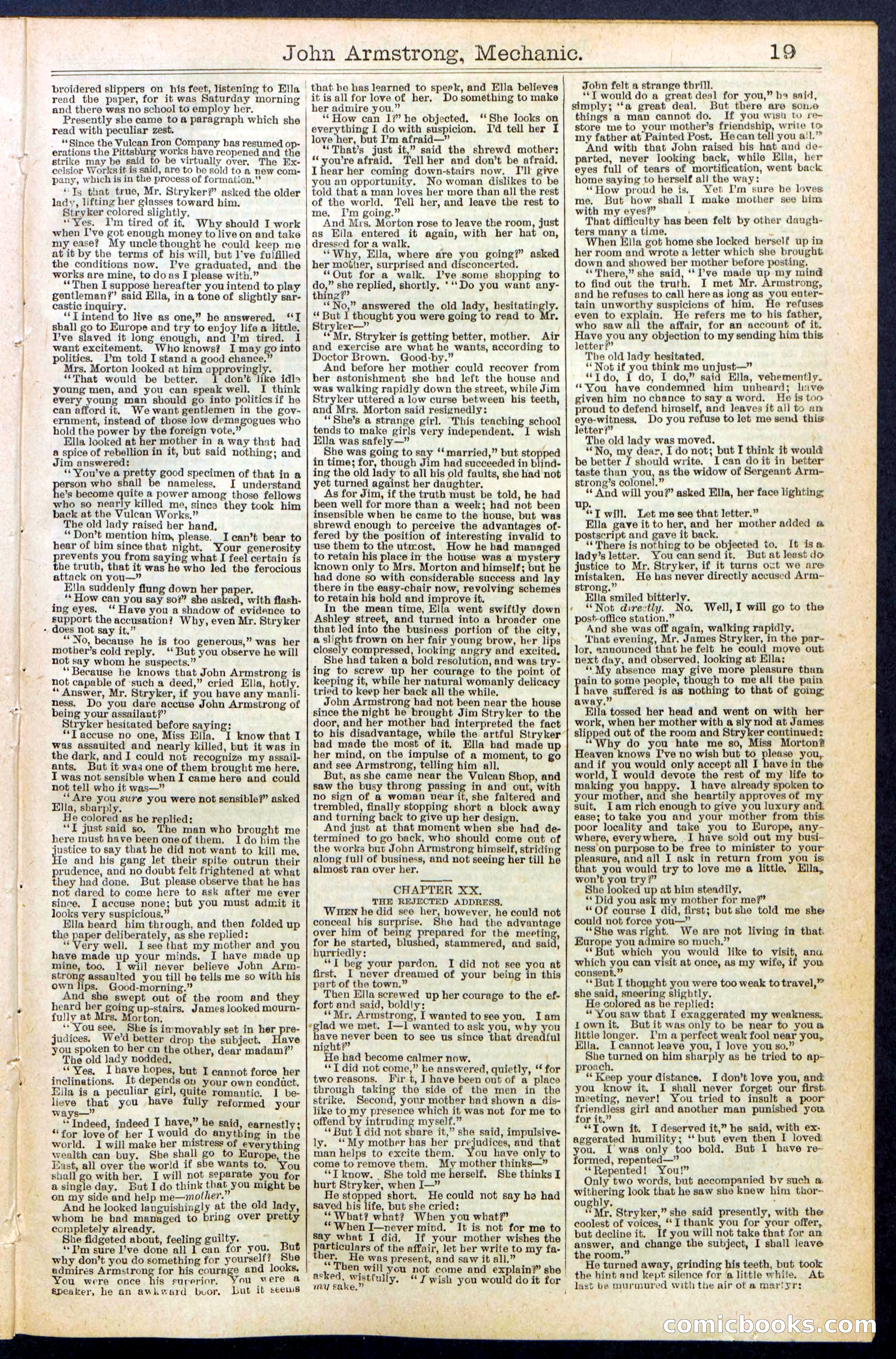
A restored page from Pulp Fiction, 1886. Page through the whole issue in the reader above.
📄 Transcribed text from this page (OCR, searchable)
Machine-transcribed from the original scan — historical spelling and the odd misread are preserved.
broidered slippers on his feet, listening to Ella read the paper, for it was Saturday morning and there was no school to employ her. Presently she came to a paragraph which she read with peculiar zest. ‘Since the Vulcan Iron Company has resumed op- erations the Pittsburg works have reopened and the strike may be said to be virtually over, The Ex- eelsior Works it is said, are to be sold to a new comes pany, which is in the process of formation.” “Ts that true, Mr. Stryker?’ asked the older lady, lifting her glasses toward him. Stryker colored slightly, “Yes. I’m tired of it. Why should I work when I’ve got enough money to live on and take my ease? My unclethought he could keep me at it by the terms of his will, but I've fulfilled the conditions now. I’ve graduated, and the works are mine, to doas I please with.” ‘Then I suppose hereafter you intend to play gentleman?” said Ella, in a tone of slightly sar- castic inquiry. ‘intend to live as one,” hoe answered, ‘I shall go to Europe and try to enjoy life a little. I’ve slaved it long enough, and I’m tired. I want excitement. Who knows? I may wo into politics. Vm told I stand a good chance.” Mrs. Morton looked at him approvingly. “That would be better. don’t like idls young men, and you can speak well. I think every young man should go into politics if he can afford it, e want gentlemen in the goy- ernment, instead of those low demagogues who hold the power by the foreign vote,” Ella looked at her mother in a way that had a spice of rebellion in it, but said nothing; and Jim answered: ‘You've a a good specimen of that in a rson who shall nameless, I understand e’s become = ah a power among those fellows who so nearly killed me, since they took him back at the Vulcan Works.” The old lady raised ber hand, “Don’t mention him, please. I can’t bear to hear of him since that night. Your generosity prevents you from saying what I feel certain is the truth, that it was he who led the ferocious attack on you—” E}la suddenly flung down her paper. _ ‘* How can you say so?” she asked, with flash- ing eyes, ‘‘ Have you a shadow of evidence to support the accusation? Why, even Mr. Stryker - does not say it,” ‘* No, because he is too generous,” was her mother’s cold reply. ‘‘ But you observe he will not say whom he suspects.” ‘Because he knows that John Armstrong is not capable of ‘such a deed,” cried Ella, hotly. ** Answer, Mr. Stryker, if you have any mani ness. Do you dare accuse John Armstrong of being your assailant?’ Stryker hesitated before saying: “*T accuse no one, Miss Hila. I know that I was assaulted and nearly killed, but it was in J ohn Armstrong, Mechanic. that be has learned to speek, and Ella believes it is all for love of her. Do something to make her admire you.” ‘“How can 1?” he objected. ‘‘She looks on everything I do with suspicion. Id tell her I love her, but I’m afraid—” “That’s just it,” said the shrewd mother: ** you're afraid. Tell her and don’t be afraid. I hear her coming down-stairs now. Ill give you an opportunity. No woman dislikes to be told that a man loves her more than all the rest of the world. Tell her, and leave the rest to me, I’m going.” And Mrs, Morton rose to Jeave the room, just as Ella entered it again, with her hat on, dressed for a walk, ‘Why, Ella, where are you going?’ asked her mother, surprised and disconcerted. “Out for a walk. D’ve some shopping to do,” she replied, shortly, *‘‘Do you want any- thinz?”’ ‘* No,” answered the old lady, wath na ** But 1 thought you were going to read to Mr, Stryker—” ‘* Mr, Stryker is getting better, mother. Air and exercise are what he wants, according to Doctor Brown. Good-by.” And before her mother could recover from her astonishment she bad left the house and was walking rapidly down the street, while Jim Stryker uttered a low curse between his teeth, and Mrs. Morton said resignedly: *“*She’s a strange girl. "This teaching school tends to make girls very independent. I wish Killa was safely—” She was going to say ‘‘married,” but stopped in time; for, though Jim had succeeded in blind- ing the old lady to all his old faults, she had not yet turned against her daughter. As for Jim, if the truth must be told, he had been well for more than a week; had not been insensible when he came to the house, but was shrewd enough to perceive the advantages of- fered by the position of interesting invalid to use them to the utmost. How be had managed to retain his place in the house was a mystery known only to Mrs. Morton and himself; but he had done so with considerable success and lay there in the easy-chair now, revolving schemes to retain his bold and improve it. In the mean time, Ella went swiftly down Ashley street, and turned into a broader one that led into the business portion of the city, a slight frown on her fair young brow, her lips closely compressed, looking angry and excited, She had taken a bold resolution, and was try- ing to screw up her courage to the point of keeping it, while her natural womanly delicacy tried to keep her back all the while. Jobn Armstrong had not been near the house since the night he brought Jim Stryker to the door, and her mother had interpreted the fact to his disadvantage, while the artful Stryker’ bad made the most of it. Ella bad made up Jobn felt a strange thrill. ‘tT would do a great desl for you,” he said, simply; ‘‘a great deal. But there are some things a man cannot do. If you wish to re- store me to your mother’s friendship, write to my father at Painted Post, Hecan tell you ail.” And with that John raised his hat and de- parted, never looking back, while Ella, her eyes full of tears of mortification, went back home saying to herself all the way: “How proud he is, Yet I’m sure be loves me. But how shall I make mother see bin with my eyes?” That difficulty has been felt by other daugh- ters many a time. When Ella got home she locked herself up im her room and wrote a letter which she brought down and showed her mother before posting. “There,” she said, ‘‘ I’ve made up my mind to find out the truth, I met Mr. Armstrong, and he refuses to call here as long as you euter- tain unworthy suspicions of him, He refuses even to explain. e refers me to his father, who saw all the affair, for an account of it. pet you any objection to my sending him this etter? The old lady hesitated. ** Not if you think me unjust—” “‘T do, 1 do, I do,” said Ella, vehemently. ‘You have condemned him unheard; lave given him nochance tosay aword. He is too proud to defend himself, and leaves it all to am eye-witness, Do you refuse to let me send this letter?” The old lady was moved, ‘“No, my dear, I do not; but I think it would be better J should write. Ican doit in better taste than you, as the widow of Sergeant Arm- strong’s colonel.” ‘* And will you?” asked Ella, her face lighting: u . MK I will. Let me see that letter.” Ella gave it to her, and her mother added @ postscript and gave it back. — ‘There is nothing to be objected to. I[t isa. lady’s letter. You cansendit. But at least do justice to Mr, Stryker, if it turns oct we are mistaken. Hoe has never directly accused Arm- strong.” Ella smiled bitterly. « “Not directly. No. post-office station.” And she was off again, walking rapidly. That evening, Mr, James Stryker, in the par~- lor, announced that he felt he could move out next day, and observed, looking at Ella; ‘‘ My absence may give more pleasure tham ain to some people, though to me all the pain have suffered is as nothing to that of going away. Ella tossed her head and went on with her work, when her mother with a sly nod at James attpeed out of the room and Stryker continued: ‘Why do you hate me so, Miss Morton? Well, I will go to the the dark, and I could not recognize my assail- | her mind, on the impulse of a moment, to go | Heaven knows [ve no wish but to please you, ants, But it was one of them brought me here, | and see Armstrong, telling him all. and if re would only accept all I havein the | I was not sensible when I came here and could | But, as she came near the Vulcan Sbop, and | world, I would devove the rest of my life to tetitatlcrho tt wase.? saw the busy throng passing in and out, with | making you happy. 1 have already spoken to ‘‘ Ave you sure you were not sensible?” asked | 2 sign of a woman vear it, she faltered and | your mother, and she heartily approves of my Ella, sharply. He colored as he replied: ‘IT just said so, The man who brought me here must have been oneof them. Ido him the justice to say that he did not want to kill me. e and his gang let their spite outrun their prudence, and no doubt felt frightened at what they had done, But please observe that he has not dared to come here to ask after me ever since, I accuse none; but you must admit it looks very suspicious.’ Bila beard him through, and then folded up the paper deliberately, as she replied: ‘Very well. Isee that my mother and you have made up your minds. I have made up mine, too. I will never believe Jobn Arm- strong assaulted you till he tells me so with his own lips. Good-morning.” And she swept out of the room and they heard her going up-stairs, James looked mourn- fully at Mrs. Morton, trembled, finally stopping short a block away and turning back to give up her design, And just at that moment when she had de- termined to go back, who should come out of the works but John Armstrong himself, striding along full of business, and not seeing her till he almost ran over her. CHAPTER XX, THE REJECTED ADDRESS, WHEN he did see her, however, he could not conceal his surprise. She had the advantage over him of being prepared for thé meeting, for he started, blushed, stammered, and said, hurriedly: ‘““I beg your pardon, I did not see first. I never dreamed of part of the town.” Then Ella screwed up her courage to the ef- fort and said, boldly: ‘*Mr, Armstrong, I wanted to see you. Iam ou at your being in this suit, Iam rich enough to give you luxury and. ease; to take you and your mother from this poor locality and take you to Europe, any-~- where, everywhere, I have sold out my busi- ness on purpose to be free to minister to your pleasure, and all I ask in return from you is: that you would try to love me a little, Ella, won’t you try?” She looked up at him steadily, ‘*Did you ask my mother for me?” *Of course I did, first; but she told me she could not force you—” ‘*She was right. We are not living in that. Europe you admire so much,” * But which you would like to visit, ana which you can visit at once, as my wife, if you consent.” ‘But I thopght you were too weak to travel,” she said, sneering slightly. He colored as he replied: “You saw that I exaggerated my weakness, “You see. She is im in her pre- |"glad we met. I—1 wanted to ask you, why you] 1 own it. Butit was only to be near to youa judices, We'd Rene the. eet. fave | have never been to see us since that dreadful little longer. I’m a perfect weak fool near you, you spoken to ber on the other, dear madam?” | night?’ Ella, Icannot leave you, I love you so. The old lady nodded, ‘Yes, Ihave hopes, but I cannot force her inclinations. It depends oy your own conduct. Hila is a peculiar girl, quite romantic. 1 be- lieve that you have fully reformed your ways— “Indeed, indeed I have,” he said, earnestly; “for love of ber I would do anytbing in the world, I will make her mistress of everything wealth can buy. She shall go to Europe, the Tiast, all over the world if sbe wants to. You shall go with her, I will not separate you for a single day. But I do think that you might be on my side and help me—mother. And he looked languishingly at the old lady, whom he had managed to bring over pretty completely already. : She fidgeted about, feeling guilty. “Dm sure I’ve done all 1 can for you. But why don’t you do something for yourself? admires Armstrong for his courage and looks, You were once his surerior, You were @& gPeaker, he an awkward bvoor, but ib seems She | th He had become calmer now. ‘I did not come,” he answered, quietly, “ for tworeasons. Fir t, I have been out of a place through taking the side of the men in the strike. Second, your mother had shown a dis- like to my presence which it was not for me to offend by intruding myself.” ‘‘ But I did not share it,” she said, impulsive- ly. ‘‘My mother has her Bree and that man helps to excite them. You have only to come to remove them. My mother thinks—” “T know. . She told me herself. Ske thinks I hurt Stryker, when I—” He stopped short. He could not say ho had saved bis life, but she cried: ‘What? what? When you what?” “When I—never mind. It is not for me to Say what I did, If your mother wishes the particulars of the affair, let ber write to my fa- er, © was present, and saw it all.” “Then will | ation acked, wistful Erel i Gone Sie: CATT Bho my sake.” ~ “Jwish you would do it for | She turned on him sharply as he tried to ap- proach. ** Keep your distance. I don’t love you, and you know it. I shall never forget our first. meeting, never! You tried to insult a poor i i ge girl and another man punished you or it. “Town it. I deserved it,” he said, with ex- aggerated humility; ‘‘ but even then I loved you. I’ was only too bold. But I have re~ formed, repented—” ‘‘Repented! You!” ; Only two words, but accompanied by such @ withering look that he saw she knew him thor- mest A } ‘Mr. Stryker,” she said presently, with the coolest of voices, **I thank you for your offer, but decline it. If you will not take that for an answer, and change the subject, I sball leave the room.” He turned away, grinding his teeth, but took the hint and kept silence for ‘a little while. At last be murwured with the air of a martyr: pea | = < 4 et . Y! (C JOOKS7EO