
Pulp Fiction, 1886 · page 18 of 32
Beadle's New York Dime Library, No. 378 — page 18: what you’re looking at
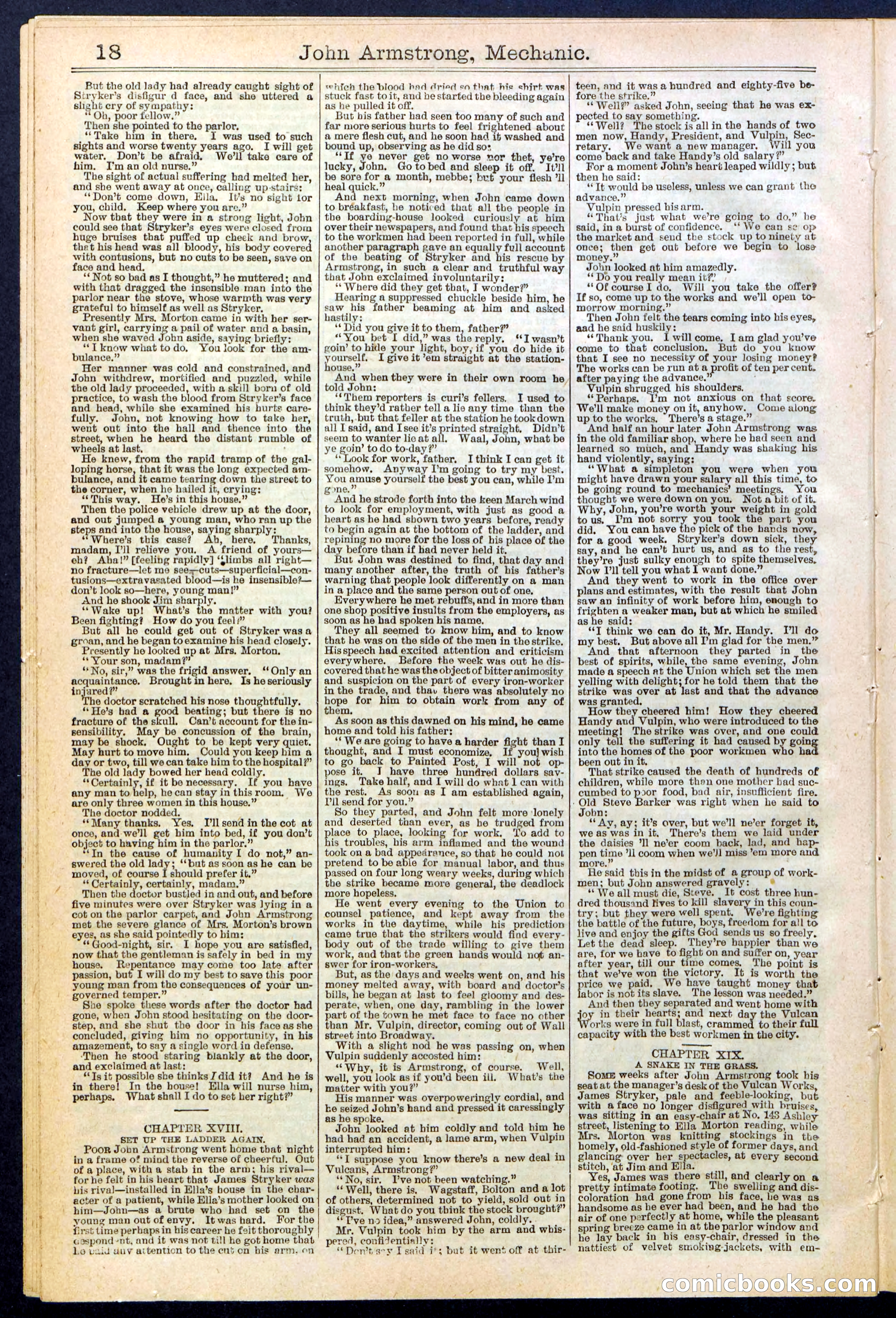
A restored page from Pulp Fiction, 1886. Page through the whole issue in the reader above.
📄 Transcribed text from this page (OCR, searchable)
Machine-transcribed from the original scan — historical spelling and the odd misread are preserved.
Se we oes oe ee ee — — . - — — 3 ——— ~ a < - ‘ ~ - —-—-~— te -- ~ —— + es Oe i ee Se Fe ig sg ST bs . -* ~ --. es 18 But the old lady had already caught sight of Stryker’s disfigur d face, and she uttered a sheht ery of sympathy: **Oh, poor fellow.” Then she pointed to the parlor, **Take him in there. I was used to such sights and worse twenty years ago. I will get water. Don’t be afraid. We’ll take care of him. I’m an old nurse.” The sight of actual suffering had melted her, and she went away at once, calling up-stairs: ‘*Don’t come down, Hila. It’s no sight tor you, child, Keep where you are.” Now tbat they were in a strong light, John could see that Stryker’s eyes were closed from huge bruises that puffed up cheek and brow thet his head was all bloody, his body covered with contusions, but no cuts to be seen, save on face and head. ** Not so bad as I thought,” he muttered; and with that dragged the insensible man into the parlor near the stove, whose warmth was very grateful to himself as well as Stryker, Presently Mrs. Morton came in with her ser- vant girl, carrying a pail of water and a basin, when she waved John aside, saying briefly: ““T know what todo, You look for the am- bulance.” Her manner was cold and constrained, and John withdrew, mortified and puzzled, while the old lady proceeded, with a skill born of old practice, to wash the blood from Stryker’s face and head, while she examined his hurts care- fully. John, not knowing how to take her, went out into the hall and thence into the street, when he heard the distant rumble of wheels at last, He knew, from the rapid tramp of the gal- loping horse, that it was the long expected am- bulance, and it camo tearing down the street to the corner, when he hailed it, crying: ‘““'This way. He’s in this house.” Then the police vehicle drew up at the door, and out jumped a young man, who ran up the steps and into the house, saying sharply: ‘“Where’s this case? Ab, here. Thanks, madam, I'll relieve you. A friend of yours— eh? Aha!” [feeling rapidly] ‘glimbs all right— no fracture—let me see-—-cuts—superficial—con- tusions—extravasated blood—is he insensible?— don’t look so—here, young man!” And he shook Jim sharply. ‘*Wake up! What’s the matter with you? Been fighting? How do you feel?” But all he could get out of Stryker wasa groan, and he began toexamine his head closely. Presently he looked up at Mrs, Morton, ‘Your son, madam?? ‘*'No, sir,” was the frigid answer. “Only an acquaintance. Broughtin here, Is heseriously injured?’ e doctor scratched his nose thoughtfully, ‘‘He’s had a good beating; but there is no fracture of the skull, Can’t account for the in- sensibility. May be concussion of the brain, may be shock, Ought to be kept very quiet. May hurt to move him. Could you keep him a day or two, till we can take him to the hospital?” The old lady bowed her head coldly. bern if it be necessary. If you have any man to help, hecan stay in thisroom, We are only three women in this house.” The doctor nodded. } ‘*Many thanks. Yes. I'll send in the cot at once, and we'll get him into bed, if you don’t object to having him in the parlor.” ‘In the cause of humanity I do not,” an- swered the old lady; ‘‘but as soon as he can be moved, of course I should prefer it,” ‘‘ Certainly, certainly, madam,” Then the doctor bustled in and out, and before five minutes were over Stryker was lying in a cot on the parlor carpet, and John Armstrong met the severe glance of Mrs. Morton’s brown eyes, as she said pointedly to him: $ Good-night, sir. I hope you are satisfied, now that the gentleman is safely in bed in my house. Repentance may come too late after passion, but I will do my best to save this poor young man from the consequences of your un- governed femper.” She spoke these words after the doctor had gone, when John stood hesitating on the door- step, and she shut the door in his face as she concluded, giving him no opportunity, in his amazement, to say a single word in defense, ‘Then he stood staring blankly at the door, and exclaimed at last: ‘“Ts it possible she thinks J did it? And he is in there! In the house! Ella will nurse him, perhaps. What shall I do to set her right?” CHAPTER XVIII. SET UP THE LADDER AGAIN. Poor Jobn Armstrong went home that night in a frame of mind the reverse of cheerful, Out of a place, with a stab in the arm, his rival— for he felt in his heart that James Stryker was bis rival—installed in Ella’s bouse in the cbar- acter of a patient, while Ella’s mother looked on him—John—as a brute who had set on the young man out ofenvy. It was hard. For the first time perbaps in his career he feit thoroughly Gaspond -nt, and it was not till he got home that Loe vaid duv attention to the ent on his arm. on John Armstrong which the blood had dried eo that his shirt was stuck fast toit, and he started the bleeding again as he pulled it off. But his father had seen too many of such and far more serious hurts to feel frightened about a mere flesh cut, and he soon had it washed and bound up, observing as he did sos ‘If ye never get no worse nor thet, ye’re lucky, John, Go tobed and sleep it off. ~ It'll be sore for a month, mebbe; brt your flesh ’Il heal quick.” And next morning, when John came down to bréakfast, he noticed that all the people in the boarding-house looked curiously at him over their newspapers, and found that his speech to the workmen had been reported in full, while another paragraph gave an equally full account of the beating of Stryker and his rescue by Armstrong, in such a clear and truthful way that John exclaimed involuntarily: ‘* Where did they get that, I wonder?” Hearing a suppressed chuckle beside him, he saw his father beaming at him and asked hastily: ‘* Did you give it to them, father?” “You bet I did,” was the reply. ‘I wasn’t goin’ to hide your light, boy, if you do hide it vauneely I give it ’em straight at the station- ouse, And when they were in their own room he told John: ‘*Them reporters is curi’s fellers. I used to think they’d rather tell a lie any time than the truth,-but that feller at the station he took down all I said, and [see it’s printed straight, Didn’t seem to wanter licat all. Waal, John, what be ye goin’ to do to-day?” ‘* Look for work, father, I think I can get it somehow, Anyway I’m going to try my best. You amuse yourself the best you can, while ’m gone, And he strode forth into the keen March wind to look for employment, with just as good a heart as he had shown two years before, ready to begin again at the bottom of the ladder, and repining no more for the loss of his place of the day before than if had never held it. But John was destined to find, that day and many another after, the truth of his father’s warning that people look differently on a man in a place and the same person out of one, Everywhere he met rebuffs, and in more than one shop Rosaize insults from the employers, as soon as he had spoken his name. They all seemed to know him, and to know that he was on the side of the men in thestrike, Hisspeech had excited attention and criticism everywhere. Before the week was out he dis- covered that he was the object of bitter animosity and suspicion on the part of every iron-worker in the trade, and thav there was absolutely no ey for him to obtain work from any of em, As soon as this dawned on his mind, he came home and told his father; ‘* We are going to have a harder fight than I thought, and I must economize, If you} wish to go back to Painted Post, I will not op- pose it. J have three hundred dollars sav- ings. Take half, and I will do what 1 can with the rest. As soou as I am established again, Vil send for you.” So they parted, and John felt more ‘lonely and deserted than ever, as he trudged from lace to place, looking for work. ‘To add to is troubles, his arm inflamed and the wound took on a bad appearance, so that he could not pretend to be able for manual labor, and thus passed on four long weary weeks, during which the strike became more general, the deadlock more hopeless. He went every evening to the Union to counsel patience, and kept away from the works in the daytime, while his prediction came true that the strikers would find every- body out of the trade willing to give them work, and that the green hands would not an- swer for iron-workers, But, as the days and weeks went on, and his money melted away, with board and doctor’s bills, he began at last to feel gioomy and des- perate, when, one day, rambling in the lower part of the town he met face to face no other than Mr, Vulpin, director, coming out of Wall street into Broadway. With a slight nod he was passing on, when Vulpin suddenly accosted him: “Why, it is Armstrong, of course. Well, well, you look as if you’d been ill. What’s the matter with you?” His manner was overpoweringly cordial, and ke seized John’s hand and pressed it caressingly as he spoke. : John looked at him coldly and told him he had had an accident, a lame arm, when Vulpin interrupted him: z “T suppose you know there’s a new deal in Vulcans, Armstrong?” ; ‘No, sir. I’ve not been watching.” ‘Well, there is. Wagstaff, Bolton and a lot of others, determined not to yield, sold out in disgust. What do you think the stock brought? ‘“Pve n> idea,” answered John, coldly.. Mr. Vulpin took him by the arm and whis- pered, confidentially: “Dont sex Isaid it; but it went off at thir- ‘Old Steve , Mechunic. teen, and it was a hundred and eighty-five be- fore the strike.” ‘* Well?” asked John, seeing that he was ex- pected to say something. ‘‘Well? The stock is allin the hands of two men now, Handy, President, and Vulpin, Sec- retary. We want a new manager. Will you come back and take Handy’s old salary?’ For a moment John’s heart leaped wildly ; but then he said: ‘Tt would ba useless, unless we can grant the advance,” Vulpin pressed bis arm. “That's just what we’re going to do,” he said, in a burst of confidence. ‘* We can se op the market and send the stock up to ninety at once; then get out before we begin to lose money.” Jolin looked at him amazedly. **Do you really mean it?’ ‘‘Of course I do, Will you take the offer? If so, come up to the works and we’ll open to- morrow morning.” Then John felt the tears coming into his eyes, aad he said huskily: ‘‘Thank you. 1 willcome, Iam glad you’ve come to that conclusion. But do you know that I see no necessity of your losing money? The works can be run ata profit of ten per cent. after paying the advance.’ Vulpin shrugged his shoulders, ‘‘Perbaps. I’m not anxious on that score. We'll make money on it, anyhow. Come along up to the works, There’s a stage.” And half an hour later John Armstrong was in the old familiar shop, where he had seen and learned so much, and Handy was shaking his hand violently, saying: “What a simpleton you were when you might have drawn your salary all this time, to be going round to mechanics’ meetings. You thought we were downon you. Not a bit of it. Why, John, you’re worth your weight in gold tous. I’m not so you took the part you did, ‘You can have the pick of the hands now, for a good week. Stryker’s down sick, they say, and he can’t hurt us, and as to the rest, they’re just sulky enough to spite themselves, Now lll tell you what I want done.” And they went to work in the office over plans and estimates, with the result that John saw an infinity of work before him, enough to frighten a weaker man, but at which he smiled as he said: “YT think we can do it, Mr. Handy. I'll do my best. But above all I’m glad for the men.” And that afternoon they parted in_ the best of spirits, while, the same evening, John made a speech at the Union which set the men yelling with delight; for he told them that the strike was over at last and that the advance was granted, How they cheered him! How they cheered Handy and Vulpin, who were introduced to the meeting! The strike was over, and one could only tell the suffering it had caused b going into the homes of the poor workmen who h been out in it, That strike caused the death of hundreds of children, while more then one mother bad suc- cumbed to poor food, bad air, insufficient fire. arker was right when he said to Jobn: ‘* Av, ay; it’s aver, but we’ll ne’er forget it, we as was in it, There’s them we laid under the daisies ‘Il ne’er coom back, lad, and hap- pen time 11 coom when we’)l miss ’em more and more. He said this in the midst of a group of work- men; but John answered gravely: © ‘‘ We all must die, Steve. It cost three hun- dred thousand lives to kill slavery in this coun- try; but they were well spent. e’re fighting the battle of the future, boys, freedom for all to live and enjoy the gifts God sends us so freely, Let the dead sleep. They’re happier than we are, for we have to fight on and suffer on, year after year, till our time comes. The point is that we’ve won the victory. It is worth the rice we paid, We have taught money that abor is not its slave. The lesson was needed.” And then they separated and went home with joy in their hearts; and next day the Vulcan orks were in full blast, crammed to their full capacity with the best workmen in the city. CHAPTER XTX. A SNAKE IN THE GRASS. Some weeks after John Armstrong took his seat at the manager’s desk of the Vulcan Works, James Stryker, pale and feeble-looking, but with a face no longer disfigured with bruises, was sitting in an easy-chair at No. 143 Ashley street, listening to Ella Morton reading, while Mrs. Morton was knitting stockings in the homely, old-fashioned style of former days, and glancing over her aati at every second stitch, ‘at Jimand Ejla. |. Yes, James was there still, and clearly on a pretty intimate footing. The swelling and dis- coloration had gone from his face, he was as handsome as he ever had been, and he had the air of one perfectly at home, while the pleasant spring breeze came in at the parlor window and he lay back in his easy-chair, dressed in the nattiest of velvet smokivg-jackets, with em- iGO .OO ance (Si