
Pulp Fiction, 1886 · page 13 of 32
Beadle's New York Dime Library, No. 378 — page 13: what you’re looking at
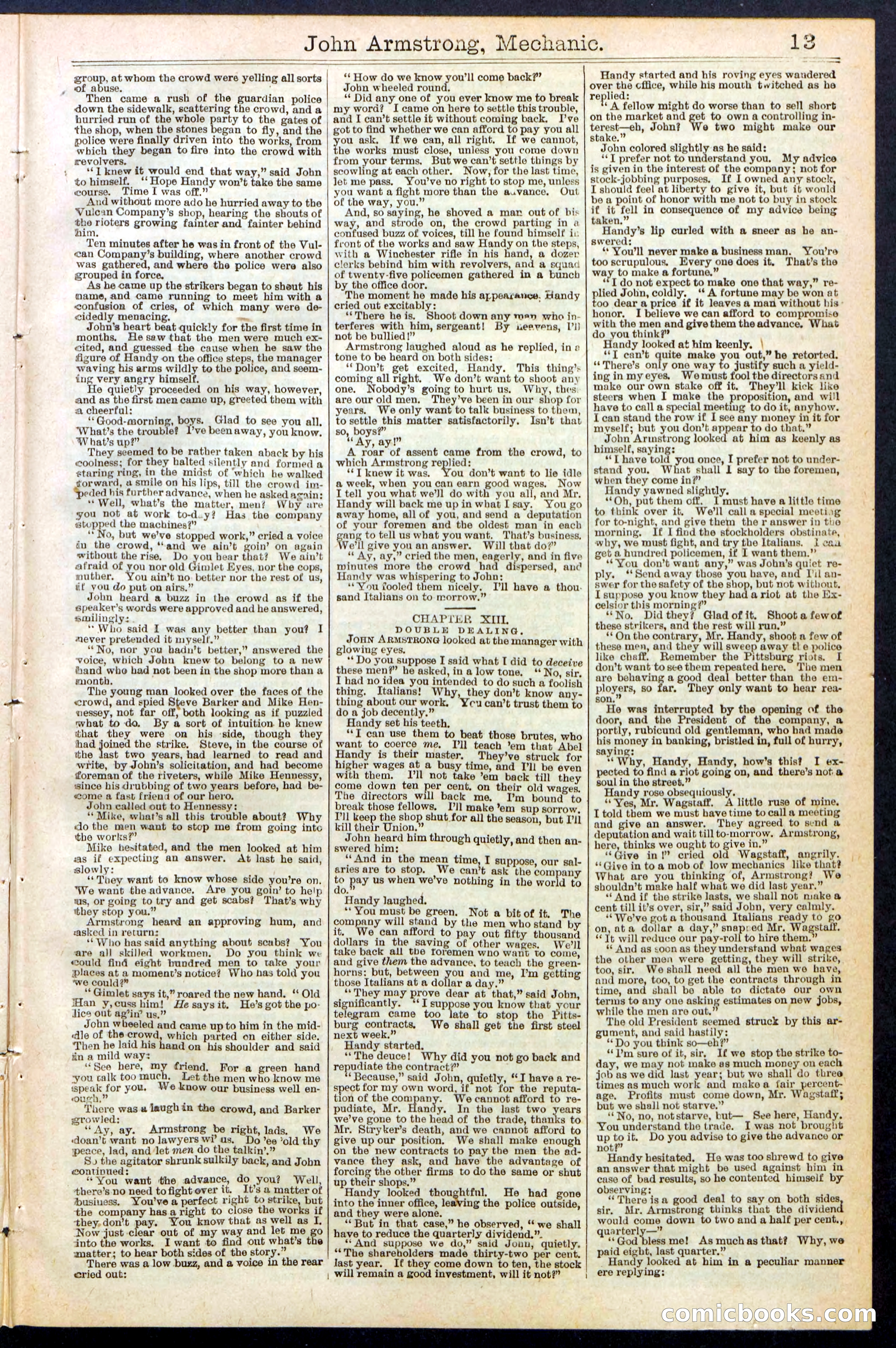
A restored page from Pulp Fiction, 1886. Page through the whole issue in the reader above.
📄 Transcribed text from this page (OCR, searchable)
Machine-transcribed from the original scan — historical spelling and the odd misread are preserved.
ppm EEE -_—s ee . to himself. John Armstrong, Mechanic. Nene ees $e group, at whom the crowd were yelling all sorts of abuse. Then came a rush of the guardian police down the sidewalk, scattering the crowd, and a | burried run of the whole prey to the gates of | the shop, when the stones began to fly, and the police were finally driven into the works, from which they began to fire into the crowd with revolvers ‘‘] knew it would end that way,” said John ‘‘Hope Handy won’t take the same course. Time I was off.” And without more ado he hurried away to the Vulcan Company’s shop, hearing the shouts of the rioters growing fainter and fainter behind Him. Ten minutes after he was in front of the Vul- can Company’s building, where another crowd was gathered, and where the police were also grouped in force, As he came up the strikers began to sheut his mame, and came running to meet him with a confusion of cries, of which many were de- cidedly menacing. ~ John’s heart beat quickly for the first time in months, Hesew that the men were much ex- cited, and guessed the cause when he saw the figure of Handy on the office steps, the manager waving his arms wildly to the police, and seem- ing very angry himself. He quietly proceeded on his way, however, and as the first men came up, greeted them with a cheerful: ‘‘Good-morning, boys. Glad to see you all, ‘What's the trouble? 1’ve beenaway, you know. W hat’s up?” They seemed to be rather taken aback by his coolness; for they halted silently and formed a staring ring, in the midst of ‘which he walked ¢orward, a smile on his lips, till the crowd im- eded his further advance, when he asked acain: ‘Well, what’s the matter, men? Why are you not at work to-d.y? Has the company etupped the machines?” _ ‘* No, but we've stopped work,” cried a voice du the crowd, ‘and we ain’t goin’ on again without the rise, Do you bear that? We ain’t afraid of you nor old Gimlet Eyes, nor the cops, muther, ‘You ain’t no. better nor the rest of us, if you do put on airs,” John heard a buzz in the crowd as if the speaker's words were approved and he answered, samilingly: ‘Who said I was any better than you? I never pretended it myself.” ‘No, nor you hadn’t better,” answered the voice, which John knew to belong to a new hand who had net been in the shop more than a month, The young man looked over the faces of the «crowd, and spied Steve Barker and Mike Hen- wessey, not far off, both looking as if puzzled what to do. By a sort of intuition he knew that they were on his ‘side, though they had org the strike. Steve, in the course of tthe Jast two years, had learned to read and write, by John’s solicitation, and had become foreman of the riveters, while Mike Hennessy, since his drubbing of two years before, had be- «come a fast friend of our hero, John called out to Hennessy: ** Mike, what’s all this trouble about? Why do the men want to stop me from going intc the works?” Mike hesitated, and the men looked at him as if expecting an answer. At last he said, slowly: “They want to know whose side you’re on, ‘We want the advance, Are you goin’ to help us, or going to try and get scabs? That’s why tthey stop you,” Armstrong heard an approving hum, and masked in return: ‘Who has said anything about scabs? You are all skilled workmen. Do you think we eould find eight hundred men to take your places at a momenv’s notice? Who has told you we could?” ‘* Ginlet says it,” roared the new hand. “ Old iHan y,cuss him! Hesaysit. He’s got the po- lice out ag’in’ us,” John wheeled and came up to him in the mid- «ile of the crowd, which parted on either side. Then he laid his hand on his shoulder and said in a mild way: ‘See here, my friend. For a green hand ‘you talk toomuch, Let the men who know me speak for you. We know our business well en- ouch, : ae was wu laughin the crowd, and Barker wrowled: “Ay, ay. Armstrong be right, lads. ‘doan’t want no lawyers wi us. Do’ee ‘old thy peace, lad, and let men do the talkin’,” So the agitator shrunk sulkily back, and Jobn continued: “You want the advance, do you? Well, there’s no need tofightover it. It’s a matter of busiuess. You've a perfect right to strike, but the company hasa right to close the works if they,don’t pay, You know that as well as I, Now just clear out of my way and let me Bo into the works. I want to find out what's the matter; to hear both sides of the story.’ There was a low buzz, and a voice in the rear cried out: ** How do we know you'll come back?” Jobn wheeled round, ‘¢ Did any one of you ever know me to break my word? I came on here to settle this trouble, and I can’t settle it without coming back. I’ve got to find whether we can afford to pay you all you ask, If we can, all right. If we cannot, he works must close, unless you come down from your terms, But we can’t settle things by scowling at each other. Now, for the last time, Jet me pass. You’ve no right to stop me, unless you want a fight more than the auvance, Out of the way, you.” And, so saying, he shoved a mar out of bis way, and strode on, the crowd parting in a confused buzz of voices, till he found himself ic front of the works and saw Handy on the steps, with a Winchester rifle in his hand, a dozer clerks bebind bim with revolvers, and a squad of twenty-five policemen gathered in a bunch by the office door. The moment he made his appearance. Handy cried out excitably: ‘There he is. Shoot down any men who in- terferes with him, sergeant! By ueevens, I'l) not be bullied!” Armstrong laughed aloud as he replied, in a tone to be heard on both sides; “Don’t get excited, Handy. This thing’s coming all right. We don’t want to shoot any one. Nobody’s going to hurt us, Why, thes are our old men, They’ve been in our shop for years. We only want to talk business to them, to settle this matter satisfactorily. Isn’t that so, boys?” “ Ay, ay 1” A roar of assent came from the crowd, to which Armstrong replied: **T knew it was, ou don’t want to lie idle a week, when you can earn good wages. Now I tell you what we’Jl do with you all, and Mr. Handy will back me upin what I say. You go away home, all of you, and send a deputation of your foremen and the oldest man in each ang to tellus what you want. That’s business, Ve'll give you an answer. Will that do?” “Ay, ay,” cried the men, eagerly, and in five minutes more the crowd had dispersed, anc Handy was whispering to John: ‘You fooled them nicely, Ill have a thou. sand Italians on to morrow.” CHAPTER XIII DOUBLE DEALING, JoHN ARMSTRONG looked at the manager with glowing eyes, ** Do you suppose I said what I did to deceive these men?” he asked, in a low tone, ‘No, sir, I had no idea you intended to do such a foolish thing, Italians! Why, they don’t know any- thing about our work, Ycu can’t trust them to do a job decently.” Handy set his teeth, ‘IT can use them to beat those brutes, who want to coerce me, [ll teach ’em that Abel Handy is their master, They’ve struck for higher wages at a busy time, and I’ll be even with them. Ill not take ’em back till they come down ten per cent. on their old wages, The directors will back me, I’m bound to break those fellows, I'll make ’em sup sorrow. Pll keep the shop shut for all the season, but ’ll kill their Union,” John heard him through quietly, and then an- ee A ae h ‘And in the mean time, I suppose, our gsal- aries are to stop. We can't ank the com any "i pay us when we’ve nothing in the world to 0. Handy laughed. ** You must be green. Not a bitof it, The company will stand by the men who stand by it. We can afford to pay out fifty thousand dollars in the saving of other wages. We’ll take back all tbe foremen wno want to come, and give them the advance, to teach the green- horns: but, between you and me, I’m getting those Italians at a dollar a day,” “They may prove dear at that,” said Jobn, pasar ** IT suppose you know that your telegram came too late to stop the Pitts- burg contracts, We shall get the first steel next week,” Handy started. ‘The deuce! Why did you not go back and repudiate the contract?” ‘ Because,” said John, quietly, ‘I have a re- spect for my own word, if not for the reputa- tion of the company. We cannot afford to re- pudiate, Mr. Handy. In the last two years we’ve gone to the head of the trade, thanks to Mr. Stryker’s death, and we cannot afford to give up our position, We shall make enough on the new contracts to pay the men the ad- vance they ask, and have the advantage of forcing the otber firms to do the same or shut up their shops.” Handy looked thoughtful. He had gone into the inner office, leaving the police outside, and they were alone. ‘*But in that case,” he observed, ‘* we shall have to reduce the quarterly dividend.”. **And suppose we do,” said Joun, quietly. ‘**The shareholders made thirty-two per cent. Jast year. If they come down to ten, the stock will remain a good investment, will it not?” 13 wenn ~+-~—~- ee -— —- = Handy started and his roving eyes wandered over the cftice, while his mouth twitched as he replied: h A fellow might do worse than to sell short on the market and get to own a controlling in- terest—eh, John? e two might make our stake.” John colored slightly as he said: ‘*T prefer not to understand you. My advice is given in the interest of the company; not for stock-jobbing purposes. If 1 owned any stock I should feel at liberty to give it, but it woul be a point of honor with me not to buy in stock if it fell in consequence of my advice being taken,” Handy’s lip curled with a sneer as he an- swered: ‘* You'll never make a business man. You're too scrupulous. Every one does it, That’s the way to make a fortune,” **T do not expect to make one that way,” re- plied John, coldly, ‘‘ A fortune may be won at too dear a price if it leaves a man without his’ honor. I believe we can afford to compromise with the men and give them the advance, What do you think?’ Handy looked at him keenly. | ‘“*T can’t quite make you out,” he retorted. **There’s only one way to justify such a yield- ing inmyeyes. Wemust fool the directors and make our own stake off it. They’ll kick like steers when I make the proposition, and will have to call a special meeting to do it, anyhow. I can stand the row if I see any money in it for myself; but you don’t appear to do that,” John Armstrong looked at him as keenly as himself, saying: ‘‘T have told you once, I prefer not to under- stand you. What shall 1 say to the foremen, when they come in?” Handy yawned slightly. ‘Oh, put them off. I must have a little time to think over it. We'll calla special meeting for to-night, and give them the r answer in tie morning, If I find the stockholders obstinate, | why, we must fight, and try the Italians. | caa get a hundred policemen, it I want them.” ‘*'You don’t want any,” was John’s quiet re- ply. ‘Send away those you have, and lil an- swer for the safety of the shop, but not without, I suppose you know they hada riot at the Ex- celsior this morning?” ‘*No, Didthey? Glad ofit. Shoot a fewof these strikers, and the rest will run,” **On the contrary, Mr. Handy, shoot a few of these men, and they will sweep away tl e police like chaff. Remember the Pittsburg riots. I don’t want to see them repeated here, The men are behaving a good deal better than the em- ployers, 80 far. They only want to hear rea- son, He was interrupted by the opening of the door, and the President of the company, a portly, rubicund old gentleman, who had made his money in banking, bristled in, full of hurry, saying: ‘““Why, Handy, Handy, how's this? I ex- pected to find a riot going on, and there’s nota soul in the street,” Handy rose obsequiously,. } “Yes, Mr. Wagstaff. A little ruse of mine. I told them we must have time to call a meeting and give an answer, They agreed to send a deputation and wait till to-morrow. Armstrong, here, thinks we ought to give in.” ‘Give in!” cried old Wagstaff, angrily. ‘(Give in toa mob of low mechanics like that? What are you thinking of, Armstrong! We | shouldn’t make half what we did last year,” ‘‘ And if the strike lasts, we shall not makea cent till it’s over, sir,” said John, very calmly. ‘“Woe'’ve got a thousand Italians ready to ae on, ata dollar a day,” snapred Mr. Wagstalf. ‘¢ Tt will reduce our pay-roll to hire them.” ** And as soon as they understand what wages the other men were getting, they will strike, too, sir. Weshall need all the men we have, and more, too, to get the contracts through in time, and shall be able to dictate our own terms to any one asking estimates on new jobs, while the men are out,’ Sar The old President seemed struck by this ar- gument, and said hastily: Do you think so—eh?” ‘‘’m sure of it, sir, If we stop the strike to- day, we may not make as much money on each job as we did last year; but we shall do three times as much work and makea fair percent- age. Profits must come down, Mr. Wagstaff; but we shall not starve.” ‘‘No, no, notstarve, but— See here, Handy, You understand the trade. I was not brought up to it. Do you advise to give the advance or Handy hesitated, He was too shrewd to give an answer that might be used against him in case of bad results, so he contented himself by observing: ‘There isa good deal to say on both sides sir. Mr. Armstrong thinks that the dividen would come down to two and a half per cent.,. i eytterly ‘*God bless me! As muchas that? Why, we paid eight, last quarter.” _ Handy looked at him in a peculiar manner | ere replying: - GOmichboo (C cS €or a eS