
Pulp Fiction, 1886 · page 12 of 32
Beadle's New York Dime Library, No. 378 — page 12: what you’re looking at
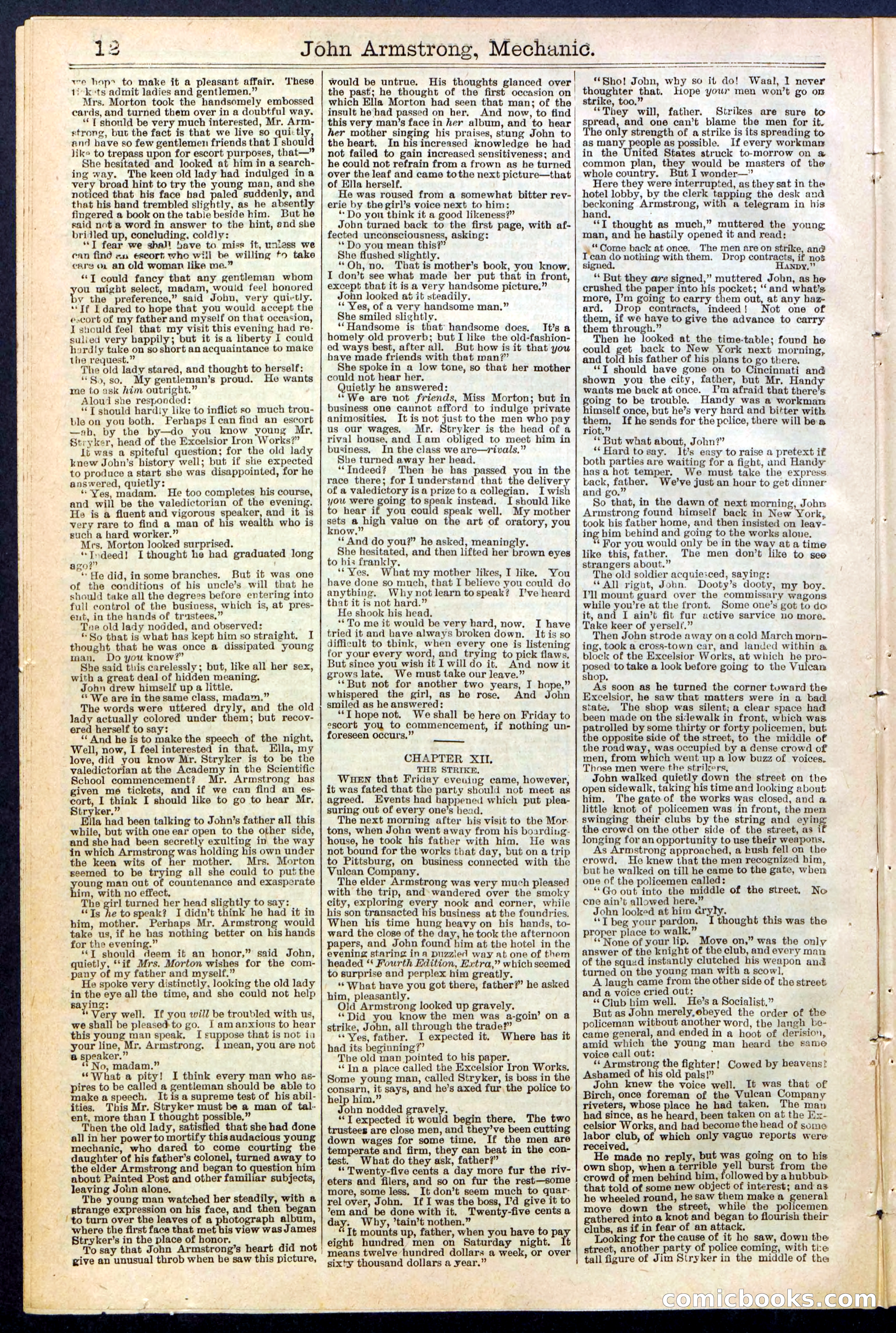
A restored page from Pulp Fiction, 1886. Page through the whole issue in the reader above.
📄 Transcribed text from this page (OCR, searchable)
Machine-transcribed from the original scan — historical spelling and the odd misread are preserved.
wre hop» to make it a pJeasant affair. ‘These 1i-k ts admit ladies and gentlemen,” Mrs. Morton took the handsomely embossed cards, and turned them over in a doubtful way. *‘ { should be very much interested, Mr. Arm- strong, but the fact is that we live so quictly and have so few gentlemen friends that I should like to trepass upon for escort purposes, that—” She hesitated and looked at him in a search- ing way. The keen old lady had indulged ina very broad hint to try the young man, and she noticed that his face had paled suddenly, and that his hand trembled slightly, as he absently fingered a book on the tabie beside him. But he said not a word in answer to the hint, and she bridjled up, concluding. coldly: “IT fear we shall have to miss it, unless we ean fine zu eseort who will be willing to take care o an old woman like me.” ‘“‘T could fancy that any gentleman whom rou might select, madam, would feel honored he the preference,” said Jobn, very quictly. ‘Tf I dared to hope that you would accept the e,cort of my father and myself on that occasion, I should feel that my visit this evening had re- sulied very happily; but it isa liberty I could hordly take on soshort an acquaintance to make the request.” The old lady stared, and thought to herself: “So so. My gentleman’s proud. He wants me to ask him outright.” Aloud she responded: ‘*T should hardly like to inflict so much trou- ble on you both. Ferbaps I can find an escort —ah, by the by—do you know young Mr. Stryker, head of the Excelsior ron Works?” li was a spiteful question; for the old lady knew Jobn’s history well; but if she expected to produce a start she was disappointed, for he answered, quietly: : ‘* Yes, madam. He too completes his course, and will be the valedictorian of the evening. He is a fluent and vigorous speaker, and it is very rare to find a man of his wealth who is such a hard worker.” Mrs. Morton looked surprised. ‘Indeed! I thought he had graduated long ago?” “ He did, in some branches. But it was one of the conditions of his uncle’s will that he should take all the degrees before entering into full control of the busivuess, which is, at pres- eut, in the hands of trustees.” Tne old lady nodded, and observed; * So that is what has kept him so straight. I thought that he was once a dissipated young man. Do you know?” She said this carelessly; but, like all her sex, with a great deal of hidden meaning. John drew himself up a little. ‘‘ We are in the same class, madam.” The words were uttered dryly, and the old lady actually colored under them; but recov- ered herself to say: ‘“ And he is to make the speech of the night, Well, now, I feel interested in that. Ella, my love, did you know Mr. Stryker is to be the valedictorian at the Academy in the Scientific School commencement? Mr. Armstrong has given me tickets, and if we can find an es- cort, I think I should like to go to hear Mr, Stryker.” ; Ella had been talking to John’s father all this while, but with one ear open to the other side, and she had been secretly exulting in the way in which Armstrong was holding his own under the keen wits of her mother. Mrs. Morton seemed to be trying all she could to put the oung man out of countenance and exasperate him, with no effect. The girl turned her head slightly to say: “Ts he tospeak? I didn’t think he had it in him, mother. Perhaps Mr, Armstrong would take us, if he has nothing better on his hands for the evening.” **T should deem it an honor,” said John, quietly, ‘if Mrs. Morton wishes for the com- _pany of my father and myself.” He spoke very distinctly, looking the old lady in the eye al] the time, and she could not help saying: i Very well. If you will be troubled with us, we shall be pleased to go. I amanxious to hear this young man speak, I suppose that is not ia your line, Mr. Armstrong. 1 mean, you are not a speaker.” ‘* No, madam.” ‘What a pity! I think every man who as- pires to be called a gentleman should be able to make a speech. It is a supreme test of his abil- ities. This Mr. Stryker must be a man of tal- ent, more than I thought possible,” Then the old lady, satisfied that she had done all in her power to mortify this audacious young mechanic, who dared to come courting the daughter of his father’s colonel, turned away to the elder Armstrong and began to question him about Painted Post and other familiar subjects, leaving John alone. The young man watched her steadily, with a strange expression on his face, and then began _ / to turn over the leaves of a photograph album, where the first face that met his view was James Stryker’s in the place of honor. 3 To say that John Armstrong’s heart did not give an unusual throb when be saw this picture, would be untrue. His thoughts glanced over the past; he thought of the first occasion on which Ella Morton had seen that man; of the insult he had passed on her. And now, to find this very man’s face in her album, and to hear her mother singing his praises, stung John to the heart. In hisincreased knowledge he had not failed to gain increased sensitiveness; and he could not refrain from a frown as he turned over the leaf and came tothe next picture—that of Ella herself. He was roused from a somewhat bitter rev- erie by the girl’s voice next to him: ‘**Do you think it a good likeness?” John turned back to the first page, with af- fected unconsciousness, asking: ‘*Do you mean this?” She flushed slightly. “Oh, no. That is mother’s book, you know. I don’t see what made her put that in front, except that it is a very handsome picture,” John looked at it steadily. ‘* Yes, of a very handsome man.” She smiled slightly. ‘*Handsome is that’ handsome does, It’s a homely old proverb; but I like tke old-fashion- ed ways best, after all. But how is it that you have made friends with that man?’ She spoke in a low tone, so that her mother could not hear her. Quietly he answered: ‘*We are not friends, Miss Morton; but in business one cannot afford to indulge private animosities. It is not just to the men who pay us our wages. Mr. Stryker is the head of a rival house, and [am obliged to meet him in business, In the class we are—rivals,” Sbe turned away her head. ‘‘Indeed? Then he has passed you in the race there; for l understand that the delivery of a valedictory isa prize to a collegian. I wish you were going to em instead. I should like to hear if you could speak well. My mother sets a high value on the art of oratory, you know.” ** And do you?” he asked, meaningly. She hesitated, and then lifted her brown eyes to his frankly. ‘* Yes, hat my mother likes, I like. You have done so much, that I believe you could do anything. Whynotlearntospeak? I’ve heard that it is not hard.” He shook his head. ‘*To me it would be very hard, now. I have tried it and have always broken down. Itis so difficult to think, when every one is listening for your every word, and trying to pick flaws. But since you wish it I will do it. And now it grows late. We must take our leave.” ‘*But not for another two years, I hope,” whispered the girl, as he rose. And John smiled as he answered: ‘*T hope not. Weshall be here on Friday to escort you to commencement, if nothing un- foreseen occurs,” CHAPTER XII, THE STRIKE. WueEn that Friday evening came, however, it was fated that the party should not meet as agreed. Events had happened which put plea- suring out of every one’s head. The next morning after his visit to the Mor. tons, when John went away from his boarding- house, he took his father with him. He was not bound for the works that day, but on a trip to Pittsburg, on business connected with the Vulcan Company. The elder Armstrong was very much pleased with the trip, and» wandered over the smoky city, exploring every nook and corner, while his son transacted his business at the foundries. When his time hung heavy on his hands, to- ward the close of the day, he took the afternoon papers, and John found him at the hotel in the evening staring ina puzzied way at one of them headed ‘‘ Fourth Edition, Extra,” which seemed to surprise and perplex him greatly. ‘* What have you got there, father?’ he asked him, pleasantly. Old Armstrong looked up gravely. ‘‘Did you know the men was a-goin’ on a strike, John, all through the trade?” ‘* Yes, father. I expected it. Where has it had its beginning?’ The old man pointed to his paper. ‘“In a place called the Excelsior Iron Works, Some young man, called Stryker, is boss in the consarn, it says, and he’s axed fur the police to ne him.” ohn nodded grovel ‘‘T expected it would begin there. The two trustees are close men, and they’ve been cutting down wages for some time. If the men are temperate and firm, they can beat in the con- test. What do they ask, father?” ‘“‘ Twenty-five cents a day more fur the riv- eters and filers, and so on fur the rest—some more, some less. It don’t seem much to quar- rel over, John. If I was the boss, I’d give it to ’em and be done with it. Twenty-five cents a day. Why, ’tain’t nothen.” ‘It mounts up, father, when you have to pay eight hundred men on Saturday night. It means twelve hundred dollars a week, or over sixty thousand dollars a year.” John Armstrong, Mechanic. res ee | “Sho! John, why so it do! Waal, 1 never thoughter that. strike, too.” “They will, father. spread, and one can’t blame the men for it. he only strength of a strike is its spreading to as many people as possible. If every workman in the United States struck to-morrow on & common plan, they would be masters of the whole country. But I wonder—” Here they were interrupted, as they sat in the hotel lobby, by the clerk tapping the desk and a Armstrong, with a telegram in his and. : “I thought as much,” muttered the young man, and he hastily opened it and read: **Come back at once. The men are on strike, an@ Tecan do nothing with them. Drop contracts, if nos signed, Hanpy,.” ** But they @re signed,” muttered John, as he crushed the paper into his pocket; ‘‘ and what’s more, I’m going to carry them out, at any haz- ard. Drop contracts, indeed! Not one of them, if we have to give the advance to carry them through.” Then he looked at_the time-table; found he could get back to New York next morning, and told his father of his plans to go there. ‘‘T should have gone on to Cincinnati and shown you the city, father, but Mr, Handy wants me back at once. I’m afraid that there's going to be trouble. Handy was a workman himself once, but he’s very hard and bitter with rahi, If he sends for the pclice, there will bea riot. ** But what about, John?” *‘Hard tosay. It’s easy to raise a pretext if both parties are waiting for a fight, and Handy has a hot temper. We must take the express back, father. We've just an hour to get dinner and go.” So that, in the dawn of next morning, John Armstrong found himself back in New York, took his father home, and then insisted on leay- ing him behind and going to the works aloue. ‘For you would only be in the way at a time like this, father. The men don’t like to seo strangers about.” The old soldier acquiesced, saying: ‘* All right, John. Dooty’s dooty, my boy. I'll mount guard over the commissary wagons while you’re at the front. Some one’s got to do it, and I ain’t fit fur active sarvice no more. Take keer of yerselt.” Then John strode away onacold March morn- ing, took a cross-town car, and landed within a block of the Excelsior Works, at which he pro- paved to take a look before going to the Vulcan shop. As soon as he turned the corner tuward the Excelsior, he saw that matters were in a bad state. The shop was silent; a clear space had been made on the sidewalk in front, which was patrolled by some thirty or forty policemen, but the opposite side of the street, to the middle of the roadway, was occupied by a dense crowd of men, from which went up a low buzz of voices. Those men were the strilrers, John walked quietly down the street on the open sidewalk, taking his time and looking about him. The gate of the works was closed, and a little knot of policemen was in front, the men swinging their clubs by the string and eyin the crowd on the other side of the street, as i longing for an opportunity to use their weapons, As Armstrong approached, a bush fell on the crowd, He knew that the men recognized him, but be walked on till he came to the gate, when ove of the policemen called: ‘‘Go out into the middle of the street, No cne ain’t allowed here.” John looked at him aryly. . “T beg your pardon, I thought this was the proper place to walk.” ‘*None of your lip. Move on,” was the only answer of the knight of the club, and every man of the squed instantly clutched his weapon and turned on the young man with a scowl. A Jaugh came from the other side of the street and a voice cried out: ‘‘Club him well. He’s a Socialist.” But as John merely,ebeyed the order of the policeman witkout another word, the langh be- came general, and ended in a hoot of derision, amid which the young man heard the same voice call out: ‘¢ Armstrong the fighter! Cowed by heavens! Ashamed of his old pals!” John knew the voice well. Tt was that of Birch, once foreman of the Vulcan Company riveters, whose place he had taken. The man had since, as he heard, been taken on at the Ex- celsior Works, and had become the head of some labor club, of which only vague reports were received, ~ : He made no reply, but was going on to his own shop, when a terrible yell burst from the crowd of men behind bim, followed by a hubbub. that told of some new object of interest; and as he wheeled round, he saw them make a general move down the street, while the policemen gathered into a knot and began to flourish their clubs, as if in fear of an attack. Looking for the cause of it he saw, down the street, another party of police coming, with tre tall figure of Jim Stryker in the middle of the kiope your men won’t go on Strikes are sure to GoOmilcbooks. (C Gc