
Pulp Fiction, 1886 · page 14 of 32
Beadle's New York Dime Library, No. 378 — page 14: what you’re looking at
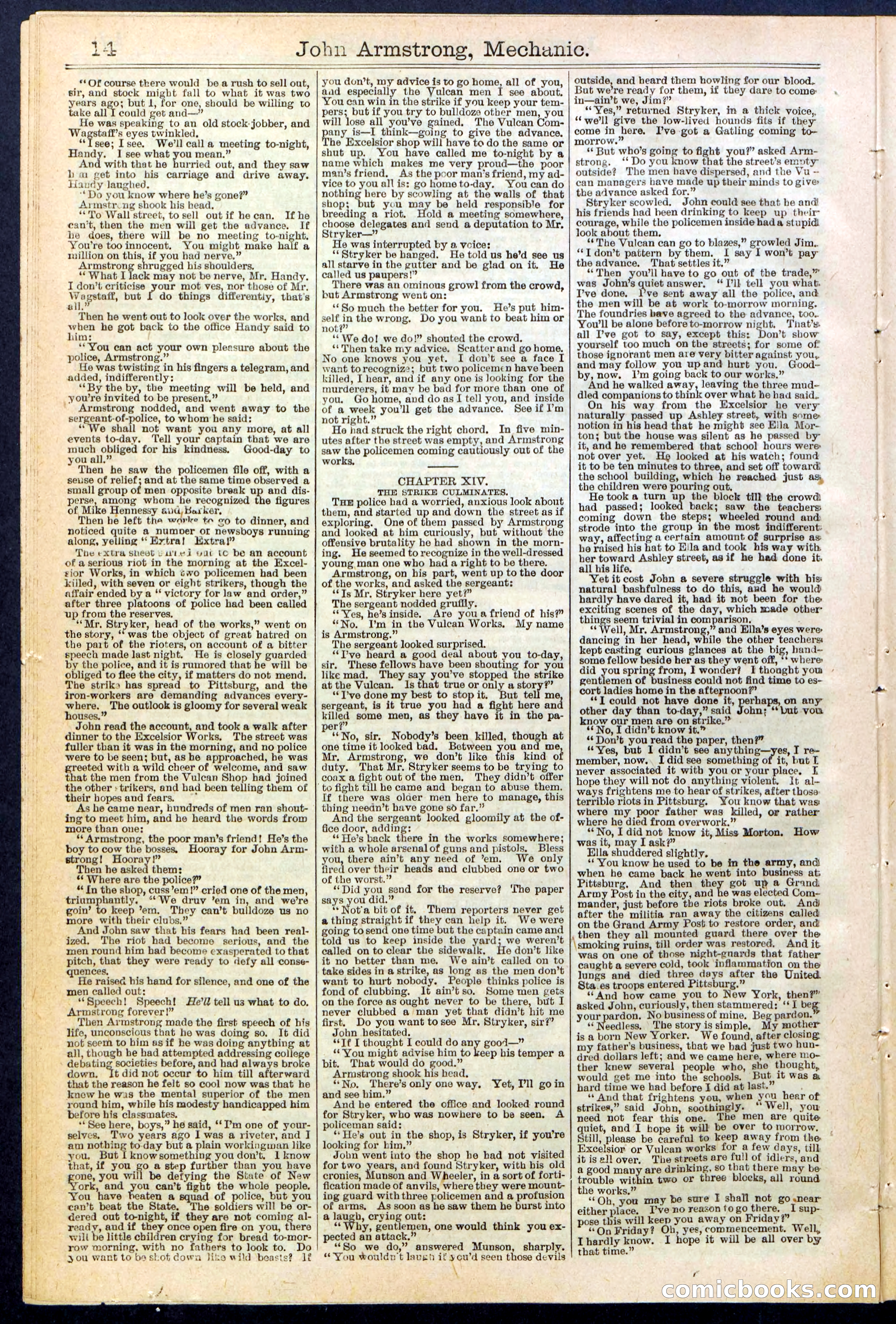
A restored page from Pulp Fiction, 1886. Page through the whole issue in the reader above.
📄 Transcribed text from this page (OCR, searchable)
Machine-transcribed from the original scan — historical spelling and the odd misread are preserved.
—_— ————-e- += - you. : pets you wi **Of course there would be a rush to sell out, sir, and stock might fall to what it was two years ago; but 1, for one, should be willing to take all I could get and—” He was speaking to an old stock-jobber, and Wagstaff’s eyes twinkled, “‘Tsee; I see, We'll calla meeting to-night, Handy. I see what you mean.” And with that he hurried out, and they saw lh m get into his carriage and drive away. Haudy laughed. ‘Do you know where he’s gone?” Armstrcng shook his head, *“'To Wall street, to sell out if hecan. If he can’t, then the men will get the advance. If he does, there will be no meeting to-night, Youw’re too innocent, You might make half a million on this, if you had nerve.” Armstron shrugged his shoulders, ‘What I lack may not be nerve, Mr. Handy. I don’t criticise your mot ves, nor those of Mr. RA ecrta but I do things differentiy, that's u -_ ~_ Then he went out to look over the works, and shee he got back to the office Handy said to im: ‘You can act your own pleasure about the police, Armstrong.” He was twisting in his fingers a telegram, and added, indifferently: ‘*By the by, the meeting will be held, and you’re invited to be present,” Armstrong nodded, and went away to the sergeant-of-police, to whom he said: “We shall not want you any more, at all events to-day. Tell your captain that we are Shee gan for his kindness. Good-day to you all, Then he saw the policemen file off, with a seuse of relief; and at the same time observed a small group of men opposite break up and dis- perse, among whom he recognized the figures of Mike Hennessy aud, Barker, Then he left tha warke te eo to dinner, and noticed a a numoer Of newsboys running along, yelling ‘Extra! Mxtra!” The extra sheet vuiei vat tc be an account of a serious riot in the morning at the Excel- sior Works, in which éwo policemen had been killed, with seven or eight strikers, though the affair ended by a “‘ victory for law and order,” after three platoons of police had been called ‘up from the reserves, “Mr. Stryker, head of the works,” went on the story, ‘* was the object of great hatred on the pait of the rioters, on account of a bitter speech made last night. He is closely guarded by the police, and it is ramored that he will be obliged to flee the city, if matters do not mend, The striko has spread to Pittsburg, and the iron-workers are demanding advances every- where, The outlook is gloomy for several weak houses,” Jobn read the account, and took a walk after dinner to the Excelsior Works, The street was fuller than it was in the morning, and no police were to be seen; but, as he approached, he was reeted with a wild cheer of welcome, and saw t the men from the Vulcan Shop had joined : _ the other : trikers, and bad been telling them of their hopes and fears. As he came near, hundreds of men ran shout- ing to meet him, and he heard the words from more than one: ** Armstrong, the poor man’s friend! He’s the boy to cow the bosses, Hooray for John Arm- strong! Hooray!” Then he asked them: *“‘ Where are the police?” ** In the shop, cuss’em!” cried one of the men, triumphantly. “‘We druv ’em in, and we’re goin’ to keep ’em, They can’t bulldoze us no more with their clubs,” _ And John saw that his fears had been real- ized. The riot had become serious, and the men round him had become exasperated to that pitch, that they were ready to defy all conse- quences, raisea his hand for silence, and one of the men called out: _ “Speech! Speech! He'll tell us what to do. Armstrong forever!” Then Armstrong made the first speech of his life, unconscious that he was doing so, It did not seem to him asif he was doing anything at all, though he had attempted addressing college . Senating. societies before, and had always broke down, It did not occur to him till afterward that the reason he felt so cool now was that he knew he was the mental superior of the men round him, while his modesty handicapped him before his classmates. ** See here, boys,” he said, ‘‘ I’m one of your- selves. Two years ago I was a riveter, and J am nothing to-day but a plain workingwan like But [ knowsomething you don’t, I know that, if you f° a step further than you have be defying the State of New ork, and you can’t fight the whole people, You have beaten a squad of police, but you can’t beat the State. The soldiers will be or- dered out to-night, if they are not coming al- ready, and if they once open fire on you, there will be little children crying for bread to-mor- row morning, with no fathers to look to. Do you want to ba shof Gowa Jike wild beasts? If John Armstrong, Mechanic. you don’t, my advice is to go home, all of you, aad especially the Vulcan men I see about, ‘You can win in the strike if you keep your tem- pers; but if you try to bulldoze other men, you will lose all you’ve gained, The Vulcan Com- pany. is—I think—going to give the advance. he Excelsior shop will have to do the same or shut up. You have called me to-night by a name which makes me very proud—the poor man’s friend. As the poor man’s friend, my ad- vice to you allis: go hometo-day. You can do eat hah by scowling at the walls of that shop; but you may be held responsible for breeding a riot. old a meeting somewhere, choose delegates and send a deputation to Mr, Stryker—” He was interrupted by a vcice: ‘‘Stryker be hanged. He told us he’d see us all starve in the gutter and be glad on it. He called us paupers!” There was an ominous growl from the crowd, but Armstrong went on: ‘*So much the better for you. He’s put him- self in the wrong. Do you want to beat him or not? ‘* We do! we do!” shouted the crowd, ‘‘Then take my advice. Scatter and go home. No one knows you yet. I don’t see a face I want torecognize; but two policemen have been killed, I hear, and if any one is looking for the murderers, it may be bad for more than one of you. Go home, and do as I tell you, and inside of a week you'll get the advance. See if I’m not right.” ; He had struck the right chord, In five min- utes after the street was empty, and Armstrong saw the policemen coming cautiously out of the works, CHAPTER XIV. THE STRIKE CULMINATES. Tum police had a worried, anxious look about them, and started up and down the street as if exploring. One of them passed by Armstrong and looked at him curiously, but without the offensive brutality he had shown in the morn- ing. He seemed to recognize in the well-dressed young man one who had a right to be there. Armstrong, on his part, went up to the door of the works, and asked the sergeant: ‘Ts Mr, Stryker here yet?” The sergeant nodded gruflly. ‘Yes, he’s inside, Are youa friend of his?” “No. I’m in the Vulcan Works, My name is Armstrong.” 3 The sergeant looked surprised. “T’ve heard a good deal about you to-day, sir. These fellows have been shouting for you like mad. They say you’ve stopped the strike at the Vulcan. Is that true or only a story?’ ‘*T’ve done my best to ben it. But tell me sergeant, is it true you had a fight here and killed some men, as they have it in the pa- er?” ** No, sir. Nobody’s been killed, though at one time it looked bad. Between you and me Mr. Armstrong, we don’t like this kind of duty. That Mr, Stryker seems to be trying to coax a fight out of the men, They didn’t offer ‘to fight till he came and began to abuse them. If there was olaer men here to manage, this thing needn’t have gone sd far.” And the sergeant looked gloomily at the of- fice door, adding: ‘* He’s back there in the works somewhere; with a whole arsenalof guns and pistols. Bless you, there ain’t any need of ’em, We only fired over their heads and clubbed one or two of the worst.” ‘‘Did you send for the reserve? ‘Tho paper says you did.” ** Not'a bit of it. Them reporters never get a thing straight if they can help it. We were going tosend one time but the captain came and told us to keep inside the yard; we weren't \ smoking ruins, till order was restored, And it called on to clear the sidewalk. He don’t like it no better than me, We ain’t called on to take sides in a strike, as long as the men don’t want to hurt nobody. People thinks police is fond of clubbing. It ain’tso. Some men gets on the force as ought never to be there, but I never clubbed a man yet that didn’t hit me first. Do you want tosee Mr, Stryker, sir?” John hesitated. “Tf I thought I could do any gool—” ‘““You might advise him to keep his temper a bit. That would do good.” Armstrong shook his head, ‘“‘No. There’s only one way, Yet, Pll goin and see him.” And he entered the office and looked round for Stryker, who was nowhere to be seen. A policeman said: , ‘**Ffe’s out in the shop, is Stryker, if you’re looking for him,” John went into the shop be had not visited for two years, and found Stryker, with his old cronies, Munson and Wheeler, in a sort of forti- fication made of anvils, where they were mount- ing guard with three policemen and a profusion of arms, As soon as he saw them he burst into a ing» crying out: ‘“*Why, gentlemen, one would think you ex- pected an attack.” ‘““So we do,” answered Munson, sharply. “You wouldn't laveh if you'd seen those devils outside, and heard them howling for our blood. But we’re ready for them, if they dare to come: in—ain’t we, Jim?” “Yes,” returned Stryker, in a thick voice,, ‘we'll give the low-lived hounds fits if they come in here, Pve got a Gatling coming to- morrow.” ‘* But who’s going to fight you?” asked Arm- strong. ‘*‘ Do you know that the street’s empty outside? The men have dispersed, and the Vu ~ can managers bave made up their minds to give the advance asked for.” Stryker scowled. John could see that be and his friends had been drinking to keep up their courage, while the policemen inside had a stupid. look about them, ‘*'The Vulcan can go to blazes,” growled Jim.. ‘“‘T don’t pattern by them. I say I won’t pay the advance. That settles it.” “Then you'll have to go out of the trade,” was John’s quiet answer, “ J’ll tell you what. I’ve done, lve sent away all the police, and the men will be at work to-morrow morning. The foundries bave agreed to the advance, too. You'll be alone before to-morrow night, That’s all I’ve got to say, except this: Don’t show yourself too much on the streets; for some of: those ignorant men are very bitter against you, and may follow you upand hurt you. Good-- by, now. I’m going back to our works,” And he walked away, leaving the three mud- dled companions to think over what he had said. On his way from the Excelsior he very naturally passed up Ashley street, with some notion in his head that he might see Ella Mor- ton; but the house was silent as he passed by it, and he remembered that school hours were not over yet. He looked at his watch; found it to be ten minutes to three, and set off toward the school building, which he reached just asi, the children were pouring out, He took a turn ar the block till the crowd had passed; looked back; saw the teachers: coming down the steps; wheeled round and strode into the group in the most indifferent: way, affecting a certain amount of surprise as he raised his hat to Hila and took his way with her toward Ashley street, as if he had done it. all his life, Yet it cost John a severe struggle with bis: natural bashfulness to do this, and he would hardly have dared it, had it not been for the exciting scenes of the day, which made other things seem trivial in comparison. ; ‘Well, Mr. Armstrong,” and Ella’s eyes were dancing in her head, while the other teachers: kept casting curious glances at the big, hand— some fellow beside her as they went off, ‘* where did you spring from, I wonder? I thought yow ohathonien of business could not find time to es- cort ladies home in the afternoon?” **T could not have done it, perhaps, on any other day than to-day,” said John; ** but vou know our men are on strike.” ‘No, I didn’t know it.” ‘¢Don’t you read the paper, then?” “Yes, but I didn’t see anything—yes, I re- member, now.. I did see something of it, but TE never associated it with you or your place, hope they will not do anything violent. It al- ways frightens me to hear of strikes, after those terrible riots in Pittsburg. You know that was where my poor father was killed, or rather where he died from overwork.” ‘No, I did not know it, Miss Morton, How was it, may I ask?” Ella shuddered slightly. ‘‘-You know he used to be in the army, and when he came back he went into business ats Pittsburg, And then aed got up a Grand Arwy Post in the city, and he was elected Com- mander, just before the riots broke out. Andi after the militia ran away the citizens called on the Grand Army Post to restore order, and then they all mounted guard there over the was on one of those night-gnards that father caught a severe cold, took inflammation on the lungs and died three days after the United Sta.es troops entered Pittsburg.” ‘‘And how came you to New York, then?” asked John, curiously, then stammered: ‘I be your pardon, No business of mine, Beg pardon. ‘Needless, The story is simple, My mother is a born New Yorker. We found, after closing my father’s business, that we had just two hun- dred dollars left; and we came here, where mo- ther knew several people who, she thought, would get me into the schools. But it was hard time we had before I did at last. ' “And that frightens you, when you hear of strikes,” said John, soothingly. ‘ Well, you need not fear this one. The men are quite quiet, and I hope it will be Over to morrow, Still, please be careful to keep away from the ° Excelsior or Vulcan works for a few days, till it is ell over, The streets are full of idlers, and a good mapy are drinking, so that there may be trouble within two or three blocks, all round the works,” ‘Oh, you may be sure I shall not go.near either place. [ve no reason togo there, I sup- pose this will keep you away on Friday?” “On Friday? Ob, yes, commencement. Well, I hardly know. I hope it will be all over by that time.” r .OOKS Gomic