
Pulp Fiction, 1886 · page 11 of 32
Beadle's New York Dime Library, No. 378 — page 11: what you’re looking at
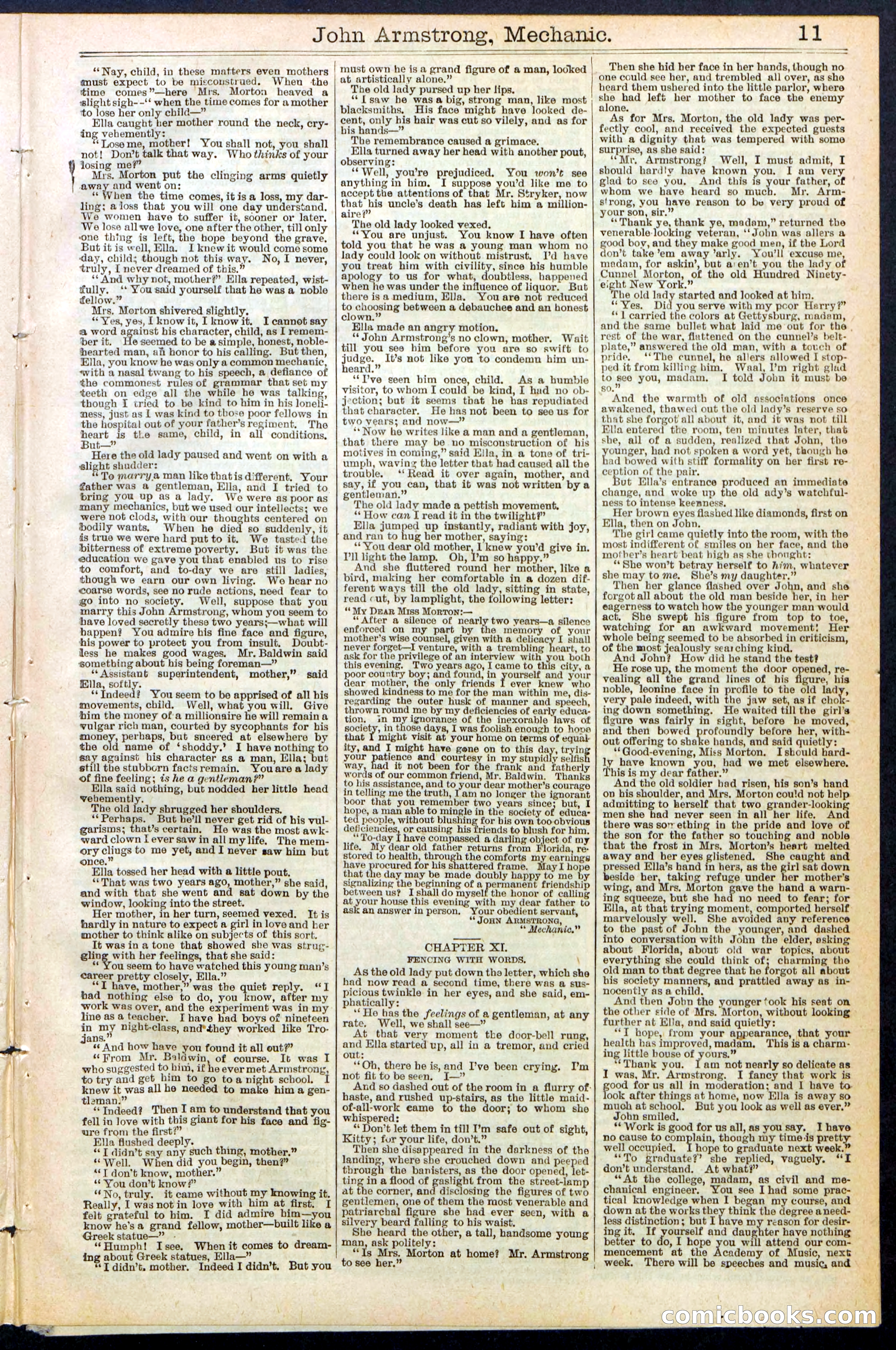
A restored page from Pulp Fiction, 1886. Page through the whole issue in the reader above.
📄 Transcribed text from this page (OCR, searchable)
Machine-transcribed from the original scan — historical spelling and the odd misread are preserved.
auto —— ES ‘*Nay, child, in these matters even mothers must expect to be misconstrued. When the time comes”—here Mrs. Morton heaved a slight sigh--‘‘ when the time comes for a mother to lose her only chila—” Ella caught ber mother round the neck, cry- ing vehemently: ‘Lose me, mother! You shall not, you shall not! Don’t talk that way. Whothinks of your losing me?” Mrs, Morton put the clinging arms quietly away and went on: “When the time comes, itis a loss, my dar- ling; a loss that you will one day understand, We women have to suffer it, sooner or later, We lose all we love, one after the other, till only one thing is left, the hope beyond the grave, But it is well, Ella. I knewit would come some day, child; though not this way. No, I never, truly, [ never dreamed of this.” ‘‘And why not, mother?” Ella repeated, wist- fully. ‘* You said yourself that he was a noble fellow.” Mrs. Morton shivered slightly, “Yes, yes, [know it, Iknowit. I cannot say a word against his character, child, as I remem- ber it. Heseemed to be a simple, honest, noble- hearted man, ah honor to his calling. But then, Ella, you know he was only a common mechauic, with a nasal twang to his speech, a defiance of the commonest rules of grammar that set my teeth on edge all the while he was talking, though I tried to be kind to him in his loneli- mess, just as L was kind to those poor fellows in the hospital out of your father’s regiment, The heart is the same, child, in all conditions, But—” Here the old lady paused and went on with a slight shudder: “To marry a man like thatis different. Your father was a gentleman, Ella, and I tried to bring you up as a lady. We were as poor as many mechanics, but we used our intellects; we were not clods, with our thoughts centered on bodily wants. When he died so suddenly, it is true we were hard put to it. We tasted the bitterness of extreme poverty. But it was the education we gave you that enabled us to rise to comfort, and to-day we are still ladies, though we earn our own living. We hear no coarse words, see no rude actions, need fear to go into no society. Well, suppose that you marry this John Armstrong, whom you seem to have loved secretly these two years;—what will bappen? You admire his fine face and figure, his power to protect you from insult. Doubt- less he makes good wages. Mr. Baldwin said something about his being foreman—” ‘* Assistant superintendent, mother,” said Ella, igi ‘*TIndeed? You seem to be apprised of all his movements, child. Well, what you will, Give him the money ofa millionaire he will remaina vulgar rich man, courted by sycophants for bis money, perhaps, but sneered at elsewhere by the old name of ‘shoddy.’ I have nothing to gay against his character as a man, Ella; but still the stubborn factsremain. Youare a lady of fine feeling; is he a gentleman?” Ella said nothing, but nodded her little head be cee The old lady shrugged her shoulders. ‘*Perhaps. But he’ll never get rid of bis vul- garisms; that’s certain. He was the most awk- ward clown I ever saw in all my life, The mem- ory clings to me yet, and I never saw him but once. Ella tossed her head with a little pout, “‘That was two years ago, mother,” she said, and with that she went and sat down by the window, looking into the street. Her mother, in her turn, seemed vexed. It is hardly in nature to expect a girl in love and her mother to think alike on subjects of this sort. It was in a tone that showed she was strug- eling with her feelings, that she said: ** You seem to have watched this young man’s career pretty closely, Ella.” *“*I have, mother,” was the quiet reply. “I bad nothing else to do, you know, after my work was over, and the experiment was in my line as a teacher. I have had boys of nineteen in my night-class, and*they worked like Tro- ‘¢ And how have you found it all out?” ‘From Mr. Baldwin, of course. It was I who suggested to him, if he ever met Armstrong, to try and get him to go toa night school. I knew it was all he needed to make him a gen- tleman.” ‘Indeed? Then I am to understand that you fell in Jove with this giant for his face and fig- ure from the first?” Ella flushed deeply. ‘“‘T didn’t say any such thing, mother.” ‘‘“ Well. When did you begin, then?” ‘“T don’t know, mother.” “You don’t know?” ‘No, truly. it came without my knowing it. Really, I was not in love with him at first. I felt grateful to him. I did admire him—you rise he’s a grand fellow, mother—built like a reek statue—” - ‘‘Humph! Isee. When it comes to dream- ing about Greek statues, Ella—” “T didn’t. mother. Indeed I didn’t. But you | must own he is a grand figure of a man, looked John Armstrong, Mechanic. CS ene eS at artistically alone.” The old lady pursed up her lips. ‘““Lsaw he was a big, strong man, like most blacksmiths, His face might have looked de- cent, only his hair was cut so vilely, and as for his hands—” Tbe remembrance caused a grimace. Ella turned away her head with another pout, observing: ‘* Well, youre prejudiced, You won’t see anything in him. I suppose you’d like me to accept the attentions of that Mr. Stryker, now that ibis uncle’s death has left him a million- aire ¢ The old lady looked vexed. “You are unjust. You know I have often told you that he was a young man whom no lady could look on without mistrust. Id have you treat him with civility, since his humble apology to us for what, doubtless, happened when he was under the influence of liquor. But there isa medium, Ela. You are not reduced to choosing between a debauchee and an honest clown.” Ella made an angry motion. ‘* John Armstrong’s no clown, mother. Wait till you see him before you are so swift to judge. It’s not like you to condemn him un- heard.” ‘*Yve seen him once, child. As a humble visitor, to whom I could be kind, I had no ob- jection; but it seems that he has repudiated that character. He has not been to see us for two vears; and now—” ‘** Now he writes like a man and a gentleman, that there may be no misconstruction of his motives in coming,” said Ella, in a tone of tri- umph, waving the letter that had caused all the trouble. ‘‘ Read it over again, mother, and say, if you can, that it was not written bya gentleman.” The old lady made a pettish movement, “* How can I read it in the twilight?” Ella jumped up instantly, radiant with joy, and ran to hug her mother, saying: ‘*'You dear old mother, 1 knew you’d give in. Pll light the lamp. Oh, I’m so happy.” And she fluttered round her mother, like a bird, making her comfortable in a dozen dif- ferent ways till the old lady, sitting in state, read cut, by lamplight, the following letter: ‘My Dear Miss Morton:— “After a silence of nearly two years—a silence enforced on my part by the memory of your mother’s wise counsel, given with a delicacy I shall never forget—I venture, with a trembling art. to ask for the privilege of an interview with you both this evening. Two years ago, I came to this city, a oor country boy; and found, in ate. and your ear mother, the only friends I ever knew who showed kindness to me for the man within me, dis- regarding the outer husk of manner and speech, thrown round me by my deficiencies of early educa- tion. in my ignorance of the inexorable laws of society, in those days, I was foolish enough to hope that I might visit at your home on terms of equal ity, and I might have gene on to this day, tryin your patience and courtesy in my stupidly selfis way, had it not been for the frank and fatherly words of our common friend, Mr. Baldwin. Thanks to his assistance, and to your dear mother’s courage in telling me the truth, Tam no longer the ignorant boor that you remember two years since; but, I hope, a man able to mingle in the society of educa- ted people, without blushing for bis own too obvious deficiencies, or causing his friends to blush for him. To-day I have compassed a darling object of my life. My dear old father returns from Florida, ré- stored to health, through the comforts my earnings have procured for his shattered frame. May I hope that the day may be made doubly happy to me by signalizing the beginning of a permanent friendship between us? I shall do myself the honor of calling at your house this evening with my dear father to ask an answer in person, Your obedient servant, ** JOHN ARMSTRONG, ** Mechanic.” CHAPTER XI. FENCING WITH WORDS, \ As the old lady put down tho letter, which she had now read a second time, there was a sus- picious twinkle in her eyes, and she said, em- phatically: ‘* fle has the feelings of a gentleman, at any rate. Well, we shall see—” At that very moment the door-bell rung, and Ella started up, all in a tremor, and cried out: ‘*Oh, there he is, and I’ve been crying. I’m not fit to be seen. J—” And so dashed out of the room in a flurry of. haste, and rushed up-stairs, as the little maid- of-all-work came to the door; to whom shoe whispered: ** Don’t let them in till ’'m safe out of sight, Kitty; for your life, don’t.” Then she disappeared in the darkness of the landing, where she crouched down and peeped through the banisters, as the door opened, let- ting in a flood of gaslight from the street-lamp at the corner, and disclosing the figures of two gentlemen, one of them the most venerable and patriarchal figure she had ever seen, with a silvery beard falling to his waist, She heard the other, a tall, handsome young man, ask politely: “Is Mrs. Morton at home? Mr. Armstrong to see her.” . . - - tl ce et rn ee li —— Then she hid her face in her hands, though no one could see her, and trembled all over, as she heard them ushered into the little parlor, where AA had left her mother to face the enemy alone. As for Mrs. Morton, the old lady was per- fectly cool, and received the expected guests with a dignity that was tempered with some surprise, as she said: ‘*Mr, Armstrong? Well, I must admit, I should hard!y have known you, I am very glad to see you, And this is your father, of whom we have heard so much. Mr, Arm- strong, you have reason to be very proud of your son, sir.” “Thank ye, thank ye, madam,” returned the venerable:looking veteran, ‘‘Jobn was allers a good boy, and they make good men, if the Lord don’t take’em away ’arly. You'll excuse me, madam, for askin’, but a'en’t you the lady of Cunnel Morton, of the old Hundred Ninety- eight New York.” he old lady started and looked at him. “Yes. Did you serve with my peor Harry?” * 1 carried the colors at Gettysburg, madam, and the same bullet what laid me out for the . rest of the war, flattened on the cunnel’s belt- plate,” answered the old man, with a touch of pride, ‘*The cunnel, he allers allowed I stop- ped it from killing bim, Waal, ’m right glad to see you, madam, I told Jobn it must bo so. And the warmth of old associations once awakened, thawed out the old lady’s reserve so that she forgot all about it, and it was not till Eula entered the room, ten minutes later, that she, all of a sudden, realized that John, the ounger, had not spoken a word yet, though he had bowed with stiff formality on her first re- ception of the pair. 3ut Ella’s entrance produced an immediate change, and woke up the old ady’s watchful- ness to intense keenness, Her brown eyes flashed like diamonds, first on Ella, then on Jobn, The girl came quietly into the room, with the most indifferent of smiles on her face, and the mofher’s heart beat high as she thought: **She won’t betray herself to him, whatever she may tome. She’s my daughter.” Then her glance flashed over vol and she forgot all about the old man beside her, in her eagerness to watch how the younger man would act. She swept his figure from top to toe, watching for an awkward movement! Her whole being seemed to be absorbed in criticism, of the most jealously searching kind, And John? How did he stand the test? He rose up, the moment the door opened, re- vealing all the grand lines of his re, his noble, leonine face in profile to the old lady, very pale indeed, with the jaw set, as if chok- ing down something. He waited till the girl’s figure was fairly in sight, before he moved, and then bowed profoundly before her, with- out offering to shake hands, and said quietly: ‘*Good-evening, Miss Morton. Ishould hard- ly have known you, had we met elsewhere. This is my dear father.” And the old soldier had risen, his son’s hand ov his shoulder, and Mrs. Morton cou!d not help admitting to herself that two i guy men she had never seen in all her life. An there was sor Siping. in the pride and love of the son for the father so touching and noble that the frost in Mrs, Morton’s heart melted away and her eyes glistened. She caught and pressed Ella’s hand in hers, as the girl sat down beside her, taking refuge under her mother’s wing, and Mrs. Morton Fave the hand a warn- ing squeeze, but she had no need to fear; for Ella, at that trying moment, comported herself marvelously well. She avoided any reference to the past of John the younger, and dashed into conversation with John the elder, asking about Florida, about old war topics, about everything she could think of; charming the old man to that degree that he forgot all about © his society manners, and prattled away as in- nocently as a child. And then Jobn the younger ‘ook his seat on the other side of Mrs. ‘Marton further at Ella, and said quietly: “*T hope, from your appearance, that your : health has improved, madam, This is a charm- ing little house of yours.” ‘*Thank you. lam not nearly so delicate as I was, Mr. Armstrong. I fancy that work is ood for us all in moderation; and I have to ook after things at home, now Ella is away so much at school. But you look as well as ever.” John smiled, ** Work is good for us all, as yousay, I have no cause to eo es though my time.is well occupied. I hope to graduate next week. “To graduate?’ she replied, vaguely. “I. don’t understand. At what?’ **At the college, madam, as civil and me- © chanical engineer. You see I had some prac- tical knowledge when I began my course, and down at the works they think the degree aneed- less distinction; but I have my reason for desir- ing it, If yourself and daughter have nothing better to do, I hope mencement at the Academy of Music, next , week, There will be speeches and music, and without looking ~ ou will attend our com- — e@anikel vere)