
Pulp Fiction, 1878 · page 3 of 24
Beadle's New York Dime Library, Vol. III, No. 34 — page 3: what you’re looking at
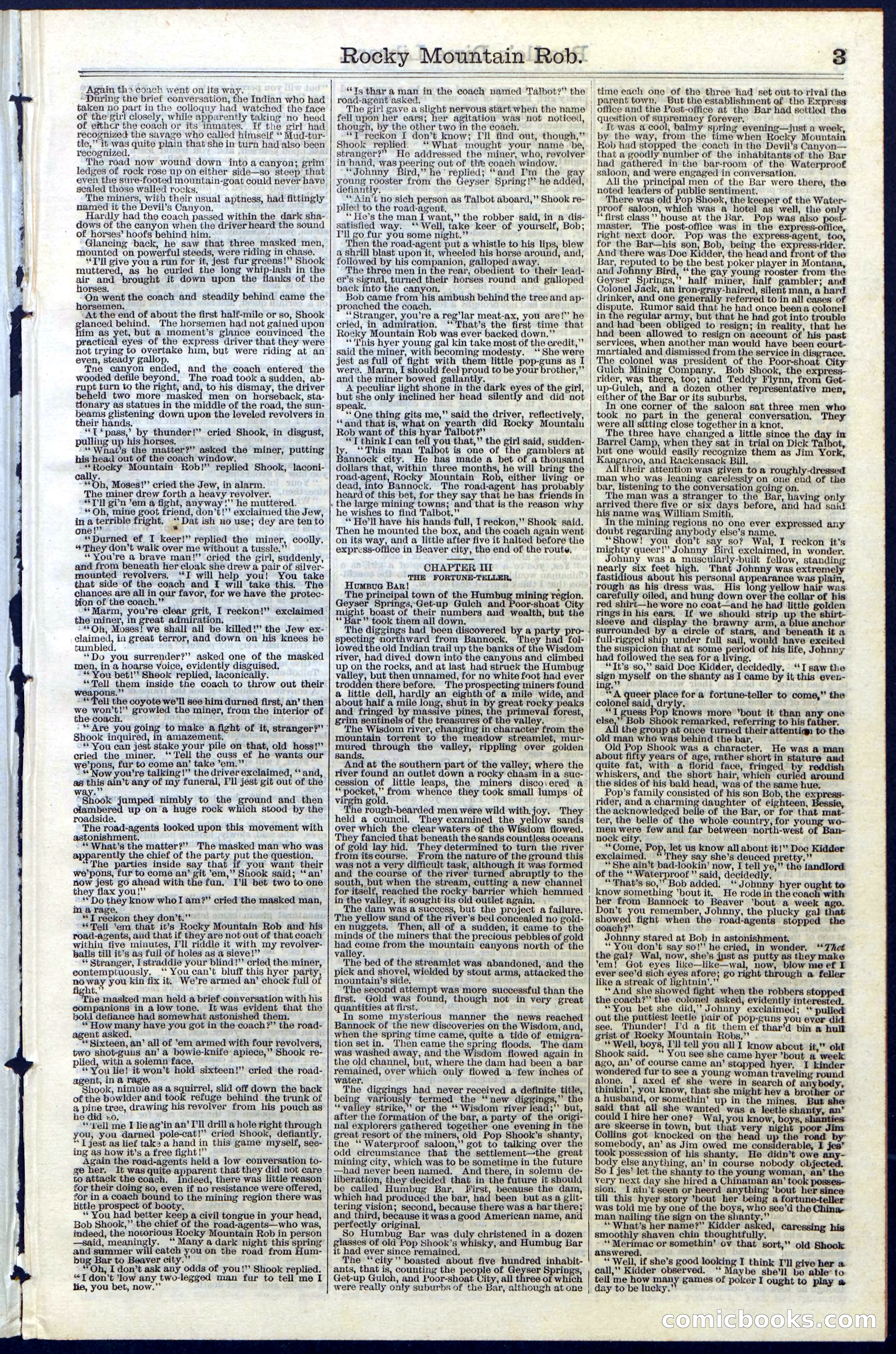
A restored page from Pulp Fiction, 1878. Page through the whole issue in the reader above.
📄 Transcribed text from this page (OCR, searchable)
Machine-transcribed from the original scan — historical spelling and the odd misread are preserved.
oo , Rocky Mountain Rob.. $8 — —— ~— — ——— ——_ — -—_ - -- — — - + oe Again ths coach went on its way. During the brief conversation, the Indian who had taken no part in the colloquy had watched the face of the girl closely, while apparently taking no heed of either the coach or its inmates. If the girl had recognized the savage who called himself **‘ Mud-tur- tle,” it was quite plain that she in turn had also been recognized. The road now wound down into a canyon; grim ledges of rock rose up on either side—so steep that even the sure-footed mountain-goat could never have scaled those walled rocks, The miners, with their usual aptness, had fittingly named it the Devil’s Canyon, Hardly had the coach passed within the dark sha- dows of the canyon when the driver heard the sound of horses’ hoofs behind him. Glancing back, he saw that three masked men, mounted on powerful steeds, were riding in chase. “Tl give you a run for it, jest fur greens!’’ Shook muttered, as he curled the long whip-lash in the air and brought it down upon the flanks of the horses. On went the coach and steadily behind came the horsemen. ; At the end of about the first half-mile or so, Shook lanced behind. The horsemen had not gained upon m as yet, but a moment’s glance convinced the practical eyes of the express driver that they were not trying to overtake him, but were riding at an even, steady gallop. Tne canyon ended, and the coach entered the wooded defile beyond. The road took a sudden, ab- mupt turn to the right, and, to his dismay, the driver beheld two more masked men on horseback, sta- tionary as statues in the middle of the road, the sun- beams glistening down upon the leveled revolvers in their hands. ‘**T ‘pass,’ by thunder!” cried Shook, in disgust, pulling up his horses, ‘‘ What's the matter?’’ asked the miner, putting his head out of the coach window. **Rocky Mountain Rob!” replied Shook, laconi- cally. “On, Moses!"’ cried the Jew, in alarm. The miner drew forth a heavy revolver. “Tl gi’n ’em a fight, anyway!” he muttered. * Oh, mine goot friend, don’t!’’ exclaimed the Jew, in a terrible fright, 3 Dat ish no use; dey are ten to one!’ t **Durned ef I keer!” replied the miner, coolly, * They don’t walk over me without a tussle.’ “You're a brave man!” cried the girl, suddenly, and from beneath her cloak she drew a pair of silver- mounted revolvers, “I will help you! You take that side of the coach and [ will take this. The chances are all in our favor, for we have the protec- tion of the coach.” ‘*Marm, you’re clear grit, I reckon!’ exclaimed the miner, in great admiration. ‘*Oh, Moses! we shall all be killed!” the Jew ex- claimed, in great terror, and down on his knees he tumbled. ‘‘Do you surrender?” asked one of the masked men, in a hoarse voice, evidently disguised, ** You bet!’ Shook replied, laconically. “Tell them inside the coach to throw out their Saeeee “Tell the coyote we'll see him durned first, an’ then bi A oh !” growled the miner, from the interior of the coach. * Are you going to make a fight of it, stranger?” ’ Shook inquired, in amazement. * You can jost stake your pile on that, old hoss!”’ cried the miner, ‘Tell the cuss ef he wants our we’pons, fur to come an’ take ’em,” oi Now ou’re talking!" the driver exclaimed, *‘ and, as this ain’t any of my funeral, I'll jest git out of the W ae Shook umped nimbly to the ground and then clambered up on’a huge rock which stood by the roadside. The road-agents looked upon this movement with astonishment. “‘What’s the matter?” The masked man who was apparently the chief of the pert, gue the question, “The parties inside say that if you want their we’pons, fur to come an’ git ’em,” Shook said; “‘ an’ now jest go ahead with the fun. I'll bet two to one they flax you!”’ ‘**Do they know whol! am?” cried the masked man, Met ronboi they aow*sl” reckon they don't. “Tell ‘em that it’s Rocky Mountain Rob and his road-agents, and that if they are not out of that coach within five minutes, Pll riddle it with my revolver- balls till it’s as full of holes as a sieve!” * Stranger, I straddle your blind!”’ cried the miner, eontemptuously, ‘ You can’t bluff this hyer party no way you kin fix it. We’re armed an’ chock full of zht.”’ he masked man held a brief conversation with his companions in alow tone. It was evident that the bold defiance had somewhat astonished them. “How many have you got in the coach?” the road- agent asked. ** Sixteen, an’ all of ’em armed with four revolvers, two shot-guns an’a bowie-knife apiece,” Shook re- plied, with a solemn face, _ “You lie! it won’t hold sixteen!"’ cried the road- agent, in @ rage. k Shook, nimpbie as a squirrel, slid off down the back of the bowlder and took refuge behind the trunk of a, pine tree, drawing his revolver from his pouch as he 60, tel me I lieag’in an’ I'll drill a hole right through you, you darned pole-cat!” cried Shook, defiantly, ‘1 jest as lief taka a hand in this game myself, see- ing as how it’s a free fight!” Again the road-agents held a low conversation to- ge her. It was quite apparent that they did not care to attack the coach. Indeed, there was little reason for their doing so, even if no resistance were offered, for in a coach bound to the mining region there was little prospect of booty. ‘“‘ You had better keep a civil tongue in your head, Bob Shook,” the chief of the road-agents—who was, indeed, the notorious Rocky Moun Rob in person —said, meaningly. “ Many a dark night this spring” and summer will catch you on the road from Hum- bug Bar to Beaver city.” ~ “Oh, I don’t ask any odds of you!” Shook replied. “T don't ‘low any two-legged man fur to tell me I lie, you bet, now.” “Ts thar a man in the coach named Talbot?” the | road-agent asked, The girl gave a slight nervous start when the name fell upon her ears; her agitation was not noticed, though, by the other two in the coach. ‘*T reckon I don’t know; Ill find out, though,” Shook replied. “What mought your name. be, stranger?” He addressed the miner, who, revolver in hand, was peering out of tht coach window. “Johnny Bird,” he’ replied; ‘and I'm the ga young rooster from the Geyser Spring!” he added, defiantly. ‘* Ain't no sich person as Talbot aboard,” Shook re- plied to the road-agent, ** Hle’s the man I want,’’ the robber said, in a dis- satisfied way. ‘* Well, take keer of yourself, Bob; Pll go fur you some night.” Then the road-agent put a whistle to his lips, blew a shrill blast upon it, wheeled his horse around, and, followed by his companion, galloped away. ’ The three men in the rear, obedient to their lead- er’s signal, turned their horses round and galloped back into the canyon. Bob came from his ambush behind the tree and ap- proached the coach. ‘Stranger, you're a reg’lar meat-ax, you are!”’ he cried, in admiration. ‘That’s the first time that Rocky Mountain Rob was ever backed down.” * This hyer young gal kin take most of the eredit,”’ said the miner, with becoming modesty. ‘‘ She were jest as full of fight with them little pop-guns as I were, Marm, I should feel proud to be your brother,” and the miner bowed gallantly. A peculiar light shone in the dark eyes of the girl, but she only inclined her head silently and did not speak. Pi One thing gits me,” said the driver, reflectively, “and that is, what on yearth did Rocky Mountain Rob want of this hyar Talbot?” “T think I can tell you that,” the girl said, sudden- ly. “This man Talbot is one of the gamblers at annock city. He has made a bet of a thousand dollars that, within three months, he will bring the road-agent, Rocky Mountain Rob, either living or dead, into Bannock. The road-agent has 01d goed heard of this bet, for they say that he has friends in . the large mining towns; and that is the reason why he wishes to find Talbot,” ‘** He'll have his hands full, I reckon,”’ Shook said. Then he mounted the box, and the coach again went on its way, and a little after five it halted before the express-office in Beaver city, the end of the route, CHAPTER Il THE FORTUNE-TELLER, Humsvue Bar! ° The principal town of the Humbug mining region. Geyser Springs, Get-up Gulch and Poor-shoat City muge boast of their numbers and wealth, but the ‘** Bar” took them all down, The diggings had been discovered by a party pro- specting northward from Bannock. They had fol- lowed the old Indian trail wp the banks of the Wisdom river, had dived down into the canyons and climbed up on the rocks, and at last had struck the Humbug valley, but then unnamed, for no white foot had ever trodden there before, The ate pei miners found a little dell, hardly an eighth of a mile wide, and about half a mile long, shut in by great eh eaks and fringed by massive pines, the primeval forest, grim sentinels of the treasures of the valley. The Wisdom river, changing in character from the mountain torrent to the meadow streamlet, mur- ine through the valley, rippling over golden sands. And at the southern part or the valley, where the river found an outlet down a rocky chasm ina suc- cession of little leaps, the miners discovered a oe ae whence they took small lumps of virgin gold. he rough-bearded men were wild with.joy. The held a council. They examined the yellow sands over which the clear waters of the Wisdom flowed. They fancied that beneath the sands countless oceans of gold lay hid. They determined to turn the river from its course, From the nature of the ground this was not a very difficult task, although it was formed and the course of the river turned abruptly to the south, but when the stream, cutting a new channel for itself, reached the rocky barrier which hemmed in the valley, it sought its old outlet again. The dam was a success, but the project a failure. The yellow sand of the river’s bed concealed no gold- en nuggets. Then, all of a sudden, it came to the minds of the miners that the precious pebbles of gold i come from the mountain canyons north of the valley. The bed of the streamlet was abandoned, and the pick and shovel, wielded by stout arms, attacked the mountain’s side. ' The second attempt was more successful than the first. Gold was found, though not in very great quantities at first. In some mysterious manner the news reached Bannock of the new discoveries on the Wisdom, and, when the spring time came, quite a tide of emigra- tion setin. Then came the spring floods. The dam was washed away, and the Wisdom flowed again in the old channel, but, where the dam had been a bar Ag over which only flowed a few inches of water. The diggings had never received a definite title, being variously termed the ‘new diggings ” the ‘va ey strike,’ or the ** Wisdom river ;’ but, after the formation of the bar, a party of the origi- nal explorers gathered together one evening in the great resort of the miners, old Pop Shook’s shanty, the ** Waterproof saloon,’”’ got to talking over the odd circumsiance that the settlement—the great mining city, which was to be sometime in the future —had never been named. And there, in solemn de- liberation, they decided that in the future it should be called Humbug Bar. Jirst, because the dam, which had produced the bar, had been but asa glit- vere second, because there was a bar there; and third, because it was a good American name, an perfectly original. . So Humbug Bar was go hd ag in a dozen glasses of old Pop Shook’s whisky, and Humbug Bar it had ever since remained. The “city” boasted about five hundred inhabit- ants, that is, counting the people of Geyser Springs, Get-up Gulch, and Poor-shoat City, all three of which were really only suburbs of the Bar, although at one time each one of the three had set out to’rival the parent town, But tho establishment of theo Express office and the Post-office at the Bar had settled the | question of supremacy forever. Tt was a cool, balmy spring evening—just a week, by the way, from the time when Rocky Mountain Rob had stopped the coach in the Devil’s Canyon— that a goodly number of the inhabitants of the Bar had gathered in the bar-room of the Waterproof saloon, and were engaged in conversation. All the Pe almen of the Bar were there, the noted leaders of public sentiment, There was old Pop Shook, the keeper of the Water- proof saloon, which was a hotel as well, the onl ‘first class’? house at the Bar. Pop was also master. The post-office was in the express-office, right next door. Pop was the express-agent, too, for the Bar—his son, Bob, being the express-rider. And there was Doe Kidder, the head and front of the Bar, reputed to be the best poker player in Montana, and Johnny Bird, “the gay young rooster from the Geyser Springs,"’ half miner, half gambler; and Colonel Jack, an iron-gray-haired, silent man, a hard drinker, and one generally referred to in all cases of dispute. Rumor said that he had once been a colonel in the regular army, but that he had got into trouble and had been obliged to resign; in reality, that he had been allowed to resign on account of his past services, when another man would have been court- martialed and dismissed from the service in race. The colonel was president _of the Poor-shoat City Gulch Mining Company. Bob Shook, the express- rider, was there, too; and Teddy Flynn, from Get- up-Gulch, and a dozen other representative men, either of the Bar or its suburbs, In one corner of the saloon sat three men who took no Wo in the general conversation. They were all sitting close together in a knot, The three have changed a little since the day in Barrel Camp, when they sat in trial on Dick Talbot, but one would easily recognize them as Jim York, Kangaroo, and Rackensack Bill. All their attention was given to a roughly-dressed man who was leaning carelessly on one end of the bar, listening to the conversation going on. The man was a stranger to the Bar, having only arrived there five or six days before, and had said his name wag William Smith. In the mining regions no one ever expressed any doubt regarding anybody else’s name. “Show! you don’t say so? Wal, I reckon it's mighty queer!” Johnny Bird exclaimed, in wonder. Johnny was a muscularly-built fellow, standing nearly six feet high. That Johnny was extremely fastidious about his personal appearance was plain, rough as his dress was. His long yellow hair was carefully oiled, and hung down over the collar of his red shirt—he wore no coat—and he had little golden rings in his ears. If we should strip a the shirt- sleeve and display the brawny arm, a blue anchor surrounded by a circle of stars, and beneath it a full-rigged ship under full sail, would have excited the suspicion that at some period of his life, Johnn;, had followed the sea for a living. *Tt’s so,” said Doe Kidder, decidedly. “I saw the sign myself on the shanty as I came by it this even- in *A yaa place for a fortune-teller to come," the colonel said, dryly. **T guess Pop knows more "bout it than a else,’” Bob Shook remarked, referring to his fa 3 the group at once turned their attentiqn to the old man who was behind the bar. Old Pop Shook was a character, He was a man about fifty years of age, rather short in stature and quite fat, with a florid face, fringed by reddish whiskers, and the short hair, which curléd around the sides of his bald head, was of the same hue. Pop’s family consisted of his son Bob, the express- rider, and that er daughter of eighteen, sie, the acknowledged belle of the Bar, or for that mat- ter, the belle of the whole country, for young wo- net MA few and far between north-west of Ban- nock city. “Come, Pop let us know all about it!’ Doc Kidder exclaimed. They say she’s deuced pretty.” She ain’t bad-lookin’ now, I tell ye,” the landlord of the ** Waterproof " said, decidedly. ‘That's so,” Bob added. _‘* Johnny hyer ought to know something ‘bout it. He rode in the coach with her from Bannock to Beaver ‘bout a week ago. Don’t you remember, Johnny, the plucky gal that posts fight when the road‘agents stopped the coac Johnny stared at Bob in astonishment. iat ae don say ponte in ronan: “*Thet e now, she’s as putty as they make ‘een Got eyes like—like—wal, TOW blow mae ef I ever see’d sich eyes afore } go right through a feller like a streak of lightnin’.’ ‘*‘And she showed fight when the robbers stopped the coach?” the colonel asked, evidently intabested, “You bet she did,” Johnny exclaimed; * pulled out the puttiest leetle pair of pop-guns you ever did see. Thunder! Id a fit_them ef thar’d bin a hull "Well, boys, I’ you ow about it,” old Shook said. “ You seé she came hyer ’bout . week ago, an’ of course came an’ stap hyer, I kinder wondered fur to see a young woman traveling round alone. I axed ef she were in search of an body, thinkin’, you know, that she might hev a bro or a husband, or somethin’ up in the mines, But she said that all she wanted was a leetle shanty, an” could I hire her one? Wal, you know, boys, shanties are skeerse in town, but that ve ht poor Jin Collins got rnbeleat on the h Bom the road by somebody, an’ as Jim owed me considerable I jes’ took possession of his shanty, He didn’t owe - pow. else anything, an’ in course nobody ob, So I jes’ let the shanty to the young woman, an’ the very next day she hired a Chinaman an’ took posses- sion. I ain't seen or heerd anything 'bout her since till this hyer story *bout her being a fortune-teller was told me by one of the boys, who see’d the China- man nai the sign on the shanty.” *“What’s her name?” Kidder asked, caressing his smoothly shaven chin thoughtfully. ‘*Merimac or somethin’ ov that sort,” old Shook answered. | “Well, if she’s good looking I think Ill give her a = ae observed. 7 ay be shell & able” to me how many games ol poker I o t to play day to be lucky. y = ° Ehookstcom com