
Pulp Fiction, 1878 · page 2 of 24
Beadle's New York Dime Library, Vol. III, No. 34 — page 2: what you’re looking at
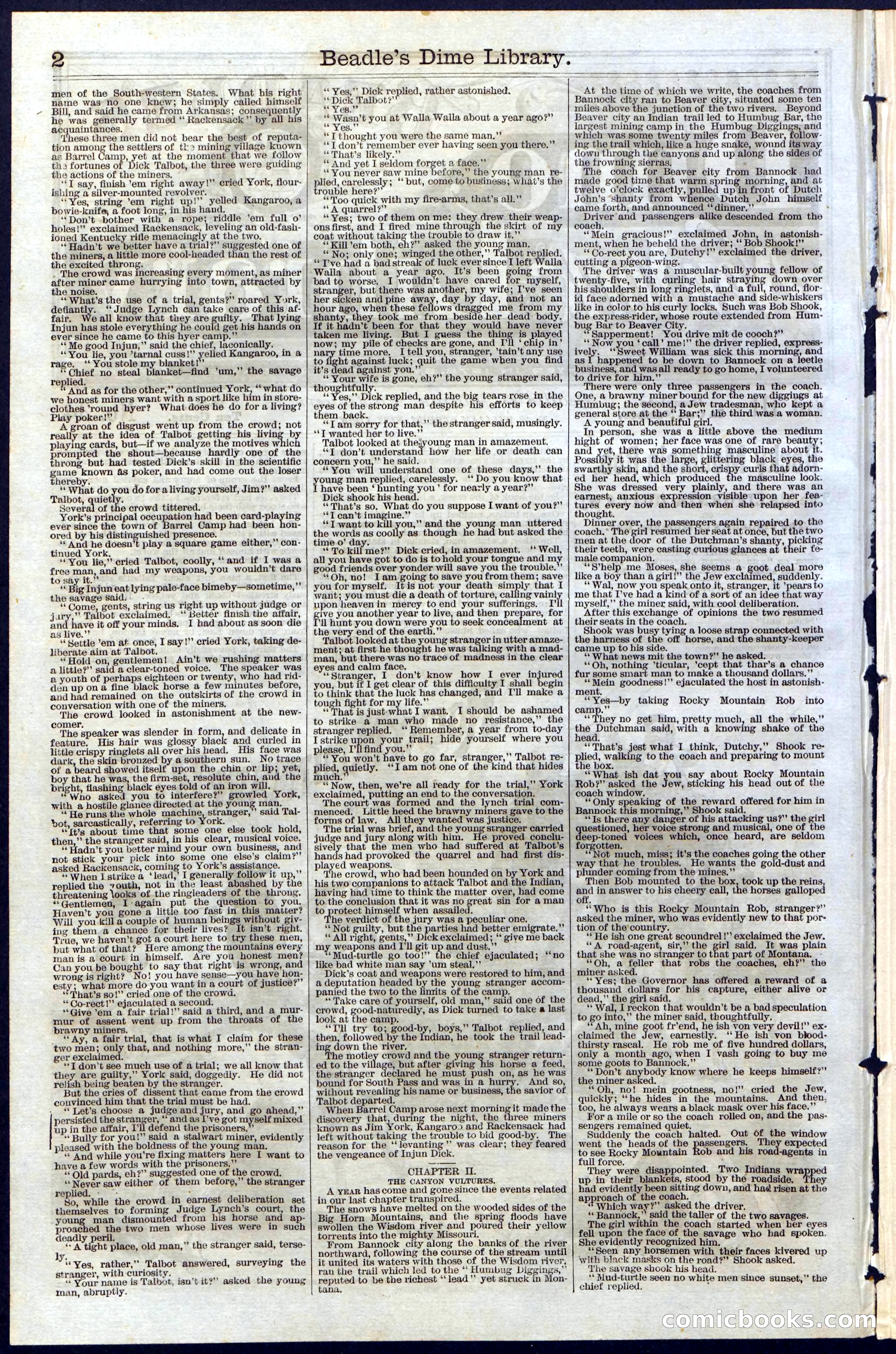
A restored page from Pulp Fiction, 1878. Page through the whole issue in the reader above.
📄 Transcribed text from this page (OCR, searchable)
Machine-transcribed from the original scan — historical spelling and the odd misread are preserved.
2 oe —_—$$ $$ — ee ee men of the South-western States. What his right name was no one knew; he simply called bimself Bill, and said he came from Arkansas; consequently he was generally termed ‘‘ Rackensack” by all his acquaintances. These three men did not bear the best of reputa- tion among the settlers of th» mining yillage known as Barrel Camp, yet at the moment that we follow tha fortunes of Dick Talbot, the three were guiding the actions of the miners, “T say, finish ’em right away!” eried York, flour- ishing a silver-mounted revolver. “Yes, string °em right up!’’ yelled Kangaroo, a bowie-knife, a foot long, in his hand, ‘‘Don’t bother with a rope; riddle ’em full o’ holes!" exclaimed Rackensack, leveling an old-fash- ioned Kentucky rifle menacingly at the two. ‘‘ Hadn't we better have a trial?” suggested one of the miners, a little more cool-headed than the rest of the excited perongs . . The crowd was increasing every moment, as miner after miner came hurrying into town, attracted by the noise. : . **What’s the use of a trial, gents?” roared York, defiantly. ‘‘ Judge Lynch can take care of this af- fair. e all know that they are guilty. That lying Injun has stole everything he could get his hands on ever since he came to this hyer camp.” ‘Me good Injun,”’ said the chief, laconically. ‘“You lie, you ’tarnal cuss!” elled Kangaroo, in a rage. ** You stole my blanket!” Chief no steal blanket—find ’um,’’ the savage replied. _ ‘And as for the other,” continued York, “what do we honest miners want with a sport like him in store- clothes ‘round hyer? What does he do for a living? Play poker!" 2 A groan of disgust went up from the crowd; not really at the idea of Talbot getting his wide 3 by playing cards, but—if we analyze the motives whic prompted the shout—because hardly one of the throng but had tested Dick’s skill in the scientific Ae eh As poker, and had come out the loser thereby. ““ What do you do for a living yourself, Jim?” asked Talbot, quiet. ny: Several of the crowd tittered. York’s principal Lge AL otrate had been card-playing ever since the town of Barrel Camp had been hon- ored by his distinguished presence. “* And he doesn’t play a square game either,” con- tinued York, ‘You lie,” cried Talbot, coolly, ‘‘ and if I was a free man, and had my weapons, you wouldn’t dare to say it.” ai Big Injun eat lying pale-face bimeby—sometime,” the savage said, - 1 } : ‘Come, gents, string us right up without judge or jury,” Talbot exclaimed, “ Better finish the affair, and have it off your minds. I had about as soon die as live.”’ “ Settle ’em at once, I say!’ cried York, taking de- liberate aim at Talbot. “Hold on, gentlemen! Ain’t we rushing matters a little?’ said a clear-toned voice. The speaker was a youth of perhaps eighteen or twenty, who had rid- den up on a fine black horse a few minutes before, and had remained on the outskirts of the crowd in conversation with one of the miners, The crowd looked in astonishment at the new- comer. : The speaker was slender in form, and delicate in feature. His hair was glossy black and curled in little crispy ringlets all over his head. His face was dark, the skin bronzed by a southern sun. No trace of a beard showed itself upon the chin or lip; yet, boy that he was, the firm-set, resolute chin, and the bright, flashing black eyes told of an iron will. “Who asked you to interfere?” growled York, with a hostile glance directed at the young man, “ He runs the whole machine, stranger,”’ said Tal- bot, sarcastically, referring to York. “It’s about time that some one else took hold, then,” the stranger said, in his clear, musical voice, = ’t you better mind your own business, and not stick your pick into some one else's claim?”’ asked Rackensack, coming to York’s assistance. ‘“ When I strike a ‘lead,’ I generally follow it up,”’ replied the youth, not in the least abashed by the threatening looks of the ringleaders of the throng. ‘‘Gentlemen, I again put the question to you. Haven’t you gone a little too fast in this matter? Will you kill a couple of human beings without giv- ing them. a chance for their lives? It isn’t right. True, we haven't got a court here to try these men, but what of that? Here among the mountains every man is a court in himself, Are you honest men? Can you be bought to say that right is wrong, and wrong is right? No! you have sense—you have hon- esty; what more do you want in a court of justice? ‘i hat’s sol’’ cried one of the crowd. “ Co-reet !”’ ejaculated a second, ‘Give ’em a fair trial!’ said a third, and a mur- mur of assent went up from the throats of the brawny miners. “Ay, a fair trial, that is what I claim for these two men; cs Nema a and nothing more,” the stran- ger exclaimed. : **T don’t see much use of a trial; we all know that they are guilty,” York said, doggedly. He did not relish being beaten by the stranger. But the cries of dissent that came from the crowd couvinced him that the trial must be had. . ** Let’s choose a judge and jury, and go ahead,”’ persisted the stranger, ** and as I’ve got myself mixed up in the affair, ll defend the prisoners,” “ Bully for you!” said a stalwart miner, evidently pleased with the boldness of the young man. “And while you're fixing matters here I want to have a few words with the prisoners,”’ “Old pards, eh?” suggested one of the crowd. ‘Never saw either of them before,” the stranger replied. - - : So, while the crowd in earnest deliberation set themselves to forming Judge Lynch’s court, the young man dismounted from his horse and ap- proached the two men whose lives were in such cleadly peril. ’ ‘A tight place, old man,” the stranger said, terse- ly. Vie Yes, rather,” Talbot answered, surveying the stranger, with curiosity. “ Your name is Talbot, isn’t it?”’ asked the young roan, abruptly. ee ey. ee eeeEEE— ee *¢ Yes,” Dick replied, rather astonished, ‘* Dick Talbot?’ “ Yes.”’ is =e you at Walla Walla about a year ago?” 6 fess.’ *“T thought you were the same man,”’ ‘*T don’t remember ever having seen you there,”’ “'That’s likely.” * And yet I seldom forget a face.” ‘““You never saw mine before,” the young man re- ped, carelessly; ‘‘ but, come to business; what’s the rouble here?” ““oo quick with my fire-arms, that’s all.” ‘‘A quarrel?” “Yes; two of them on me: they drew their weap- ons first, and I fired mine through the skirt of my coat without taking the trouble to draw it,”’ ‘* Kill’em both, eh?’ asked the young man, “ No; only one; winged the other,” Talbot replied. ‘*Tve had o badstreak of luck ever since I left Walla Walla about a year ago. It’s been going from bad to worse. I wouldn’t have cared for myself, stranger, but there was another, my wife; I’ve seen her sicken and pine away, day by day, and not an hour ago, when these fellows dragged me from my shanty, they took me from beside her dead: body, If it hadn’t been for that they would have never taken me living. But I guess the thing is played now; my pile of checks are gone, and Ill ‘chip in’ nary time more. I tell you, stranger, ’tain’t any use to ght against luck; quit the game when you find it’s dead against you.”’ ‘‘ Your wife is gone, eh?’ the young stranger said, thoughtfully. f ‘‘-Yes,"’ Dick replied, and the big tears rose in the eyes of the strong man despite his efforts to keep them. back. 3 “Tam sorry for that,’’ the stranger said, musingly. ‘*T wanted her to live.’ Talbot looked at thejyoung man in amazement. “T don’t understand how her life or death can concern you,”’ he said. “You will understand one of these days,” the young man replied, carelessly. ‘‘ Do you know that I have been ‘ hunting you’ for nearly a year?” Dick shook his head. ‘‘That’s so. What do you suppose I want of you?” ‘*T can’t imagine.” **T want to kill you,”’ and the young man uttered the words as coolly as though he had but asked the time o’ day. ‘To kill me?” Dick cried, in amazement. ‘' Well, all you have got to do is to hold your tongue and my good friends over yonder will save you the trouble.” “Oh, no! Iam going to save youfrom them; save you for myself. Itis not “sae death a that I want; you must die a death of torture, calling vain! upon heaven in merey to end your sufferings. T’ll rive you another year to live, and then prepare, for ‘1 hunt you down were you to seek concealment at the very end of the earth.”’ Talbot looked at the young stranger in utter amaze- ment; at first he thought he was talking with a mad- man, ‘put there was no trace of madness in the clear eyes and calm face. ‘Stranger, I don't know how I ever injured you, but if I get clear of this difficulty I shall begin to think that the luck has changed, and [I'll make a tough fight for my life.”’ “That is just-what I want. I should be ashamed to strike a man who made no resistance,’’ the stranger replied. ‘‘ Remember, a year from to-day I strike upon pee trail; hide yourself where you please, I'll find you.” “You won’t have to go far, stranger,’’ Talbot re- eae quietly. ‘*T am not one of the kind that hides much, * Now, then, we’re all pends. for the trial,"’ York exclaimed, putting an end to the conversation, The court was formed and the lynch trial com- menced, Little heed the brawny miners gave to the forms of law. All they wanted was justice. The trial was brief, and the young stranger carried judge and jury along with him. He proved conclu- sively that the men who had suffered at Talbot’s hands had provoked the quarrel and had first dis- played weapons. The crowd, who had been hounded on by York and his two companions to attack Talbot and the Indian, having had time to think the matter over, had come to the conclusion that it was no great sin for aman to protect himself when assailed. he verdict of the jury was a peculiar one. “Not guilty, but the parties had better emigrate.” * All right, gents,” Dick exclaimed; “ give me back my weapons and I'll git Uae dust.’’ ‘Mud-turtle go too!” the chief ejaculated; *‘no like bad white man say ‘um steal,”’ Dick's coat and weapons were restored to him, and a deputation headed by the young stranger accom- panied the two to the lintits of the camp. “Take care of yourself, old man,” said one of the crowd, good-naturedly, as Dick turned to take a last look at the camp. . “Tl try to; good-by, boys,” Talbot replied, and then, followed by the Indian, he took the trail lead- ing down the river. : e Slo crowd and the young sea return- ed to the village, but after giving horse a feed, the stranger declared he must push on, as he was bound for South Pass and was in a ney And so, without revealing his name or business, the savior of Talbot departed. : When Barrel Camp arose next morning it made the discovery that, during the night, the three miners known as Jim York, Kangaroo and Rackensack had left without taking the trouble to bid good-by. The reason for the “‘levanting’’ was clear; they feared the vengeance of Injun Dick. CHAPTER II. THE CANYON VULTURES, A YEAR has come and gone since the events related in our last chapter transpired. The snows have melted on the wooded sides of the Big Horn Mountains, and the pprins floods have swollen the Wisdom river and poured their yellow torrents into the hty Missouri. From Bannock city along the banks of the river northward, following the course of the stream until it united its waters with those of the Wisdom river, ran the trail which led to the ‘‘ Humbug Diggings,” reputed to be the richest “lead” yet struck in Mon- tana. ne At the time of which we write, the coaches from Bannock city ran to Beaver city, situated some ten miles above the junction of the two rivers. Beyond Beaver city an Indian trail led to Humbug Bar, the largest mining camp in the Humbug Diggings, and which was some twenty miles from Beaver, ‘toliow- ing the trail which, like a huge snake, wound its way down through the canyons and up along the sides of the trowning sierras. . The coach for Beaver city from Bannock had made good time that warm spring morning, and at twelve o’clock exactly, pulled up in front of Dutch John’s shanty from whence Dutch John himself came forth, and announced “ dinner,”’ ett pe ‘and passengers alike descended from the coach. “Mein gracious!’ exclaimed John, in astonish- ment, when he beheld the driver; “ Bob Shook!”” ‘*Co-rect you are, Dutehy!”’ exclaimed the driver, cutting a pigeon-wing. The driver was a muscular-built young fellow of twenty-five, with curling hair pba ad down over his shoulders in long ringlets, and a full, round, flor- id face adorned with a mustache and side-whiskers like in color to his curly locks. Such was Bob Shook, the express-rider, whose route extended from Hum- bug Bar to Beaver City. *“Sapperment! You drive mit de cooch?”’ ‘* Now you ‘call’ me!”’ the driver replied, express- ively. ‘Sweet William was sick this morning, and as I happened to be down to Bannock on a leetle business, and was all ready to go home, I volunteered to drive for him." There were only three passengers in the coach. One, a brawny miner bound for the new diggings at Humbug; the second, a Jew tradesman, who kept a general store at the “ Bar;” the third was a woman. A young and beautiful girl. In person, she was a little above the medium hight of women; her face was one of rare beauty; and yet, there was parse ping masculine about it. Possibly it was the large, glittering black eyes, the swarthy skin, and the short, erispy curls that adorn- ed her head, which produced the masculine look. She was dressed very plainly, and there was an earnest, anxious expression visible upon her fea- tures every now and then when she relapsed into thought. Dinner over, the passengers again repaired to the coach, The girl resumed her seat at once, but the two men at the door of the Dutechman’s shanty, picking their teeth, were casting curious glances at their fe- male companion. “S’help me Moses, she seems a goot deal more like a boy than a girl!” the Jew exclaimed, suddenly. “Wal, now you 4 ee onto it, stranger, it pears to me that I’ve had a kind of a sort of an idee that way myself,’’ the miner said, with cool deliberation. After this exchange of opinions the two resumed their seats in the coach. Shook was busy tying a loose strap connected with the harness of the off horse, and the shanty-keeper came up to his side. ‘* What news mit the town?” he asked. ‘*Oh, nothing ‘ticular, *’cept that thar’s a chance fur some smart man to make a thousand dollars.” i =e goodness !’’ ejaculated the host in astonish- ment, ‘ es—by taking Rocky Mountain Rob into camp.’ “They no get him, pretty much, all the while,” se Dutchman said, with a knowing shake of the ead. ‘*That’s jest what I think, Dutchy,’’ Shook re- pied walking to the coach and preparing to mount 1e box. “What ish dat you say about Rock Rob?” asked the Jew, sticking his he coach window. * Onl cpeaking of the reward offered for him in Bannock this morning,” Shook said. ““Is there any danger of his attacking us?’’ the girl Maal Sie her voice strong and musical, one of the aa voices which, once heard, are seldom orgotten. ee ‘*Not much, miss; it’s the coaches going the other way that he troubles. He wants the gold-dust and plunder coming from the mines,”’ Then Bob mounted to the box, took up the reins and in answer to his cheery call, the horses gallo off. ‘Who is this Rocky Mountain Rob, ins galt asked the miner, who was evidently new to that por- tion of the'couniry, ‘He ish one great scoundrel !’’ exclaimed the Jew. “A road-agent, sir,’’ the girl said. It was plain that she was no stranger to that part of Montana. - “Oh, a feller that robs the coaches, eh?’’ the miner asked. ‘* Yes; the Governor has offered a reward of a thousand dollars for his capture, either alive or dead,” the girl said. : “Wal, Ireckon that wouldn’t be a bad speculation to go into,”’ the miner said, thoughtfully. ‘Ah, mine goot fr’end, he ish von very devil!’’ ex- claimed the Jew, earnestly. ‘‘He ish von blood- thirsty rascal. He rob me of five hundred dollars, only a month ago, when I vash going to buy me some goots to Bannock.” ** Don’t anybody know where he keeps himself?” the miner asked. “Oh, no! mein gootness, no!’ cried the Jew, quickly; “‘he hides in the mountains. And then, too, he always wears a black mask over his face.” For a mile or so the coach rolled on, and the pas- sengers remained quiet. Suddenly the coach halted. Out Of the window Mountain out of the went the heads of the passengers. They expected to fv Rocky Mountain Rob and his “agents in orce, i They were disappointed. Two Indians wra up in their blankets, stood by the roadside, They had evidently been sitting down, and had risen at the approach of the coach. “Which way?” asked the driver. ‘** Bannock,”’ said the taller of the two savages. The girl within the coach started when her eyes fell upon the face of the savage who had spoken. She evidently recognized him. _ “Seen any horsemen with their faces kivered up with black masks on the road?’ Shook asked. The savage shook his head. ** Mud-turtle seen no white men since sunset,” the chief replied. ‘ Eom Ebooks-com ae rad elt. Ne Mime ~ e >.