
Pulp Fiction, 1878 · page 5 of 24
Beadle's New York Dime Library No. 32 — page 5: what you’re looking at
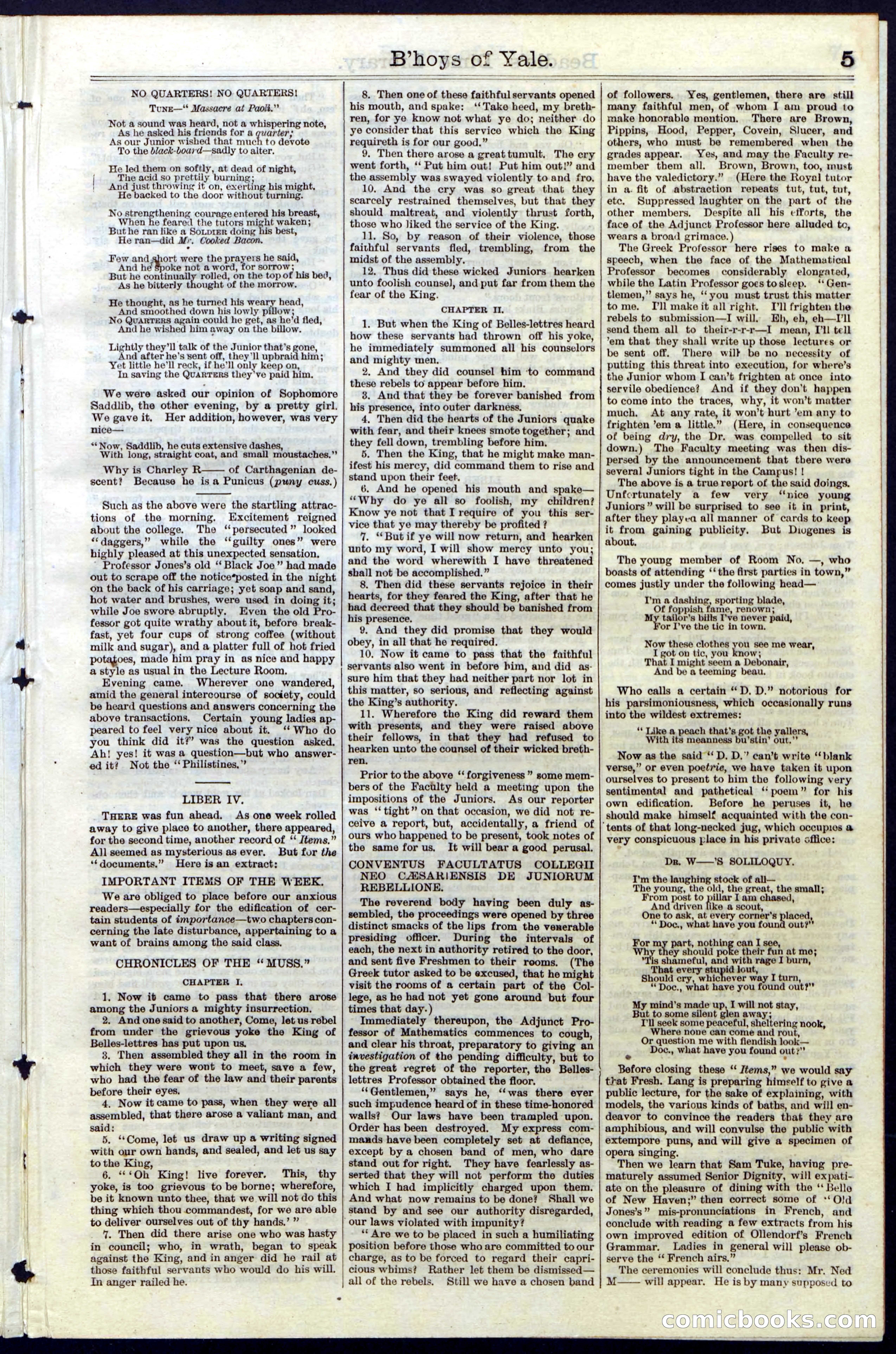
A restored page from Pulp Fiction, 1878. Page through the whole issue in the reader above.
📄 Transcribed text from this page (OCR, searchable)
Machine-transcribed from the original scan — historical spelling and the odd misread are preserved.
B’hoy Ss of Yale. NO QUARTERS! NO QUARTERS! Tune—" Massacre at Paoli.” Not a sound was heard, not a whispering note, As he asked his friends for a quarter; As our Junior wished that much to devote To the black-Loar'd—sadly to alter. He led them on softly, at dead of night, The acid so prettily burning; | And just throwing it on, exerting his might, He backed to the door without turning. No penethening courage entered his breast, When he feared the tutors might waken; But he ran like a Sotprer doing his best, He ran—did Mr. Cooked Bacon. Few and.ghort were the prayers he said, And h oke not a word, for sorrow; But he qe cee 8 rolled, on the top of his bed, As he bitterly thought of the morrow. He thought, as he turned his weary head, And smoothed down his lowly pillow; No Quarters again could he get, as he'd fled, And he wished him away on the billow. Lightly they'll talk of the Junior that’s gone, And after he’s sent off, they'll upbraid him; Yet little he'll reck, if he'll only keep on, In saving the QuaRTERS they've paid him, We were asked our opinion of Sophomore Saddlib, the other evening, by a pretty girl. We gaveit. Her addition, however, was very nice— **Now, Saddlib, he cuts extensive dashes, With long, straight coat, and small moustaches,”’ Why is Charley R of Carthagenian de- scent? Because he is a Punicus (puny cuss.) Such as the above were the startling attrac- tions of the morning. Excitement reigned about the college. The “persecuted” looked ‘‘daggers,’”’ while the “guilty ones” were highly pleased at this unexpected sensation, ' Professor Jones’s old ‘‘ Black Joe” had made out to scrape off the notice*posted in the night on the back of his carriage; yet soap and sand, hot water and brushes, were used in doing it; while Joe swore abruptly. Even the old Pro- fessor got quite wrathy aboutit, before break- fast, yet four cups of strong coffee (without milk and sugar), and a platter full of hot fried potagoes, made him pray in as nice and happy a style as usualin the Lecture Room. Evening came. Wherever one wandered, amid the general intercourse of society, could be heard questions and answers concerning the above transactions. Certain young ladies ap- peared to feel very nice about it. ‘Who do you think did it?’ was the question asked. Ah! yes! it was a question—but who answer- ed it? Not the ‘‘ Philistines,” LIBER IV. THERE was fun ahead. As one week rolled away to give place to another, there appeared, for the second time, another record of ‘‘ Jtems.” All seemed as mysterious asever. But for the ‘*documents.” Here is an extract: IMPORTANT ITEMS OF THE WEEK. We are obliged to place before our anxious readers—especially for the edification of cer- tain students of importance—two chapters con- cerning the late disturbance, appertaining to a want of brains among the said class. CHRONICLES OF THE “ MUSS.” CHAPTER I, 1. Now it came to pass that there arose among the Juniors a mighty insurrection. 2. And one said to another, Come, let us rebel from under the grievous yoke the King of Belles-lettres has put upon us. 3. Then assembled they all in the room in which they were wont to meet, save a few, who had the fear of the law and their parents before their eyes. 4. Now it came to pass, when they were all assembled, that there arose a valiant man, and said: 5. ‘*Come, let us draw up a writing signed with our own hands, and sealed, and let us say tothe King, 6. “*Oh King! live forever. This, thy yoke, is too grievous to be borne; wherefore, be it known unto thee, that we will not do this thing which thou commandest, for we are able to deliver ourselves out of thy hands.’ ” 7. Then did there arise one who was hasty in council; who, in wrath, began to speak against the King, and in anger did he rail at those faithful servants who would do his will. In anger railed he. 8. Then one of these faithful servants opened his mouth, and spake: ‘‘Take heed, my breth- ren, for ye know not what ye do; neither do ye consider that this service which the King requireth is for our good.” 9. Then there arose a greattumult, The ery went forth, ‘‘ Put him out! Put him out!” and the assembly was swayed violently to and fro, 10, And the cry was so great that they scarcely restrained themselves, but that they should maltreat, and violently thrust forth, those who liked the service of the King. 11. So, by reason of their violence, those faithful servants fled, trembling, from the midst of the assembly. 12. Thus did these wicked Juniors hearken unto foolish counsel, and put far from them the fear of the King. CHAPTER II. 1. But when the King of Belles-lettres heard how these servants had thrown off his yoke, he immediately summoned all his counselors and mighty men. 2. And they did counsel him ‘to command these rebels to appear before him. 8. And that they be forever banished from his presence, into outer darknéss. 4, Then did the hearts of the Juniors quake with fear, and their knees smote together; and they fell down, trembling before him. 5. Then the King, that he might make man- ifest his mercy, did command them to rise and stand upon their feet: 6. And he opened his mouth and spake— “Why do ye all so foolish, my children? Know ye not that I require of you this ser- vice that ye may thereby be profited ? 7. “Butif ye will now return, and hearken unto my word, I will show mercy unto you; and the word wherewith I have threatened shall not be accomplished.” 8. Then did these servants rejoice in their hearts, for they feared the King, after that he had decreed that they should be banished from his presence. % And they did promise that they would obey, in all that he required. 10. Now it came to pass that the faithful servants also went in before bim, and did as- sure him that they had neither part nor lot in this matter, so serious, and reflecting against the King’s authority. 11. Wherefore the King did reward them with presents, and they were raised above their fellows, in that they had refused to hearken unto the counsel of their wicked breth- ren, Prior to the above ‘‘ forgiveness ” some mem- bers of the Factlty held a meeting upon the impositions of the Juniors. As our reporter was ‘‘ tight” on that occasion, we did not re- ceive a report, but, accidentally, a friend of ours who happened to be present, took notes of the same for us, It will bear a good perusal. CONVENTUS FACULTATUS COLLEGII NEO CASSARIENSIS DE JUNIORUM REBELLIONE. The reverend body having been duly as- sembled, the proceedings were opened by three distinct smacks of the lips from the venerable presiding officer. During the intervals of each, the next in authority retired to the door, and sent five Freshmen to their rooms. (The Greek tutor asked to be excused, that he might visit the rooms of a certain part of the Col- lege, as he had not yet gone around but four times that day.) Immediately thereupon, the Adjunct Pro- fessor of Mathematics commences to cough, and clear his throat, preparatory to giving an investigation of the pending difficulty, but to the great regret of the reporter, the Belles- lettres Professor obtained the floor. ‘‘Gentlemen,” says he, ‘“‘was there ever such impudence heard of in these time-honored walls? Our laws have been trampled upon. Order has been destroyed. My express com- mands have been completely set at defiance, except by a chosen band of men, who dare stand out for right. They have fearlessly as- serted that they will not perform the duties which I had implicitly charged upon them. And what now remains to be done? Shall we stand by and see our authority disregarded, our laws violated with impunity? ** Are we to be placed in such a humiliating position before those who are committed to our charge, as to be forced to regard their capri- cious whims? Rather let them be dismissed— all of the rebels. Still we have a chosen band 5 of followers. Yes, gentlemen, there are still many faithful men, of whom I am proud to make honorable mention. There are Brown, Pippins, Hood, Pepper, Covein, Slucer, and others, who must be remembered when the grades appear. Yes, and may the Faculty re- member them all. Brown, Brown, too, must have the valedictory.” (Here the Royal tutor in a. fit of abstraction repeats tut, tut, tut, etc. Suppressed laughter on the part of the other members. Despite all his efforts, the face of the Adjunct Professor here alluded to, wears a broad grimace. ) The Greek Professor here rises to make a speech, when the face of the Mathematical Professor becomes considerably elongated, while the Latin Professor goestosleep. ‘‘Gen- tlemen,”’ says he, “you must trust this matter tome. Ill makeit all right. Ill frighten the rebels to submission—I will. Eh, eh, eh—I’ll send them all to their-r-r-r—I mean, I'll tell ‘em that they shall write up those lectures or be sent off. There wilt be no necessity of putting this threat into execution, for where’s the Junior whom I can’t frighten at once into servile obedience? And if they don't happen to come into the traces, why, it won’t matter much, At any rate, it won’t hurt ’em any to frighten ’em a little.” (Here, in consequence of being dry, the Dr. was compelled to sit down.) The Faculty meeting was then dis- persed by the announcement that tbere were several Juniors tight in the Campus! ! The above is a true report of the said doings. Unfcrtunately a few very “nice young Juniors ” will be surprised to see it in print, after they playeva all manner of cards to keep it from gaining publicity. But Diogenes is about. The young member of Room No, —, who boasts of attending ‘‘ the first parties in town,” comes justly under the following head— I'm a dashing, sporting blade, Of foppish tiche. renowire tailor’s bills I've never or I’ve the tic in town, me Now these clothes you see me wear, I got on tic, you know; That I might seem a Debonair, And be a teeming beau. Who ealls a certain “D. D.” notorious for his parsimoniousness, which occasionally runs into the wildest extremes: With ite moanness burstin’ out.” Now as the said “ D, D.” can’t write ‘blank verse,” or even poetiie, we have taken it upon ourselves to present to him the following very sentimental and pathetical * poem” for his own edification. Before he peruses it, he should make himself acquainted with the con- ‘tents of that long-necked jug, which occupies a very conspicuous place in his private office: Dr. W——’S SOLILOQUY. I'm the laughing stock of alli— The young, the old, the great, the small; From post to ae Iam chased, And driven like a scout, One to ask, at every corner’s laced, * Doc., what have you f out?’ For t, pothing can I Wh they 6 should poke Shel ah at mo; Tis shameful, and with rage I burn, Should ° hiche ge I turn 18) w v “ Doc., what have you found out?" uy mind’s made up, I will not stay, t to some silent LOWAY: I'll seek some peaceful, pa Fa nook, Where none can come and rout, Or question me with flendish look— Doc., what have you found out?” Before closing these ‘ Jtems,” we would say that Fresh. Lang is preparing himeelf to give a public lecture, for the sake of explaining, with models, the various kinds of baths, and will en- deavor to convince the readers that they are amphibious, and will convulse the public with extempore puns, and will give a specimen of opera singing. Then we learn that Sam Tuke, having pre- maturely assumed Senior Dignity, will expati- ate on the pleasure of dining with the ‘ Belle of New Haven;” then correct some of *‘ Old Jones’s” mis-pronunciations in French, and conclude with reading a few extracts from his own improved edition of Ollendorf’s French Grammar. Ladies in general will please ob- serve the “ French airs,” The ceremonies will conclude thus: Mr. Ned M—— will appear. He is by many supposed to SS) (E() m GOMmiGchboo a eee ee