
Pulp Fiction, 1878 · page 6 of 24
Beadle's New York Dime Library No. 32 — page 6: what you’re looking at
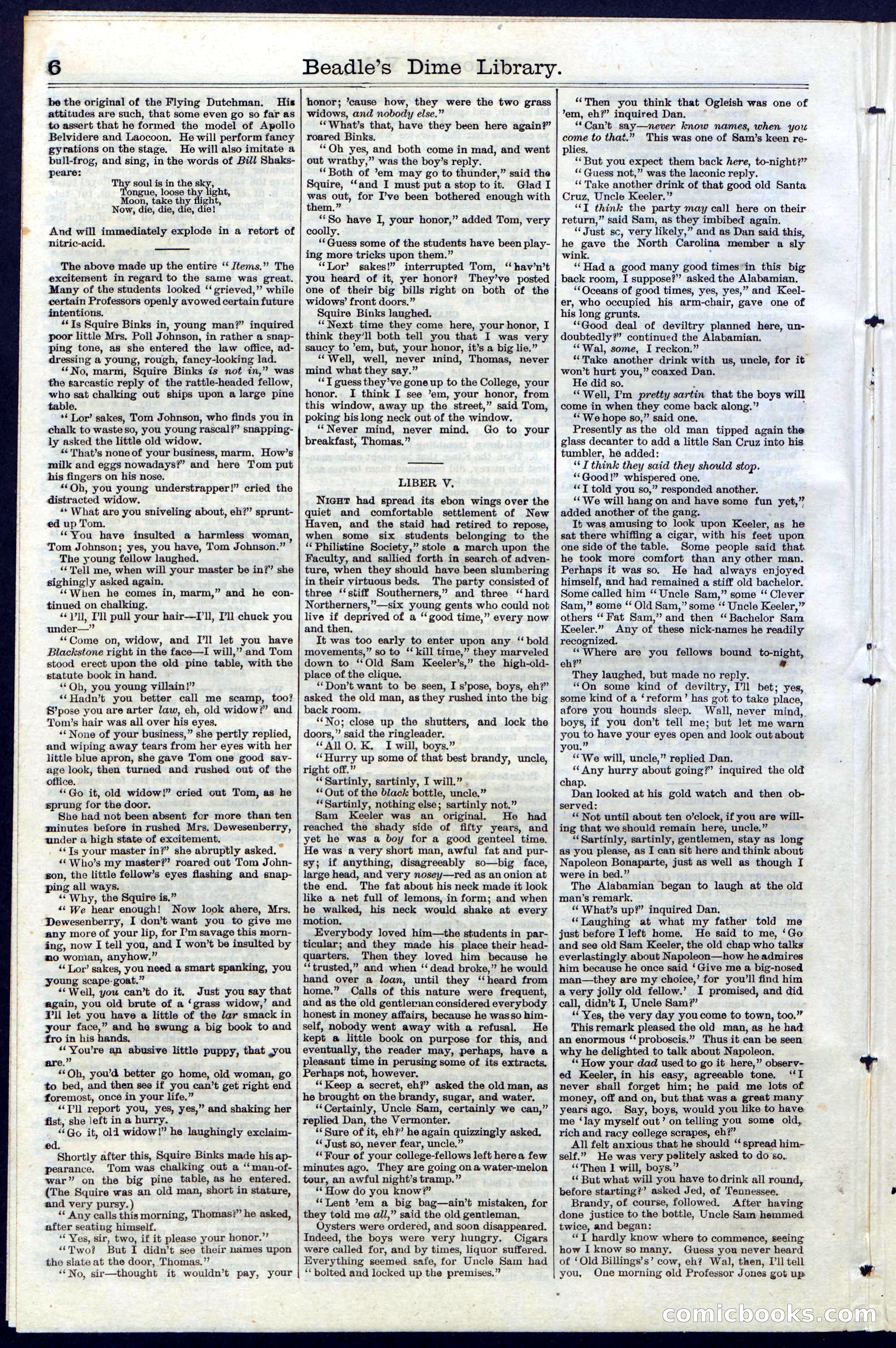
A restored page from Pulp Fiction, 1878. Page through the whole issue in the reader above.
📄 Transcribed text from this page (OCR, searchable)
Machine-transcribed from the original scan — historical spelling and the odd misread are preserved.
/ | | } } } e) be the original of the Flying Dutchman. His attitudes are such, that some even go so far as to assert that he formed the model of Apollo Belvidere and Laocoon. He will perform fancy gyrations on the stage. He will also imitate a bull-frog, and sing, in the words of Bill Shaks- peare: es soul is in the sky, ongue, loose thy light, Moon, take thy flight, Now, die, die, die, die! And will immediately explode in a retort of nitric-acid. The above made up the entire “‘ Jtems.”’ The excitement in regard to the same was great. Many of the students looked ‘‘ grieved,” while certain Professors openly avowed certain future intentions. “Is Squire Binks in, young man?” inquired poor little Mrs. Poll Johnson, in rather a snap- ping tone, as she entered the law office, ad- dressing a young, rough, fancy-looking lad. ‘No, marm, Squire Binks is not in,” was the sarcastic reply of the rattle-headed fellow, who sat chalking out ships upon a large pine table. *¢ Lor’ sakes, Tom Johnson, who finds you in chalk to waste so, you young rascal?” snapping- ly asked the little old widow. *<'That’s none of your business, marm. How’s milk and eggs nowadays?” and here Tom put his fingers on his nose. ‘Oh, you young understrapper!” cried the distracted widow. ‘* What are you sniveling about, eh?” sprunt- ed up Tom. ‘*You have insulted a harmless woman Tom Johnson; yes, you have, Tom Johnson.” The young fellow laughed. ‘‘ Tell me, when will your master be in?” she sighingly asked again. ‘“When he comes in, marm,” and he con- tinued on chalking. “11, Pll pull your hair—PU, [’ll chuck you under—” ‘‘Come on, widow, and I'll let you have Blackstone right in the face—lI will,” and Tom stood erect upon the old pine table, with the statute book in hand. ‘‘Oh, you young villain!” ‘“‘Hadn’t you better call me scamp, too? §’pose you are arter law, eh, old widow?” and Tom’s hair was all over his eyes. ‘‘ None of your business,” she pertly replied, and wiping away tears from her eyes with her little blue apron, she gave Tom one good say- age look, then turned and rushed out of the office. “Go it, old widow!” cried out Tom, as he sprung for the door. She had not been absent for more than ten minutes before in rushed Mrs. Dewesenberry, under a high state of excitement. . ‘‘Ts your master in?” she abruptly asked. ‘¢ Who’s my master?’ roared out Tom John- son, the little fellow’s eyes flashing and snap- ping all ways. ‘Why, the Squire is,” ‘‘ We hear enough! Now look ahere, Mrs. Dewesenberry, I don’t want you to give me any more of your lip, for ’m savage this morn- ing, now I tell you, and I won’t be insulted by mo woman, anyhow.” ‘Lor’ sakes, you need a smart spanking, you young scape-goat.” ‘Well, you can’t do it. Just you say that again, you old brute of a ‘grass widow,’ and T’ll let you have a little of the Jar smack in your face,” and he swung a big book to and fro in his hands, ‘*You’re an abusive little puppy, that ,you are.” ‘Oh, you’d better go home, old woman, go to bed, and then see if you can’t get right end foremost, once in your life,” “‘Tll report you, yes, yes,” and shaking her fist, she left in a hurry. “Go it, oll widow!” he laughingly exclaim- ed. Shortly after this, Squire Binks made his ap- pearance. Tom was chalking out a ‘‘man-of- war” on the big pine table, as he entered. (The Squire was an old man, short in stature, and very , “* Any Rack morning, Thomas?” he asked, after seating himself. ‘Yes, sir, two, if it please your honor.”’ ‘“‘Two? But I didn’t see their names upon the slate at the door, Thomas.’’ ‘No, sir—thought it wouldn’t pay, your Beadle’s Dime Library. honor; ’cause how, they were the two grass widows, and nobody else.” ‘*What’s that, have they been here again?’ roared Binks. ‘Oh yes, and both come in mad, and went out wrathy,” was the boy’s reply. “Both of ’em may go to thunder,” said the Squire, “and I must puta stoptoit. Glad I was out, for I’ve been bothered enough with them.” **So have I, your honor,” added Tom, very coolly. ‘*Guess some of the students have been play- ing more tricks upon them.” ‘Lor’? sakes!” interrupted Tom, ‘ hav’n’t you heard of it, yer honor? They’ve posted one of their big bills right on both of the widows’ front doors.” Squire Binks laughed. ‘Next time they come here, your honor, I think they’ll both tell you that I was very saucy to ’em, but, your honor, it’s a big lie.” “Well, well, never mind, Thomas, never mind what they say.” ‘““T guess they’ve gone up to the College, your honor. I think I see ’em, your honor, from this window, away up the street,” said Tom, poking his long neck out of the window. ‘“Never mind, never mind, Go to your breakfast, Thomas.” LIBER V. Nicut had spread its ebon wings over the quiet and comfortable settlement of New Haven, and the staid had retired to repose, when some six students belonging to the ‘Philistine Society,” stole a march upon the Faculty, and sallied forth in search of adven- ture, when they should have been slumbering in their virtuous beds. The party consisted of three ‘‘stiff Southerners,” and three “hard Northerners,”—six young gents who could not live if deprived of a “‘ good time,” every now and then. It was too early to enter upon any “bold movements,” so to ‘‘ kill time,” they marveled down to ‘*Old Sam Keeler’s,” the high-old- place of the clique. ‘*Don’t want to be seen, I s’pose, boys, eh?’ asked the old man, as they rushed into the big back room. ‘“No; close up the shutters, and lock the doors,” said the ringleader, “AO. K. I will, boys.” ‘Hurry up some of that best brandy, uncle, right off.” “*Sartinly, sartinly, I will.” . **Out of the black bottle, uncle.” “‘Sartinly, nothing else; sartinly not.” Sam Keeler was an original. He had reached the shady side of fifty years, and yet he was a boy for a good genteel time. He was a very short man, awful fat and pur- sy; if anything, disagreeably so—big face, large head, and very nosey—red as an onion at the end. The fat about his neck made it look like a net full of lemons, in form; and when he walked, his neck would shake at every motion, Everybody loved him—the students in par- ticular; and they made his place their head- quarters. Then they loved him because he “trusted,” and when ‘dead broke,” he would hand over a loan, until they ‘heard from home.” Calls of this nature were frequent, and as the old gentleman considered everybody honest in money affairs, because he wasso him- self, nobody went away with a refusal. He kept a little book on purpose for this, and eventually, the reader may, perhaps, have a pleasant time in perusing some of its extracts, Perhaps not, however. “Keep a secret, eh?’ asked the old man, as he brought on the brandy, sugar, and water. ‘Certainly, Uncle Sam, certainly we can,” replied Dan, the Vermonter. ‘Sure of it, eh?’ he again quizzingly asked, ‘‘ Just so, never fear, uncle.” ‘* Four of your college-fellows left herea few minutes ago. They are going ona water-melon tour, an awful night’s tramp.” ** How do you know?” ‘Lent ’em a big bag—ain’t mistaken, for they told me ail,” said the old gentleman, Oysters were ordered, and soon disappeared. Indeed, the boys were very hungry. Cigars were called for, and by times, liquor suffered. Everything seemed safe, for Uncle Sam had ‘** bolted and locked up the premises,” ‘Then you think that Ogleish was one of ’em, eh?’ inquired Dan. **Can’t say—never know names, when you come to that.” This was one of Sam’s keen re- plies. ‘*But you expect them back here, to-night?” ‘* Guess not,” was the laconic reply. ‘Take another drink of that good old Santa Cruz, Uncle Keeler.” “Tl think the party may call here on their return,” said Sam, as they imbibed again. ‘Just sc, very likely,” and as Dan said this, he gave the North Carolina member a sly wink. ' ‘Had a good many good times*in this big back room, I suppose?” asked the Alabamian. ‘*Oceans of good times, yes, yes,” and Keel- er, who occupied his arm-chair, gave one of his long grunts. ““Good deal of deviltry planned here, un- doubtedly?” continued the Alabamian. ‘* Wal, some, I reckon.” “Take another drink with us, uncle, for it won’t hurt you,” coaxed Dan. He did so. , “Well, ’m pretty sartin that the boys will come in when they come back along.” ‘* We hope so,” said one. Presently as the old man tipped again the glass decanter to add a little San Cruz into his tumbler, he added: ‘ ‘* I think they said they should stop. **Good!” whispered one, ‘*T told you so,” responded another. ‘‘ We will hang on and have some fun yet,” added another of the gang. ; It was amusing to look upon Keeler, as he sat there whiffing a cigar, with his feet upon one side of the table. Some people said that he took more comfort than any other man. Perhaps it was so. He had always enjoyed himself, and had remained a stiff old bachelor. Some called him “Uncle Sam,” some ‘ Clever Sam,” some ‘‘ Old Sam,” some ‘‘ Uncle Keeler,” others “‘ Fat Sam,” and then ‘ Bachelor Sam Keeler.” Any of these nick-names he readily recognized. ““Where are you fellows bound to-night, eh?” a They laughed, but made no reply. “On some kind of deviltry, I'll bet; yes, some kind of a ‘reform’ has got to take place, afore you hounds sleep. Wall, never mind, boys, if you don’t tell me; but let me warn you to have your eyes open and look out about you.” “We will, uncle,” replied Dan. ‘‘ Any hurry about going?’ inquired the old chap. Dan looked at his gold watch and then ob- served: ‘* Not until about ten o’clock, if you are will- ing that we should remain here, uncle.” “Sartinly, sartinly, gentlemen, stay as long as you please, as I can sit here and think about Napoleon Bonaparte, just as well as though I were in bed.” The Alabamian began to laugh at the old man’s remark. ‘‘ What’s up?” inquired Dan. ‘Laughing at what my father told me just before I left home. He said to me, ‘Go and see old Sam Keeler, the old chap who talks everlastingly about Napoleon—how he admires him because he once said ‘Give me a big-nosed man—they are my choice,’ for you'll find him a very jolly old fellow.’ I promised, and did call, didn’t I, Uncle Sam?” ‘Yes, the very day youcome to town, too.” This remark pleased the old man, as he had an enormous “‘ proboscis.” Thus it can be seen why he delighted to talk about Napoleon. ‘* How your dad used to go it here,” observ- ed Keeler, in his easy, agreeable tone. ‘I never shall forget him; he paid me lots of money, off and on, but that was a great many years ago, Say, boys, would you like to have me ‘lay myself out’ on telling you some old, rich and racy college scrapes, eh?” All felt anxious that he should ‘‘ spread him- self.” He was very pelitely asked to do so,. ‘Then 1 will, boys.” “ But what will you have to drink all round, before starting?’ asked Jed, of Tennessee. Brandy, of course, followed. After having done justice to the bottle, Uncle Sam hemmed twice, and began: ; **T hardly know where to commence, seeing how I know so many. Guess you never heard of ‘Old Billings’s’ cow, eh? Wal, then, I'll tell you, One morning old Professor Jones got up >. MIGDOO (E() (G S) G (0)