
Pulp Fiction, 1878 · page 22 of 24
Beadle's New York Dime Library No. 32 — page 22: what you’re looking at
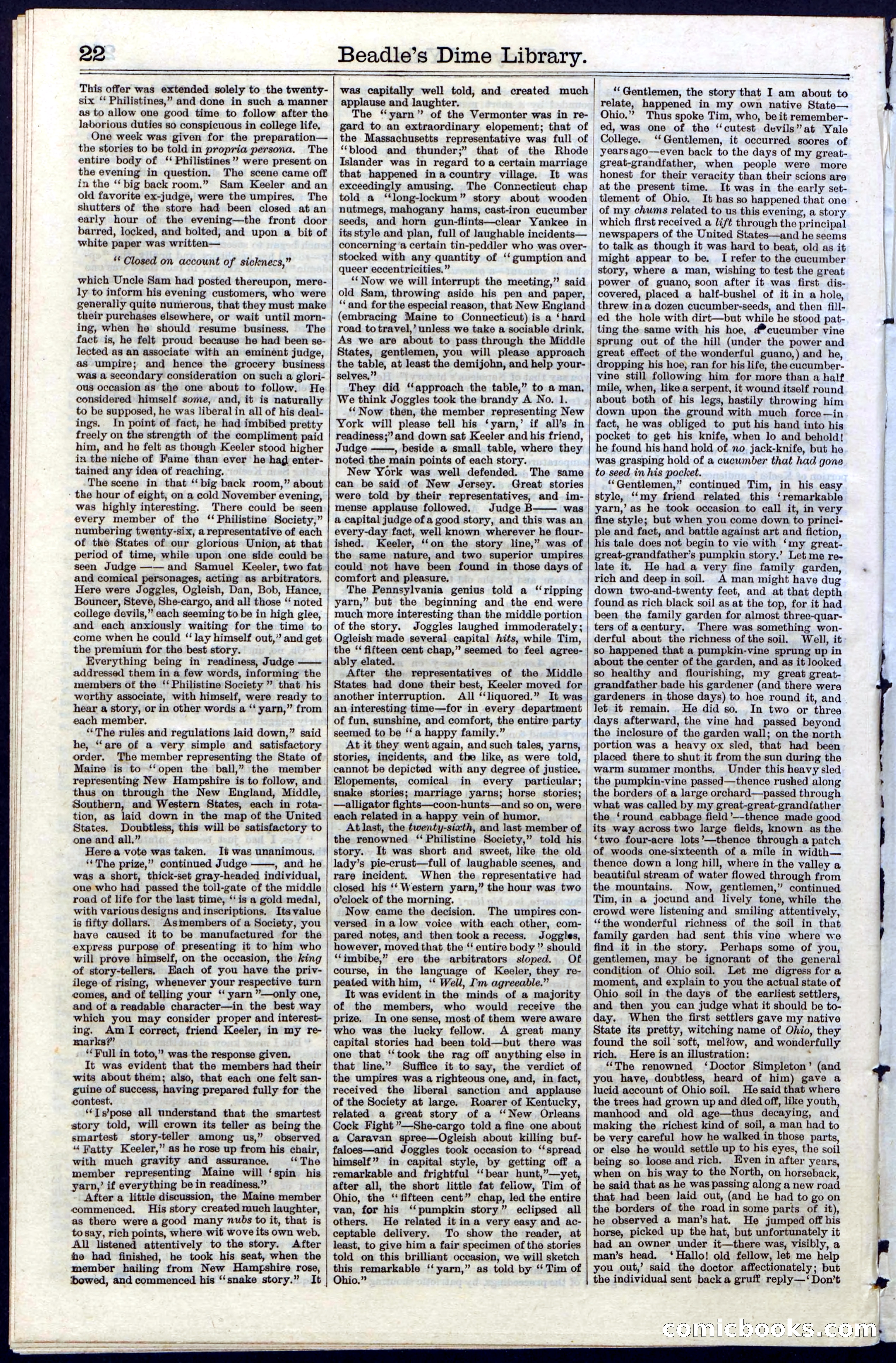
A restored page from Pulp Fiction, 1878. Page through the whole issue in the reader above.
📄 Transcribed text from this page (OCR, searchable)
Machine-transcribed from the original scan — historical spelling and the odd misread are preserved.
22 Beadle’s Dime Library. This offer was extended solely to the twenty- six ‘‘ Philistines,” and done in such a manner as to allow one good time to follow after the laborious duties so conspicuous in college life, One week was given for the preparation— the stories to be told in propria persona. The entire body of ‘‘ Philistines’? were present on the evening in question. The scene came off in the “big back room.” Sam Keeler and an old favorite ex-judge, were the umpires. The shutters of the store had been closed at an early hour of the evening—the front door barred, locked, and bolted, and upon a bit of white paper was written— ** Closed on account of sickness,” which Uncle Sam had posted thereupon, mere- ly to inform his evening customers, who were generally quite numerous, that they must make their purchases elsewhere, or wait until morn- ing, when he should resume business. The fact is, he felt proud because he had been se- lected as an associate with an eminent judge, as umpire; and hence the grocery business was a secondary consideration on such a glori- ous occasion as the one about to follow. He considered himself some, and, it is naturally to be supposed, he was liberal in all of his deal- ings. In point of fact, he had imbibed pretty freely on the strength of the compliment paid him, and he felt as though Keeler stood higher in the niche of Fame than ever he hag enter- tained any idea of reaching. The scene in that “‘ big back room,” about - the hour of eight, on a cold November evening, was highly interesting. There could be seen every member of the “ Philistine Society,” numbering twenty-six, a representative of each of the States of our glorious Union, at that period of time, while upon one side could be seen Judge —— and Samuel Keeler, two fat and comical personages, acting as arbitrators. Here were Joggles, Ogleish, Dan, Bob, Hance, Bouncer, Steve, She-cargo, and all those “ noted college devils,” each seeming to be in high glee, and each anxiously waiting for the time to come when he could “ lay himself out,’ and get the premium for the best story. Everything being in readiness, Judge addressed them in a few words, informing the members of the ‘‘ Philistine Society ” that his worthy associate, with himself, were ready to hear a story, or in other words a “‘ yarn,” from each member. ‘*The rules and regulations laid down,” said he, “are of a very simple and satisfactory order. The member representing the State of Maine is to ‘‘open the ball,” the member representing New Hampshire is to follow, and thus on through the New England, Middle, Southern, and Western States, each in rota- tion, as laid down in the map of the United States. Doubtless, this will be satisfactory to one and all.” Here a vote was taken. It was unanimous. ‘The prize,” continued Judge ——, and he was a short, thick-set gray-headed individual, one who had passed the toll-gate of the middle road of life for the last time, ‘‘ is a gold medal, with various designs andinscriptions. Its value is fifty dollars. Asmembers of a Society, you have caused it to be manufactured for the express purpose of presenting it to him who will prove himself, on the occasion, the king of story-tellers, Each of you have the priv- ilege of rising, whenever your respective turn comes, and of telling your ‘‘ yarn ”—only one, and of a readable character—in the best way which you may consider proper and interest- ing. Am TI correct, friend Keeler, in my re- marks?” ‘*Full in toto,” was the response given. It was evident that the members had their wits about them; also, that each one felt san- guine of success, having prepared fully for the contest, ‘*Ts’pose all understand that the smartest story told, will crown its teller as being the smartest story-teller among us,” observed “ Fatty Keeler,” as he rose up from his chair, with much gravity and assurance. ** The member representing Maine will ‘spin his yarn,’ if everything be in readiness.” After a little discussion, the Maine member commenced. His story created much laughter, as there were a good many nubs to it, that is to say, rich points, where wit wove its own web. All listened attentively to the story. After he had finished, he took his seat, when the member hailing from New Hampshire rose, ‘bowed, and commenced his ‘‘snake story.” It was capitally well told, and created much applause and laughter. The “yarn” of the Vermonter was in re- gard to an extraordinary elopement; that of the Massachusetts representative was full of “blood and thunder;” that of the Rhode Islander was in regard toa certain marriage | that happened inacountry village. It was exceedingly amusing. The Connecticut chap told a ‘‘long-lockum” story about wooden nutmegs, mahogany hams, cast-iron cucumber seeds, and horn gun-flints—clear Yankee in its style and plan, full of laughable incidents— concerning ‘a certain tin-peddler who was over- stocked with any quantity of ‘‘ gumption and queer eccentricities,” ‘‘Now we will interrupt the meeting,” said old Sam, throwing aside his pen and paper, ‘and for the especial reason, that New England (embracing Maine to Connecticut) is a ‘hard road totravel,’ unless we take a sociable drink. As we are about to pass through the Middle States, gentlemen, you will please approach the table, at least the demijohn, and help your- selves,” They did “approach the table,” to a man, We think Joggles took the brandy A No. 1. ‘Now then, the member representing New York will please tell his ‘yarn,’ if all’s in readiness; and down sat Keeler and his friend, Judge ———, beside a small table, where they noted the main points of each story. New York was well defended. The same can be said of New Jersey. Great stories were told by their representatives, and im- mense applause followed. Judge B—— was a capital judge of a good story, and this was an every-day fact, well known wherever he flour- ished. Keeler, ‘‘on the story line,” was of the same nature, and two superior umpires. could not have been found in those days of comfort and pleasure, The Pennsylvania genius told a “ripping yarn,” but the beginning and the end were much more interesting than the middle portion of the story. Joggles laughed immoderately; Ogleish made several capital hits, while Tim, the “‘ fifteen cent chap,” seemed to feel agree- ably elated. After the representatives of the Middle States had done their best, Keeler moved for another interruption. All ‘‘liquored.” It was an interesting time—for in every department of fun, sunshine, and comfort, the entire party seemed to be ‘‘ a happy family.” At it they went again, and such tales, yarns, stories, incidents, and tbe like, as were told, cannot be depicted with any degree of justice. Elopements, comical in every particular; snake stories; marriage yarns; horse stories; —alligator fights—coon-hunts—and so on, were each related in a happy vein of humor, At last, the twenty-sixth, and last member of the renowned “Philistine Society,” told his story. It was short and sweet, like the old lady’s pie-crust—full of laughable scenes, and rare incident. When the representative had closed his ‘‘ Western yarn,” the hour was two o’cloeck of the morning. Now came the decision. The umpires con- versed ina low voice with each other, com- pared notes, and then took a recess. Joggles, however, moved that the “ entire body ” should ‘‘imbibe,” ere the arbitrators sloped. Of course, in the language of Keeler, they re- peated with him, ‘‘ Well, I'm agreeable.” It was evident in the minds of a majority of the members, who would receive the prize. In one sense, most of them were aware who was the lucky fellow. A great many capital stories had been told—but there was one that ‘‘took the rag off anything else in that line.” Suffice it to say, the verdict of the umpires was a righteous one, and, in fact, received the liberal sanction and applause of the Society at large. Roarer of Kentucky, related a great story of a ‘‘New Orleans Cock Fight ”—She-cargo told a fine one about a Caravan spree—Ogleish about killing buf- faloes—and Joggles took occasion to “‘spread himself” in capital style, by getting off a remarkable and frightful ‘‘bear hunt,”—yet, after all, the short little fat feliow, Tim of Ohio, the ‘fifteen cent” chap, led the entire van, for his ‘‘ pumpkin story” eclipsed all others. He related it ina very easy and ac- ceptable delivery. To show the reader, at least, to give him a fair specimen of the stories told on this brilliant occasion, we will sketch this remarkable ‘‘ yarn,” as told by ‘‘ Tim of Ohio.” “Gentlemen, the story that I am about to relate, happened in my own native State— Ohio.”” Thus spoke Tim, who, be it remember- ed, was one of the “cutest devils” at Yale College. ‘Gentlemen, it occurred soores of years ago—even back to the days of my great- great-grandfather, when people were more honest for their veracity than their scions are at the present time. It was in the early set- tlement of Ohio, It has so happened that one . of my chums related to us this evening, a story which first received a lift through the principal newspapers of the United States—and he seems to talk as though it was hard to beat, old as it might appear to be. I refer to the cucumber story, where a man, wishing to test the great power of guano, soon after it was first dis- covered, placed a half-bushel of it in a hole, threw ina dozen cucumber-seeds, and then fill- ed the hole with dirt—but while he stood pat- ting the same with his hoe, @cucumber vine sprung out of the hill (under the power and great effect of the wonderful guano,) and he, dropping his hoe, ran for his life, the cucumber- vine still following him for more than a half mile, when, like a serpent, it wound itself round about both of his legs, hastily throwing him down upon the ground with much force—in fact, he was obliged to put his hand into his pocket to get his knife, when lo and behold! he found his hand hold of no jack-knife, but he was grasping hold of a cucumber that had gone to seed in his pocket. “Gentlemen,” continued Tim, in his easy style, ‘‘my friend related this ‘remarkable yarn,’ as he took occasion to call it, in very fine style; but when you come down to princi- ple and fact, and battle against art and fiction, his tale does not begin to vie with ‘my great- great-grandfather’s pumpkin story.’ Let me re- late it. He had a very fine family garden, rich and deep in soil. A man might have dug down two-and-twenty feet, and at that depth found as rich black soil as at the top, for it had been the family garden for almost three-quar- ters of acentury. There was something won- derful about the richness of the soil. Well, it so happened that a pumpkin-vine sprung up in about the center of the garden, and as it Jooked so healthy and flourishing, my great great- grandfather bade his gardener (and there were gardeners in those days) to hoe round it, and let it remain. He did so. In two or three days afterward, the vine had passed beyond the inclosure of the garden wall; on the north portion was a heavy ox sled, that had been placed there to shut it from the sun during the warm summer months, Under this heavy sled the pumpkin-vine passed—thence rushed along the borders of a large orchard—passed through what was called by my great-great-grandfather the ‘round cabbage field’—-thence made good its way across two large fields, known as the ‘two four-acre lots’—thence through a patch of woods one-sixteenth of a mile in width— thence down a long hill, where in the valley a beautiful stream of water flowed through from the mountains. Now, gentlemen,” continued Tim, in a jocund and lively tone, while the crowd were listening and smiling attentively, “the wonderful richness of the soil in that family garden had sent this vine where we find it in the story. Perhaps some of you, gentlemen, may be ignorant of the general condition of Ohio soil. Let me digress for a moment, and explain to you the actual state of Ohio soil in the days of the earliest settlers, and then you can judge what it should be to- day. When the first settlers gave my native State its pretty, witching name of Ohio, they found the soil’ soft, melfow, and wonderfully rich. Here is an illustration: : “The renowned ‘Doctor Simpleton’ (and you have, doubtless, heard of him) gave a lucid account of Ohio soil. Hesaid that where the trees had grown up and died off, like youth, manhood and old age—thus decaying, and making the richest kind of soil, a man had to be very careful how he walked in those parts, or else he would settle up to his eyes, the soil being so loose and rich. Even in after years, when on his way to the North, on horseback, he said that as he was passing along a new road that had been laid out, (and ke had to go on the borders of the road in some parts of it), he observed a man’s hat. He jumped off his horse, picked up the hat, but unfortunately it had an owner under it—there was, visibly, a man’s head. ‘ Hallo! old fellow, let me help you out,’ said the doctor affectionately; but the individual sent back a gruff reply—‘ Don’t (E IOOKS m ew