
Pulp Fiction, 1878 · page 23 of 24
Beadle's New York Dime Library No. 32 — page 23: what you’re looking at
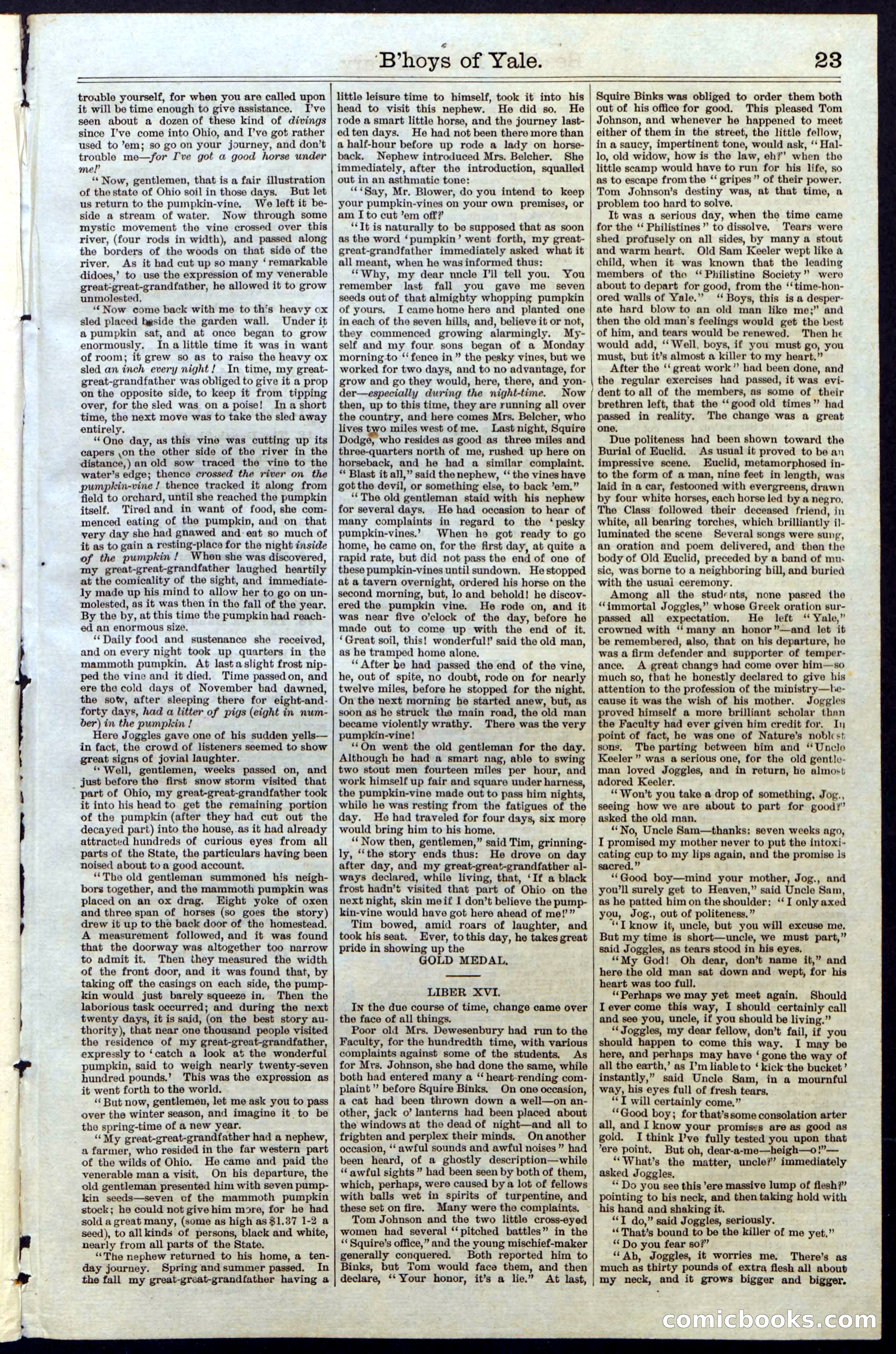
A restored page from Pulp Fiction, 1878. Page through the whole issue in the reader above.
📄 Transcribed text from this page (OCR, searchable)
Machine-transcribed from the original scan — historical spelling and the odd misread are preserved.
trouble yourself, for when you are called upon it will be time enough to give assistance. I’ve seen about a dozen of these kind of divings since I’ve come into Ohio, and I’ve got rather used to ’em; so go on your journey, and don’t trouble me—for Ive got a good horse under mel’ ‘* Now, gentlemen, that is a fair illustration of the state of Ohio soil in those days. But let us return to the pumpkin-vine. We left it be- side a stream of water. Now through some mystic movement the vine crossed over this river, (four rods in width), and passed along the borders of the woods on that side of the river, As it had cut up so many ‘remarkable didoes,’ to use the expression of my venerable great-great-grandfather, he allowed it to grow unmolested, ‘‘Now come back with me to th's heavy ox sled placed hgside the garden wall. Under it a pumpkin sat, and at once began to grow enormously. Ina little time it was in want of room; it grew so as to raise the heavy ox sled an inch every night! In time, my great- great-grandfather was obliged to give it a prop on the opposite side, to keep it from tipping over, for the sled was on a poise! Ina short time, the next move was to take the sled away entirely. “One day, us this vine was cutting up its capers ,on the other side of the river in the distance,) an old sow traced the vine to the water’s edge; thence crossed the river on the pumpkin-vine ! thence tracked it along from field to orchard, until she reached the pumpkin itself. Tired and in want of food, she com- menced eating of the pumpkin, and on that very day she had gnawed and eat so much of it as to gain a resting-place for the night inside of the pumpkin! When she was discovered, my great-great-grandfather laughed heartily at the comicality of the sight, and immediate- ly made up his mind to allow her to go on un- molested, as it was then in the fall of the year. By the by, at this time the pumpkin had reach- ed an enormous size. ‘Daily food and sustenance she received, and on every night took up quarters in the mammoth pumpkin, At lastaslight frost nip- ped the vine and it died. Time passedon, and ere the cold days of November bad dawned, the sotv, after sleeping there for eight-and- forty days, had a litter of pigs (eight in num- ber) in the pumpkin ! Here Joggles gave one of his sudden yells— in fact, the crowd of listeners seemed to show great signs of jovial laughter. ‘* Well, gentlemen, weeks passed on, and just before the first snow storm visited that part of Ohio, my great-great-grandfather took it into his head to get the remaining portion of the pumpkin (after they had cut out the decayed part) into the house,.as it had already attracted hundreds of curious eyes from all parts of the State, the particulars having been noised about to a good account. “The old gentleman summoned his neigh- bors together, and the mammoth pumpkin was placed on an ox drag. Eight yoke of oxen and three span of horses (so goes the story) drew it up to the back door of the homestead, A measurement followed, and it was found that the doorway was altogether too narrow to admit it. Then they measured the width of the front door, and it was found that, by taking off the casings on each side, the pump- kin would just barely squeeze in. Then the laborious task occurred; and during the next twenty days, it is said, (on the best story au- thority), that near one thousand people visited the residence of my great-great-grandfather, expressly to ‘catch a look at the wonderful pumpkin, said to weigh nearly twenty-seven hundred pounds.’ This was the expression as it went forth to the world. ‘‘ But now, gentlemen, let me ask you to pass over the winter season, and imagine it to be the spring-time of a new year. “My great-great-grandfather had a nephew, a farmer, who resided in the far western part of the wilds of Ohio. He came and paid the venerable man a visit. On his departure, the old gentleman presented him with seven pump- kin seeds—seven cf the mammoth pumpkin stock; he could not give him more, for he had sold a great many, (some as high as $1.37 1-2 a seed), to allkinds of persons, black and white, nearly from all parts of the State. ‘*The nephew returned to his home, a ten- day journey. Spring andsummer passed. In the fall my great-great-grandfather having a B’hoys of Yale. little leisure time to himself, took it into his head to visit this nephew. He did so. He rode a smart little horse, and the journey last- ed ten days. He had not been there more than a half-hour before up rode a lady on horse- back. Nephew introduced Mrs. Belcher. She immediately, after the introduction, squalled out in an asthmatic tone: ‘**Say, Mr. Blower, do you intend to keep your pumpkin-vines on your own premises, or am I to cut ’em off? ‘“*It is naturally to be supposed that as soon as the word ‘pumpkin’ went forth, my great- great-grandfather immediately asked what it all meant, when he was informed thus: “Why, my dear nncle [ll tell you. You remember last fall you gave me seven seeds outof that almighty whopping pumpkin of yours. I came home here and planted one in each of the seven hills, and, believe it or not, they commenced growing alarmingly. My- self and my four. sons began of a Monday morning-to ‘‘ fence in” the pesky vines, but we worked for two days, and to no advantage, for grow and go they would, here, there, and yon- der—especially during the night-time. Now then, up to this time, they are running all over the country, and here comes Mrs. Belcher, who lives two miles west of me. Last night, Squire Dodge, who resides as good as three miles and three-quarters north of me, rushed up here on horseback, and he had a similar complaint. ** Blast it all,” said the nephew, ‘‘ the vines have got the devil, or something else, to back ’em.” ‘The old gentleman staid with his nephew for several days. He had occasion to hear of many complaints in regard to the ‘pesky pumpkin-vines.’ When he got ready to go home, he came on, for the first day, at quite a rapid rate, but did not pass the end of one of these pumpkin-vines until sundown. He stopped at a tavern overnight, ordered his horse on the second morning, but, lo and behold! he discov- ered the pumpkin vine. He rode on, and it was near five o’clock of the day, before he made out to come up with the end of it. ‘Great soil, this! wonderful!’ said the old man, as he tramped home alone. ‘‘ After he had passed the end of the vine, he, out of spite, no doubt, rode on for nearly twelve miles, before he stopped for the night. On the next morning he started anew, but, as soon as he struck the main road, the old man became violently wrathy. There was the very pumpkin-vine! ‘*On went the old gentleman for the day. Although he had a smart nag, able to swing two stout men fourteen miles per hour, and work himself up fair and square under harness, the pumpkin-vine made out to pass him nights, while he was resting from the fatigues of the day. He had traveled for four days, six more would bring him to his home, ‘‘ Now then, gentlemen,” said Tim, grinning- ly, ‘“‘the story ends thus: He drove on day after day, and my great-great-grandfather al- ways declared, while living, that, ‘If a black frost hadn’t visited that part of Ohio on the next night, skin meif I don’t believe the pump- kin-vine would have got here ahead of me!’” Tim bowed, amid roars of laughter, and took his seat. Ever, tothis day, he takes great pride in showing up the GOLD MEDAL, LIBER XVI. In the due course of time, change came over the face of all things. Poor old Mrs. Dewesenbury had run to the Faculty, for the hundredth time, with various complaints against some of the students. As for Mrs. Johnson, she had done the same, while both had entered many a “ heart-rending com- plaint ” before Squire Binks. On one occasion, a cat had been thrown down a well—on an- other, jack o’ lanterns had been placed about the windows at the dead of night—and all to frighten and perplex their minds. On another occasion, ‘‘ awful sounds and awful noises ” had been heard, of a ghostly description—while ‘“‘ awful sights ” had been seen by both of them, which, perhaps, were caused by a lot of fellows with balls wet in spirits of turpentine, and these set on fire. Many were the complaints. Tom Johnson and the two little cross-eyed women had several ‘‘ pitched battles” in the ‘* Squire’s office,” and the young mischief-maker generally conquered. Both reported him to Binks, but Tom would face them, and then declare, ‘‘ Your honor, it’s a lie.” At last, 23 Squire Binks was obliged to order them both out of his office for good. This pleased Tom Johnson, and whenever he happened to meet either of them in the street, the little fellow, in a saucy, impertinent tone, would ask, “ Hal- lo, old widow, how is the law, eh?’ when the little seamp would have to run for his life, so as to escape fromthe “ gripes” of their power. Tom Johnson’s destiny was, at that time, a problem too hard to solve. It was a serious day, when the time came for the ‘‘ Philistines” to dissolve. Tears were shed profusely on all sides, by many a stout and warm heart. Old Sam Keeler wept like a child, when it was known that the leading members of tho ‘ Philistine Society’ were about to depart for good, from the ‘‘time-hon- ored walls of Yale.” “ Boys, this is a desper- ate hard blow to an old man like me;” and then the old man’s feelings would get the best of him, and tears would be renewed. Then he would add, ‘‘ Well, boys, if you must go, you must, but it’s almost a killer to my heart,” After the ‘‘ great work’ had been done, and the regular exercises had passed, it was evi- dent to all of the members, as some of their brethren left, that the “good old times” had passed in reality, The change was a great one. Due politeness had been shown toward the Burial of Euclid. As usual it proved to be an impressive scene. Euclid, metamorphosed in- to the form of a man, nine feet in length, was laid in a car, festooned with evergreens, drawn by four white horses, each horse led by a negro, The Class followed their deceased friend, in white, all bearing torches, which brilliantly il- luminated the scene Several songs were sung, an oration and poem delivered, and then the body of Old Euclid, preceded by a band of mu. sic, was borne to a neighboring bill, and buried with the usual ceremony. Among all the students, none pasred tho ‘immortal Joggles,” whose Greek oration sur- passed all expectation. He left ‘ Yale,” crowned with ‘‘many an honor”—and let it be remembered, also, that on his departure, he was a firm defender and supporter of temper- ance. A great changs had come over him—so much so, that he honestly declared to give his attention to the profession of the ministry—bhe- cause it was the wish of his mother. Joggles proved himself a more brilliant scholar than the Faculty had ever given him credit for. I) point of fact, he was one of Nature’s noblcst sons. The parting between bim and “ Unclo Keeler” was a serious one, for the old gent)ov- man loved Joggles, and in return, be almost adored Keeler. “‘Won’t you take a drop of something, Jog., seeing how we are about to part for good?” asked the old man. “No, Uncle Sam—thanks: seven weeks ago, I promised my mother never to put the intoxi- cating cup to my lips again, and the promise ls sacred.” ‘Good boy—mind your mother, Jog., and you'll surely get to Heaven,” said Uncle Sam, as he patted him on the shoulder; ‘‘I only axed you, Jog., out of politeness,” ‘*T know it, uncle, but you will excuse me, But my time is short—uncle, we must part,” said Joggles, as tears stood in his eyes. ‘My God! Oh dear, don’t name it,” and here the old man sat down and wept, for his heart was too full. ‘‘Perhaps we may yet meet again. Should Iever come this way, I should certainly call and see you, uncle, if you should be living.” “* Joggles, my dear fellow, don’t fail, if you should happen to come this way. I may be here, and perhaps may have ‘gone the way of all the earth,’ as I’m liable to ‘kick the bucket’ instantly,” said Uncle Sam, in a mournful way, his eyes full of fresh tears, “T will certainly come.” “‘Good boy; for that’ssome consolation arter all, and I know your promises are as good as gold. I think I’ve fully tested you upon that ere point. But oh, dear-a-me—heigh—o!”— ‘““What’s the matter, uncle?’ immediately asked Joggles, “* Do you see this ere massive lump of flesh?” pointing to his neck, and then taking hold with his hand and shaking it. ““T do,” said Joggles, seriously. ‘‘That’s bound to be the killer of me yet,” * Do you fear so?” ‘“‘ Ah, Joggles, it worries me. There’s as much as thirty pounds of extra flesh all about my neck, and it grows bigger and bigger. Eomichbooks (e(@)