
Pulp Fiction, 1878 · page 10 of 24
Beadle's New York Dime Library No. 32 — page 10: what you’re looking at
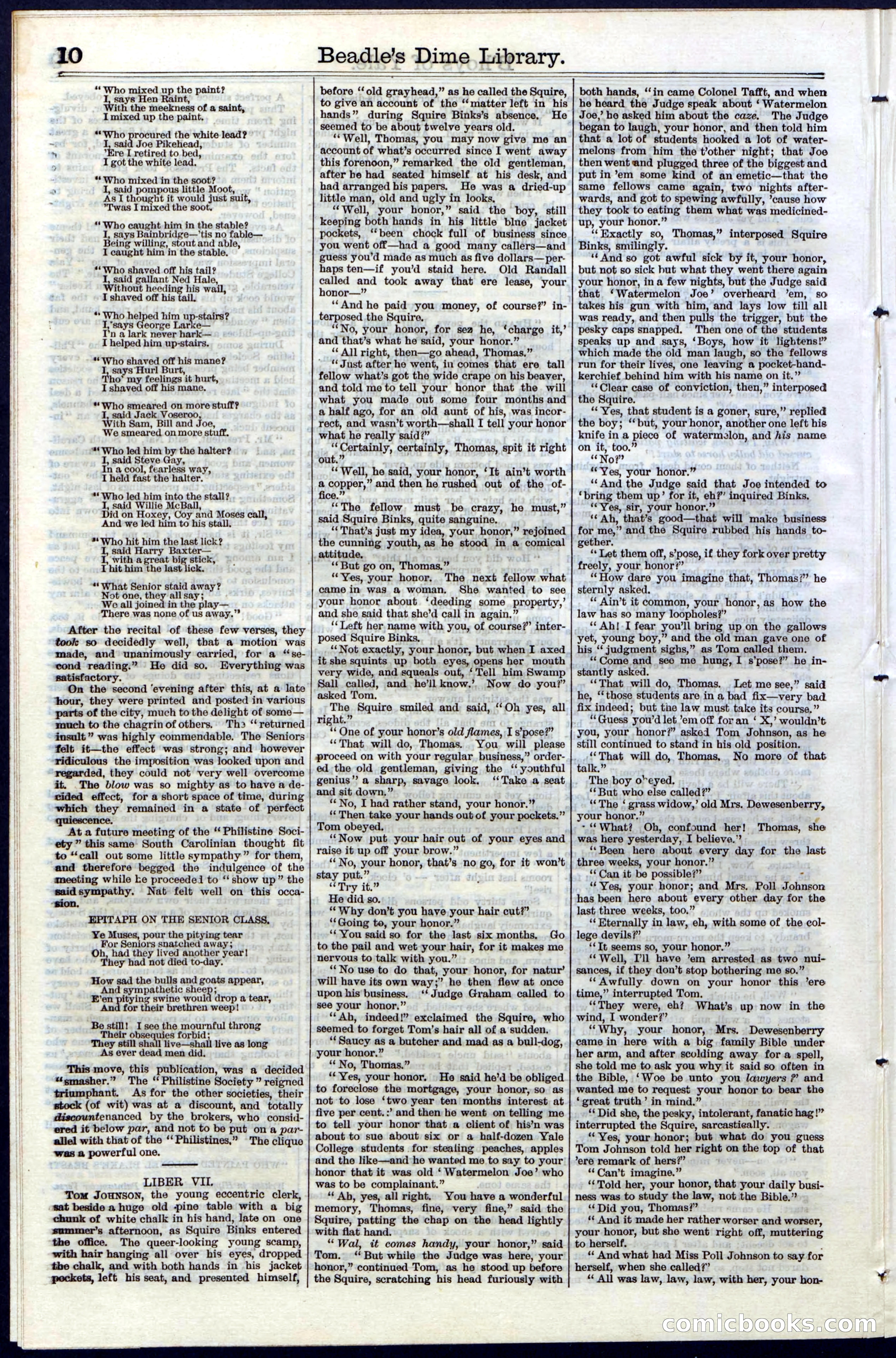
A restored page from Pulp Fiction, 1878. Page through the whole issue in the reader above.
📄 Transcribed text from this page (OCR, searchable)
Machine-transcribed from the original scan — historical spelling and the odd misread are preserved.
i! 10 “Who mixed up the paint? I, says Hen Raint, With the meekness of a saint, I mixed up the paint, **Who procured the white lead? said Joe Pikehead, ‘ Ere L retired to bed, I got the white lead. **Who mixed in the soot? I, said pompous little Moot, | AsI megene it would just suit, *T was I mixed the soot, **Who caught him in the stable? I, says Bainbridge—’tis no fable— Being willing, stout and able, I caught him in the stable. **Who shaved off his tail? I, said gallant Ned Hale, Without heeding his wail, I shaved off his tail. * Who pees him up-stairs? I,"says eorge Larke— I’n a lark never hark— I helped him up-stairs. “Who shaved off his mane? La bat oO eelings i I ahaa off his mane, “Who smeared on more stuff? I, said Jack Voseroo, With Sam, Bill and Joe, We smeared on more stuff. “* Who led him by the halter? I, said Steve Gay, In a cool, fearless way, I held fast the halter. “ Who led him into the stall? i said Willie McBall, id on Hoxey, Coy and Moses call, And we led him to his stall, “Who hit him the last lick? Baxter— said I, with a t big stick, I hit him the last lick. “What Senior staid away? Not one, they all say; We all joined in the play— There was none of us away.” After the recital of these few verses, they took so decidedly well, that a motion was made, and unanimously carried, for a ‘se- cond reading.” He did so, Everything was satisfactory. On the second ‘evening after this, at a late ‘hour, they were printed and posted in various parts of the city, much to the delight of some— much to the chagrin of others. Ths “returned insult” was highly commendable. The Seniors felt it—the effect was strong; and however ridiculous the imposition was looked upon and regarded, they could not very well overcome it. The blow was so mighty as to have a de- vided effect, for a short space of time, during which they remained in a state of perfect nce, At a future meeting of the ‘ Philistine Soci- ety ” this same South Carolinian thought fit to “call out some little sympathy” for them, and therefore begged the indulgence of the aneeting while Le proceeded to “‘ show up” the saidsympathy. Nat felt well on this occa- “sion, EPITAPH ON THE SENIOR CLASS, Ye Muses, pour the pitying tear For Seniors snatched away; Oh, had they lived another year! They had not died to-day. How sad the bulls and goats appear, And sympathetic phoee E’en itying swine would drop a tear, for their brethren weep! Be still! I see the mournful throng Their o uies forbid: They still shell live—shall live as long As ever dead men did. This move, this publication, was a decided “smasher.” The “ Philistine Society ” reigned triumphant. As for the other societies, their stock (of wit) was at a discount, and totally discountenanced by the brokers, who consid- ered it below par, and not to be put on a par- allel with that of the ‘‘ Philistines,” The clique was a powerful one. LIBER VIL. Tom JouNnsoN, the young eccentric clerk, sat beside a huge old -pine table with a big chunk of white chalk in his hand, late on one summer’s afternoon, as Squire Binks entered the office. The queer-looking young scamp, with hair hanging all over his eyes, dropped the chalk, and with both hands in his jacket pockets, left his seat, and presented himself, ——_—_ -o- = —- Beadle’s Dime Library. before ‘‘old grayhead,” as he called the Squire, to give an account of the “matter left in his hands” during Squire Binks’s absence, He seemed to be about twelve years old. ‘* Well, Thomas, you may now give me an account of what’s occurred since I went away this forenoon,” remarked the old gentleman, after he had seated himself at his desk, and had arranged bis papers. He was a dried-up little man, old and ugly in looks, “Well, your honor,” said the boy, still keeping both hands in his little blue jacket pockets, ‘‘been chock full of business since you went off—had a good many callers—and guess you’d made as much as five dollars—per- haps ten—if you’d staid here. Old Randall called and took away that ere lease, your honor—” ‘‘And he paid you money, of course?” in- terposed the Squire, “No, your honor, for sea he, ‘charge it,’ and that’s what he said, your honor.” ‘All right, then—go ahead, Thomas,” ** Just after he went, in comes that ere tall fellow what’s got the wide crape on his beaver, and told me to tell your honor that the will what you made out some four months and a half ago, for an old aunt of his, was incor- rect, and wasn’t worth—shall I tell your honor what he really said?” > Certainly, certainly, Thomas, spit it right out. “Well, he said, your honor, ‘It ain’t worth a copper,” and then he rushed out of the of- fice.” “The fellow must be crazy, he must,” said Squire Binks, quite sanguine. “‘That’s just my idea, your honor,” rejoined the cunning youth, as he stood in a comical attitude, ' ‘*But go on, Thomas,” “Yes, your honor, The next fellow what came in was a woman. She wanted to see your honor about ‘deeding some property,’ and she said that she’d callin again.” ‘‘Left her name with you, of course?’ inter- posed Squire Binks, “Not exactly, your honor, but when I axed it she squints up both eyes, opens her mouth very wide, and squeals out, ‘ Tell him Swamp Sall called, and he’ll know,’, Now do you?” asked Tom. The Squire smiled and said, ‘‘Oh yes, all right.” “One of your honor’s old flames, I s’pose?” “That will do, Thomas. You. will please proceed on with your regular business,” order- ed the old gentleman, giving the ‘ youthful genius’? a sharp, savage look. ‘Take a seat and sit down,” ** No, I had rather stand, your honor.” ‘Then take your hands outof your pockets.” Tom obeyed, ‘‘Now put your hair out of your eyes and raise it up off your brow.” “No, your honor, that’s no go, for it won’t stay put.” “Try it.” He did so. “Why don’t you have your hair cut?” ‘‘Going te, your honor.” ‘You said so for the last six months, Go to the pail and wet your hair, for it makes me nervous to talk with you.” ‘No use to do that, your honor, for natur’ will have its own way;’ he then flew at once upon his business. ‘‘ Judge Graham called to see your honor,” “‘Ab, indeed!” exclaimed the Squire, who seemed to forget Tom’s hair all of a sudden. ‘Saucy as a butcher and mad as a bull-dog, your honor.” ‘* No, Thomas.” : ‘Yes, your honor. He said he’d be obliged to foreclose the mortgage, your honor, so as not to lose ‘two year ten months interest at five per cent. :’ and then he went on telling me to tell your honor that a client of his’n was about to sue about six or a half-dozen Yale College students for stealing peaches, apples and the like—and he wanted me to say to your honor that it was old ‘Watermelon Joe’ who was to be complainant.” “* Ab, yes, all right. You have a wonderful memory, Thomas, fine, very fine,” said the Squire, patting the chap on the head lightly with flat hand. “Wal, it comes handy, your honor,” said Tom. “But while the Judge was here, your honor,” continued Tom, as he stood up before the Squire, scratching his head furiously with both hands, ‘‘in came Colonel Tafft, and when he heard the Judge speak about ‘ Watermelon Joe,’ he asked him about the caze. The Judge began to laugh, your honor, and then told him that a lot of students hooked a lot of water- melons from him the t’other night; that Joe then went and plugged three of the biggest and put in’em some kind of an emetic—that the same fellows came again, two nights after- wards, and got to spewing awfully, ’cause how they took to eating them what was medicined- up, your honor.” “Exactly so, Thomas,” interposed Squire Binks, smilingly. ‘*And so got awful sick by it, your honor, but not so sick but what they went there again your honor, in a few nights, but the Judge said that ‘Watermelon Joe’ overheard ’em, so takes his gun with him, and lays low till all was ready, and then pulls the trigger, but the pesky caps snapped. Then one of the students speaks up and says, ‘Boys, how it lightens!” which made the old man laugh, so the fellows run for their lives, one leaving a pocket-hand- kerchief behind him with his name on it.” “Clear case of conviction, then,” interposed the Squire. “Yes, that student is a goner, sure,” replied the boy; “but, your honor, another one left his knife in a piece of watermelon, and Ais name on it, too.” cc No ?? “Yes, your honor.” ‘And the Judge said that Joe intended to ‘bring them up’ for it, eh?’ inquired Binks, ‘Yes, sir, your honor,” ‘¢ Ah, that’s good—that will make business for me,” and the Squire rubbed his hands to- gether. ‘* Let them off, s’pose, if they fork over pretty freely, your honor?” “How dare you imagine that, Thomas?’ he sternly asked. ‘“‘ Ain’t it common, your honor, as how the law has so many loopholes?” *‘ Ah! I fear you'll bring up on the gallows yet, young boy,” and the old man gave one of his ‘‘ judgment sighs,” as Tom called them. ‘*Come and see me hung, I s’pose?” he in- stantly asked. ‘“‘That will do, Thomas. Let me see,” said he, ‘‘those students are in a bad fix—very bad fix indeed; but the law must take its course.” “Guess you'd let ’em off for an ‘ X,’ wouldn’t you, your honor?” asked Tom Johnson, as he still continued to stand in his old position. ‘‘That will do, Thomas, No more of that The boy o*eyed, ‘‘ But who else called?’ “The ‘ grass widow,’ old Mrs. Dewesenberry, your honor.” ~‘*What? Oh, confound her! was here yesterday, I believe.” ‘‘Been here about every day for the last three weeks, your honor.” ‘*Can it be possible?” . ‘Yes, your honor; and Mrs. Poll Johnson has been here about every other day for the last three weeks, too.” ‘“‘ Eternally in law, eh, with some of the col- lege devils?’ ‘¢Tt seems so, your honor.” ‘Well, Pll have ’em arrested as two nui- sances, if they don’t stop bothering me so.” *‘Awfully down on your honor this ’ere time,” interrupted Tom, “They were, eh? What’s up now in the wind, I wonder?” ‘“Why, your honor, Mrs. Dewesenberry came in here with a big family Bible under her arm, and after scolding away for a spell, she told me to ask you why it said so often in the Bible, ‘Woe be unto you lawyers ?’ and wanted me to request your honor to bear the ‘great truth’ in mind.” ‘* Did she, the pesky, intolerant, fanatic hag!” interrupted the Squire, sarcastically. . “Yes, your honor; but what do you guess Tom Johnson told her right on the top of that ’ere remark of hers?’ | Can't i ine.” ‘Told her, your honor, that your daily busi- ness was to study the law, not the Bible,” “Did you, Thomas?” *¢ And it made her rather worser and worser, your honor, but she went right off, muttering to herself. *¢ And what had Miss Poll Johnson to say for herself, when she called?” “ All was law, law, law, with her, your hon- Thomas, she (E| 6 (0)0) Com “SiG (0)