
Pulp Fiction, 1878 · page 27 of 32
Beadle's Dime Library, Vol. III, No. 31 — page 27: what you’re looking at
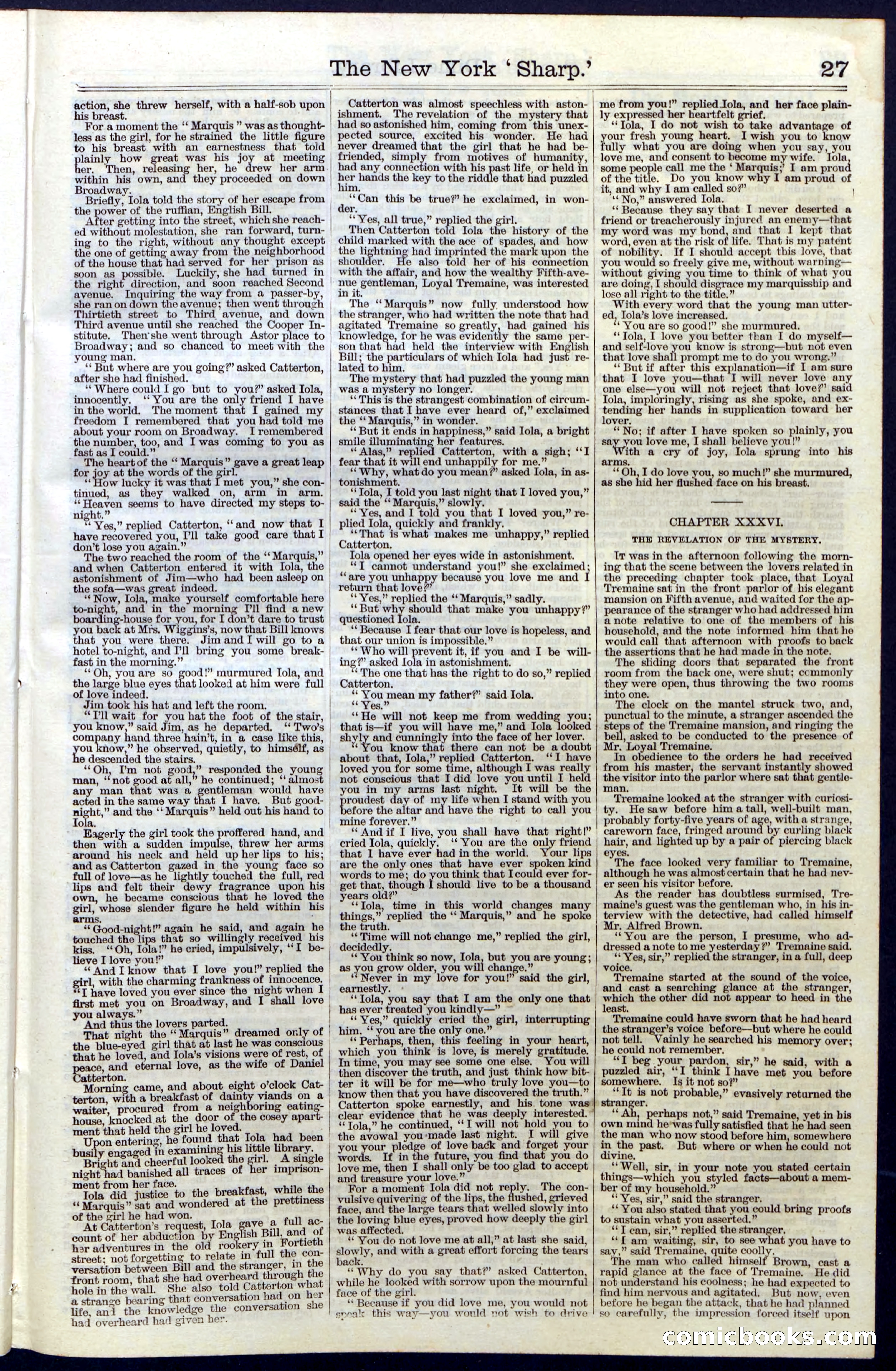
A restored page from Pulp Fiction, 1878. Page through the whole issue in the reader above.
📄 Transcribed text from this page (OCR, searchable)
Machine-transcribed from the original scan — historical spelling and the odd misread are preserved.
an action, she threw herself, with a half-sob upon his breast. For a moment the ‘‘ Marquis ” was as thought- less as the girl, for he strained the little figure to his breast with an earnestness that told lainly how great was his joy at meeting er. Then, releasing her, he drew her arm within his own, and they proceeded on down Broadway. Briefly, Iola told the story of her escape from the power of the ruffian, English Bill. After getting into the street, which she reach- ed without molestation, she ran forward, turn- ing to the right, without any thought except the one of getting away from the neighborhood of the house that had served for her prison as soon as possible. Luckily, she had turned in the right direction, and soon reached Second avenue. Inquiring the way from a passer-by, she ran on down the avenue; then went through Thirtieth street to Third avenue, and down Third avenue until she reached the Cooper In- stitute. Then'she went through Astor place to Broadway; and so chanced to meet with the young man. ‘* But where are you going?” asked Catterton, after she had finished. ** Where could I go but to you?’ asked Iola, innocently. ‘‘ You are the only friend I have in the world. The moment that I gained my freedom I remembered that you had told me about your room on Broadway. I remembered the number, too, and Iwas coming to you as fast as I could.” The heart of the ‘‘ Marquis” gave a great leap for joy at the words of the girl. ‘* How lucky it was that I met you,” she con- tinued, as they walked on, arm in arm. ‘‘Heaven seems to have directed my steps to- night.” “Ves,” replied Catterton, ‘and now that I have recovered you, I'll take good care that I don’t lose you again.” . The two reached the room of the ‘‘ Marquis,” and when Catterton entered it with Iola, the astonishment of Jim—who had been asleep on the sofa—was great indeed. ‘¢ Now, Iola, make yourself comfortable here to-night, and in the morning [ll find a new b ing-house for you, for I don’t dare to trust ou back at Mrs. Wiggins’s, now that Bill knows hat you were there. JimandI will go to a hotel to-night, and Pll bring you some break- fast in the morning.” **Oh, you are so good!” murmured fola, and the large blue eyes that looked at him were full of love indeed. Jim took his hat and left the room. “Tl wait for you hat the foot of the stair, you know,” said Jim, as he departed. ‘' Two's company hand three hain’t, in a case like this, ou know,” he observed, quietly, to himsélf, as e descended the stairs. “Oh, I’m not good,” responded the young man, ‘not good at all,” he continued; ‘‘ almost any man that was a gentleman would have acted in the same way that I have. But good- night,” and the ‘‘ Marquis” held out his hand to Tola. Eagerly the girl took the a et hand, and then with a sudden impulse, threw her arms around his neck and held up her lips to his; and as Catterton gazed in the young face so full of love—as he lightly touched the full, red lips and felt their dewy fragrance upon his own, he became conscious that he loved the girl, whose slender figure he held within his arms. “ Good-night!” again he said, and again he touched the lips that so willingly received his kiss. ‘Oh, fon !” he cried, impulsively, ‘‘I be- lieve I love you!” ; “ And I know that I love you!” replied the girl with the charming frankness of innocence. ‘T have loved you ever since the night when I first met you on Broadway, and I shall love you always.” And thus the lovers parted. That night the “Marquis” dreamed only of the blue-eyed girl that at last he was conscious that he loved, and Iola’s visions were of rest, of aaa and eternal love, as the wife of Daniel rton. Mornin came, and about eight o’clock Cat- terton, with a breakfast of ee on a waiter, procured from a neighboring eating- house, knocked at ee gecr ‘ee the cosey apart- eld the girl he loved. rath = ae fd found that Tola had been busily engaged in examining his little library. Bright and cheerful looke the girl. A single night had banished all traces of her imprison- ment from her face. fola aid justice to the breakfast, while the “ Marquis” Sat and wondered at the prettiness of the girl he had won. ’ ve a full ac- At Catterton’s request, Lola gay ait: and’ of Fortieth count of her abduction by En her adventures in the old rookery mm street; not forgetting to relate in full the wae versation between Bill and the stranger, 1 t e front room, that she had overheard through oe hole in the wall. She also told Catterton ae a strange bearing that conversation had on - life, ani the knowledge the conversation she had overheard had given her. _ The New York Sharp.” _ Catterton was almost speechless with aston- ishment. The revelation of the mystery that had so astonished him, coming from this unex- pected source, excited his wonder. He had never dreamed that the girl that he had be- friended, simply from motives of humanity, had any connection with his past life, or held in ad hands the key to the riddle that had puzzled iim. r ‘*Can this be true?’ he exclaimed, in won- er. ** Yes, all true,” replied the girl. Then Catterton told Iola the history of the child marked with the ace of spades, and how the lightning had imprinted the mark upon the shoulder. e also told her of his connection with the affair, and how the wealthy Fifth-ave- ig i pen vy Loyal Tremaine, was interested in it. The ‘‘ Marquis” now fully understood how the stranger, who had written the note that had agitated Tremaine so greatly, had gained his knowledge, for he was evidently the same per- son that had held the interview with English Bill; the particulars of which Iola had just re- lated to him. The mystery that had puzzled the young man was a mystery no longer. ‘This is the strangest combination of circum- stances that I have ever heard of,” exclaimed the ‘‘ Marquis,” in wonder. ‘* But it ends in happiness,” said lola, a bright smile illuminating her features. ‘* Alas,” replied Catterton, with a sigh; ‘‘I fear that it will end unhappily for me.” “Why, what do you mean?” asked Iola, in as- tonishment. ‘*Tola, I told you last night that I loved you,” said the ‘‘ Marquis,” reat “Yes, and I told you that I loved you,” re- plied Iola, quickly and frankly. “That is what makes me unhappy,” replied Catterton, Iola opened her eyes wide in astonishment. “IT cannot understand you!” she exclaimed; “are you unhappy because you love me and I return that love?” ** Yes,” replied the ‘ Marquis,” sadly. ‘But why should that make you unhappy?” questioned Lola. ** Because I fear that our love is hopeless, and that our union is impossible.” ‘* Who will prevent it, if you and I be will- ing?” asked Lola in astonishment. ‘The one that has the right to do so,” replied Catterton. ‘You mean my father?” said Iola, se Yes ” “He will not keep me from wedding you; that is—if you will have me,” and Iola looked shyly and cunningly into the face of her lover. ou know that there can not be a doubt ““T have loved you for some time, although I was really not conscious that I did love you until I held It will be the life when I stand with you fore the altar and have the right to call you about that, Iola,” replied Catterton. arms last night. you in m ay of m arb mine forever.” ‘‘ And if I live, you shall have that right!” friend our lips oken kind ou think that Icould ever for- should live to be a thousand cried Iola, quickly. ‘‘ You are the onl that I have ever had in the world. are the only ones that have ever words to me; do get that, though years old?” ‘‘Tola, time in this world changes many things,” replied the ‘‘ Marquis,” and he spoke the truth. ‘* Time will not change me,” replied the girl, decidedly. ‘You think so now, Iola, but you are young ; as you grow older, you will chan ** Never in my love for you!” said the girl, earnestly. “‘Tola, you say that I am the only one that has ever treated you kindly—” rT Yes,” quick] him, ‘‘ you are the only one.” ‘‘ Perhaps, then, this feeling in your heart, which you think is love, is merely gratitude. In time, you may see some one else. know then that you have discovered the truth.” Catterton spoke earnestly, and his tone w clear evidence that he was deeply interested. “Tola,” he continued, ‘‘I will not hold you to the avowal you‘made last night. I will give you your pledge of love back and forget your al If in the future, you find that you do love me, then I shall only be too glad to accept and treasure your love.” For a moment Iola did not reply. The con- vulsive quivering of the lips, the flushed, grieved face, and the large tears that welled slowly into the loving blue eyes, proved how deeply the girl was affected. “You do not love me at all,” at last she said, slowly, and with a great effort forcing the tears k back. ‘‘Why do you say that?’ asked Catterton, while he looked with sorrow upon the mournful face of the girl. ‘* Because if you did love me, you would not sneak this way—you would not wish to drive ly love me, an some peo of the title. cried the girl, interrupting You will then discover the truth, and just think how bit- ter it will be for me—who truly love you—to 27 me from you!” replied Iola, and her face plain- expressed her heartfelt grief. ——- ‘‘Tola, I do not wish to take advantage of ly what it, and why I am called so?” ‘*No,” answered Iola. at fresh young heart. I wish you to know ul ou are doing when you say, you consent to become my wife. le call me the ‘ Marquis; I am proud Do you know why I am proud of lola | ‘‘ Because they say that I never deserted a friend or treacherously injured an enemy—that my word was my bond, and that I kept that word, even at the risk of life. That is my patent of nobility. If I should accept this love, that you would so freely give me, without warning— without givin are doing, I pou and self-love ou time to think of what you d dis ace my marquisship and lose all right to the title.” With every word that the young man utter- ed, Iola’s love increased. ‘You are so good!” she murmured. “‘Tola, I love you better than I do myself— ou know is strong—but not even that love shall prompt me to do you wrong.” ‘But if after this explanation—if I am sure that I love you—that I will never love any one else—you will not reject that love?” said Iola, imploringly, rising as she spoke, and ex- tending her hands in supplication toward her lo say you love me, I shall believe you!” ith a ery of joy, Iola sprung into his ver. ‘No; if after I have spoken so plainly, you ms. ‘Oh, I do love you, so much!” she murmured, as she hid her flushed face on his breast, CHAPTER XXXVI, THE REVELATION OF THE MYSTERY. Ir was in the afternoon following the morn- ing that the scene between the lovers related in the preceding chapter took place, that Loyal Tremaine sat in the front parlor of his elegant mansion on Fifth avenue, and waited for the ap- pearance of the stranger who had addressed him a note relative to one of the members of his household, and the note informed him that he would call that afternoon with proofs to back the assertions that he had made in the note. The slidin doors that separated the front room from the back one, were shut; commonly they were open, thus throwing the two rooms into one. The clock on the mantel struck two, and, punctual to the minute, a stranger ascended the ae of the Tremaine mansion, and ringing the bell, asked to be conducted to the presence of Mr. Loyal Tremaine. In obedience to the orders he had received from his master, the servant instantly showed the visitor into the parlor where sat that gentile- man. Tremaine looked at the stranger with curiosi- . Hesaw before him a tall, well-built man, probably forty-five years of age, with a strange, careworn face, fringed around by curling black hair, and lighted up by a pair of piercing black eyes, The face looked very familiar to Tremaine, although he was almost certain that he had nev- er seen his visitor before. As the reader has doubtless surmised, Tre- maine’s guest was the gentleman who, in his in- terview with the detective, had called himself Mr. Alfred Brown. “You are the person dressed a note to me yesterday ? ‘Yes, sir,” replied the stranger, in a full, deep voice. , I presume, who ad- ” Tremaine said. Tremaine started at the sound of the voice, and cast a searching which the other did n east. Tremaine could have sworn that he had heard ] ot lan ce at the stranger, appear to heed in the the sess voice before—but where he could not tell. ae I be & yo puzzled air, “I think somewhere. Is it not so?” ainly he searched he could not remember. ur pardon, sir,” he said, with a Ihave met you before his memory over; ‘It is not probable,” evasively returned the ) stranger. ? own min divine. rhaps not,” said Tremaine, yet in bis he’was y satisfied that he had seen the man who now stood before him, somewhere in the past. But where or when he could not ‘Well, sir, in your note you stated certain things—which you styled facts—about a mem- ber of my household.” ** Yes, sir,” said the stranger ‘** You also stated that to sustain what you asse ‘“T can, sir,” replied the stranger, ‘“*f am waitin say,” said Tremal The man who » SIT, ne call to see w quite cooll ed himsel rapid glance at the face of Tremaine. not understand his coolness; he had expected to find him nervous and agitated. you could bring proofs t you have to rd Brown, cast a He did But now, even before he began the attack, that he had planned so carefully, the impression forced itself upon (E(0) m Cc JOO <S) (E(0)