
Pulp Fiction, 1878 · page 28 of 32
Beadle's Dime Library, Vol. III, No. 31 — page 28: what you’re looking at
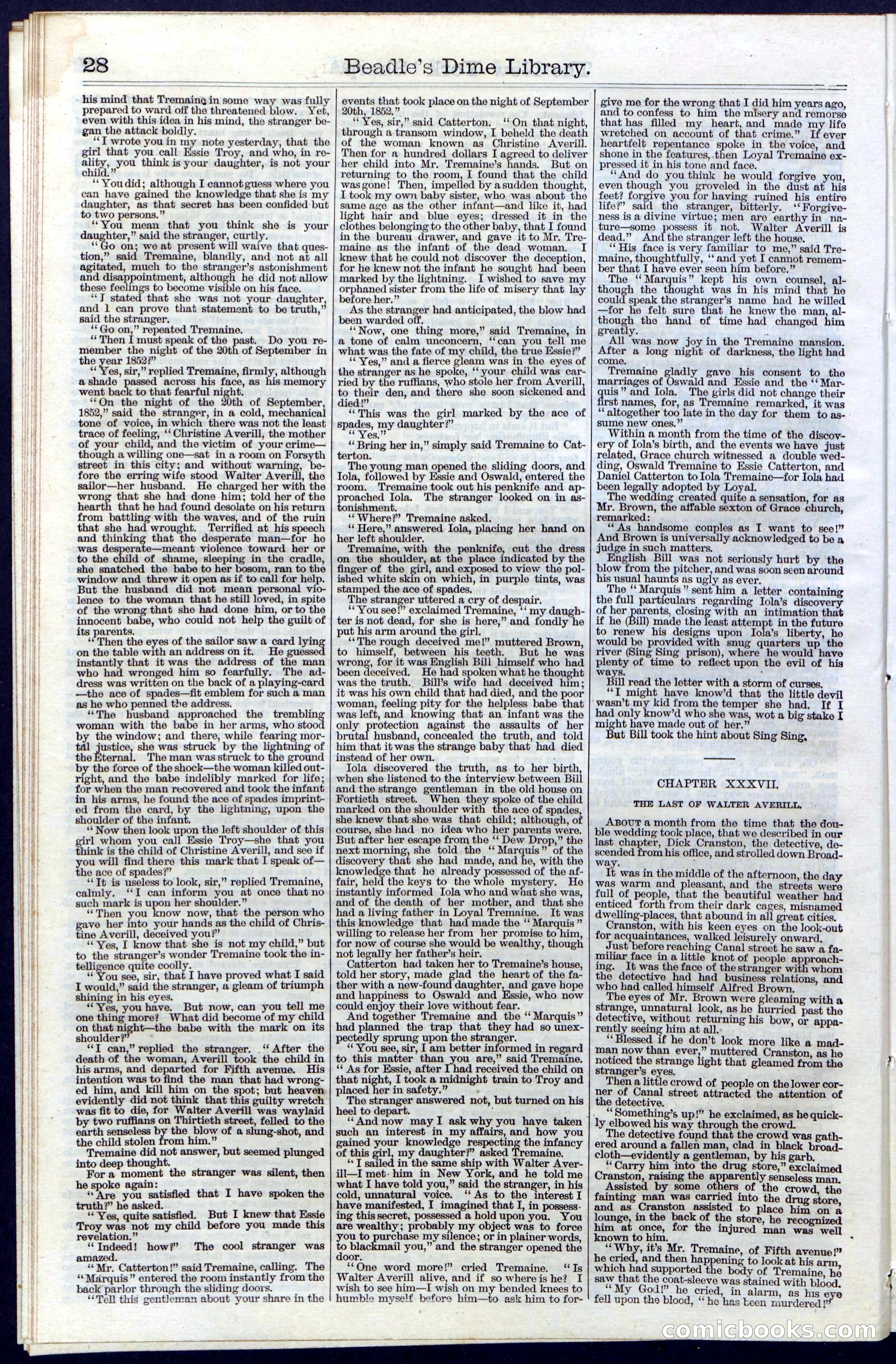
A restored page from Pulp Fiction, 1878. Page through the whole issue in the reader above.
📄 Transcribed text from this page (OCR, searchable)
Machine-transcribed from the original scan — historical spelling and the odd misread are preserved.
23 his mind that Tremaing in some way was fully prepared to ward off the threatened See Yet, even with this idea in his mind, tho stranger be- gan the attack boldly. ‘“‘T wrote you in my note yesterday, that the girl that you call Essie Troy, and who, in re- ality, you think is your daughter, is not your child. ‘**Youdid; although I cannot guess where you can have gained the knowledge that she is my daughter, as that secret has been confided but to two persons.” “You mean that you think she is your daughter,” said the stranger, curtly. ‘*Go on; we at present will waive that ques- tion,” said Tremaine, blandly, and not at all agitated, much to the stranger’s astonishment and aa 25 ny ge although he did not allow these feelings to become visible on his face. ‘*] stated that she was not your daughter and 1 can prove that statement to be truth,’ said the stranger. ‘*Go on,” repeated Tremaine. “Then I must speak of the past. Do you re- member the night of the 20th of September in the year 1852?” ** Yes, sir,” replied Tremaine, firmly, although a shade d across his face, as his memory went back to that fearful night. ‘On the night of the 20th of September, 1852,” said the stranger, in a cold, mechanical tone of voice, in which there was not the least trace of feeling, ‘‘ Christine Averill, the mother of your child, and the victim of your crime— though a willing one—sat in a room on Forsyth street in this city; and without warning, bes fore the erring wife stood Walter Averill, the sailor—her husband. He charged her with the wrong that she had done him; told her of the hearth that he had found desolate on his return from battling- with the waves, and of the ruin that she had wrought. Terrified at his speech and thinking that the desperate man—for he was desperate—meant violence toward her or to the child of shame, sleeping in the cradle, she snatched the babe to her bosom, ran to the window and threw it open as if to call for help. But the husband did not mean personal vio- lence to the woman that he still loved, in spite of the wrong that she had done him, or to the innocent babe, who could not help the guilt of its parents. ‘Then the eyes of the sailor saw a card lyin on the table with an address on it. He gu instantly that it was the address of the man who had wronged him so fearfully. The ad- dress was written on the back of a playing-card —the ace of spades—fit emblem for such a man as he who penned the address. “The husband approached the tremblin woman with the babe in her arms, who stooc by the window; and there, while fearing mor- tal justice, she was struck by the lightning of the ternal. The man was struck to the ground by the force of the shock—the woman killed out- right, and the babe indelibly marked for life; for when the man recovered and took the infant in his arms, he found the ace of spades imprint- ed from the card, by the lightning, upon the shoulder of the infant. ‘‘ Now then look upon the left shoulder of this irl whom you call Essie Troy—she that you fhink is the child of Christine Averill, and see if ou will find there this mark that I speak of— the ace of spades?” ‘*Tt is useless to look, sir,” replied Tremaine, calmly. ‘‘I can inform you at once that no such mark is upon her shoulder.” “Then you know now, that the person who gave her into your hands as the child of Chris- tine Averill, deceived you?” ; ‘Yes, I know that she is not my child,” but to the stranger’s wonder Tremaine took the in- telligence quite coolly. “You see, sir, that I have proved what I said I would,” said the stranger, a gleam of triumph shining in his eyes. **-Yes, you have. But now, can you tell me one thing more? What did become of my child on that night—the babe with the mark on its 3 shoulder? “T can,” replied the a, _“ After the death of the woman, Averill k the child in his arms, and departed for Fifth avenue. His intention was to find the man that had wrong- ed him, and kill him on the spot; but heaven evidently did not think that this guilty wretch was fit to die, for Walter Averill was waylaid by two ruffians on Thirtieth street, felled to the earth senseless by the blow of a slung-shot, and the child stolen from him.” Tremaine did not answer, but seemed plunged into deep thought. For a moment the stranger was silent, then he spoke again: «Are you satisfied that I have spoken the truth?” he asked. ‘“‘-Yes, quite satisfied. But I knew that Essie Troy was not my child before you made this revelation.” ** Indeed! how?’ amazed. “Mr. Catterton!” said Tremaine, calling. The “Marquis” entered the room instantly from the back parlor through the sliding doors. ; “Tell this gentleman about your share in the The cool stranger was Beadle’s Dime Library. events that took place on the night of September 20th, 1852.” ‘ Yes, sir,” said Catterton. ‘On that night, through a transom window, I beheld the death of the woman known as Christine Averill. Then for a hundred dollars I agreed to deliver her child into Mr. Tremaine’s hands. But on returning to the room, I found that the child was gone! Then, impelled by asudden thought, I took my own baby sister, who was about the same age as the other infant—and like it, had light hair and blue eyes; dressed it in the clothes belonging to the other baby, that I found in the bureau drawer, and gave it to Mr. Tre- maine as the infant of the dead woman. I knew that he could not discover the deception, for he knew not the infant he sought had been marked by the lightning. I wished to save my orphaned sister from the life of misery that lay before her.” As the smengen had anticipated, the blow had been warded off, ‘Now, one thing more,” said Tremaine, in a tone of calm unconcern, ‘‘can you tell me what was the fate of my child, the true Essie?’ “Yes,” and a fierce gleam was in the eyes of the stranger as he spoke, ‘‘ your child was car- ried by the ruffians, who stole her from Averill to their den, and there she soon sickened an died!” 3 ‘“This was the girl marked by the ace of spades, my daughter?” ce Yes ” ‘*‘ Bring her in,” simply said Tremaine to Cat- terton. The young man opened the sliding doors, and Tola, followed by Essie and Oswald, entered the room. Tremaine took out his penknife and ap- proached Iola. The stranger looked on in as- tonishment. ‘* Where?” Tremaine asked. ‘* Here,” answered Iola, placing her hand on her left shoulder. Tremaine, with the penknife, cut the dress on the shoulder, at the place indicated by the finger of the girl, and exposed to view the pol- ished white skin on which, in purple tints, was stamped the ace of spades, The stranger uttered a cry of despair. ‘*'You see!” exclaimed Tremaine, ‘‘ my daugh- ter is not dead, for she is here,” and fondly he put his arm around the girl. ‘The rough deceived me!” muttered Brown, to himself, between his teeth. But he was wlan for it was English Bill himself who had been deceived. He had spoken what he thought was the truth. Bills wife had deceived him; it was his own child that had died, and the poor woman, feeling pity for the helpless babe that was left, and knowing that an infant was the only protection against the assaults of her b nital husband, concealed the truth, and told him that it was the strange baby that had died instead of her own. Iola discovered the truth, as to her birth when she listened to the interview between Bill and the strange gentleman in the old house on Fortieth street. When they spoke of the child marked on the shoulder with the ace of spades, she knew that she was that child; although, of course, she had no idea who her parents were. But after her escape from the ‘‘ Dew Drop,” the next morning, she told the ‘‘ Marquis” of the discovery that she had made, and he, with the knowledge that he already possessed of the af- fair, held the keys to the whole mystery. He instantly informed Iola who and what she was, and of the death of her mother, and that she had a living father in Loyal Tremaine. It was this knowledge that had made the ‘ Marquis ” willing to release her from her promise to him, for now of course she would be wealthy, though not legally her father’s heir. Catterton had taken her to Tremaine’s house, told her story, made toe the heart of the fa- ther with a new-found daughter, and gave hope and happiness to Oswald and Essie, who now could enjoy their love without fear. And together Tremaine and the ‘‘ Marquis” had planned the trap that they had so unex- pectedly sprung upon the stranger. “You see, sir, I am better informed in regard to this matter than you are,” said Tremaine. ‘* As for Essie, after I had received the child on that night, I took a midnight train to Troy and placed her in safety.” . The stranger answered not, but turned on his heel to depart ‘And now ‘may I ask why you have taken such eo _—e as my cag earl de’ you gained your knowledge respectin e infanc of this girl my daughter?” asked cam “ “T sailed in the same ship with Walter Aver- ill—I met: him in New York, and he told me what I have told you,” said the stranger, in his cold, unnatural voice. ‘‘ As to the interest I have manifested, I imagined that I, in possess- ing this secret, possessed a hold ye gue you. You are wealthy; probably my object was to force you to purchase my silence; or in plainer words, L blac il you,” and the stranger opened the oor. ‘““One word more!” cried Tremaine. ‘Is Walter Averill alive, and if so whereis he? I wish to see him—I wish on my bended knees to humble myself before him—to ask him to for- aaa — - oo —-—-— give me for the wrong that I did him years ago, and to confess to him the misery and remorse that has filled my heart, and made my life wretched on account of that crime.” If ever heartfelt repentance spoke in the voice, and shone in the features,.then Loyal Tremaine ex- pressed it in his tone and face. ‘And do you think he would forgive you, even though you groveled in the dust at his feet? forgive you for haying ruined his entire life?” said the stranger, bitterly. ‘‘ Forgive- ness is a divine virtue; men are earthy in na- ture—some possess it not. Walter Averill is dead.” And the stranger left the house, “‘His face is very familiar to me,” said Tre- maine, thoughtfully, ‘‘ and yet I cannot remem- ber that I have ever seen him before,” The ‘‘ Marquis” kept his own counsel, al- though the thought was in his mind that he could speak the stranger’s name had _ he willed —for he felt sure that he knew the man, al- though the hand of time had changod him greatly. : All was now joy in the Tremaine mansion. After a long night of darkness, the light had come. Tremaine gladly gave his consent to the marriages of Oswald and Essie and the ‘‘ Mar- uis” and Iola. The girls did not change their rst names, for, as Tremaine remarked, it was ‘‘ altogether too late in the day for them to as- sume new ones.”’ Within a month from the time of the discoy- a of [ola’s birth, and the events we have just related, Grace church witnessed a double wed- ding, Oswald Tremaine to Essie Catterton, and Daniel Catterton to Iola Tremaine—for Iola had been legally adopted by Loyal. , The wedding created quite a sensation, for as Mr. Brown, the affable sexton of Grace church, remarked: ‘‘As handsome couples as I want to see!” And Brown is universally acknowledged to be a judge in such matters, English Bill was not seriously hurt by the blow from the pitcher, and was soon seen around his usual haunts as ugly as ever, The “ Marquis” sent him a letter containing the full particulars regarding Iola’s discove of her yp sab, Spain with an intimation that if he (Bill) made the least attempt in the future to renew his designs upon Tola’s liberty, he would be provided with snug quarters up the river (Sing Sing prison), where he would have plenty of time to reflect upon the evil of his ways. Till read the letter with a storm of curses. “T might have know’d that the little devil ‘wasn’t my kid from the temper she had. If I had only know’d who she was, wot a big stake I might have made out of her.” ut Bill took the hint about Sing Sing, CHAPTHR XXXVII. THE LAST OF WALTER AVERILL, AxBovuT a month from the time that the dou- ble wedding took place, that we described in our last chaptes, Dick Cranston, the detective, de- scended from his office, and strolled down Broad- way. : It was in the middle of the afternoon, the day was warm and pleasant, and the streets were full of people, that the beautiful weather had enticed forth from their dark cages, misnamed dwelling-places, that abound in all great cities, Cranston, with his keen eyes on the look-out for acquaintances, walked leisurely onward, Just efore reaching Canal street he saw a fa- miliar face in a little knot of people approach- ing. It was the face of the stranger with whom the detective had had business relations, and who had called himself Alfred Brown, The eyes of Mr. Brown were gleaming with a strange, unnatural look, as he hurried past the detective, without returning his bow, or appa- ney seeing him at all. ‘* Blessed if he don’t look more like a mad- man now than ever,” muttered Cranston, as he noticed the strange light that gleamed from the stranger’s eyes. Then a little crowd of people on the lower cor- ner of Canal street attracted the attention of the ae ‘ ; omething’s up!” he exclaimed, as he quick- ly elbowed his way through the crowd. e The detective found that the crowd was gath- ered around a fallen man, clad in black broad- cloth—evidently a gentleman, by his garb. “Carry him into the drug store,” exclaimed Cranston, raising the apparently senseless man. Assisted by some others of the crowd, the fainting man was carried into the drug store and as Cranston assisted to place him on a soxenge, in the — i ee store, he re at once, for the ured man w known to hin f j as well “Why, it’s Mr. Tremaine, of Fifth avenue!” he cried, and then nappening to look at his arm which had supported the body of Tremaine, he saw that the coat-sleeve was stained with blood, My God!” he cried, in alarm, as his eye fell upon the blood, “ho has been murdered P (E(0) EOE KOOKS ™/™