
Pulp Fiction, 1878 · page 26 of 32
Beadle's Dime Library, Vol. III, No. 31 — page 26: what you’re looking at
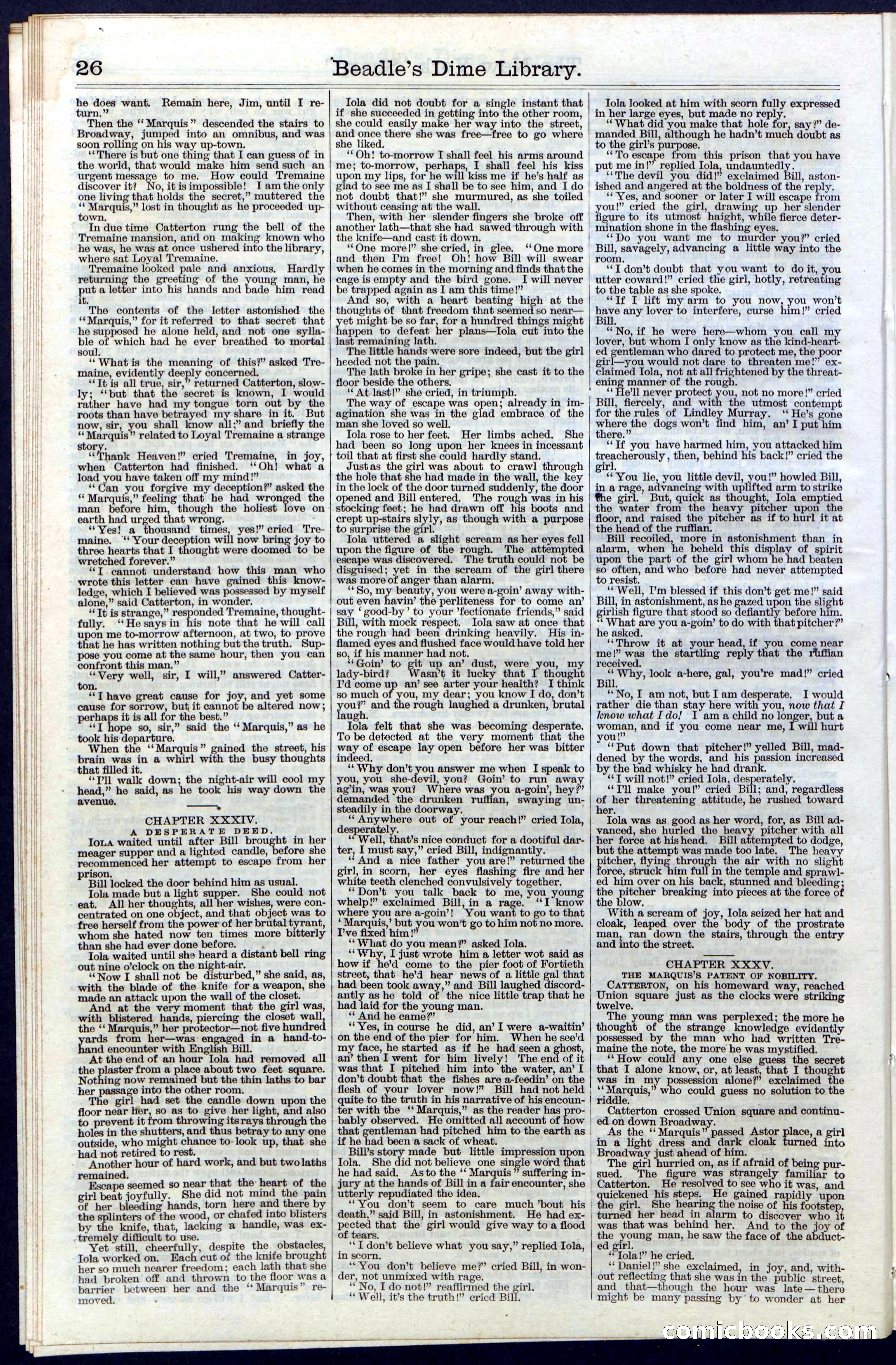
A restored page from Pulp Fiction, 1878. Page through the whole issue in the reader above.
📄 Transcribed text from this page (OCR, searchable)
Machine-transcribed from the original scan — historical spelling and the odd misread are preserved.
rs does want. Remain here, Jim, until I re- urn, Then the ‘‘ Marquis” descended the stairs to Broadway, jumped into an omnibus, and was soon rolling on his way up-town. ‘*There is but one thing that I can guess of in the world, that would make him send such an urgent message to me. How could Tremaine discover it? No, itisimpossible! I am the only one living that holds the secret,” muttered the ‘“‘ Marquis,” lost in thought as he proceeded up- town. In due time Catterton rung the bell of the Tremaine mansion, and on making known who he was, he was at once ushered into the library, where sat Loyal Tremaine. Tremaine looked pale and anxious. Hardly returning the greeting of the young man, he put a letter into his hands and bade him read t it. The contents of the letter astonished the ‘*Marquis,” for it referred to that secret that he aps pact he alone held, and not one sylla- ble of which had he ever breathed to mortal soul. ‘What is the meaning of this?’ asked Tre- maine, evidently deep! y concerned, “It is all true, sir,” returned Catterton, slow- ly; ‘‘but that the secret is known, I would rather have had my tongue torn out by the roots than have betrayed my share in it. But now, sir, you shall know all;” and briefly the “Marquis” related to Loyal Tremaine a strange ‘Thank Heaven!” cried Tremaine, in joy, when Catterton had finished. ‘‘Oh! what a load you have taken off my mind!” ‘*Can you forgive my deception?” asked the ** Marquis,” feeling that he had wronged the man before him, though the holiest love on earth had urged that wrong. ‘Yes! a thousand times, yes!” cried Tre- maine. “ Your deception will now brin joy to three hearts that I thought were doomed to be wretched forever.” “T cannot understand how this man who wrote this letter can have gained this know- ledge, which I believed was possessed by myself alone,” said Catterton, in wonder. — ‘Tt is strange,” responded Tremaine, thought- fully. ‘“Hesaysin his note that he will call upon me to-morrow afternoon, at two, to prove that he has written nothing but the truth. Sup- pose you come at the same hour, then you can confront this man.” : “Very well, sir, I will,” answered Catter- n. ‘‘T have great cause for joy, and yet some cause for sorrow, but it cannot be altered now; wirg © it is all for the best.” ‘‘T hope so, sir,” said the ‘“‘ Marquis,” as he took his departure. When the ‘‘Marquis” gained the street, his brain was in a whirl with the busy thoughts that filled it. : “Pll walk down; the night-air will cool my head,” he said, as he took his way down the avenue, CHAPTER XXXIV. A DESPERATE DEED. IoLa waited until after Bill esa me in her meager supper and a lighted candle, before she recommenced her attempt to escape from her prison. ; Bill locked the door behind him as usual. Iola made but a light supper. She could not eat. All her thoughts, all her wishes, were con- centrated on one object, and that object was to free herself from the power of her brutal tyrant, whom she hated now sooth times more bitterly than she had ever done before. ‘ Iola waited until she heard a distant bell ring out nine o’clock on the night-air. é “Now I shall not be disturbed,” she said, as, with the blade of the knife for a weapon, she made an attack upon the wall of the closet. And at the very moment that the girl was, with blistered hands, piercing the closet wall the ‘‘ Marquis,” her protector—not five hundred ards from her—was engaged in a hand-to- lecuat encounter with English Bill. At the end of an hour Iola had removed all the plaster from a place about two feet square. Nothing now remained but the thin laths to bar her paneer into the other room. The girl had set the candle down upon the floor near Her, so as to give her light, and also to prevent it from throwing itsrays through the holes in the shutters, and thus betray to any one outside, who might chance to- look up, that she had not retired to rest. Another hour of hard work, and but twolaths mained. " Recape seemed so near that the heart of the irl beat joyfully. She did not mind the pain of her bleeding hands, torn here and there by the splinters of the wood, or chafed into blisters by the knife, that, lacking a handle, was ex- tremely difficult to use. ‘ Yet still, cheerfully, despite the. obstacles, Iola worked on. Each cut of the knife brought her so much nearer freedom; each lath that she had broken off and thrown to the floor was a barrier between her and the “ Marquis” re- moved. . Beadle’s Dime Library. Iola did not doubt for a single instant that if she succeeded in getting into the other room, she could easily make her way into the street, and once there she was free—free to go where she liked, ‘Oh! to-morrow I shall feel his arms around me; to-morrow, perhaps, I shall feel his kiss upon my lips, for he will kiss me if he’s half as glad to see me as I shall be to see him, and I do not doubt that!” she murmured, as she toiled without ceasing at the wall. Then, with her slender fingers she broke off another lath—that she had sawed through with the knife—and cast it down. ‘One more!” she cried, in glee. ‘‘One more and then [’m free! Oh! how Bill will swear when he comes in the morning and finds that the cage is empty and the bird gone. I will never be ne again as I am this time!” And so, with a heart beating high at the thoughts of that freedom that seemed so near— ret might be so far, for a hundred things might appen to defeat her plans—lIola cut into the last remaining lath. The little hands were sore indeed, but the girl heeded not the pain. The lath broke in her gripe; she cast it to the floor beside the others. ‘* At last!” she cried, in triumph. The way of escape was open; already in im- agination she was in the glad embrace of the man she loved so well. Iola rose to her feet. Her limbs ached. She had been so long upon her knees in incessant toil that at first she could hardly stand. Justas the girl was about to crawl through the hole that she had made in the wall, the key in the lock of the door turned suddenly, the door opened and Bill entered, The rough was in his stocking feet; he had drawn off his boots and crept up-stairs slyly, as though with a purpose to surprise the girl. lola uttered a eo scream as her eyes fell upon the figure of the rough. The attempted escape was discovered. The truth could not be disguised; yet in the scream of the girl there was more of anger than alarm. ‘*So, my beauty, you were a-goin’ away with- out even havin’ the perliteness for to come an’ say ‘good-by’ to your ’fectionate friends,” said Bill, with mock respect. Iola saw at once that the rough had been drinking heavily. His in- flamed eyes and flushed face would have told her so, if his manner had not. ‘**Goin’ to git up an’ dust, were you, my lady-bird? sn’t it lucky that I thought I’d come up an’ see arter your health? I think so much of you, my dear; you know I do, don’t ou?” and the rough laughed a drunken, brutal augh. Iola felt that she was becoming desperate. To be detected at the very moment that the way of escape lay open before her was bitter mccWhy don't hen I speak to y don’t you answer me when you, you sbotevil you? Goin’ to run away ag’in, was you? here was you a-goin’, hey?” demanded the drunken ruffian, swaying un- steadily in the doorway. ‘‘ Anywhere out of your reach!” cried Iola, d rately. ‘* Well, that’s nice conduct for a dootiful dar- ter, I must say,” cried Bill, indignantly. “And a nice father you are!” returned the girl, in scorn, her eyes flashing fire and her white teeth clenched convulsively together. “Don’t you talk back to me, you young whelp!” exclaimed Bill, in a eee “T know where you are a-goin’! You want to go to that ‘Marquis,’ but you won't go to him not no more. I’ve fixed him! ‘* What do you mean?” asked Iola. ‘s ware I just wrote him a letter wot said as how if he’d come to the pier foot of Fortieth street, that he’d hear news of a little gal that had been took away,” and Bill laughed disco rd- aoe fl he told of the nice little trap that he had laid for the young man. ‘** And he came?” ‘*’Yes, in course he did, an’ I were a-waitin’ on the end of the pier for him. When he see’d my face, he as if he had seen a ghost, an’ then I went for him lively! The end of it was that I pitched him into the water, an’ I don’t doubt that the fishes are a-feedin’ on the flesh of your lover now!” Bill had not held quite to the truth in his narrative of his encoun- ter with the ‘‘ Marquis,” as the reader has pro- bably observed. He omitted all account of how that gentleman had pitched him to the earth as if he had been'a sack of wheat. Bill’s story made but little impression Pa Iola. She did not believe one single word that he had said. Asto the “ uis ” suffering in- jury at the hands of Bill in a fair encounter, she utterly repudiated the idea. ‘*You don’t seem to care much ’bout his death,” said Bill, in astonishment. He had ex- pected that the girl would give way to a flood of tears. _ ‘I don’t believe what you say,” replied Iola, in scorn, ‘““You don’t believe me?’ cried Bill, in won- der, not unmixed with rage. ‘** No, I do not!” reaffirmed the girl. * Well, it’s the truth!” cried Bill. en A Tola looked at him with scorn fully expressed in her large eyes, but made no reply. “What did you make that hole for, say?’ de- manded Bill, although he hadn’t much doubt as to the girl’s purpose. “To escape from this prison that you have put me in!” replied Iola, undauntedly. ‘‘The devil you did!” exclaimed Bill, aston- ished and angered at the boldness of the reply. ‘Yes, and sooner or later I will escape ee you!” cried the girl, drawing up her slender figure to its utmost haight, while fierce deter- mination shone in the flashing eyes. ‘Do you want me to murder you?” cried Bill, savagely, advancing a little way into the ) ge | om. ‘*T don’t doubt that you want to do it, you utter coward!” cried the girl, hotly, retreating to the table as she spoke. “Tf I lift my arm to you now, you _won’t ne any lover to interfere, curse him!” cried “No, if he were here—whom you call m lover, but whom I only know as the kind-hea ed gentleman who dared to protect me, the poor girl—you would not dare to threaten me!” ex- claimed Iola, not at all frightened by the threat- ening manner of the rough. ‘* He'll never protect you, not no more!” cried Bill, fiercely, and wi the utmost contempt for the rules of Lindley Murray. ‘“ He’s gone where the dogs won’t find him, an’ I put him there.” “Tf you have harmed him, you attacked him treecheromny then, behind his back!” cried the irl, **'You lie, you little devil, you!” howled Bill, in a rage, cdl tia. Reka uplifted arm to strike fhe girl. But, quick as thought, Iola emptied the water from the heavy pitcher upon the floor, and raised the pitcher as if to hurl it at the head of the ruffian. Bill recoiled, more in astonishment than in alarm, when he beheld this display of spirit upon the part of the girl whom he had beaten so often, and who before had never attempted to resist. ‘* Well, I’m blessed if this don’t get me!” said Bill, in astonishment, as he at upon the slight irlish figure that stood so defiantly before him. ‘What are you a-goin’ to do with that pitcher?” he asked. ‘‘Throw it at your head, if you come near me!” was the startling reply that the riffian received. rn Why, look a-here, gal, you’re mad!” cried “No, I am not, but Iam desperate. I would rather die than stay here with you, now that I know what Ido! I amachild no longer, but a cr and if you come near me, will hurt you ‘‘Put down that pitcher!” yelled Bill, mad- dened by the words, and his passion increased by the bad whisky he had drank. “*T will not!” cried Iola, desperately. ‘‘Tll make you!” cried Bi 1; and, regardless - her threatening attitude, he rushed toward er. Iola was as. good as her word, for, as Bill ad- vanced, she hurled the heavy pitcher with all her force at hishead. Bill attempted to dodge, but the attempt was made too late. The heavy itcher, Ay ing through the air with no slight orce, struck him in the ketiple and sprawl- ed him over on his back, stunned and bleeding; the pitcher breaking into pieces at the force o the blow. With a scream of Joy; Iola seized her hat and cloak, leaped over the body of the prostrate man, ran down the stairs, through the entry and into the street. CHAPTER XXXV. THE MARQUIS’S PATENT OF NOBILITY. CATTERTON, on his homeward way, reached Union square just as the clocks were striking twelve. The young man was perplexed; the more he thought of the strange knowledge evidently possessed by the man who had written Tre- maine the note, the more he was mystified. “How could any one else guess the secret that I alone know, or, at least, that I thought was In my possession alone?” exclaimed the Marans, * who could guess no solution to the © riddle. Catterton crossed Union square and continu- ed on down Broadway. As the ‘‘ Marquis” passed Astor af Bir in in a light dress and dark cloak Broadway just ahead of him. The girl hurried on, as if afraid of being pur- sued. The figure was strangely familiar to Catterton. He resolved to see who it was, and wigs his steps. He gained rapidly upon e girl. She hearing the noise of his foo turned her head in alarm to discover who if was that was behind her. And to the joy of the young man, he saw the face of the abduct- ed girl. **Tola!” he cried. ‘* Daniel!” she exclaimed, in joy, and, with- out reflecting that she was in the public street, — and that—though the hour was late—there might be many passing by’ to wonder at her VOOK (0)