
Pulp Fiction, 1878 · page 25 of 32
Beadle's Dime Library, Vol. III, No. 31 — page 25: what you’re looking at
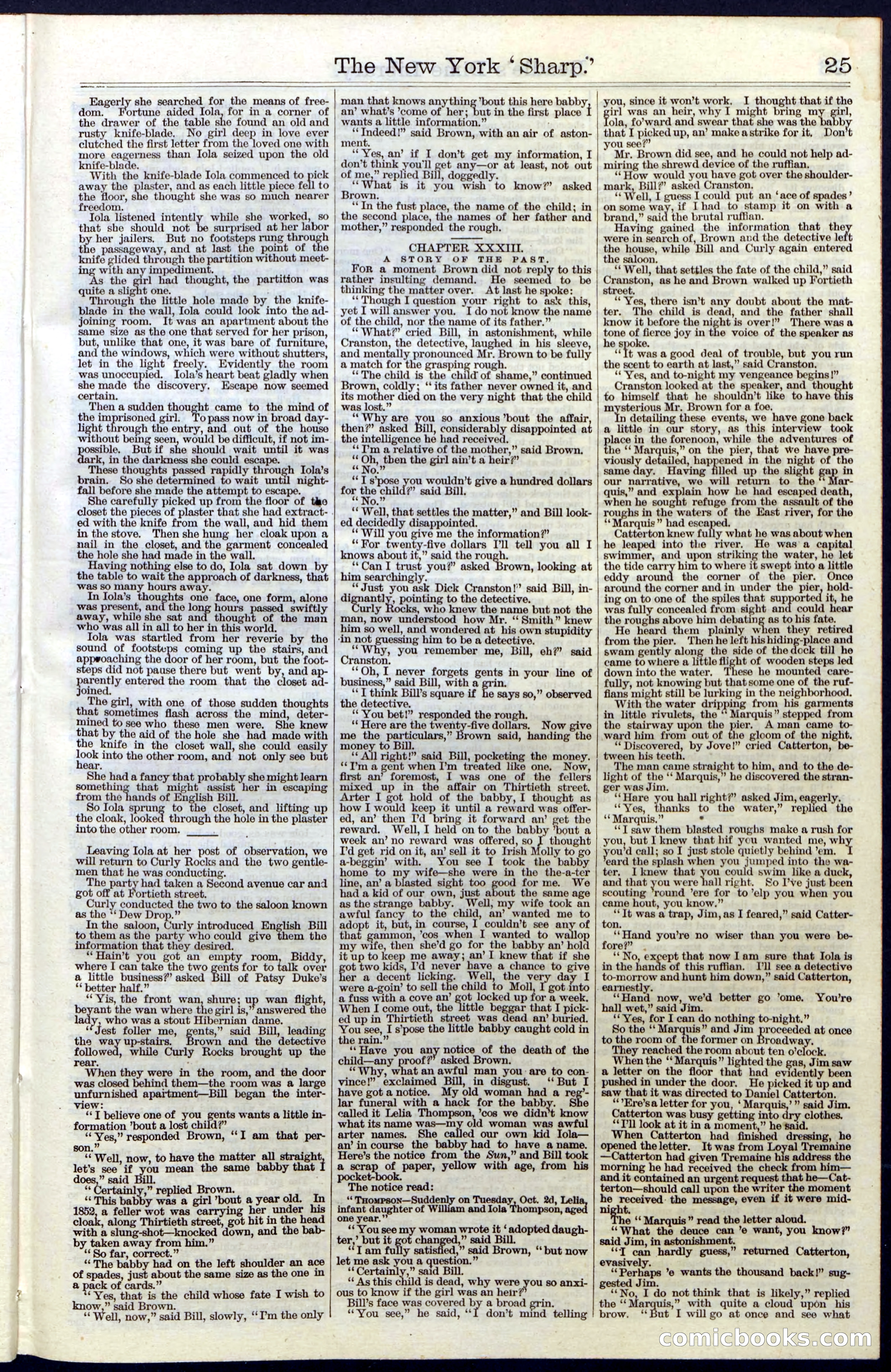
A restored page from Pulp Fiction, 1878. Page through the whole issue in the reader above.
📄 Transcribed text from this page (OCR, searchable)
Machine-transcribed from the original scan — historical spelling and the odd misread are preserved.
The New York * Sharp.’ —_ ED ee rere wee Eagerly she searched for the means of free- dom. Hortons aided Iola, for in a corner of the drawer of the table she found an old and rusty knife-blade, No girl deep in love ever clutched the first letter from the loved one with more eagerness than Iola seized upon the old knife-blade. With the knife-blade Iola commenced to pick away the plaster, and as each little piece fell to | the floor, she thought she was so much nearer freedom. Jola listened intently while she worked, so that she should not surprised at her labor by her jailers, But no footsteps rung through the passageway, and at last the point of the knife glided through the partition without meet- ing with any impediment. nf s the girl had thought, the partition was quite a slight one. 4 Through the little hole made by the knife- blade in the wall, Iola could look into the ad- joining room. It was an apartment about the same size as the one that served for her prison, but, unlike that one, it was bare of furniture, and the windows, which were without shutters, let in the light freely. Evidently the room was unoccupied. Iola’s heart beat gladly when she made the discovery. Escape now seemed certain. Then a sudden thought came to the mind of the 3 deat girl, ‘Topass now in broad day- light through the entry, and out of the house without being seen, would be difficult, if not im- sible. Butif she should wait until it was k, in the darkness she could escape. These thoughts passed rapidly through Iola’s brain. So she determined to wait until night- fall before she made the attempt to escape. She carefully picked up from the floor of tie closet the pieces of plaster that she had extract- ed with the knife from the wall, and hid them in the stove. Then she hung her cloak upon a nail in the closet, and the garment concealed the hole she had made in the wall. Having nothing else to do, Iola sat down by the table to wait the approach of darkness, that was 580 many hours away. In Iola’s thoughts one face, one form, alone was present, and the long hours swiftly away, while she sat and thought of the man who was all in all to her in this world. Iola was startled from her reverie by the sound of footsteps coming up the stairs, and approaching the door of her room, but the foot- steps did not pause there but went by, anda parently entered the room that the closet ad- joined. The girl, with one of those sudden thoughts that sometimes flash across the mind, deter- mined to see who these men were. She knew that by the aid of the hole she had made with the knife in the closet wall, she could easily look into the other room, and not only see but ear. She had a fancy that probably she might learn peter that might assist her in escaping from the hands of English Bill. So Iola ee to the closet, and lifting up the cloak, looked through the hole in the plaster into the other room. Leaving Iola at her post of observation, we will return to Curly Rocks and the two gentile- men that he was conducting. The party had taken a Second avenue car and got off at Fortieth street. Curly conducted the two to the saloon known as the *‘ Dew Drop.” In the saloon, Curly introduced English Bill to them as the party who could give them the information that they desired. *“Hain’t you got an empty room, Biddy, where I can take the two gents for to over a little business?’ asked Bill of Patsy Duke’s ** better half.” * Yis, the front wan, shure; up wan flight, perene the wan where the gir] is,” answered the dame. 'y, who was a stout Hibernian : Jest foller me, gente said Bill, leading the way up-stairs. rown and the detective followed, while Curly Rocks brought up the rear. When they were in the room, and the door was closed behind them—the room was a large unfurnished apartment—Bill began the inter- view: ‘“‘T believe one of you gents wants a little in- formation ’bout a lost da?” ‘““-Yes,” responded Brown, “I am that per- son.” ‘‘ Well, now, to have the matter all straight let's see if you mean the same babby that I acy ; rain] My lied Brown 2 re rown. ‘Thin babby was a girl ’bout a year old. In 1852, a feller wot was carrying her under his cloak, along Thirtieth street, got bit in the head with a slung-shot—knocked down, and the bab- by taken away from him.” ** So far, correct.” “The babby had on the left shoulder an ace of spades, just about the same size as the one in a pack o : ‘Yes, that is the child whose fate I wish to know,” said Brown. s Well, now,” said Bill, slowly, “I’m the only ‘ of me,” replied Bi “What man that knows anything "bout this here babby an’ what’s ’come of her; but in the first place i wants a little information.” ‘ ir ta said Brown, with an air of aston- ment, ‘Yes, an’ if I don’t get my information, I don’t think you'll get any—or at least, not out ll, doggedly. i asked hat is it you wish to know?’ Brown. ‘In the fust place, the name of the child; in the second place, the names of her father and mother,” responded the rough. CHAPTER XXXITITI. A STORY OF THE PAST, For a moment Brown did not reply to this rather insulting demand. He seemed to be thinking the matter over. At last he spoke: ‘* Though I question your right to ask this, yet I will answer you. I do not know the name of the child, nor the name of its father.” * What?” cried Bill, in astonishment, while Cranston, the detective, laughed in his sleeve, and mentally pronounced Mr. Brown to be fully a match for the grasping rough. “The child is the child of shame,” continued Brown, coldly; “ its father never owned it, and its mother died on the very night that the child was lost.” “Why are ree so anxious "bout the affair then?” asked Bill, considerably disappointed at the intelligence he had received. ‘*‘T’'m a relative of the mother,” said Brown. a fag tben the girl ain’t a heir?” oO. ae & ou wouldn’t give a hundred dollars for Ps chil ?” said Bill. ‘No ** Well, that settles the matter,” and Bill look- ed decidedly disappointed. ‘Will you give me the information?” “For twenty-five dollars [ll tell you all I knows about it,” said the rough. ‘*Can I trust you?’ asked Brown, looking at him searchingly. ** Just you ask Dick Cranston!” said Bill, in- signens , pointing to the detective. urly , who knew the name but not the man, now understood how Mr. ‘ Smith” knew him so well, and wondered at his own stupidity ‘in not guessing him to be a detective. ‘Why, you remember me, Bill, eh?” said Cranston. ‘*Oh, I never forgets gents in your line of business,” said Bill, with a grin. ‘‘T think Bill’s square if he says so,” observed the detective. ‘You bet!” responded the rough. ‘Here are the twenty-five dollars. Now give me the particulars,” Brown said, handing the money to Bill. ae right!” said Bill, pocketing the money. “ma gent when I’m treated like one. Now, first an’ foremost, I was one of the fellers mixed up in the affair on Thirtieth street. Arter I got hold of the babby, I thought as how I would keep it until a reward was offer- ed, an’ then I’d bring it forward an’ get the reward. Well, I held onto the babby ’bout a week an’ no reward was offered, so 3 thought I'd get rid on it, an’ sell it to Irish Molly to go a-beggin’ with. You see I took the babby home to my wife—she were in the the-a-ter line, an’ a x feet) sight too good forme. We had a kid of our own, just about the same age as the strange babby. Well, my wife took an awful fancy to the child, an’ wanted me to adopt it, but, in course, I couldn’t see an that gammon, ‘cos when I wanted to wallo my wife, then she’d go for the babby an’ hol it up to keep me away; an’ I knew that if she t two kids, ’'d never have a chance to give fer a decent licking. Well, the oy day I were a-goin’ to sell the child to Moll, I got.into a fuss with a cove an’ got locked up for a week, When I come out, the little be that I pick- ed up in Thirtieth street was dead an’ buried. You See, I s’pose the little babby caught cold in the rain. ‘‘Have you any notice of the death of the child—any proof?’ asked Brown. ‘“Why, what an awful man you are to con- vince!” exclaimed Bill, in di * But I have got a notice. My old woman had a oe lar funeral with a hack for the babby. © called it Lelia Thompson, ’cos we didn’t know what its name was—my old woman was awful arter names. She ed our own kid Iola— an’ in course the babby had to have a name. Here’s the notice from the Sun,” and Bill took a scrap of paper, yellow with age, from his pocket-book. The notice read: “ THomPpson—Sud on Tuesday, Oct. 2d infant daughter of Willian and ial Gapmapariareted one year.’ ‘* You see my woman wrote it ‘adopted daugh- ter,’ but it changed, said Bill. “Tam fully satisfied,” said Brown, “ but now let me ask you a question.” vy Certainl yr, said Bill. ** As this child is dead, why were you so anxi- ous to know if the girl was an heir Bill’s face was covered by a broad grin. “You see,” he said, ‘1 don’t mind telling | you, since it won’t work, I thought that if the irl was an heir, why I might bring my er, ola, fo’ward and swear that she was the by that I picked up, an’ make astrike for it, Don’t you see?” Mr. Brown did see, and he could not help ad- miring the shrewd device of the ruffian, ‘““How would you have got over the shoulder- mark, Bill?’ asked Cranston, “f Well, I guess I could put an ‘ace of spades’ on some way, if [had to stamp it on with a brand,” said the brutal ruffian. | Having gained the information that the were in search of, Brown and the detective left the house, while Bill and Curly again entered the saloon. ' ‘* Well, that settles the fate of the child,” said Cranston, as he and Brown walked up Fortieth street. “Yes, there isn’t any doubt about the mat- ter. The child is dead, and the father shall know it before the night is over!” There was a tone of fierce joy in the voice of the speaker as he spoke. ‘Tt was a good deal of trouble, but you run the scent to earth at last,” said Cranston. ‘Yes, and to-night my vengeance begins!” Cranston looked at the speaker, and thought to himself that he shouldn’t like to have thi mysterious Mr. Brown for a foe, detailing these events, we have gone back a little in our story, as this interview took lace in the forenoon, while the adventures of he ‘‘ Marquis,” on the pier, that we have pre- viously de ied hap poe in pe ey of na same day. Havi up the our ce ag So will return _— Rar quis,” and explain how he had escaped death, when he sought refuge from the assault of the roughs in the waters of the East river, for the “Marquis ” had escaped, . Catterton knew fully what he was about when he leaped into the river. He was a capital swimmer, and upon striking the water, he let the tide carry him to where it swept into a little eddy around the corner of the pier. Once around the corner and in under the pier, hold- ing on to one of the spiles that sup rted it, he was fully concealed from sight and could hear the roughs above him deba § a8 to his fate. He heard them plainly when they retired from the pier. Then he left his hiding-place and swam gently along the side of the dock till he came to where a little flight of wooden steps led down into the water. ese he mounted care- fully, not knowing but that some one of the ruf- fians might still be lurking in the neighborhood. With the water dripping from his garments in little rivulets, the ‘‘ Marquis” stepped from the stairway upon the pier. A man came to- ward him from out of the gloom of the night. ** Discovered, by Jove!” cried Catterton, be- tween his teeth. The man came straight to him, and to the de- light of the ‘‘ Marquis,” he discovered the stran- Bf. Hare you hall right?” asked Ji eager] re you g im, rly. ‘* Yes, thats to the water,” replied the iT Marquis.” . ‘‘T saw them blasted roughs make a rush for you, but I knew that hif you wanted me, wh ou'd call; so I just stole quietly behind ’em. eard the splash when you b SROneS into the wa- ter. I knew that you could swim like a duck, and that you were hall right. So I’ve just been scouting ‘round ’ere for to’elp you when you came hout, you know.” ‘‘ It was a trap, Jim, as I feared,” said Catter- n. : bgp d youw’re no wiser than you were be- ore?” | ‘* No, except that now Iam sure that Iola is in the hamaa of this ruffian. I'll see a detective to-morrow and hunt him down,” said Catterton, earnestly. ‘“‘Hand now, we'd better go ‘ome. You’re hall wet,” said Jim. ‘Yes, for I can do nothing to-night.” So the gre 0a and Jim zroecenel at once to the room of the former on Broadway. They reached the room about ten o’clock. When the ‘‘ Marquis” lighted the gas, Jim saw a letter on the floor that had evidently been pushed in under the door. He picked it up and saw that it was directed to Daniel Catterton. ‘“*Ere’sa letter for you pene ’” said Jim. Catterton was b ye ing in usy clothes, ‘Tl look at it in a moment,” he When Catterton had finished dressing, he opened the letter. It was from loves Tremaine —Catterton had given Tremaine his address the morning he had received the check from him— and it contained an urgent request that he—Cat- terton—should call upon the writer the moment < received: the message, even if it were mid- Marquis” read the letter aloud. the deuce can ’e want, you know?” said Jim, in astonishment. os can hardly guess,” returned Catterton, e . Perhaps ’e wants the thousand back!” sug- “No, I do not think that is likely,” replied the “Marquis,” with quite a cloud upon his brow. ‘But I will go at once and see what Eomicbooks: co € 25.