
Pulp Fiction, 1878 · page 24 of 32
Beadle's Dime Library, Vol. III, No. 31 — page 24: what you’re looking at
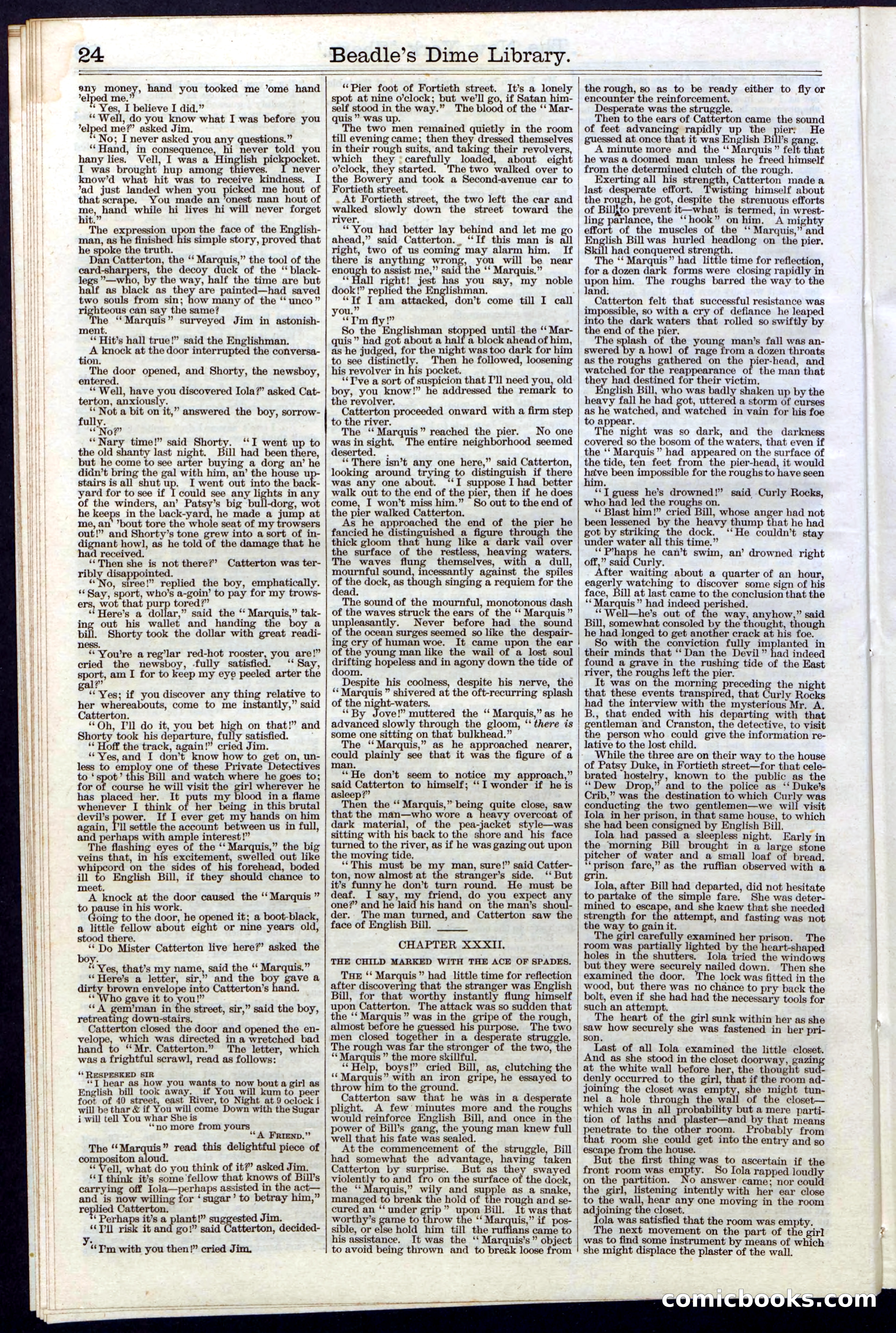
A restored page from Pulp Fiction, 1878. Page through the whole issue in the reader above.
📄 Transcribed text from this page (OCR, searchable)
Machine-transcribed from the original scan — historical spelling and the odd misread are preserved.
24 any money, hand you tooked me ’ome hand elped me. ‘ Yes, I believe I did.” “Well, do you know what I was before you ’elped me?” asked Jim. ‘No; I never asked you any questions.” ‘*Hand, in consequence, hi never told you hany lies. Vell, I was a ate Tea eg ja et. I was brought hup among thieves. never know’d what hit was to receive kindness. I ’ad just landed when you picked me hout of that scrape. You made an ’onest man hout of me, hand while hi lives hi will never forget hit.” The expression upon the face of the English- man, as he finished his simple story, proved that he spoke the truth. Dan Catterton, the ‘‘ Marquis,” the tool of the card-sharpers, the decoy duck of the “ black- legs "—who, by the way, half the time are but half as black as they are painted—had saved two souls from sin; how many of the “‘ unco” ighteous can say the same? he ‘“‘Marquis” surveyed Jim in astonish- ment. ‘* Hit’s hall true!” said the Englishman. A knock at the door interrupted the conversa- tion. The door opened, and Shorty, the newsboy, entered. “Well, have you discovered Iola?” asked Cat- terton, anxiously. ‘** Not a bit on it,” answered the boy, sorrow- ge “N time!” said oggatd “*T went up to the old shanty last night. Bill had been there, but he come to see arter buying a dorg an’ he didn’t bring the gal with him, an’ the house u stairs is all shut up. I went out into the back- yard for to see if I could see any lights in any of the winders, an’ Patsy’s big bull-dorg, wot he keeps in the back-yard, he made a jump at me, an’ *bout tore the whole seat of my trowsers out!” and Shorty’s tone grew into a sort of in- dignant howl, as he told of the damage that he had received. ‘‘Then she is not there?’ Catterton was ter- ribly disappointed. ; ‘No, siree!” replied the boy, emphatically. ‘Say, sport, who’s a-goin’ to pay for my trows- ers, wot that p tored?”’ “Here's a dol ar,” said the “ Marquis,” tak- ing out his wallet and handing the boy a bill. Shorty took the dollar with great readi- n ess. “You're a reg’lar red-hot rooster, you are!” cried the newsboy, -fully satisfied. ‘‘ Say, sport, am I for to keep my eye peeled arter the 9) ‘‘-Yes; if you discover any thing relative to her whereabouts, come to me instantly,” said Catterton. “Oh, Pll do it, you bet high on that!” and Shorty took his departure, fully satisfied. : ‘* Hoff the track, again!” cried Jim. ‘* Yes, and I don’t know how to get on, un- less to employ one of these Private Detectives to ‘spot’ this Bill and watch where he goes to; for of course he will visit the girl wherever he has placed her. It puts my blood ina flame whenever I think of her being in this brutal devil’s power. If I ever get my hands on him again, I’ll settle the account between us in full, and perhaps ample interest!” _ The flashing eyes of the ‘“‘ Marquis,” the big veins that, in his excitement, swelled out like whipcord on the sides of his forehead, boded ill English Bill, if they should chance to meet. A knock at the door caused the ‘‘ Marquis ” to pause in his work. oing to the door, he opened it; a boot-black, a little fellow about eight or nine years old, stood there. ‘‘ Do Mister Catterton live here?’ asked the boy. x Yes, that’s my name, said the “ Marquis.” “‘Here’s a letter, sir,” and the Eo > a a ee envelope into Catterton’s d. : oO gave it to you!” ‘‘ A gem’man in the street, sir,” said the boy, retreating down-stairs. Catterton closed the door and opened the en- velope, which was directed in a wretched bad hand to “Mr. Catterton.” The letter, which was a frightful scrawl, read as follows: ‘* RESPESKED SIR ‘‘T hear as how you wants to now bout a girl as English bill took away. if You_will kum to peer foot of 40 street, east River, to Night at 9 oclock i will be thar & if You will come Down with the Sugar i will tell You whar She is ‘*no more from yours ‘““A FRrenp.” The Tenet ” read this delightful piece of compositon aloud. inp “Vell, what do you think of it?’ asked Jim. “T think it’s some fellow that knows of Bill’s carrying off Iola—perhaps assisted in the act— and is now willing for ‘sugar’ to betray him,” replied Catterton. 2 lant!” ey ee Jim ‘ Perhaps it’s a ; <“Pu siaie it and go!” said Catterton, decided- Ve I’m with you then!” cried Jim. Beadle’s Dime Library. —- “Pier foot of Fortieth street. It’s a lonely spot at nine o’clock; but we'll go, if Satan him- self stood in the way.” The blood of the ‘“ Mar- quis ” was up. The two men remained quietly in the room till evening came; then they dressed themselves in their rough suits, and ing their revolvers, which they ‘carefully loaded, about eight o’clock, they started. The two walked over to the Bowery and took a Second-avenue car to Fortieth street. .At Fortieth street, the two left the car and walked slowly down the street toward the river. “You had better lay behind and let me go ahead,” said Catterton.. “If this man is all right, two of us coming may alarm him. If there is anything wrong, you will be near enough to assist me,” said the ‘‘ Marquis.” ‘Hall right! jest has you say, my noble dook!” replied the Englishman. “Tt I am attacked, don’t come till I call So the Englishman 6g until the ‘‘ Mar- quis ” had got about a a block ahead of him, as he judged, for the night was too dark for him to see distinctly. Then he followed, loosening his revolver in his pocket. ‘“Pve a sort of suspicion that I'll need you, old boy, you know!” he addressed the remark to the revolver. Catterton proceeded onward with a firm step to the river. ; The ‘‘ Marquis” reached the pier. No one was in sight. The entire neighborhood seemed deserted. . ** There isn’t any one here,” said Catterton, looking around trying to distinguish if there was any one about. ‘‘I suppose I had better walk out to the end of the pier, then if he does come, I won’t miss him.” So out to the end of the pier walked Catterton. As he approached the end of the pier he fancied he distinguished a figure through the thick gloom that hung like a dark vail over the surface of the restless, heaving waters. The waves flung themselves, with a dull, mournful sound, incessantly against the spiles A = dock, as though singing a requiem for the ead. The sound of the mournful, monotonous dash of the waves struck the ears of the ‘“‘ Marquis” unpleasantly. Never before had the sound of the ocean surges seemed so like the despair- ing cry of human woe. It came upon the ear of the young man like the wail of a lost soul Sane hopeless and in agony down the tide of oom. Despite his coolness, despite his nerve, the ‘* Marquis ” shivered at the oft-recurring splash of the night-waters. ‘*By Jove!” muttered the “‘ Marquis,” as he advanced slowly through the gloom, ‘‘ there is some one sitting on that bulkhead.” The ‘‘ Marquis,” as he approached nearer, could plainly see that it was the figure of a man ‘*He don’t seem to notice my approach,” said Catterton to himself; ‘‘I wonder if he is asleep?” Then the “‘ Marquis,” being quite close, saw that the man—who wore a heavy overcoat of dark material, of the pea-jacket style—was ae with his back to the shore and his face turned to the river, as if he was gazing out upon the moving tide, ‘This must be my man, sure!” said Catfer- ton, now almost at the stranger’s side. ‘ But it’s funny he don’t turn round. He must be deaf. I say, my, friend, do you expect any one?’ and he laid his hand on the man’s shoul- der. The man turned, and Catterton saw the face of English Bill. CHAPTER XXXII. THE CHILD MARKED WITH THE ACE OF SPADES. THE ‘‘ Marquis” had little time for reflection after discovering that the stranger was English Bill, for that worthy instantly flung himself upon Catterton. The attack was so sudden that the ‘‘ Marquis ” was in the gripe of the rough, almost before he at his purpose. The two men closed together in a desperate struggle. The phe. 2 was far the stronger of the two, the ** Mar ” the more skillful. ‘* Help, boys!” cried Bill, as, clutching the ‘* Marquis” with an iron gripe, he essayed to throw him to the ground. Catterton saw that he was in a desperate plight. A few minutes more and the roughs would reinforce English Bill, and once in the power of Bill’s gang, the young man knew full well that his fate was sealed. At the commencement of the struggle, Bill had somewhat the advantage, having taken Catterton by surprise. But as they swayed Meets to and fro on the surface of the dock, the ‘‘ Marquis,” wily and apne as a snake, managed to break the hold of the rough and se- cured an ‘‘ under grip” upon Bill. It was that worthy’s game to throw the ‘‘ Marquis,” if pos- sible, or else hold him till the Ss came to his assistance. It was the ‘‘ Marquis’s” object to avoid being thrown and to break loose from the rough, so as to be ready either to fly or encounter the reinforcement. Desperate was the struggle. Then to the ears of Catterton came the sound of feet advancing rapidly up the piery He guessed at once that it was English Bill's ang. A minute more and the ‘‘ Marquis” felt that he was a doomed man unless he freed himself from the determined clutch of the rough. Exerting all his strength, Catterton madea last d rate effort. Twisting himself about the rough, he got, despite the strenuous efforts of Bill,to prevent it—what is termed, in wrest- ling parlance, the ‘“‘hook” onhim. <A mighty effort of the muscles of the ‘‘ Marguis,” and English Bill was hurled headlong on the pier. Skill had conquered strength. The ‘‘ Marquis” had little time for reflection, for a dozen dark forms were closing rapidly in ups him. The roughs barred the way to the and, Catterton felt that successful resistance was impossible, so with a cry of defiance he leaped into the dark waters that rolled so swiftly by the end of the pier. The foe of the young man’s fall was an- swered by a how] of rage from a dozen throats as the roughs gathered on the watched for the reappearance o they had destined for their victim. nglish Bill, who was badly shaken up by the heavy fall he had Sot, uttered a storm of curses as he watched, and watched in vain for his foe to appear. The night was so dark, and the darkness covered so the bosom of the waters, that even if the ‘‘ Marquis” had appeared on the surface of the tide, ten feet from the pier-head, it would have been impossible for the roughs to have seen m ‘*T guess he’s drowned!” said Curly Rocks, who had led the roughs on. ‘** Blast him!” cried Bill, whose anger had not been lessened by the heavy thump that he had got by striking the dock. ‘‘He couldn’t stay under water all this time.” ‘‘P’*haps he can’t swim, an’ drowned right off,” said Curly. After waiting about a quarter of an hour, eagerly watching to discover some sign of his face, Bill at last came to the conclusion that the ‘* Marquis” had indeed perished. ‘‘ Well—he’s out of the way, anyhow,” said Bill, somewhat consoled by the thought, though he had longed to get another crack at his foe. So with the conviction fully implanted in their minds that ‘‘ Dan the Devil” had indeed found a grave in the rushing tide of the East river, the roughs left the pier. It was on the morning preceding the night that these events transpired, that Guile Rocks had the interview with the mysterious Mr. A. B., that ended with his departing with that gentleman and Cranston, the detective, to visit the person who could give the information re- lative to the lost child. While the three are on their way to the house of Patsy Duke, in Fortieth street—for that cele- brated hostelry, known to the public as the ‘‘Dew Drop,” and to the police as ‘‘ Duke's Crib,” was the destination to which Curly was conducting the two gentlemen—we will visit Iola in her prison, in that same house, to which she had been consigned by English Bill. Iola had passed a sleepless night. Early in the morning Bill brought in a large stone pitcher of water and a small loaf of bread, ‘prison fare,” as the ruffian observed with a grin. Iola, after Bill had departed, did not hesitate to partake of the simple fare. She was deter- mined to escape, and she knew that she needed strength for the attempt, and fasting was not the way to gain it. The girl carefully examined her prison. The room was ially lighted by the heart-shaped holes in the shutters. Iola tried the windows but they were securely nailed down. Then she examined the door. The lock was fitted in the wood, but there was no chance to pry back the bolt, even if she had had the necessary tools for such an attempt. The heart of the girl sunk within her as she saw how securely she was fastened in her pri- son, Last of all Iola examined the little closet. And as she stood in the closet doorway, gazing at the white wall before her, the thought sud- denly occurred to the girl, that if the room ad- joining the closet was empty, she might tun- nel a hole through the w of the closet~— which was in all probability but a mere parti- tion of laths and pee by that means penetrate to the other room. Probably from that room she could get into the entry and so escape from the house. But the first thing was to ascertain if the front room was empty. So Iola rapped loudly on the partition. No answer came; nor could the girl, listening intently with her ear close to the wall, hear any one moving in the room adjoining the closet. ola was satisfied that the room was empty. The next movement on the part of the girl was to find some instrument by means of which she might displace the plaster of the wall. ier-head, and the man that OMmMrcpeO CO 7 Ps ) .