
Pulp Fiction, 1878 · page 23 of 32
Beadle's Dime Library, Vol. III, No. 31 — page 23: what you’re looking at
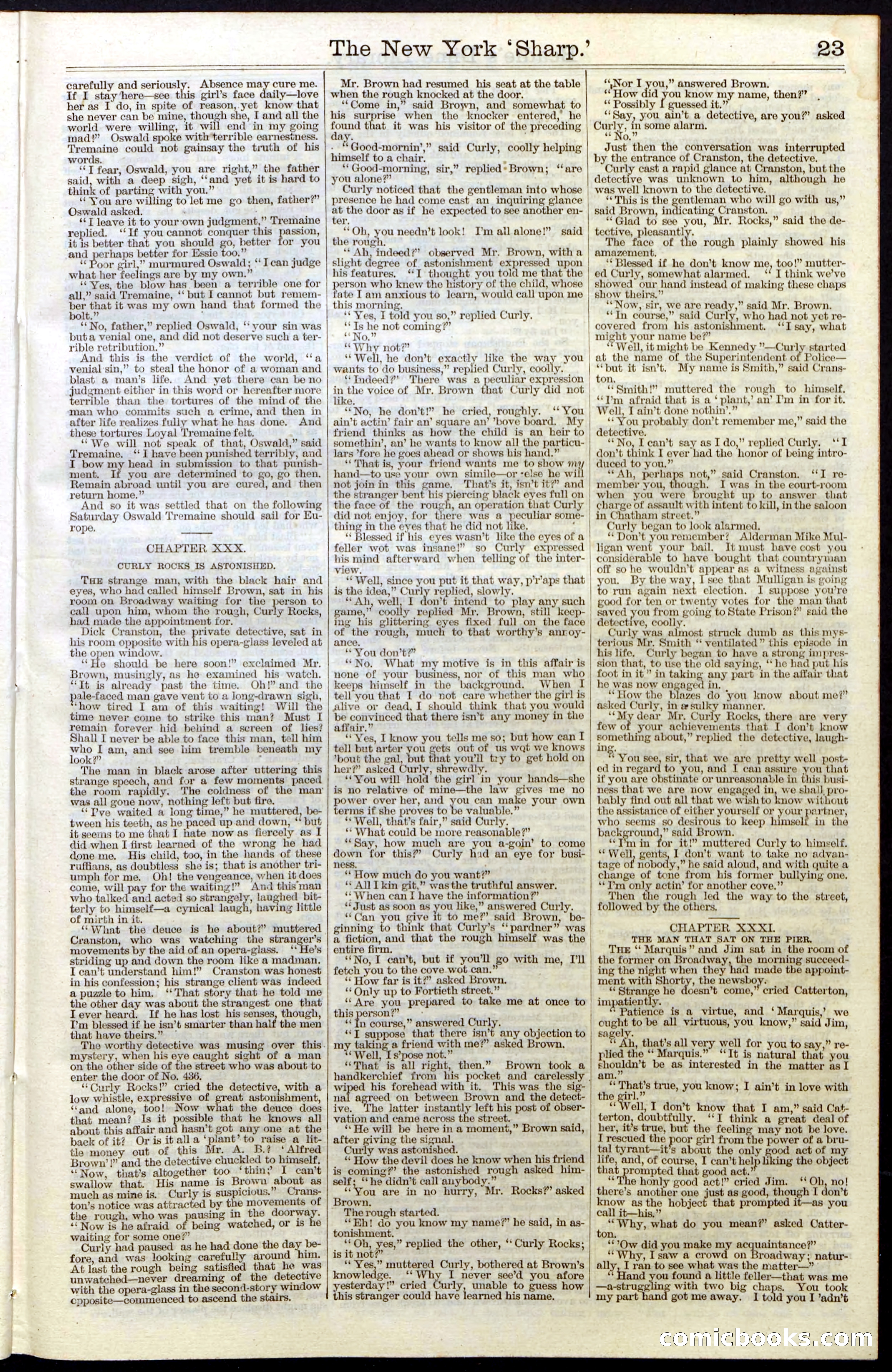
A restored page from Pulp Fiction, 1878. Page through the whole issue in the reader above.
📄 Transcribed text from this page (OCR, searchable)
Machine-transcribed from the original scan — historical spelling and the odd misread are preserved.
——— ——— ———— —— — — carefully and seriously, Absence may cure me. If I stay here—see this girl’s face daily—love her as I do, in spite of reason, yet know that she never can be mine, though she, I and all the world were willing, it will end in my going mad!” Oswald spoke withterrible earnestness. Tremaine could not gainsay the truth of his words. ‘‘T fear, Oswald, you are right,” the father said, with a deep sigh, ‘‘and yet it is hard to think of parting with you.” ‘‘ You are willing to let me go then, father?” Oswald asked. ‘*T leave it to your‘own judgment,” Tremaine replied. ‘If you cannot conquer this passion, it is better that you should go, better for you and perhaps better for Essie too.” : * Poor girl,” murmured Oswald; “ I can judge what her feelings are by my own.” ‘‘- Yes, the blow has been a terrible one for all,” said Tremaine, ‘‘ but I cannot but remem- ber that it was my own hand that formed the bolt.” ‘‘ No, father,” replied Oswald, ‘your sin was but a venial one, and did not deserve such a ter- rible retribution.” And this is the verdict of the world, “a venial sin,” to steal the honor of a woman and blast a man’s life. And yet there can be no judgment either in this word or hereafter more terrible than the tortures of the mind of the man who commits such a crime, and then in after life realizes fully what he has done. And these tortures Loyal Tremaine felt. ‘‘We will not speak of that, Oswald,” said Tremaine, ‘I have been punished terribly, and I bow my head in submission to that punish- ment. If you are determined to go, go then. Remain abroad until you are cured, and then return home.” And so it was settled that on the following Saturday Oswald Tremaine should sail for Eu- rope. uF CHAPTER XXX. CURLY ROCKS IS ASTONISHED. THe strange man, with the black hair and eyes, who had called himself Brown, sat in his room on Broadway waiting for the person to call upon him, whom the rough, Curly Rocks, had made the appointment for. Dick Cranston, the Aap detective, sat in his room opposite with his opera-glass leveled at the open window. “Ho should be here soon!” exclaimed Mr. Brown, musingly, as he examined his watch. “It is already past the time. Oh!” and the pale-faced man gave vent to a long-drawn sigh, ‘how tired I am of this waiting! Will the time never come to strike this man? Must I remain forever hid behind a sereen of lies? Shall I never be able to face this man, tell him who [ am, and see him tremble beneath my look?” The man in black arose after uttering this strange speech, and for a few moments paced the room rapidly. The coldness of the man was all gone now, nothing left but fire. ‘‘Pve waited a long time,” he muttered, be- tween his teeth, as he paced up and down, “* but it seems to me that I hate now as fiercely as I did when I first learned of the wrong he had done me. His child, too, in the hands of these ruffians, as doubtless she is; that is another tri- umph for me. Oh! the vengeance, when it does come, will pay for the waiting!” And this man who talked and acted so strangely, laughed bit- terly to himself—a cynical laugh, having little of mirth in it. ‘What the deuce is he about?” muttered Cranston, who was watching the egg movements by the aid of an opera-glass. ‘* He’s striding up and down the room like a madman. I can’t understand him!” Cranston was honest in his confession; his strange client was indeed a puzzle to him. ‘That story that he told me the other day was about the strangest one that ITever heard. If he has lost his senses, though, I’m blessed if he isn’t smarter than half the men that have theirs.” — The worthy detective was musing over this. mystery, when his eye caught sight of a man on the other side of the street who was about to enter the door of No. 436. ‘Curly Rocks!” cried the detective, with a low whistle, expressive of great astonishment, ‘and alone, too! Now what the deuce does that mean? Is it ible that he knows all about this affair and hasn’t got any one at the back of it? Or is it alla ‘plant’ to raise a lit- tle money out of this Mr. A. B.? ‘Alfred Brown’!” and the detective chuckled to himself. ‘Now, that’s altogether too ‘thin? I can’t swallow that. His name is Brown about as much as mine is. Curly is suspicious.” Crans- ton’s notice was attracted by the movements of the rough, who was pausing in the doorway. ‘“ Now - he afraid of being watched, or 15 he waiting for some one? Curly had paused as he had done the day be- fore, and was looking carefully around him. At last the rough being satisfied that he was unwatched—never dreaming of the detective with the opera-glass in the second-story window cpposite—commenced to ascend the stairs. The New York ‘Sharp. Mr. Brown had resumed his seat at the table when the rough knocked at the door. **Come in,” said Brown, and somewhat to his pe tag when the knocker entered, he sae that it was his visitor of the preceding ay. * Good-mornin’,” said Curly, coolly helping himself to a chair. . **Good-morning, sir,” replied» Brown; ‘are you alone?” Curly noticed that the gentleman into whose presence he had come cast an inquiring glance aa the door as if he expected to see another en- er. ‘**Oh, you needn’t look! the rough. ‘* Ah, indeed?’ observed Mr. Brown, with a slight degree of astonishment expressed upon his features. “I thought you told me that the person who knew the history of the child, whose I’m all alone!” said fate Iam anxious to learn, would call upon me | this morning. ‘* Yes, I told you so,” replied Curly. ** Ts he not coming?’ °* NO.” : “Why not?” ‘* Well, he don’t exactly like the way you wants to do business,” replied Curly, coolly. ‘* Indeed?’ There was a peculiar expression in the voice of Mr. Brown that Curly did not like, ‘*No, he don’t!” he cried, roughly. ‘ You ain’t actin’ fair an’ square an’ ’bove board. My friend thinks as how the child is an heir to somethin’, an’ he wants to know all the particu- lars ‘fore he goes ahead or shows his hand.” ‘* That is, your friend wants me to show m hand—to use your own simile—or -else he wi not join in this game. That’s it, isn’t it?’ and the stranger bent his piercing black eyes full on the face of the rach. an operation that Curly did not enjoy, for there was a peculiar some- thing in the eyes that he did not like. - ‘‘ Blessed if his eyes wasn’t like the eyes of a feller wot was insane!” his mind afterward when telling of the inter- view. ‘Well, since you put it that way, p’r’aps is the idea,” Curly replied, slowly. ‘Ah, well, I don’t intend to play any such game,” coolly replied Mr. Brown, still keep- ing his glittering eyes fixed full on the face of the rough, much to that worthy’s anroy- ance. * You don’t?” ‘*No. What my motive is in this affair is none of your business, nor of this man who keeps himself in the background. When I tell you that I do not care whether the girl is alive or dead, I should think that you would ns convinced that there isn’t any money in the affair.” “Yes, I know you tells me so; but how ean I tell but arter you gets out of us wat we knows ‘bout the gal, but that you'll try to get hold on her?’ asked Curly, shrewdly. ‘*You will hold the girl in your hands—she is no relative of mine—the law gives me no power over her, and you can make your own terms if she proves to be valuable.” ‘Well, that’s fair,” said Curly. * What could be more reasonable?” **Say, how much are you a-goin’ to come down for this?’ Curly had an eye for busi- ness. ** How much do you want?” * All kin git,” wasthe truthful answer. ** When can I have the information?” “Just as soon as you like,” answered Curly. ‘Can you give it to me?” said Brown, be- ginning to think that Curly’s “pardner” was a fiction, and that the rough himself was the entire firm. ‘“No, I can’t, but if you'll go with me, ll fetch you to the cove wot can.’ ‘« How far is it?” asked Brown. ‘‘ Only up to Fortieth street.” ‘‘ Are you prepared to take me at once to this person?” ‘Tn course,” answered Carly. ‘“T suppose that there isn’t any objection to my taking a friend with me?’ asked Brown, ‘Well, Is’pose not.” Brown took a “That is all right, then.” handkerchief from his that wie his forehead with it. This was the sig- nal agreed on between Brown and the detec ive. The latter instantly left his post of obser- vation and came across the street. ‘He will be here in a moment,” Brown said, after giving the signal. Curly was astonished. y “« How the devil does he know when his friend is coming?’ the astonished rough asked him- self; “he didn’t call anybody.” “You are in no hurry, Mr. Rocks?’ asked Brown. The rough started. ‘‘Eh! do you know my name?” he said, in as- tonishment. ** Oh, yee” replied the other, ‘‘ Curly Rocks; is it not?” ** Yes,” muttered Curly, bothered at Brown’s knowl Let I never see’d you afore esterday!” cried ‘ly, unable to guess how his stranger could have learned his name. so Curly expressed | pocket and carelessly | am 23 ‘Nor I you,” answered Brown. ** How did you know my name, then?’ ** Possibly I guessed it.” ‘‘Say, you ain’t a detective, are you?” asked Curly, in some alarm. * 0, Just then the conversation was interrupted by the entrance of Cranston, the detective. Curly cast a rapid glance at Cranston, but the detective was unknown to him, although he was well known to the detective. “This is the gentleman who will go with us,” said Brown, indicating Cranston. “Glad to see you, Mr. Rocks,” said the de- tective, pignsantiy The face of the rough plainly showed his amazement, ‘* Blessed if he don’t know me, too!” mutter- ed Curly, somewhat alarmed. ‘‘ I think we’ve showed our hand instead of making these chaps show theirs.” ** Now, sir, we are ready,” said Mr. Brown. **In course,” said Curly, who had not yet re- covered from his astonishment. ‘I say, what might your name be?” ‘Well, it might be Kennedy ”—Curly started at the name of the Superintendent of Police— “but it isn’t. My name is Smith,” said Crans- ton, ‘* Smith!” muttered the rough to himself. “Tm afraid that is a ‘ plant,’ an’ Pm in for it. Well, I ain’t done nothin’.” ‘* You probably don’t remember me,” said the detective. ‘No, I can’t say as I do,” replied Curly. ‘I don’t think I ever’had the honor of being intro- duced to you.” *““Ah, perhaps not,” said Cranston. ‘‘I re- member you, though. I was in the eourt-room when you were brought up to answer that charge of assault with intent to kill, in the saloon in Chatham street.” Curly began to look alarmed. * Don’t youremember? Alderman Mike Mul- ligan went your bail. It must have cost you considerable to have bought that countryman off so he wouldn’t appear as a witness against you. By the way, I see that Mulligan is going to run again next election. I muppoee you're good for ten or twenty votes for the man that saved you from going to State Prison?” said the detective, coolly. Curly was Mitch struck dumb as this mys- terious Mr. Smith “ ventilated” this episode in his life. Curly began to have a strong impres- sion that, to use the old saying, ‘ he had put his foot in it” in taking any part in the affair that he was now engaged in, . **Hlow the blazes do ‘you know about me?” asked Curly, in # sulky manner. ‘*My dear Mr. Curly Rocks, there are very few of your achievements that I don’t know something about,” replied the detective, laugh- ing. ® you see, sir, that we are pretty well post- ed in regard to you, and I can assure you that if you are obstinate or unreasonable in this busi- ness that we are now engaged in, we shall, pro- bably find out all that we wish to know without the assistance of either yourself or your "gigs + who seems so desirous to keep himself in the Ragetoued ” said Brown. “Tm in for it!” muttered Curly to himeelf. ‘Well, gents, I don’t want to take no advan- tage o nobody,” he said aloud, and with quite a change of tone from his former bullying one, ‘*T’'m only actin’ for another cove.” Then the rough led the way to the street, followed by the others. CHAPTER XXXI. THE MAN THAT SAT ON THE PIER. THe ‘“‘ Marquis” and Jim sat in the room of the former on Broadway, the morning succeed- ing the night when they had made the appoint- ment with Shorty, the newsboy. “Strange he doesn’t come,” cried Catterton, impatien y. Patience is a virtue, and ‘ Marquis,’ we ought to be all virtuous, you know,” said Jim, NG that’s all very well for you to say,” re- plied the “ Marquis.” “Tt is natural that you shouldn’t be as interested in the matter as I That's true, you know; I ain’t in love with the oe ‘Well, I don’t know that I am,” said Cat terton, doubtfully. “T think a great deal of her, it’s true, but the ag not be love. I rescued the poor girl from the power of a bru- tal tyrant—it’s about the only act of my life, and, of course, I can’t help the object that rompted that good act. “The honly good act!” cried Jim. ‘‘ Oh, no! there’s another one just as good, though I don’t know as the hobieck that prompted i you call it—his,” Ra Why, what do you mean?” asked Catter- nD. ‘’Ow did you make my acquaintance?” “Why, Isaw a crowd on Broadway; natur- ally; IT ran to see what was the matter—” ou found a little feller—that was me —a-struggling with two big cha You took my part got me away. I told you I ’adn’t JOO (E(@) Af <SGO C