
Pulp Fiction, 1878 · page 22 of 32
Beadle's Dime Library, Vol. III, No. 31 — page 22: what you’re looking at
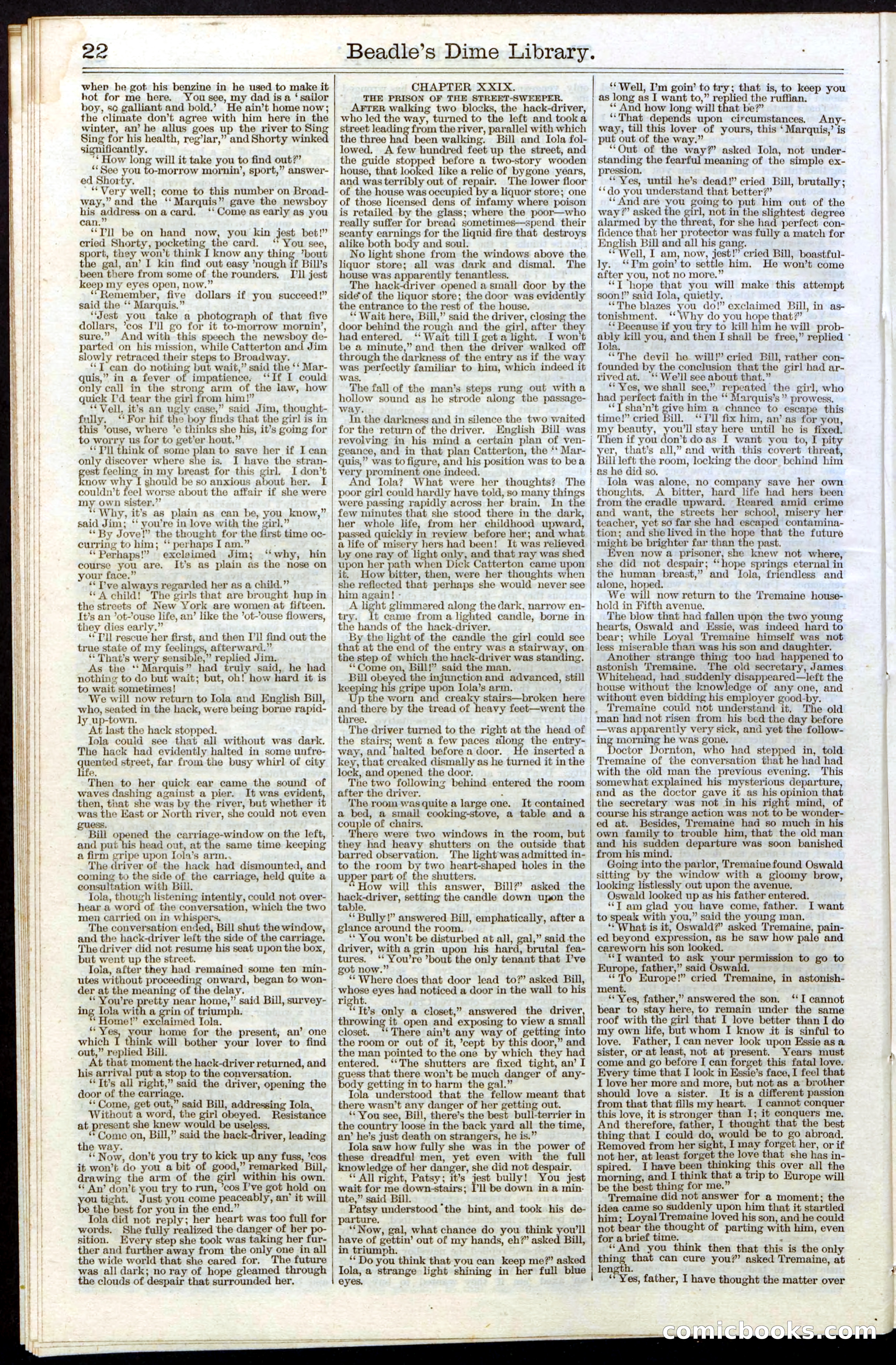
A restored page from Pulp Fiction, 1878. Page through the whole issue in the reader above.
📄 Transcribed text from this page (OCR, searchable)
Machine-transcribed from the original scan — historical spelling and the odd misread are preserved.
22 Beadle’s Dime Library. wher he got his benzine in he used to make it hot for me here. You see, my dad is a ‘sailor boy, sc galliant and bold.’ He ain’t home now; the climate don’t agree with him here in the winter, an’ he allus goes up the river to Sin Sing for his health, reg’lar,” and Shorty winke significantly. ‘* How long will it take you to find out?’ “See you to-morrow mornin’, sport,” answer- ed Shorty. "Very well; come to this number on Broad- way,” and the ‘‘ Marquis” gave the newsboy his address onacard. ‘‘ Come as early as you can. “Tll be on hand now, you kin jest bet!” cried Shorty, pocketing the card. ‘ You see, nee they won’t think I know any thing *bout the gal, an’ I kin find out easy ’nough if Bill’s been there from some of the rounders, Ill jest keep my eyes open, now.” ‘*Remember, five dollars if you succeed!” said the ‘* Marquis.” “Jest you take a photograph of that five dollars, ’cos I'll go for it to-morrow mornin’, sure.” And with this speech the newsboy de- parted on his mission, while Catterton and Jim slowly retraced their steps to Broadway. “T can do nothing but wait,” said the ‘‘ Mar- quis,” in a fever of impatience, ‘If I could only call in the strong arm of the law, how quick I'd tear the girl from him!” ‘* Vell, it’s an ugly case,” said Jim, thought- fully. this ’ouse, where to worry us for to get’er hovt.” ’ ‘‘T’ll think of some po to save her if I can | I have the stran- | only discover where she is. est feeling in my breast for this girl. I don’t snow why I should be so anxious about her. I couldn’t feel worse about the affair if she were my own sister.” ‘Why, it’s as plain as can be, you know,” said Jim; ‘‘ you’re in love with the girl.” ‘*By Jove!” the thought for the first time oc- eurring to him; ‘* perhaps I am.” : “Perhaps!” excleimed Jim; ‘‘why, hin course you are. It’s as plain as the nose on your face.” ‘‘T’ve always regarded her as a child.” “A child! The girls that are brought hup in the streets of New York are women at fifteen. It’s an ’ot~ouse life, an’ like the ’ot-’ouse flowers, they dies early.” ‘Tl rescue her first, and then Il) find out the true state of my feelings, afterward.” ‘“ That’s wery sensible,” replied Jim. As the ‘*‘ Marquis” had truly said, he had nothing to do but wait; but, oh! how hard it is to wait sometimes! ‘For hif the boy finds that the girl is in | e thinks she his, it’s going for | CHAPTER XXIX. THE PRISON OF THE STREET-SWEEPER. AFTER walking two blocks, the hack-driver, who led the way, turned to the left and tooka street leading from the river, parallel with which the three had been walking. Bill and Iola fol- lowed. A few hundred feet up the street, and | | standing the fearful meaning of the simple ex- the guide stopped before a two-story wooden house, that looked like a relic of bygone years, and was terribly out of repair. of the house was occupied by a liquor store; one of those licensed dens of infamy where poison is retailed by the glass; where the poor—who really suffer for bread sometimes—spend their sean y earnings for the liqnid fire that destroys alike both body and soul. No light shone from the windows above the liquor store; all was dark and dismal. The house was apparently tenantless. The hack-driver opened a small door by the side of the liquor store; the door was evidently the entrance to the rest of the house. “Wait here, Bill,” said the driver, closing the | door behind the rough and the girl, after they 7 , I won't ably kill you, and then I shall be free,” replied - had entered. ‘‘ Wait till I get a light. The lower floor | ** Well, I’m goin’ to try; that is, to keep you as long as I want to,” replied the ruffian. ** And how long will that be?” ‘That depends upon circumstances, Any- way, till this lover of yours, this ‘Marquis,’ is | put out of the way.” ‘‘Out of the way?’ asked Iola, not under- pression. ** Yes, until he’s dead!” cried Bill, brutally; ‘*do you understand that better?” ‘‘And are you going to put him out of the way?” asked the girl, not in the slightest degree alarmed by the threat, for she had perfect con- fidence that her protector was fully a match for | English Bill and all his gang. * Well, I am, now, jest!” cried Bill, boastful- ly. “I’m goin’ to settle him. He won’t come after you, not no more.” “T hope that you will make this attempt soon!” said Iola, quietly. **The blazes you do!” exclaimed Bill, in as- tonishment. ‘‘ Why do you hope that?” ‘* Because if you try to kill him he will prob- be a minute,” and then the driver walked off | Iola. through the darkness of the entry as if the way | was perfectly familiar to bim, which indeed it Ww : hollow sound as he strode along the passage- way. In the darkness and in silence the two waited for the return of the driver. as. The fall of the man’s steps rung out with a | | had Pe faith in the * English Bill was | | revolving in his mind a certain plan of ven- geance, and in that plan Catterton, the *' Mar- | ‘The devil he will!” cried Bill, rather con- founded by the conclusion that the girl had ar- rived at. ‘* We'll see about that.” ** Yes, we shall see,” Aste oc Daeg girl, who farquis’s”” prowess. sha’n’t give him a chance to escape this time!” cried Bill. ‘Tl fix him, an’ as for you, my beauty, you'll stay here until he is fixed. Then if you don’t doas I want you to, I pit yer, that’s all,” and with this covert threat, quis,” was to figure, and his position was to bea | Bill left the room, locking the door behind him | very prominent one indeed. And Tola? What were her thoughts? The | thoughts. A poor girl could hardly have told, so many things were passing rapidly across her brain. In the few minutes that she stood there in the dark, her whole life, from her childhood upward, passed quickly in review before her; and what | a life of misery hers had been! It was relieved by one ray of light only, and that ray was shed upon her path when Dick Catterton came upon it. How bitter, then, were her thoughts when | she reflected that perhaps she would never see him again! - A light glimmered along the dark, narrow en- try. the hands of the hack-driver. t came from a lighted candle, borne in | | hearts, Oswald and Essie, was indeed hard to | as he did so. lola was alone, no company save her own bitter, hard life had hers been from the cradle upward. Reared amid crime and want, the streets her school, misery her teacher, yet so far she had escaped contamina- tion; and she lived in the hope that the future might be brighter far than the past. Even now a prisoner, she knew not where, she did not despair; «hope springs eternal in the human breast,” and Iola, friendless and alone, hoped. We will now return to the Tremaine house- hold in Fifth avenue, The blow that had fallen upon the two young By the light of the candle the girl could sce | bear; while Loyal Tremaine himself was not that at the end of the entry was a stairway, on | the step of which the hack-driver was standing. ‘Come on, Bill!” said the man. less miserable than was his son and daughter. Another strange thing too had happened to astonish Tremaine. The old secretary, James Bill obeyed the injunction and advanced, still Whitehead, had ane ey af disappeared—left the e | keeping his gripe upon Iola’s arm. We will now return to Iola and English Bill, | p the worn and creaky stairs—broken here house without the knowledge of any one, and without even bidding his employer good-by. who, seated in the hack, were being borne rapid- , and there by the tread of heavy feet—went the | . Tremaine could not understand it. The old ly up-town. At last the hack stopped. Iola could see that ali without was dark. The hack had evidently halted in some unfre- qpeated street, far from the busy whirl of city oe Then to her quick ear came the sound of waves dashing against a pier. It was evident, then, that she was by the river, but whether it was the East or North river, she could not even ess. Bill opened the carriage-window on the left, and put his head out, at the same time keeping a firm gripe upon fola’s arm.. The driver of the hack had dismounted, and coming to the side of the carriage, held quite a consultation with Bill. lola, though listening intently, could not over- hear a word of the conversation, which the two men carried on in whispers. The conversation ended, Bill shut the window, and the hack-driver left the side of the carriage. The driver did not resume his seat upon the box, but went up the street. Iola, after they had remained some ten min- utes without proceeding onward, began to won- der at the meaning of the delay. ** You're protiy near home,” said Bill, survey- ing lola with a grin of triumph. ‘Home!” exclaimed Iola. “Yes, your home for the present, an’ one which T think will bother your lover to find out,” replied Bill. At that moment the hack-driver returned, and his arrival put a stop to the conversation. “It’s all right,” said the driver, opening the door of the carriage. ‘Come, get out,” said Bill, addressing Iola, Without a word, the girl obeyed. Resistance at present she knew would be useless. ** Come on, Bill,” said the hack-driver, leading the way. ; ‘‘ Now, don’t you try to kick up any fuss, ’cos it won’t do you a bit of good,” remarked Bill, drawing the arm of the girl within his own. ** An’ don’t you try to run, ’cos I’ve got hold on Nog tizht. Just you come peaceably, an’ it will the best for you in the end.” Iola did not reply; her heart was too full for words. She fully realized the danced of her po- sition. Every step she took was ng her fur- ther and further away from the only one in all the wide world that she cared for, The future was all dark; no ray of hope gleamed through the clouds of despair that surrounded her, a a ae three. The driver turned to the right at the head of the stairs; went a few paces along the entry- way, and halted before a door. lock, and opened the door. The two following behind entered the room after the driver. . The room was quite a large one. It contained a bed, a small cooking-stove, a table and a couple of chairs. There were two windows in the room, but | they had heavy shutters on the outside that barred observation. to the room by two heart-shaped holes in the upper part of the shutters. How will this answer, Bill?’ asked the pekcir Per setting the candle down upon the e. ‘‘ Bully!” answered Bill, emphatically, after a glance around the room, ‘** You won’t be disturbed at all, gal,” said the driver, with a grin upon his hard, brutal fea- tures. ‘ You’re bout the only tenant that I’ve got now.” ‘Where does that door lead to?’ asked Bill, wae eyes had noticed a door in the wall to his right. “Ths only a closet,” answered the driver throwing it open and exposing to view a small closet. ‘‘ There ain’t any way of getting into the room or out of it, ’cept by this door,” and the man pointed to the one by which they had entered. ‘‘The shutters are fixed tight, an’ I guess that there won’t be much danger of any- body getting in to harm the gal.” Iola understood that the fellow meant that there wasn’t any danger of her getting out. **' You see, Bill, there’s the best bull-terrier in the country loose in the back yard all the time, an’ he’s just death on strangers, he is.” Tola saw how fully she was in the power of these dreadful men, yet even with the full knowledge of her danger, she did not despair, * All right, Patsy; it’s — bully! You jest wait for me down-stairs; Pll be down in a min- ute,” said Bill. " Patsy understood the hint, and took his de- ure, ‘**Now, gal, what chance do you think you'll have of gettin’ out of my hands, eh?” asked Bill, in triumph. ‘** Do you think that you can keep me?” asked lola, a strange light shining in her full blue eyes. e inserted a | key, that creaked dismally as he turned it in the | The lightwas admitted in- | EEE — ' man had not risen from his bed the day before —was apparently very sick, and yet the follow- ing morning he was gone. Doctor Dornton, who had stepped in, told Tremaine of the conversation that he had had with the old man the previous evening. This somewhat explained his mysterious departure -and as the octor gave it as his opinion tha the secretary was not in his right mind, of course his strange action was not to be wonder- ed at. Besides, Tremaine had so much in his own family to trouble him, that the old man and his sudden departure was soon banished from his mind. Going into the parlor, Tremaine found Oswald sitting by the window with a gloomy brow, looking listlessly out upon the avenue. Oswald looked up as his father entered. ‘“‘T am glad you have come, father. to speak with you,” said the young man. ‘* What is it, Oswald?” asked Tremaine, pain- ed beyond expression, as he saw how pale and Ege on bp 5 wan our on Europe, father,” said dsw d. 5% 3 to Europe!” cried Tremaine, in astonish- IT want ment. “Yes, father,” answered the son. ‘I cannot bear to stay here, to remain under the same roof with the girl that I love better than I do my own life, but whom I know jt is sinful to love. Father, I can never look upon Essie as a sister, or at least, not at present. Years must come and go before I can forget this fatal love. Every time that I look in Essie’s face, I feel that I love her more and more, but not as a’ brother should love a sister. It is a different passion from that that fills my heart. I cannot conquer this love, it is stronger than I; it conquers me. And therefore, father, I ara, ag that the best thing that I could do, would to go abroad. Removed from her sight I may forget her, or if not her, at least forget the love that she has in- spired. I have been € this over all the morning, and I think that a trip to Europe will be the best thing for me.” Tremaine did not answer for a moment; the idea came so suddenly upon him that it startled him; Loyal Tremaine loved his son, and he could not bear the thought of parting with him, even for a brief time. | ‘ “And you think then that this is the only thing that can cure you?’ asked Tremaine, at ength. ‘* Yes, father, I have thought the matter over VOOK ~=colr