
Pulp Fiction, 1878 · page 21 of 32
Beadle's Dime Library, Vol. III, No. 31 — page 21: what you’re looking at
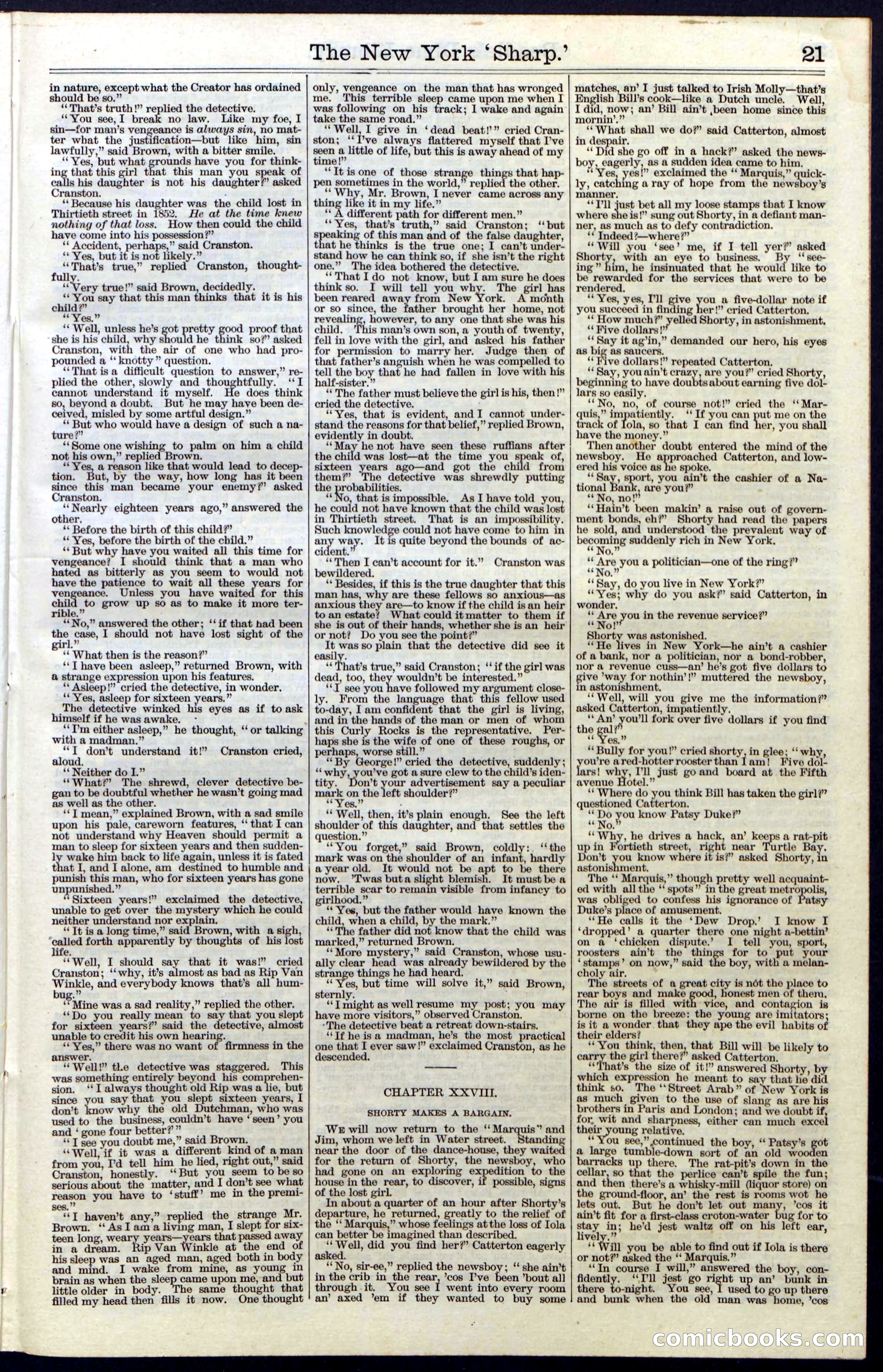
A restored page from Pulp Fiction, 1878. Page through the whole issue in the reader above.
📄 Transcribed text from this page (OCR, searchable)
Machine-transcribed from the original scan — historical spelling and the odd misread are preserved.
in nature, except what the Creator has ordained should be so.” ‘“*That’s truth!” replied the detective. “You see, I break no law. Like my foe, I sin—for man’s vengeance is always sin, no mat- ter what the justification—but like him, sin lawfully,” said Brown, with a bitter smile. ** Yes, but what agen have you for think- ing that this girl that this man you speak of calls his daughter is not his daughter?’ asked Cranston. ; ‘* Because his daughter was the child lost in Thirtieth street in 1852. He at the time knew nothing of that loss. How then could the child have come into his possession?” ‘* Accident, perhaps,” said Cranston. ‘** Yes, but it is not likely.” “That’s true,” replied Cranston, thought- fully. ‘Very true!” said Brown, decidedly. | ‘You say that this man thinks that it is his child?” a“ Yes.” ** Well, unless he’s got pretty proof that she is his child, why should he think so?’ asked Cranston, with the air of one who had pro- pounded a * knotty” question. ‘*That isa difficult question to answer,” re- plied the other, slowly and thoughtfully. “I cannot understand it myself. e does think so, beyond a doubt. But he may have been de- ceived, misled by some artful design.” = But who would have a design of such a na- re?’ **Some one wishing to palm on him a child not his own,” replied Brown. * a reason like that would lead to decep- tion. “But, by the way, how long has it been since this man became your enemy?’ asked Cranston. ‘‘Nearly eighteen years ago,” answered the other. ‘** Before the birth of this child?’ ‘Yes, before the birth of the child.” ‘** But why have you waited all this time for vengeance? I should think that a man who hated as bitterly as you seem to would not have the patience to wait all these years for ven ce. Unless you have wai for this - ,,bo grow up so as to make it more ter- ri ON o,” answered the other; ‘‘ if that had been pe case, I should not have lost sight of the r ? ‘* What then is the reason?” ‘*T have been asleep,” returned Brown, with a strange expression upon his features. ‘** Asleep!” cried the detective, in wonder, ‘* Yes, asleep for sixteen years,” ‘The detective winked his eyes as if to ask himself if he was awake. ‘Tm either asleep,” he thought, ‘“ or talking with a madman.” ‘IT don’t understand it!” aloud, ‘* Neither do 1.” ‘*What?’? The shrewd, clever detective be- gan to be doubtful whether he wasn’t going mad as well as the other. ‘*T mean,” explained Brown, with a sad smile upon his pale, careworn features, ‘‘ that I can not understand why Heaven should permit a man to sleep for sixteen years and then sudden- ly wake him back to life again, unless it is fated that I, and I alone, am destined to humble and punish this man, who for sixteen years has gone unpunished.” Sixteen years!” exclaimed the detective, unable to get over the mystery which he could neither understand nor explain. “Tt is a long time,” said Brown, with a sigh, ‘ealled forth apparently by thoughts of his lost life. ‘‘Well, I should say that it was!” cried Cranston; ‘‘ why, it’s almost as bad as Rip Van Winkle, and everybody knows that’s all hum- bug.” Fine was a sad reality,” replied the other. ‘“‘Do you really mean to say that you slept for sixteen years?’ said the detective, almost unable to credit his own hearing. ‘‘ Yes,” there was no want of firmness in the answer. “Well!” the detective was staggered. This was something entirely beyond his aioe rp ir sion. ‘Il always thought old Rip was a lie, but since you say that you slept sixteen years, I don’t know why the old Dutchman, who was used to the business, couldn’t have ‘ seen’ you and ‘gone four better?” | ‘*T see you doubt me,” said Brown. “Well, if it was a different kind of a man from you, I’d tell him he lied, right out,” said ton, honestly. ‘‘But you seem to be so serious about the matter, and I don’t see what reason you have to ‘stuff’ me in the premi- ” ‘“T haven’t any,” replied the strange Mr. Brown. ‘As Iam a living man, I slept for six- teen long, we a that passed away in a dream. Rip Van Winkle at the end of his sleep was_an aged man, aged both in body and mind. I wake from mine, as young in brain as when the ee upon me, and but little older in body. e same thought that filled my head then fills it now. One thought Cranston cried, The New York only, vengeance on the man that has wronged me. This terrible sleep came upon me when I was following on his track; 1 wake and again take the same road.” ‘Well, I give in ‘dead beat!’” cried Cran- ston; ‘‘ ve always flattered myself that I’ve seen a little of life, but this is away ahead of my time!” “It isone of those strange things that hap- pen sometimes in the world,” replied the other. ‘Why, Mr. Brown, I never came across any thing like it in my life.” ‘‘ A different path for different men.” ‘Yes, that’s truth,” said Cranston; ‘but s ing of this man and of the false daughter, that he thinks is the true one; I can’t under- stand how he can think so, if she isn’t the right one.” The idea bothered the detective. ‘That Ido not know, but I am sure he does think so. I will tell you why. The girl has been reared tal from New York. A month or so since, the father brought her home, not tS a however, to any one that she was his child, is man’s own son, a youth of twenty, fell in love with the girl, and asked his father for permission to marry her. Judge then of that father’s anguish when he was compelled to tell the boy that he had fallen in love with his half-sister.” ‘The father must believe the girl is his, then!” cried the detective. . “Yes, that is evident, and I cannot under- stand the reasons for that belief,” replied Brown, evidently in doubt. ‘*May he not have seen these ruffians after the child was lost—at the time you s of, sixteen years ago—and got the child from them?” The detective was shrewdly putting the probabilities. ‘* No, that is impossible. As I have told you he could not have known that the child was los in Thirtieth street. That is an impossibility. Such knowledge could not have come to him in any way. It is quite beyond the bounds of ac- cident.” “Then I can’t account for it.” bewildered. ‘‘ Besides, if this is the true daughter that this man has, why are these fellows so anxious—as anxious they are—to know if the child is an heir to an estate’ What could itmatter to them if she is out of their hands, whether she is an heir or not? Do you see the point?” oe was so plain that the detective did see it easily. ‘““'That’s true,” said Cranston; ‘if the girl was dead, too, hk wouldn’t be interested.” ‘*T see you have followed my ar ent close- ly. From the language that this fellow used to-day, I am confident that the girl is living, and in the hands of the man or men of whom this Curly Rocks is the representative. Per- haps she is the wife of one of these roughs, or perhaps, worse still.” : “By George!” cried the detective, suddenly ; ‘““why, you’ve got a sure clew to the child’s iden- tity. Don’t your advertisement say a peculiar aS on the eft shoulder?” meg." 5 Cranston was ‘** Well, then, it’s plain enough. See the left shoulder of this daughter, and that settles the question.” ‘You forget,” said Brown, Soe he ‘* the mark was on the shoulder of an infant, hardly a year old. It would not be apt to be there now. “Iwas buta slight blemish. It must be a terrible scar to remain visible from infancy to en Yes, but the father would have known the child, when a child, by the mark.” ‘The father did not know that the child was marked,” returned Brown. ‘*More mystery,” said Cranston, whose usu- ally clear head was already bewildered by the strange things he had heard. “Yes, but time will solve it,” said Brown, sternly. ‘‘T might as well resume my post; you ma have maore visitors,” observed Cranston. ‘A ‘The detective beat a retreat down-stairs. ‘Tf he is a madman, he’s the most practical one that I ever saw!” exclaimed Cranston, as he descended. CHAPTER XXVIII, SHORTY MAKES A BARGAIN, We will now return to the “ Marquis” and Jim, whom we left in Water street. Standin near the door of the dance-house, they wai for the return of Shorty, the newsboy, who had gone on an exploring expedition to the house in the rear, to discover, if possible, signs of the lost girl. In about a quarter of an hour after Shorty’s departure, he returned, greatly to the relief of the “ Maré 3,” whose Toctintne atthe loss of Iola can better be imagined than described. rte did you find her?” Catterton eagerly as ** No, sir-ee,” replied the newsboy; “ she ain’t in the crib in the rear, ’cos I’ve n ’bout all through it. You see | went into every room an’ axed ’em if they wanted to buy some ‘Sharp.’ 21 matches, an’ I just talked to Irish Molly—that’s English Bill’s cook—like a Dutch uncle. Well, I did, now; an’ Bill ain’t ,been home since this mornin’.” ‘What shall we do?” said Catterton, almost in despair. ‘Did she go off in a hack?’ asked the news- boy eagerly, as a sudden idea came to him. ‘Yes yes!” exclaimed the ‘ Marquis,” quick- ly, catching a ray of hope from the newsboy’s manner. ‘“*T’ll just bet all my loose stamps that I know where she is!” sung out Shorty, in a defiant man- ner, as much as to defy contradiction. ** Indeed ‘—where?” “Will you ‘see’ me, if I tell yer?’ ask Shorty, with an eye to business. By _ ‘‘see- ing” him, he insinuated that he would like to be rewarded for the services that were to be rendered, ou a five-dollar note if ‘Yes, yes, ll give you succeed in finding her!” cried Catterton, ** How much?” yelled Shorty, in astonishment, “Five dollars!’ ‘Say it ag’in,” demanded our hero, his eyes as big as saucers. ** Five dollars!” repeated Catterton. ‘* Say, you ain’t crazy, are you?” cried Shorty, beginning to have doubts about earning five dol- lars so easily. ‘*No, no, of course not!” cried the ‘ Mar- quis,” impatiently. ‘‘ If you can put me on the track of Iola, so that I can find her, you shall have the money.” Then another doubt entered the mind of the newsboy. He + anaes Catterton, and low- e spok ered his Mi ecind as . “Acad “8 x , you the cashier of a Na- tional Bank, are you?” ; ** No, no?’ ‘“Hain’t been makin’ a raise out of govern- ment bonds, eh?” Shorty had read the papers he sold, and understood the prevalent way of ae suddenly rich in New York, 0 i Are you a politician—one of the ring?” ** No. ‘Say, do you live in New York?” “Yes; why do you ask?’ said Catterton, in wonder. * Are you in the revenue service?” “ee No !’ Shorty was astonished. ‘“*He lives in New York—he ain’t a cashier of a bank, nor a politician, nor a bond-robber, nor a revenue cuss—an’ he’s got five dollars to give ’way for nothin’!” muttered the newsboy, in astonishment. ‘* Well, will you give me the information?” asked Catterton, impatiently. * An) you'll fork over five dollars if you find the gal? ac es, ” “Bully for you!” cried shorty, in glee; “wh it ared-hotter rooster thas “A Five dot. ! why, Pll just goand board at the Fifth avenue Hotel.” ‘Where do you think Bill has taken the girl?” questioned Catterton, * Do you know Patsy Duke?” se No. ? ‘Why, he drives a hack, an’ keeps a rat-pit up in Fortieth street, righ near Turtle op k Don’t you know where it is?” asked Shorty, in The “ Marquis,” though pretty well e ° rq ough pretty well acquaint- ed with all the spots” in the great metropolis, was obliged to confess his ignorance of Patsy Duke’s p of amusement. ‘“He calls it the ‘Dew Drop.’ I know I ‘dropped’ a quarter there one night a-bettin’ on a ‘chicken dispute.’ I tell you, sport, roosters ain’t the things for to put your ae ’ on now,” said the boy, with a melan- choly air. The streets of a great city is not the place to rear boys and make , honest men of therm, The air is filled with vice, and contagion is borne on the breeze: the young are imitators; is it a wonder that they ape the evil habits of ne yon think then, that Bill will be ou en ill w likely to the girl there?” asked Catterton. if “That's the size of it!” answered Shorty, by which expression he meant to say that hie did think so. The “Street Arab” of New York is as much given to the use of slang as are his brothers in Paris and London; and we doubt if for, wit and sharpness, either can much excel their young relative. “You see,” continued the boy, “ Patsy’s got a large tumble-down sort of an old en barracks up there. The rat-pit’s down in the cellar, so that the perlice can’t spile the fun; and then there’s a whisky-mill (liquor store) on the ground-floor, an’ the rest is rooms wot he lets out. But he don’t let out many, ’cos it ain’t fit for a first-class croton-water bug for to oA in; he’d jest waltz off on his left ear, vely. ‘* Will you be able to find out if Iola is there or not?” asked the ‘‘ Marquis.” “In course I will,” answered the boy, con- fidently. ‘Ill jest go rent up an’ bunk in there to-night. You see to go up there and bunk when the old man was home, ’cos JOO (€(0) im (¢ cs) (Eo)