
Pulp Fiction, 1878 · page 20 of 32
Beadle's Dime Library, Vol. III, No. 31 — page 20: what you’re looking at
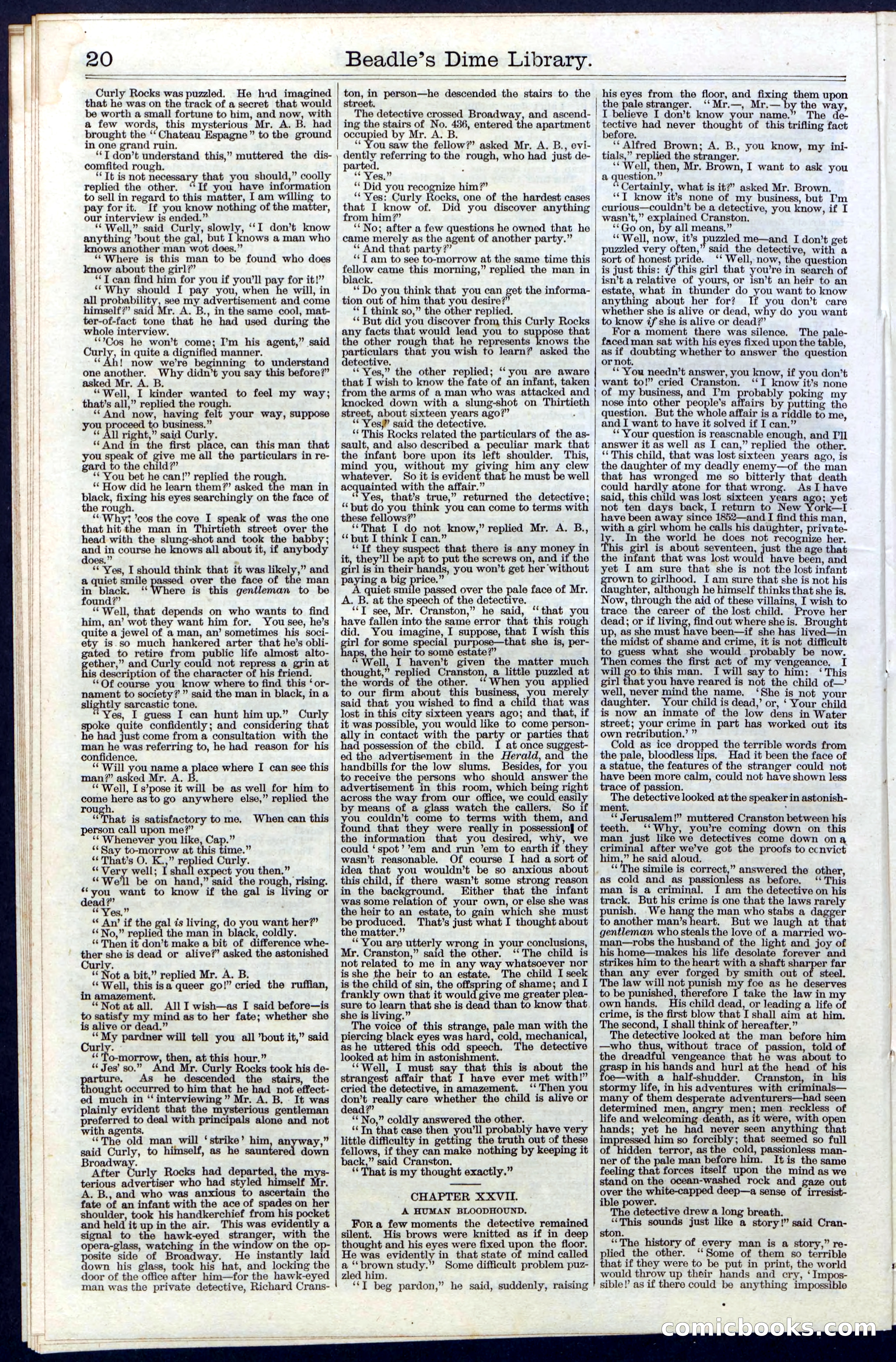
A restored page from Pulp Fiction, 1878. Page through the whole issue in the reader above.
📄 Transcribed text from this page (OCR, searchable)
Machine-transcribed from the original scan — historical spelling and the odd misread are preserved.
——— —— —— | | | ee 8 = a a 20 Beadle’s Dime Library. Curly Rocks was puzzled. He hid imagined that he was on the track of a secret that would be worth a small fortune to him, and now, with a few words, this mysterious Mr. A. B. had brought the “Chateau Espagne” to the ground in one grand ruin. ‘*T don’t understand this,” muttered the dis- comfited rough. ‘Tt is not necessary that you should,” coolly replied the other. “If you have information to sell in regard to this matter, I am willing to pay for it. If you know nothing of the matter, our interview is ended.” ‘* Well,” said Curly, slowly, “I don’t know anything ’bout the gal, but I knows a man who knows another man wot does.” ‘Where is this man to be found who does know about the girl?” *‘T can find him for you if you’ll pay for it!” ‘Why should I pay you, when he will, in all probability, see my advertisement and come himself?” said Mr. A. B., in the same cool, mat- ter-of-fact tone that he had used during the whole interview. ‘Cos he won’t come; I’m his agent,” said pate in quite a dignified manner. “Ah! now we’re beginning to understand one another. Why didn’t you say this before?” asked Mr. A. B. “Well, I kinder wanted to feel my way; _ that’s all,” replied the rough. ‘And now, having fel you proceed to business.” ** All right,” said Curly. ** And the first place, can this man that you speak of give me all the particulars in re- gard to the child?” ‘** You bet he can!” replied the rough. ‘** How did he learn them?’ asked the man in black, fixing his eyes searchingly on the face of the rough. ‘Why; ’cos the cove I speak of was the one that hit the man in Thirtieth street over the head with the slung-shot and took the babby; — in course he knows all about it, if anybody oes. » ‘Yes, I should think that it was likely,” and a quiet smile passed over the face of the man in black. ‘ ere is this gentleman to be found?” ** Well, that depends on who wants to find him, an’ wot they want him for. You see, he’s quite a jewel of a man, an’ sometimes his soci- ety is.so much hankered arter that he’s obli- gated to retire from public life almost alto- Seen and Curly could not repress a grin at is description of the character of his friend. ‘*Of course you know where to find this ‘ or- nament to society? ” said the man in black, in a slightly sarcastic tone. Yes, I guess I can hunt him up.” Curly spoke quite confidently; and considering that he had just come from a consultation with the man he was referring to, he had reason for his confidence, ‘‘ ‘Will you name a place where I can see this man?” asked Mr. A. B. ‘Well, I s’pose it will be as well for him to come here as to go anywhere else,” replied the “That is satisfactory tome, When can this person call upon me?” ‘¢ Whenever you like oy ‘*Say to-morrow at this time.” ‘¢‘ That’s O. K.,” polio. Curly. “Very well; I shall expect you then. if ‘We'll be on hand,” said the rough, rising. “vou want to know if the gal is living or dead?” ¢é Yes. ” “ An’ if the gal is living, do you want her?” ‘‘ No,” replied the man in black, coldly. ‘Then it don’t make a bit of difference whe- ther she is dead or alive?’ asked the astonished Cur ly. ‘Not a bit,” replied Mr. A. B. ‘‘ Well, this isa queer go!” cried the ruffian, in amazement. “Not at all. All I wish—as I said before—is to satisfy my mind as to her fate; whether she is alive or dead.” Ps My pardner will tell you all bout it,” said ly. é fo camronn then, at this hour.” “ Jes’ so.” And Mr. Curly Rocks took his de- . As he descended the stairs, the hought occurred to him that he had _ not effect- ed much in “interviewing” Mr. A. B, . It was plainly evident that the mysterious gentleman preferred to deal with principals alone and not with agents. : “The old man will ‘strike’ him, anyway,” said Curly, to himself, as he sauntered down Broadway. After ly Rocks had departed, the mys- terious advertiser who had styled himself Mr. A. B., and who was anxious to ascertain the fate of an infant with the ace of spades on her shoulder, took his handkerchief from his pocket and held it up in the air. This was sega ap a signal to the hawk-eyed stranger, with the opera-glass, watching in the window on the op- a side of Broadway. He instantly laid own his glass, took his hat, and locking the door of the office after him—for the hawk-eyed man was the private detective, Richard Crans- your way, suppose oan me person—he descended the stairs to the street. _ The detective crossed Broadway, and ascend- ing the stairs of No. 436, entered the apartment occupied by Mr. A. B ‘* You saw the fellow?’ asked Mr. A. B., evi- dently referring to the rough, who had just de- parted. : “'Yoa,?’ ‘** Did you recognize him?” ‘*' Yes: Curly Rocks, one of the hardest cases that I know ‘of. Did you discover anything from him?” ‘*No; after a few questions he owned that he came merely as the agent of another party.” ‘** And that party?” ‘*T am to see to-morrow at the same time this enh came this morning,” replied the man in ack. ‘Do you think that you can get the informa- tion out of him that you desire?’ ‘**T think so,” the other replied. ‘* But did you discover from this Curly Rocks any facts that would lead you to tig ho that the other rough that he represents knows the particulars that you wish to learn? asked the detective. “Yes,” the other replied; ‘‘ you are aware that I wish to know the fate of an infant, taken from the arms of a man who was attacked and knocked down with a slung-shot on Thirtieth street, about sixteen years ago?” , ** Yes?’ said the detective. ‘‘This Rocks related the particulars of the as- sault, and also described a peculiar mark that the infant bore upon its left shoulder. This, mind you, without ee giving him any clew whatever. So it is evident that he must be well acquainted with the affair.” * Yes, that’s true,” returned the detective; “but do you think you can come to terms with these fellows?” ‘That I do not know,” replied Mr. A. B., ** but I think I can.” ‘Tf they suspect that there is any money in it, they’ll be apt to put the screws on, and if the girl is in their hands, you won’t get her without paying a big ea as quiet smile passed over the pale face of Mr. A. B. at the speech of the detective. ‘*T see, Mr. Cranston,” he said, ‘‘that you have fallen into the same error that this rough did. You imagine, I suppose, that I wish this at for some special purpose—that she is, per- ps the heir to some estate?” Well, I haven’t given the matter much thought,” replied Cranston, a little puzzled at the words of the other. ‘‘ When you applied to our firm about this business, you merely said that you wished to find a child that was lost in this city sixteen years ago; and that, if it was possible, you would like to come person- ally in contact with the pony or parties that had possession of the cbild. at once cy a ed the advertisement in the Herald, and the handbills for the low slums. Besides, for you to receive the persons who should answer the advertisement in this room, which being right across the way from our office, we could easily by means of a glass watch the ers. So if ou couldn’t come to terms with them, and ound that they were really in possession] of the information that you desired, ey: we could ‘spot’’em and run ’em to earth if they wasn’t reasonable. Of course I had a sort of idea that you wouldn’t be so anxious about |. this child, if there wasn’t some strong reason in the background. Hither that the infant was some relation of your own, or else she was the heir to an estate, to gain which she must be produced, That’s just what I thought about the matter.” “You are utterly wrong in your conclusions, Mr. Cranston,” said the other. ‘‘The child is not related to me in any way whatsoever nor is she the heir to an estate, The child I seek is the child of sin, the offspring of shame; and I frankly own that it would give me greater plea- sure to learn that she is dead than to know that she is living.” The voice of this strange, pale man with the piercing black eyes was hard, cold, mechanical, as he uttered this odd speech. The detective looked at him in astonishment. ‘“Well, I must say that this is about the strangest affair that I have ever met with!” cried the detective, in amazement. ‘‘ Then you ose really care whether the child is alive or ‘‘ No,” coldly answered the other. ‘Tn that case then you'll probably have very little difficulty in getting the truth out of these fellows, if they can make nothing by keeping it back,” said Cranston. “That is my thought exactly.” CHAPTER XXVII. A HUMAN BLOODHOUND. Fora few moments the detective remained silent. His brows were knitted as if in deep thought and his eyes were fixed upon the floor. He was evidently in that state of mind called a “brown study.” Some difficult problem puz- zled him. ‘*T beg pardon,” he said, suddenly, raising his eyes from the floor, and fixing them upon the pale stranger. ‘‘Mr.—, Mr.— y the way, I believe I don’t know your name.” The de- tective had never thought of this trifling fact before. _‘* Alfred Brown; A. B., you know, my ini- tials,” replied the stranger. ‘* Well, then, Mr. Brown, I want to ask you a question.” ‘Certainly, what is it?” asked Mr. Brown, ‘‘T know it’s none of my business, but I’m curious—couldn’t be a detective, you know, if I wasn’t,” explained Cranston. ‘*Go on, by all means,” ‘Well, now, it’s puzzled me—and I don’t get puzzled very often,” said the detective, with a sort of honest pride. ‘‘ Well, now, the question is just this: if this girl that you’re in search of isn’t a relative of yours, or isn’t an heir to an estate, what in thunder do you want to know anything about her for? If you don’t care whether she is alive or dead, why do you want to know if she is alive or dead?” For a moment there was silence. The pale- faced man sat with his eyes fixed upon the table, as if ysagoahe whether to answer the question or not, ‘* You needn’t answer, you know, if you don’t want to!” cried Cranston. ‘‘I know it’s none of my business, and I’m probably poking my nose into other people's affairs by putting the question. But the whole affair is a riddle to me and I want to have it solved if I can.” ‘ ‘* Your question is reascnable enough, and Ill answer it as well as I can,” replied the other. ** This child, that was lost sixteen years ago, is the daughter of my deadly enemy—of the man that has wronged me so bitterly that death could hardly atone for that wrong. As Ihave said, this child was lost sixteen years ago; yet not ten days back, I return to New York—I have been away since 1852—and I find this man, with a girl whom he calls his daughter, private- ly. In the world he does not recognize her. is girl is about seventeen, just the age that the infant that was lost wou have been, and yet I am sure that she is not the lost infant own to girlhood. I am sure that she is not his aughter, although he himself thinks that she is. Now, through the aid of these villains, I wish to trace the career of the lost child. ove her dead; or if living, find out where sheis. Brought uP, as she must have been—if she has lived—in e midst of shame and crime, it is not difficult to guess what she would probably be now. Then comes the first act of my vengeance. I will go to this man. Iwill say to him: ‘This girl that you have reared is not the child of— well, never mind the name. ‘She is not your daughter. Your child is dead,’ or, ‘ Your child is now an inmate of the low dens in Water street; your crime in part has worked out its own retribution.’ ” Cold as ice dropped the terrible words from the pale, bloodless lips. Had it been the face of a statue, the features of the stranger could not have been more calm, could not have shown less trace of passion. ie detective looked at the speaker in astonish- ment. ‘* Jerusalem!” muttered Cranston between his teeth. ‘‘ Why, you’re coming down on this man just like we detectives come down ona crimi after we’ve got the proofs to ccnvict him,” he said aloud. **'The simile is correct,” answered the other, as cold and as passionless as before. ‘ This man is a criminal. I am the detective on his track. But his crime is one that the laws rarely pou. We hang the man who stabs a dagger another man’s heart. But we laugh at that gentleman who steals the love of a married wo- man—robs the husband of the light and joy of his home—makes his life desolate forever and strikes him to the heart with a shaft r far than any ever forged by smith out of steel. The law will not punish my foe as he deserves to be punished, therefore I take the law in my own hands, His child dead, or leading a life of crime, is the first blow that I shall aim at him. The second, I[ shall think of hereafter,” The detective looked at the man before him —who thus, without trace of passion, told of the dreadful vengeance that he was about to grasp in his hands and hurl at the head of his oe—with a half-shudder. Cranston, in his stormy life, in his adventures with criminals— many of them desperate adventurers—had seen determined men, an men; men reckless of life and welcoming death, as it were, with open hands; yet he had never seen anything that impressed him so forcibly; that seemed so full of hidden terror, asthe cold, passionless man- ner of the pale man before him. Itis the same feeling that forces itself upon the mind as we stand on the ocean-washed rock and gaze out over the white-capped deep—a sense of irresist- ible power. The detective drew a long breath. “This sounds just like a story!” said Cran- ston. “The history of every man is a story,” re- plied the other. ‘‘Some of them so tarrible that if they were to be put in print, the world would throw up their hands and cry, ‘Im sible!’ as if there could be anything impossible GJ eyoyoy, Eo) ag