
Pulp Fiction, 1878 · page 19 of 32
Beadle's Dime Library, Vol. III, No. 31 — page 19: what you’re looking at
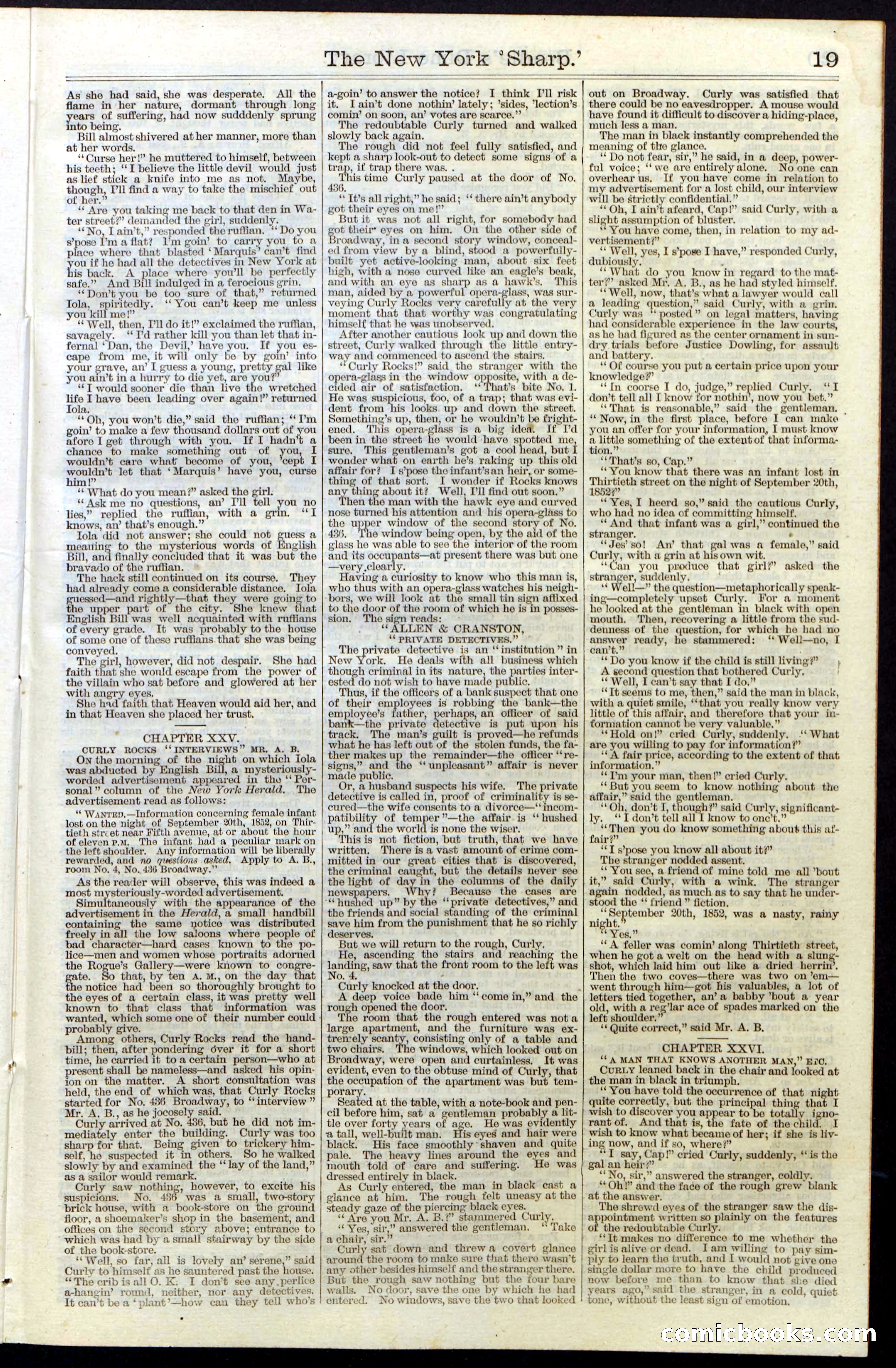
A restored page from Pulp Fiction, 1878. Page through the whole issue in the reader above.
📄 Transcribed text from this page (OCR, searchable)
Machine-transcribed from the original scan — historical spelling and the odd misread are preserved.
As she had said, she was desperate. All the flame in her nature, dormant through long ears of suffering, had now sudddenly sprung into being. Bill almostishivered at her manner, more than at her words. ‘‘Curse her!” he muttered to himself, between his teeth; “I believe the little devil would just as lief stick a knife into me as not. Maybe, though, [ll find a way to take the mischief out of her.” “ Are you taking me back to that den in Wa- ter street?” demanded the girl, suddenly. ‘No, Lain’t,” responded theruffian. “* Do you s’pose I’m a flat? I’m goin’ to carry you to a place where that blasted ‘Marquis’ can’t find rou if he had all the detectives in New York at 1is back. A place where you'll be perfectly safe.” And Bill indulged in a feroeious grin. ‘‘Don’t you be too sure of that,” returned Tola, spiritedly. ‘‘ You can’t keep me unless you kill me!” ‘Well, then, Pll do it!” exclaimed the ruffian, savagely. ‘‘ Id rather kill you than let that in- fernal ‘Dan, the Devil,’ have you. If you es- cape from me, it will only be by goin’ into your grave, an’ I guess a young, pretty gal like you ain’t in a hurry to die yet, are you?’ ‘“‘T would sooner die than live the wretched oy Ihave been leading over again!” returned ola. **Oh, you won’t die,” said the ruffian; “I’m goin’ to make a few thousand dollars out of you afore I get through with you. If I hadn‘t a chance to make something out of you, I wouldn’t care what’ become of you, ‘cept I wouldn’t let that ‘Marquis’ have you, curse : ” ‘“ What do you mean?” asked the girl. ‘Ask me no questions, an’ Pll tell you no lies,” replied the ruffian, with a grin, “TI knows, an’ that’s enough.” Iola did not answer; she could not guess a meaning to the mysterious words of English Bill, maa finally concluded that it was but the bravado of the ruffian. The hack still continued on its course. They had already come a considerable distance. Iola guessed—and rightly—that they were going to the upper part of the city. She knew that English Bill was well acquainted with ruffians of every grade. It was probably to the house of some one of these ruffians. that she was being conveyed. The girl, however, did not despair. She had faith that she would escape from the power of the villain who sat before and glowered at her with angry eyes. She had faith that Heaven would aid her, and in that Heaven she placed her trust, CHAPTER XXV. CURLY ROCKS ‘‘ INTERVIEWS” MR. A. B, On the morning of the night on which Iola was abducted by English Bill, a mysteriously- worded advertisement appeared in the ‘ Per- sonal” column of the New York Herald. The advertisement read as follows: “ Wanrrep.—Information concerning female infant lost on the night of September 20th, 1852, on Thir- tieth street near Fifth avenue, at or about the hour of eleven p.m. The infant had a peculiar mark on the left shoulder. Any information will be liberally rewarded, and no questions asked, Apply to A. B., room No, 4, No. 436 Broadway.” As the reader will observe, this was indeed a most mysteriously-worded advertisement. Sirotileanagualy with the appearance of the advertisement in the Herald, a small handbill containing the same notice was distributed freely in all the low saloons where people of bad character—hard cases known to the lice—men and women whose portraits adorned the Rogue’s Gallery—were known to congre- te. So that, by ten A. M., on the day that e notice had been so thoroughly brought to the eyes of a certain class, it was pretty well known to that class that information was wanted, which some one of their number could - probably give. Among others, Curly Rocks read the hand- bill; then, after pondering dver it for a short time, he carried it to a certain n—who at resent shall be nameless—and asked his opin- ion on the matter. A short consultation was held, the end of which was, that Curly Rocks started for No, 436 Broadway, to “interview ” Mr. A, B., as he jocosely said. Curly arrived at No, 436, but he did not im- mediately enter the building. Curly was too sharp for that. Being given to trickery him- self, he suspected it in others. So he walked slowly by and examined the “‘lay of the land,” as a sailor would remark. Curly saw nothing, however, to excite his suspicions. No. 436 was a small, two-story brick house, with a book-store on the ground floor, a shoemaker’s shop in the basement, and offices on the second story above; entrance to which was had by a small stairway by the side of the book-store. ‘Well, so far, all is lovely an’ serene,” said Curly to himself as he sauntered past the house. “The crib is all O. K. I don’t see any.perlice a-hangin’ round, neither, nor any detectives. It can’t be a ‘plant’—how can they tell who's The New York “Sharp.” a-goin’ to answer the notice? I think [ll risk it. LIain’t done nothin’ lately; ’sides, ‘lection’s comin’ on soon, an’ votes are scarce,”’ The redoubtable Curly turned and walked slowly back again. The rough did not feel fully satisfied, and kept a sharp look-out to detect some signs of a trap, if trap there was. . P This time Curly paused at the door of No. 56, * It’s allright,” he said; ‘‘ there ain’t anybody got their eyes on me!” But it was not all right, for somebody had got their eyes on him. On the other side of Broadway, in a second story window, conceal- ed from view by a blind, stood a powerfully- built yet active-looking man, about six feet high, with a nose curved like an eagile’s beak, and with an eye as sharp as a hawk’s, This man, aided by a powerful opera-glass, was sur- veying Curly Rocks very carefully at the very moment that that worthy was congratulating himself that he was unobserved. After another cautious look up and down the street, Curly walked through the little entry- way and commenced to ascend the stairs, “Curly Rocks!” said the stranger with the opera-glass in the window opposite, with a de- cided air of satisfaction. ‘* That’s bite No, 1. He was suspicious, too, of a trap; that was evi- dent from his looks. up and down the street. Something’s up, then, or he wouldn’t be fright- ened. This opera-glass is a big idea. If I'd been in the street he would have spotted me sure. This gentleman’s got a cool head but I wonder what on earth he’s raking up this old affair for? I s’pose the infant’san heir, or some- thing of that sort. I wonder if Rocks knows any thing about it? Well, Pll find out soon.” ‘hen the man with the hawk eye and curved nose turned his attention and his opera-glass to the upper window of the second story of No. 436. The window being open, by the aid of the glass he was able to see the interior of the room and its rap heap present there was but one —very.clearly. Having a curiosity to know who this man is, who thus with an opera-glass watches his neigh- bors, we will look at the small tin sign affixed to the door of the room of which he is in posses- sion. The sign reads: ~ “ALLEN & CRANSTON, “PRIVATE DETECTIVES.” The private detective is an ‘institution ” in New York. He deals with all business which though criminal in its nature, the parties inter- ested do not wish to have made public. Thus, if the officers of a bank suspect that one of their employees is robbing the bank—the employee’s father, perhaps, an officer of said bank—the private detective is put upon his track. The man’s guilt is proved—he refunds what he has left out of the stolen funds, the fa- ther makes up the remainder—the officer “‘re- signs,” and the ‘‘ unpleasant” affair is never made public. Or, a husband suspects his wife. The private detective is called in, proof of criminality is se- cured—the wife consents to a divorce—*‘ incom- patibility of temper ”—the affair is ‘‘ hushed up,” and the world is none the wiser. This is not fiction, but truth, that we have written. There is a vast amount of crime com- mitted in our great cities that is discovered, the criminal caught, but the details never see the light of = in the columns of the daily newspapers. Why? Because the cases are ‘hushed up” by the ‘private detectives,” and the friends and social standing of the criminal save him from the punishment that he so richly deserves. But we will return to the rough, Curly. He, ascending the stairs and reaching the get saw that the front room to the left was o. 4, . Curly knocked at the door. A deep voice bade him “come in,” and the rough opened the door. The room that the rough entered was nota large apartment, and the furniture was ex- tremely scanty, consisting only of a table and two chairs. The windows, which looked out on Broadway, were open and curtainless. It was evident, even to the obtuse mind of Curly, that the occupation of the apartment was but tem- abet f Seated at the table, with a note-book and pen- cil before him, sat a gentleman probably a lit- tle over forty years of age. He was evidently a tall, well-built man. His eyes and hair were black. His face smoothly’ shaven and quite pale. The heavy lines around the eyes and mouth told of eare and suffering. @ was dressed entirely in black. J As Curly entered, the man in black cast a glance at him. The rough felt uneasy at the steady gaze of the piercing black eyes. ‘Are you Mr. A. B.?’ stammered Curly, “Yes, sir,” answered the gentleman. ‘ Take a chair, sir.) Curly sat down and threw a covert glance around the room to make sure that there wasn’t any other besides himself and the stranger there. But the rough saw nothing but the four bare walls, No door, save the one by which he had entered. No windows, save the two that looked 19 out on Broadway. Curly was satisfied that there could be no eavesdropper. A mouse would have found it difficult to discover a hiding-place, much less a man. The man in black instantly comprehended the meaning of the glance. ‘“ Do not fear, sir,” he said, in a deep, power- ful voice; ‘‘ we are entirely alone. No one can overhear us. If you have come in relation to my advertisement for a lost child, our interview will be strictly confidential.” **Oh, I ain’t afeard, Cap!” said Curly, with a slight assumption of bluster. ** You have come, then, in relation to my ad- vertisement?” ‘* Well, yes, I s’pose I have,” responded Curly, dubiously. , ‘* What do you know in regard to the mat- ter?’ asked Mr. A. B., as he had styled himself. ** Well, now, that’s what a lawyer would call a leading question,” said Curly, with a grin. Curly was ‘ posted” on legal matters, having had considerable experience in the law courts, as he had figured as the center ornament in sun- dry trials before Justice Dowling, for assault and batitery. ‘* Of course you put a certain price upon your knowledge?’ ‘*In coorse I do, judge,” replied Curly. “I don’t tell all I know for nothin’, now you bet.” ‘“That is reasonable,” said the gentleman, | ‘* Now, in the first place, before | can make you an offer for your information, [ must know “ little something of the extent of that informa- ion, **That’s so, Cap.” “You know that there was an infant lost in Jaa street on the night of September 20th, ae ‘Yes, I heerd so,” said the cautious Curly, who had no idea of committing himself. ‘And that infant was a girl,” continued the stranger. . ‘Jes’ so! An’ that gal was a female,” said Curly, with a grin at his own wit. “Can you produce that girlf’ asked the stranger, suddenly. ‘* Well—” the question—metaphorically speak- ing—completely upset Curly. For a moment he looked at the gentleman in black with open mouth, Then, recovering a little from the sud- denness of the question, for which he had no answer ready, he stammered: ‘* Well—no, I can’t.” ** Do you know if the child is still living”, A second question that bothered Curly. ‘* Well, I can’t say that I do.” “Tt seems to me, then,” said the man in black, with a quiet smile, ‘‘that you really know very little of this affair, and therefore that your in- formation cannot be very valuable.” ‘*Hold on!” cried Curly, suddenly. ‘‘ What are you willing to pay for information?’ ‘*A fair price, according to the extent of that information.” ‘Tm your man, then!” eried Curly. ‘But you seem to know nothing about the affair,” said the gentleman. “Oh, don’t I, though?” said Curly, significant- Ty, = * I don’t tell all I know to one’t.” - aa you do know something about this atf- air **T spose you know all about it?’ The stranger nodded assent. ** You see, a friend of mine told me all "bout it,” said Curly, with a wink. The stranger again nodded, as much as to say that he under- stood the “ friend ” fiction. Tee ie September 20th, 1852, was a nasty, rainy night. ‘ Yes, » ‘A feller was comin’ along Thirtieth street, when he got a welt on the head with a slung- shot, which laid him out like a dried herrin’, Then the two coves—there was two on ’em— .| went prey him—got his valuables, a lot of letters tied together, an’ a babby ‘bout a year old, with a reg’lar ace of spades marked on the left shoulder.’ ‘* Quite correct,” said Mr, A. B. CHAPTER XXVI, A _— ae foi hea pron age onl EDO, URLY lean in the and looked at the man in black in triumph, ‘You have told the occurrence of that ale quite correctly, but the principal thing that I wish to discover you ap + ba totally igno- rant of. And that is, the fate of the child I wish to know what became of her; if she is liv- ing now, and if so, where?” a I say, Cap!” cried Curly, suddenly, ‘is the gal an heir?” ‘* No, sir,” answered the stranger, coldly. “Oh!” and the face of the rough grew blank at the answer. é The shrewd eyes of the stranger saw the dis- we Lacan ga: written so plainly on the features of the redoubtable Curly. “Tt makes no difference to me whether the girl is alive or dead. Iam willing to pay sim- ply to learn the truth, and I would not give one single dollar more to have the child produced now before me than to know that she died years ago,” said the stranger, in a cold, quiet tone, without the least sign of emotion. EONNIKE OO KS nEO)