
Pulp Fiction, 1878 · page 18 of 32
Beadle's Dime Library, Vol. III, No. 31 — page 18: what you’re looking at
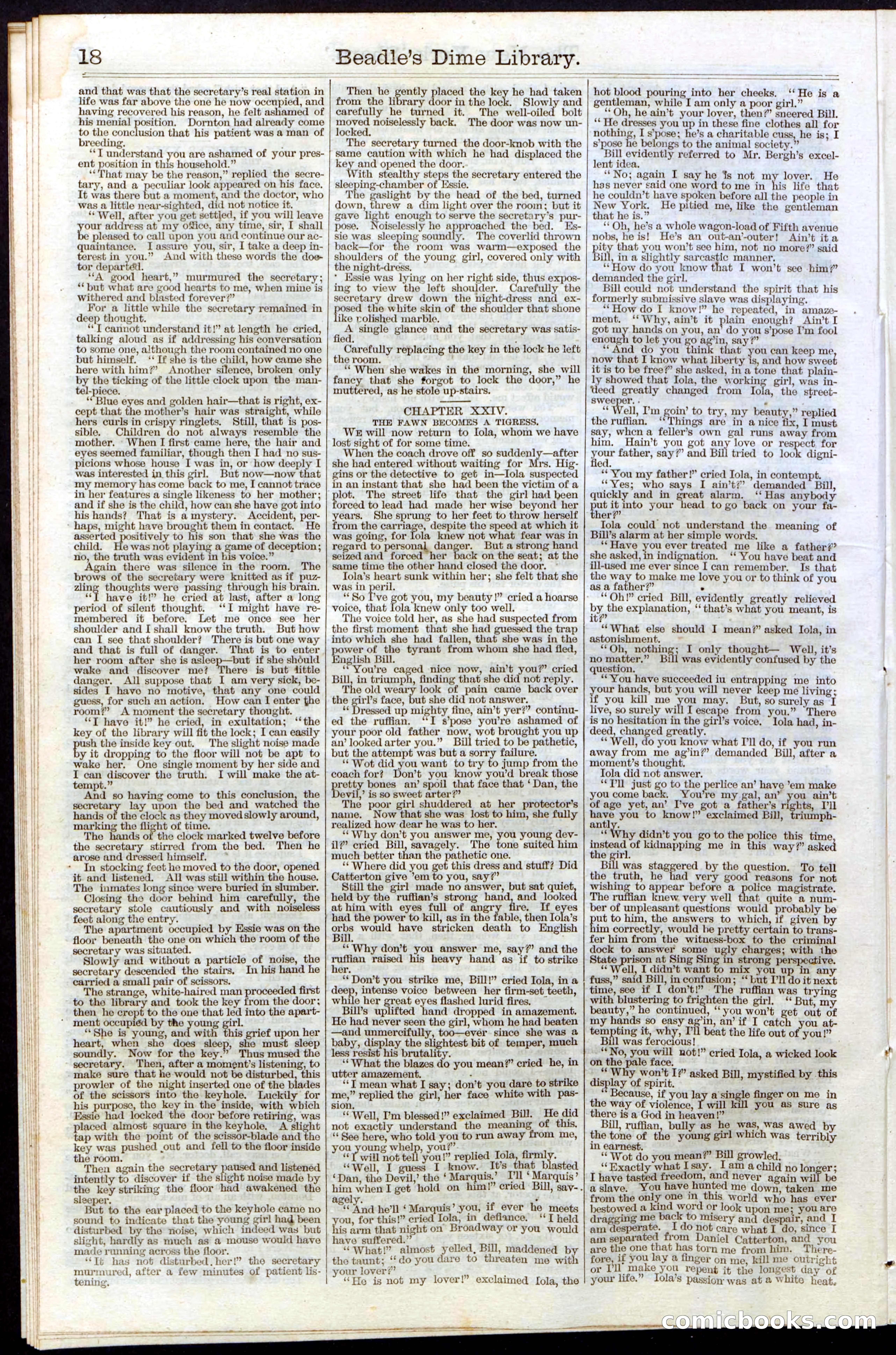
A restored page from Pulp Fiction, 1878. Page through the whole issue in the reader above.
📄 Transcribed text from this page (OCR, searchable)
Machine-transcribed from the original scan — historical spelling and the odd misread are preserved.
18 and that was that the secretary’s real station in life was far above the one he now occupied, and having recovered his reason, he felt ashamed of his menial position. Dornton had already come ve abe conclusion that his patient was a man of reeding. ‘*T understand you are ashamed of your pres- ent position in this household.” “That may be the reason,” replied the secre- tary, and a peculiar look appeared on his face. It was there but a moment, and the doctor, who was a little near-sighted, did not notice if. ‘Well, after you get settled, if you will leave our address at my office, any time, sir, I shall 2 pleased to call upon you and continue our ac- quaintance. LI assure you, sir, I take a deep in- terest in you.” And with these words the doe tor departed. ‘A good heart,” murmured the secretary; “‘but what are good hearts to me, when mine is withered and blasted forever?” For a little while the secretary remained in deep thought. ‘“‘T cannot understand it!” at length he cried, talking aloud as if addressing his conversation to some one, although the room contained no one but himself. ‘‘ [f she is the child, how came she here with him?’ Another silence, broken only by the ticking of the little clock upon the man- tel-piece. ‘* Blue eyes and golden hair—that is right, ex- cept that the mother’s hair was straight, while hers curls in crispy ringlets. Still, that is pos- sible. Children do not always resemble the mother. When I first came here, the hair and eyes seemed familiar, though then I had no sus- picions whose house I was in, or how deeply I was interested in this girl. But now—now that my memory has come back to me, I cannot trace in her features a single likeness to her mother; and if she is the child, how can she have got into his hands? That is a mystery. Accident, per- haps, might have brought them in contact. He asserted positively to his son that she was the child. e was not playing a game of deception; no, the truth was evident in his voice.” Again there was silence in the room. The brows of the secretary were knitted as if puz- zling thoughts were passing through his brain. “*T have it!” he cried at last, after a long period of silent thought. ‘‘I might have re- membered it before. Let me once see her shoulder and [ shall know the truth. But how can I see that shoulder? There is but one way and that is full of danger. That is to enter her room after she is asleep—but if she should wake and discover me? There is but fittle danger. All suppose that I am very sick, be- sides I havo no motive, that any one could guess, for such an action. How can I enter the room?’ A moment the secretary thought. **T have it!” he cried, in exultation; ‘‘the key of the library will fit the lock; I can easily —_ the inside key out. The slight noise made y it dropping to the floor will not be apt to wake her. One single moment by her side and I can discover the truth. I will make the at- tempt.” And so having come to this conclusion, the secre lay upon the bed and watched the hands of the clock as they movedslowly around, marking the flight of time. The hands of the clock marked twelve before the secretary stirred from the bed. Then he arose and dressed himself. ~ In stocking feet he moved to the door, opened it. and listened. All was still within the house. The inmates long since were buried in slumber. Closing the door behind him carefully, the secretary stole cautiously and with noiseless feet along the entry. The apartment occupied by Essie was on the floor beneath the one on which the room of the secretary was situated. Slowly and without a particle of noise, the secretary descended the stairs, In his hand he carried a small pair of scissors. The strange, white-haired man proceeded first to the library and took the key from the door; then he crept to the one that led into the apart- ment occupiéd by the young Sa “She is young, and with this grief upon her heart, when she does sleep, she must sleep soundly. Now for the key.” Thus mused the secretary. Then, after a moment’s listening, to make sure that he would not be disturbed, this prowler of the night inserted one of the blades of the scissors into the keyhole. Luckily for his purpose, the key in the inside, with which Essie had locked the door before retiring, was placed almost square in the keyhole, A slight tap with the point of the scissor-blade and the key was pushed out and fell to the floor inside the room. 4 . Then again the secretary os and listened intently to discover if the slight noise made by the key striking the floor had awakened the sleeper. But to the ear placed to the keyhole came no sound to indicate that the young girl had been disturbed by the noise, which indeed was but slight, hardly as much as a mouse would have made running across the floor. ‘Tb has not disturbed, her!” the secretary murmured, after a few minutes of patient lis- | tening. Beadle’s Dime Library. Then he gently placed the key he had taken from the library door in the lock. Slowly and carefully he turned it. The well-oiled bolt moved noiselessly back. The door was now un- locked. The secretary turned the door-knob with the same caution with which he had displaced the key and opened the door. With stealthy steps the secretary entered the sleeping-chamber of Essie. The gaslight by the head of the bed, turned down, threw a dim light over the room; but it gave light enough to serve the secretary’s pur- pose. Noiselessly he approached the bed. Es- sie was sleeping soundly. The coverlid thrown back—for the room was warm—exposed the shoulders of the young girl, covered only with the night-dress. * Kssie was lying on her right side, thus expos- ing to view the left shoulder. Carefully the secretary drew down the night-dress and ex- 90sed the white skin of the shoulder that shone ike rolished marble. A single glance and the secretary was satis- Carefully replacing the key in the lock he left the room. ‘* When she wakes in the morning, she will fancy that she forgot to lock the door,” he muttered, as he stole up-stairs. CHAPTER XXIV. THE FAWN BECOMES A TIGRESS, WE will now return to Iola, whom we have lost sight of for some time. When the coach drove off so song beg she had entered without waiting for Mrs. Hig- gins or the detective to get in—Iola suspected in an instant that she had been the victim of a lot. The street life that the girl had been orced to lead had made her wise beyond her years. She sprung to her feet to throw herself from the carriage, despite the speed at which it was going, for Iola knew not what fear was in regard to personal Conger. But a strong hand seized and forced her k on the seat; at the same time the other hand closed the door. Iola’s heart sunk within her; she felt that she was in peril. **So I’ve got you, my beauty!” cried a hoarse voice, that lola knew only too well. The voice told her, as she had suspected from the first moment that she had guessed the trap into which she had fallen, that she was in the ower of the tyrant from whom she had fled, Snglish Bill. *You’re caged nice now, ain’t eer cried Bill, in triumph, finding that she did not reply. The old weary look of pain came back over the girl’s face, but she did not answer. ‘« Dressed up mighty fine, ain’t yer?” continu- ed the ruffian. “I s’pose you’re ashamed of your poor old father now, wot brought you up an’ looked arter you.” Bill tried to be pathetic, but the attempt was but a sorry failure. ‘* Wot did you want to try to jump from the coach for? Don’t you know you’d break those retty bones an’ spoil that face that ‘Dan, the evil,’ is so sweet arter?’ The poor girl shuddered at her protector’s name. Now that she was lost to him, she fully realized how dear he was to her. ‘‘Why don’t you answer me, you young dev- il?’ cried Bill, savagely. The tone suited him much better than the pathetic one. ' ‘* Where did you get this dress and stuff? Did Catterton give ’em to you, say?” : Still the girl made no answer, but sat quiet held by the ruffian’s strong hand, and lookec at him with eyes full of angr fire, If eyes had the power to kill, as in the fable, then Iola’s — would have stricken death to English ill, ‘Why don’t you answer me, say?’ and the raised his heavy hand as if to strike her. ** Don’t you strike me, Bill!” cried Iola, in a deep, intense voice between her firm-set teeth, while her great eyes flashed lurid fires. Bil’s uplifted hand dropped in amazement. He had never seen the girl, whom he had beaten —and unmercifully, too—evér since she was & baby, display the slightest bit of temper, much less resist his brutality. ‘ ‘What the blazes do you mean?” cried he, in utter amazement. . ; ‘“‘T mean what I say; don’t you dare to strike me,” replied the girl, her face white with pas- sion, : F ‘‘ Well, I’m blessed!” exclaimed Bill. He did not exactly understand the meaning of this. ** See here, — told you to run away from me, you young whe out y “of will not tell you!” replied a firmly. “Well, I guess I know. It’s hat blaste ‘Dan, the Devil,’ the ‘ Marquis.’ Dll *‘ Marquis’ him when I get hold on him!” cried Bill, say-. agely. : “ ‘And he'll ‘ Marquis’ you, if ever he meets ou, for this!” cried Iola, in defiance. ‘“T held his arm that night on Broadway or you would have suffered.’ , “What!” almost yelled, Bill, maddened by the taunt; ‘‘do you dare to threaten me wit your lover?’ Ps “Ho is not my lover!” exclaimed [ola, the ee 2 eo” SA SES Se SE eT Gs Oe OU CUR EE ORE RO WR WEEE SE Cea es CE Ok le STS eS Se Ee ek he es RSS be ke = eee ee ee hot blood pouring into her cheeks, ‘He is a gentleman, while I am only a poor girl.” ‘* Oh, he ain’t your lover, then?’ sneered Bill. ‘* He dresses you up in these fine clothes all for nothing, I spose; he’s a charitable cuss, he is; I s’pose he belongs to the animal society.” Bill evidently referred to Mr. Bergh’s excel- lent idea, ‘*No; again I say he ts not my lover. He has never said one word to me in his life that he couldn’t have spoken before all the people in New York. He pitied me, like the gentleman that he is.” ‘** Oh, he’s a whole wagon-load of Fifth avenue nobs, he is! He’s an out-an’-outer! Ain’t ita ity that you won’t see him, not no more?” said ill, in a slightly sarcastic manner. ‘*How do you know that I won’t see him?’ demanded the girl. Bill could not understand the spirit that his formerly submissive slave was displaying. “*How do I know!” he repeated, in amaze- ment. ‘* Why, ain’t it plain enough? Ain’t I got my hands on you, an’ do you s’pose I’m fool enough to let you go ag’in, say?” ‘‘And do you think that you can keep me, now that I know what liberty is, and how sweet it is to be free?” she asked, in a tone that plain- ly showed that Iola, the working girl, was in- deed greatly changed from Iola, the street- sweeper. . , ** Well, ’m goin’ to try, my beauty,” replied the ruffian. “Things are ae nice fix, I iat say, when a feller’s own gal runs away from him. Hain’t you got any love or respect for Se father, say?’ and Bill tried to look digni- ed. “You my father!” cried Iola, in contempt. “Yes; who says I ain’t?’ demanded Bill, quickly and in great alarm. ‘‘ Has anybody a pee your head to go back on your fa- er’ Iola could not understand the meaning of Bill’s alarm at her simple words, **Have you ever treated me like a father?? she asked, in indignation. ‘‘ You have beat and ill-used me ever since I can remember. Is that the way to make me love you or to think of you as a father?” ° “Oh!” cried Bill, evidently greatly relieved re explanation, ‘‘ that’s what you meant, is 1t¢ “What else should I mean?” asked Iola, in astonishment. ~ Oh, nothing » I only thought— Well, it’s no matter.” Bill was evidently confused by the question. . “You have succeeded iu entrapping me into your hands, but you will never keep me living: if you kill me oe may. But, so surely as I live, so surely will Iescape from you.” “There is no hesitation in the girl’s voice. Iola had, in- deed, changed greatly. “Well, do you know what I'll do, if you run away from me ag’in?’ demanded Bill, after a moment’s thought. Tola did not answer. ‘Tl just go to the perlice an’ have ’em make you come back. You’re my gal, an” you ain’t of age yet, an’ I’ve got a father’s rights, Ill have you to know!” exclaimed Bill, triumph- ant Why didn’t you go to the police this time aes of kidnapping me in this way?” asked e girl. Bill was staggered by the question. To tell the truth, he had_ very pod. reasons for not babe He appear before a police magistrate. The ruffian knew very well that quite a num- ber of unpleasant questions would probably be pS to him, the answers to which, if given by im correctly, would be pretty certain to trans- fer him from the witness-box to the criminal dock to answer some ugly charges; with the OS at Sing ee strong perspective. “Well, I didn’t want to mix you up in any fuss,” said Bill, in confusion; “ but I'll do it next time, see if I don’t!” The ruffian was trying with blustering to si ten the girl. “ But, my beauty,” he continued, ‘you won’t get out of my hands so easy ag’in, an’ if I catch you at- tempting it, why, ll beat the life out of you!” Bill was ferocious! , **No, you will not!” cried I icked look on the pale face. gle, 9 oa Why or ?” asked Bill, mystified by this display of spirit. “ Because, if you la Caer finger on me in the way of violence, A will you as sure as there isa in heaven!” Bill, ruffian, bully as he was, was awed by the tone of the young girl which was terribly in earnest. ‘Wot do you mean?” Bill growled. “Exactly what Isay. Lam a child no longer; I have tasted freedom, and never again wi aslave. You have hunted me down, taken me from the only one in this world who has ever bestowed a kind word or look upon me; you are dragging me back to misery and despair, and I am desperate. I do not care what I do, since I separated from Daniel Catterton, and you are the one that has torn me from him. There- fore, if you lay a finger on me, kill me outright or TU make you repent it the longest day of your life.” Iola’s Passion was at a white heat. Goyagive eyeoroy, “COrr