
Pulp Fiction, 1878 · page 17 of 32
Beadle's Dime Library, Vol. III, No. 31 — page 17: what you’re looking at
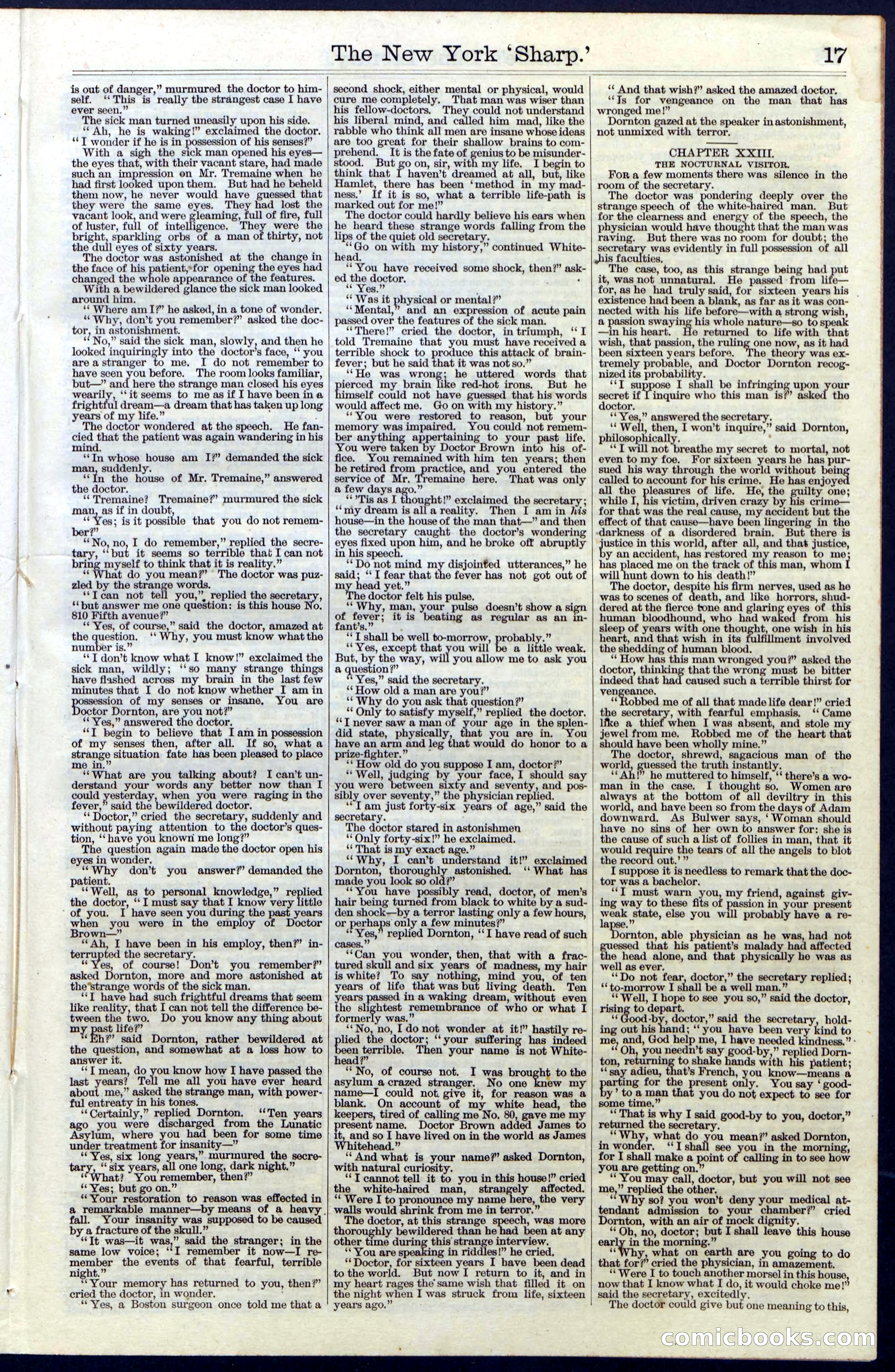
A restored page from Pulp Fiction, 1878. Page through the whole issue in the reader above.
📄 Transcribed text from this page (OCR, searchable)
Machine-transcribed from the original scan — historical spelling and the odd misread are preserved.
a = - a ee Oe ee ' of you. I have seen you during the is out of danger,” murmured the doctor to him- self. ‘This is really the strangest case I have ever seen.” The sick man turned uneasily upon his side. ‘“Ah, he is waking!” exclaimed the doctor. ‘‘T wonder if he is in possession of his senses?” With a sigh the sick man opened his eyes— the eyes that, with their vacant stare, had made such an impression on Mr. Tremaine when he had first looked upon them. But had he beheld them now, he never would have guessed that they were the same eyes. They had lost the vacant look, and were gleaming, full of fire, full of luster, full of inte igence. a Pey were the bright, sparkling orbs of a man of thirty, not the dull eyes of sixty years. , The doctor was astonished at the change in the face of his patient,for opening the eyes had changed the whol appearance of the features. With a bewildered glance the sick man looked around him, ‘* Where am I?” he asked, in a tone of wonder. “Why, don’t you remember?” asked the doc- tor, in astonishment. ‘** No,” said the sick man, slowly, and then he looked inquiringly into the doctor’s face, “‘ you are a stranger to me, I do not remember to have seen you before. The room looks familiar, but—” and here the strange man closed his eyes wearily, ‘‘it seems to me asif I have been ina frightful dream—a dream that has taken up long years of my life.” ; The doctor wondered at the speech. He fan- cied that the patient was again wandering in his mind, ‘*In whose house am I?’ demanded the sick man, suddenly. “Tn the house of Mr. Tremaine,” answered the doctor. ‘Tremaine? Tremaine?’ murmured the sick mau, as if in doubt, ‘3 Yes: is it possible that you do not remem- ber?” ‘‘No, no, I do remember,” replied the secre- tary, “put it seems so terrible that I can not bring myself to think that it is reality.” “4 t do you mean?” The doctor was puz- zled by the strange words, ‘*Tcan not tell you,” replied the secretary, ‘‘but answer me one question: is this house No. 810 Fifth avenue?” ‘** Yes, of course,” said the doctor, amazed at the question, ‘‘ Why, you must know what the number is.” **T don’t know what I know!” exclaimed the sick man, wildly; ‘‘so many strange things have flashed across my brain in the last few minutes that I do not know whether I am in pce of my senses or insane, You are octor Dornton, are you not?” ** Yes,” answered the doctor. “T begin to believe that I am in ion of my senses then, after all. If so, what a strange situation fate has been pleased to place me in. ‘“What are you talking about? I can’t un- derstand your words any better now than I could yesterday, when you were raging in the fever,” said the bewildered doctor. ‘** Doctor,” cried the secretary, suddenly and without paying attention to the doctor’s ques- tion, ‘have you known me long?” The question again made the doctor open his eyes in wonder, “Why don’t you answer?’ demanded the patient. ‘Well, as to personal knowledge,” replied the doctor, “I must say that I know past ittle years when you were in the employ of Doctor Brown—” “Ah, I have been in his employ, then?” in- terrupted the secretary. Yes, of course! Don’t you remember?” asked Dornton, more and more astonished at the*’strange words of the sick man. **T have had such frightful dreams that seem like reality, that I can not tell the difference be- tween the two. Do you know any thing about my pe life?” ‘Kh?’ said Dornton, rather bewildered at the question, and somewhat at a loss how to answer it. ‘‘T mean, do a know how I have passed the last years? Tell me all you have ever heard about me,” asked the strange man, with power- ful entreaty in his tones. “Certainly,” replied Dornton. ‘Ten years ago you were discharged from the Lunatic Asylum, where you had been for some time under treatment for insanity—” “Yes, six long pola han 9 he secre- ‘six years, all one long, dark nig ‘What? you remember, then?” ‘Yes; but go on.” “Your restoration to reason was effected in a remarkable manner—by means of a heavy fall. Your insanity was supposed to be caused by a fracture of the skull. “It was—it was,” said the stranger; in the same low voice; ‘‘I remember it now—I re- member the events of that fearful, terrible night.” ‘Your memory has returned to you, then?” cried the doctor, in wonder, ' ‘Yes, a Boston surgeon once told me that a : The New York ‘Sharp.’ : second shock, either mental or physical, would cure me completely. That man was wiser than his fellow-doctors, They could not understand his liberal mind, and called him mad, like the rabble who think all men are insane whose ideas are too great for their shallow brains to com- prehend. It is the fate of genius to be misunder- stood. But pe on, sir, with my life. I begin to think that I haven’t dreamed at all, buf, like Hamlet, there has been ‘method in my mad- ness.’ If it is so, what a terrible life-path is marked out for me!” The doctor could hardly believe his ears when he heard these strange words falling from the lips of the quiet old secretary. " ae on with my history,” continued White- ead. ‘You have received some shock, then?” ask- ed the doctor, ‘ ‘6 Yeas.” * Was it physical or mental?” ‘‘Mental,” and an expression of acute pain passed over the features of the sick man. ‘‘There!” cried the doctor, in triumph, ‘ I told Tremaine that you must have received a terrible shock to produce this attack of brain- fever; but he said that it was not so.” ‘“‘He was pron he uttered words that peers my brain ike red-hot irons. But he 1imself could not have guessed that his words would affect me, Go on with my history.” ‘You were restored to reason, but your memory was impaired, You could not remem- ber anything appertaining to your past life. You were taken by Doctor Brown into his of- fice. You remained with him ten years; then he retired from practice, and you entered the service of Mr, Tremaine here. That was only a few days ago.” “Tis as I thought!” exclaimed the secretary ; ‘*my dream is all a reality. Then I am in his house—in the house of the man that—” and then the secretary caught the doctor’s wondering eyes fixed upon him, and he broke off abruptly in his speech. ‘**Do not mind my disjointed utterances,” he said; ‘‘ I fear that the fever has not got out of my head yet.” e doctor felt his pulse. ‘* Why, man, your pulse doesn’t show a si of fever; it is beating as regular as an in- fant’s.” **T shall be well to-morrow, probably.” Yes, except that you will a little weak. But, by the way, will you allow me to ask you a question?” Yes,” said the secretary. ‘* How old a man are you?” ‘* Why do you ask that question?” ‘Only to satisfy myself,” replied the doctor. *T never saw a manof your age in the splen- did state, physically t you are in. You have an arm and leg that would do honor to a prize-fighter.” _— ‘* How old do you suppose I am, doctor?” “Well, judging by your face, I should say you were between sixty and seventy, and pos- sibly over seventy,” the physician replied, ‘*T am just forty-six years of age,” said the secretary. The doctor stared in astonishmen ‘Only forty-six!” he exclaimed. “ That is my exact age.” “Why, I can’t understand it!” exclaimed Dornton, thoroughly astonished, ‘‘ What has made you look so old?” ‘You have possibly read, doctor, of men’s hair being turned from black to white by a sud- den shock—by a terror lasting only a few hours, or perhaps only a few minutes?” . Yes, replied Dornton, ‘‘I have read of such cases. ‘“*Can you wonder, then, that with a frac- tured skull and six years of madness, my hair is white? To say nothing, mind you, of ten years of life that was but living death. Ten peg in a waking dream, without even he slightest remembrance of who or what I formerly was.” ‘‘No, no, Ido not wonder at it!” hastily re- lied the doctor; ‘‘your suffering has indeed 2 os aaa Then your name is not White- ‘No, of course not. I was brought to the asylum acrazed stranger. No one knew my name—I could not give it, for reason was a Pane Toetoe caine Oy, awe head, the eepers, oe) me No, ve me my present name. Doctor Brown added James to it, and cet have lived on in the world as James “And what is your name?” asked Dornton, with natural curiosity. : ‘“‘T cannot tell it to you in this house!” cried the white-haired man, strangely affected. “‘ Were I to pronounce my name here, the very walls would shrink from me in terror,” The doctor, at this strange h, was more thoroughly bewildered than he been at any other time during this strange interview, ‘You are Frenbine in riddles!” he cried, ** Doctor, for sixteen years I have been dead to the world. But nowI return to it, and in my heart rages the same wish that filled it on the night when I was struck from life, sixteen years ago,” 1'7 ‘** And that wish?” asked the amazed doctor. ‘Ts for vengeance on the man that has wronged me!” Dornton gazed at the speaker in astonishment, not unmixed with terror. CHAPTER XXIII. THE NOCTURNAL VISITOR. For a few moments there was silence in the room of the secretary. The doctor was poner deeply over the strange speech of the white-haired man. But for the clearness and energy of the speech, the physician would have thought that the man was raving. But there was no room for doubt; the secre was evidently in full possession of all ,his faculties, _ The case, too, as this strange being had put it, was not unnatural. He passed from life— for, as he had truly said, for sixteen years his | existence had been a blank, as far as it was con- nected with his life before—with a strong wish, a passion ea his whole nature—so to speak —1in his heart. e returned to life with that wish, that passion, the cng one now, as it had been sixteen years before. The theory was ex- tremely probable, and Doctor Dornton recog- nized its probability. ap ap I shall be infringing upon your yw if l inquire who this man is?’ asked the octor. “Yes,” answered the secretary. A Well, then, I won’t inquire,” said Dornton, Deron locally. . ‘*T will not breathe my secret to mortal, not even tomy foe. For sixteen years he has pur- sued his way through the world without bein called to account for his crime. He has enjoy all the pleasures of life. He, the ty one; while I, his victim, driven crazy by crime— for that was the real cause my accident but the effect of that cause—have been lingering in the darkness of a disordered brain, But there is ang in this world, after all, and that justice, y an accident, has restored my reason to me; has placed me on the track of this man, whom I will hunt down to his death!” The doctor, despite his firm nerves, used as he was to scenes of death, and like horrors, shud- dered at the fierce tone and glaring eyes of this human bl ound, who had w from his sleep of years with one songs one wish in his heart, and that wish in its fulfillment involved the shedding of human blood, ‘“‘ How has this man wronged you?” asked the doctor, thinking that the wrong must be bitter indeed that had caused such a terrible thirst for vengeance, ‘*Robbed me of all that made life dear!” cried the secre , with fearful emphasis. ‘‘ Came Ifke a thief when I was absent, and stole my jewel from me. Robbed me of the heart that should have been wholly mine.” The doctor, shrewd, sagacious man of the world guessed the truth instantly. “Ah! he muttered to himself, ‘‘ there’s a wo- man in the case. I thought so. Women are always at the bottom of all deviltry in this world, and have been so from the days of Adam downward, As Bulwer says, ‘Woman should have no sins of her own to answer for: she is the cause of such a list of follies in man, that it would require the tears of all the angels to blot the record out,’ ” I suppose it is needless to remark that the doc- tor pe a bgp ah a must warn you, my friend, against giv- ing way to these fi of passion in’ your opaend Ww eak state, else you will probably have a re- la mu Dattiton: able physician as he was, had not qoeseed that his patient’s malady affected e head alone, and that physically he was as wee Sik Teas daehontil tary replied not fear, doctor,” the secre re : ‘to-morrow I shall be a well man.” -_" ‘Well, I hope to see you so,” said the doctor, rising to d ; Good od hold- epart. -by, doctor,” said the secretary ing out his hand: “you have been very kind to me, and, God help me, I have needed kindness.” : Oh, you needn’t say good-by,” replied Dorn- ton, relurning to shake hands with ths patient; ** say adieu, t’s French, you know—means a g for the present only. You say ‘ good- * to a man that you do not expect to see for oot That is why I sai is W d -by to doctor,” returned the ent ~ i Wi ge : “Why, what do you mean?” asked Dornton, in wonder, ‘I see you in the morning, for I shall make a point o calling in to see how you are getting on.” “You may call, doctor, but you will not see me,” replied the other. ; ‘Why so? you won’t deny your medical at- tendant admission to your chamber?” cried Dornton, with an air of mock dignity. “Oh, no, doctor; but I shall leave this house early in the morning.” 4 y, what on earth are you going to do that for?” cried the physician, in amazement. ** Were I to touch another morsel in this house now that I know what I do, it would choke me!” said the secretary, excitedly. The doctor could give but one meaning to this, <SGO Gomicboo