
Pulp Fiction, 1878 · page 16 of 32
Beadle's Dime Library, Vol. III, No. 31 — page 16: what you’re looking at
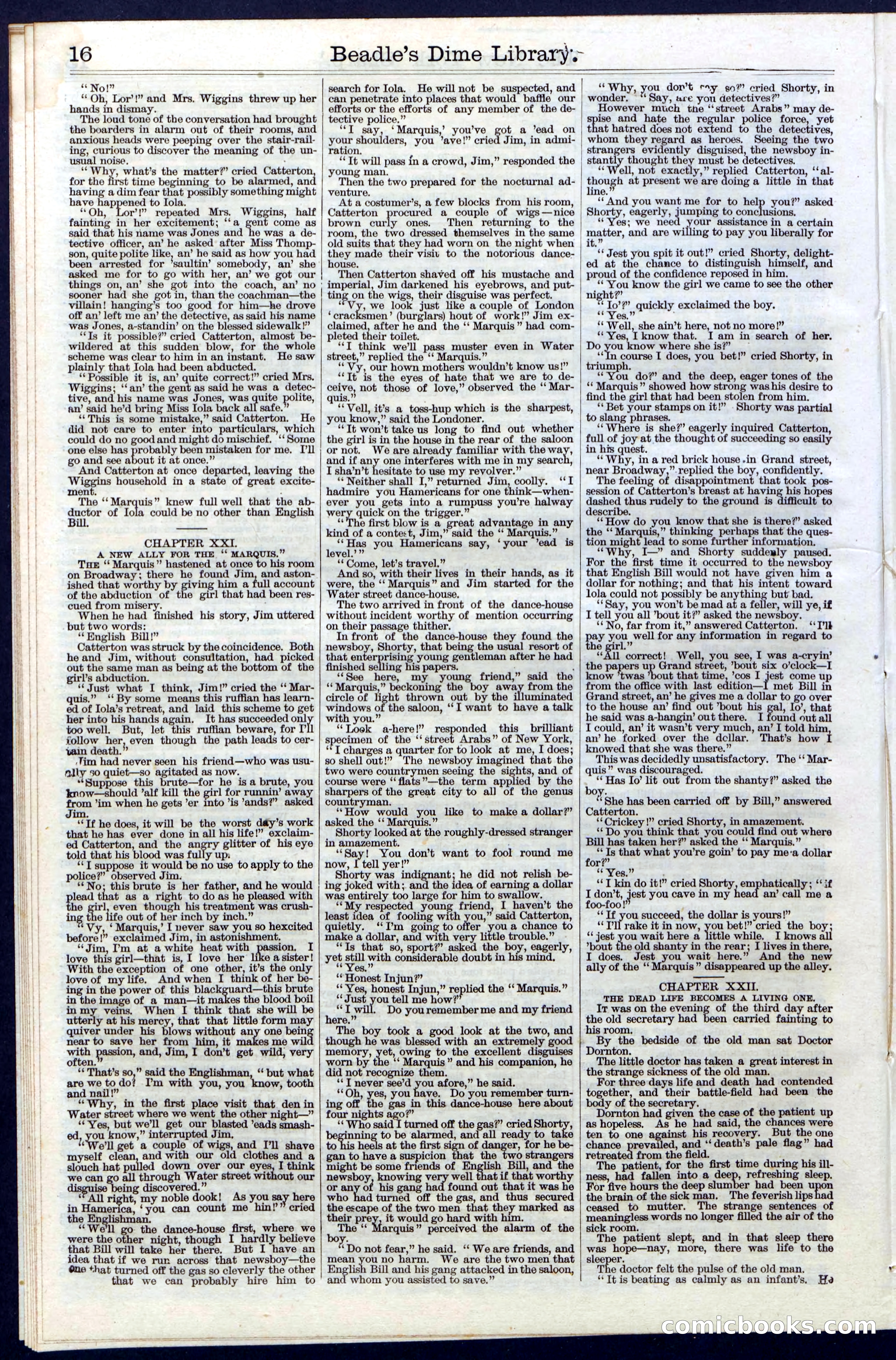
A restored page from Pulp Fiction, 1878. Page through the whole issue in the reader above.
📄 Transcribed text from this page (OCR, searchable)
Machine-transcribed from the original scan — historical spelling and the odd misread are preserved.
| | ' | ' | SSS... ——_ — a == —— —_— es > = ee ee ee te ———s 16 Beadle’s Dime Library. és No!” * Oh, Lor’!” and Mrs. Wiggins threw up her hands in dismay. The loud tone of the conversation had brought the boarders in alarm out of their rooms, and anxious heads were peeping over the stair-rail- ing, curious to discover the meaning of the un- usual noise. ‘“ Why, what’s the matter?’ cried Catterton, for the first time beginning to be alarmed, and having a dim fear that possibly something might have happened to Iola. **Oh, Lor’!” repeated Mrs. Wiggins, half fainting in her excitement; ‘‘a gent come as said that his name was Jones and he was a de- tective officer, an’ he asked after Miss Thomp- son, quite polite like, an’ he said as how you had been arrested for ’saultin’ somebody, an’ she asked me for to go with her, an’ we got our things on, an’ she got into the coach, an’ no sooner had she got in, than the coachman—the villain! hanging’s too good for him—he drove off an’ left me an’ the detective, as said his name was Jones, a-standin’ on the blessed sidewalk!” ‘*Is it possible?” cried Catterton, almost be- wildered at this sudden blow, for the whole scheme was clear to him in an instant. He saw plainly that Iola had been abducted, ‘Possible it is, an’ quite correct!” cried Mrs. Wiggins; ‘‘an’ the gent as said he was a detec- tive, and his name was Jones, was quite polite, an’ said he’d bring Miss Iola back all safe.” ‘‘This is some mistake,” said Catterton. He did not care to enter into particulars, which could do no good and might do mischief, ‘‘ Some one else has probably been mistaken for me. I'll go and see about it at once.” And Catterton at once departed, leaving the Wiggins household in a state of great excite- ment. The *‘ Marquis” knew full well that the ab- aoe of Iola could be no other than English CHAPTER XXI. A NEW ALLY FOR THE ‘‘ MARQUIS.” Tue “ Marquis’ hastened at once to his room on Broadway; there he found Jim, and aston- ished that worthy by giving him a full account of the abduction of the girl that had been res- cued from misery. When he had finished his story, Jim uttered but two words: “English Bill!” Catterton was struck by the coincidence. Both he and Jim, without consultation, had picked out the same man as being at the bottom of the girl’s abduction. ‘‘ Just what I think, Jim!” cried the ‘“‘ Mar- quis.” ‘‘By some means this ruffian has learn- ed of Iola’s retreat, and laid this scheme to get her into his hands again. It has succeeded onl too well. But, let this ruffian beware, for I tollow her, even though the path leads to cer- vain death.” ‘Tim had never seen his friend—who was usu- nlly so quiet—so agitated as now. “Suppose this brute—for he is a brute, you know—should ’alf kill the girl for runnin’ away from ’im when he gets ’er into ’is ’ands?” asked Jim. “Tf he does, it will be the worst da@y’s work that he has ever done in all his life!” exclaim- ed Catterton, and the rein glitter of his eye told that his blood was fully up. ‘‘T suppose it would be no use to apply to the police?” observed Jim. ‘* No; this brute is her father, and he would lead that as a right to do as he pleased with he om even though his treatment was crush- ing the life out of her inch by inch,” ‘Vy, ‘Marquis,’ I never saw you so hexcited before!” exclaimed J im, in astonishment. “Jim, ’m at a white heat with on, I love this girl—that is, I love her like a sister! With the exception of one other, it’s the only love of my life. And when I think of her be- ing in the power of this Pp geisha BE 9 brute in the image of a man—it makes the blood boil in my veins. When I think that she will be utterly at his mercy, that that little form may quiver under his blows without any one bein near to save her from him, it me wil wae passion, and, Jim, I don’t get wild, very often ‘* That’s so,” said the Englishman, “ but what are we todo? I’m with you, you know, tooth and nail!” ‘Why, in the first place visit that den in Water street where we went the other night—” ‘“Yes, but we'll get our blasted ’eads smash- ed von know,” interrupted Jim, we'll get a couple of wigs, and I’ll shave myself clean, and with our old clothes and a slouch hat pulled down over our eyes, I think we can ae through Water street without our disguise ing discovered. “All right, my noble dook! As you say here in Hamerica, ‘you can count me hin!’” cried the Englishman. ll go the dance-house first, where we were the other night, though I hardly believe that Bill will take her there. But I have an idea that if we run across that newsboy—the one that turned off the gas so cleverly the other that we can probably hire him to search for Iola. He will not be suspected, and can penetrate into places that would baffle our efforts or the efforts of any member of the de- tective police.” ‘*I say, ‘Marquis,’ you’ve got a ’ead on your shoulders, you ’ave!” cried Jim, in admi- ration. “Tt will pass In a crowd, Jim,” responded the young man. Then the two prepared for the nocturnal ad- venture. At a costumer’s, a few blocks from his room, Catterton procured a couple of wigs—nice brown curly ones. Then returning to the room, the two dressed themselves in the same old suits that they had worn on the night when they made their visit to the notorious dance- ouse. Then Catterton shaved off his mustache and imperial, Jim darkened his eyebrows, and put- ting on the wigs, their disguise was perfect. *“Vy, we look just like a couple of London ‘cracksmen’ (burglars) hout of work!” Jim ex- claimed, after he and the ‘‘ Marquis ” had com- pleted their toilet. ‘“‘T think we’ll pass muster even in Water street,” replied the ‘‘ Marquis.” Vy, our hown mothers wouldn’t know us!” ‘“‘It is the eyes of hate that we are to de- ceive, not those of love,” observed the ‘‘ Mar- uis. ‘* Vell, it’s a toss-hup which is the sharpest, ou know,” said the Londoner. ‘Tt won’t take us long to find out whether the girl is in the house in the rear of the saloon or not. We are already familiar with the way, and if any one interferes with me in my search, I sha’n’t hesitate to use my revolver.” ‘“* Neither shall I,” returned Jim, coolly. ‘TI hadmire you Hamericans for one think—when- ever you gets into a rumpuss you're halway wery quick on the trigger.” ‘‘ The first blow is a great advantage in any kind of a contest, Jim,” said the ‘“‘ Marquis.” ‘‘Has you Hamericans say, ‘your ’ead is level.’” ‘* Come, let’s travel,” And so, with their lives in their hands, as it were, the ‘“‘ Marquis” and Jim started for the Water street dance-house, The two arrived in front of the dance-house without incident worthy of mention occurring on their passage thither. In front of the dance-house they found the newsboy, Shorty, that being the usual resort of that en Fs Saper young gentleman after he had finished selling his papers. ; ‘‘See here, my young friend,” said the ‘* Marquis,” beckoning the boy away from the circle of light thrown out by the illuminated windows of the saloon, ‘‘I want to have a talk with you.” *‘Loek a-here!” responded this brilliant specimen of the ‘‘ street Arabs” of New York, ‘“*T charges a quarter for to look at me, I does; so shell out!” The newsboy imagined that the two were countrymen seeing the sichte, and of course were ‘‘flats”—the term applied by the sharpers of the great city to all of the genus countryman you like to make a dollar?” < ‘How would asked the ‘‘ Marquis.’ Shorty looked at the roughly-dressed stranger in amazement, : ‘Say! You don’t want to fool round me now, I tell yer!” Shorty was indi t; he did not relish be- ing joked with; and the idea of earning a dollar was entirely too large for him to swallow. ‘““My respected young friend, I haven’t the least idea of fooling with you,” said Catterton, quietly. ‘I’m going to offer you a chance to make a dollar, and with very little trouble.” “Is that so, sport?” asked the boys eagerly, yet a with considerable doubt in his mind, es. es, honest Injun,” replied the uis. ‘Just you tell me how? ale Do youremember me and my friend ere. The boy took a good look at the two, and though he was blessed with an extremely good memory, yet, owing to the excellent disguises worn by the ‘‘ Marquis” and his companion, he did not recognize them. ‘*T never see’d you afore,” he said. **Oh, yes, you have. Do you remember turn- ing off the gas in this dance-house here about four nights ago?” : ‘‘ Who said I turned off the gas?’ cried Shorty, iy gone to be alarmed, and all ready to take to his heels at the first of r, for he be- gan to have a icion that the two strangers might be some friends of English Bill, and the newsboy, knowing very well that if that worthy or any of his gang had found out that it was he who had turned off the gas, and thus secured the escape of the two men that they marked as their prey, it would go hard with him. The ‘ quis” perceived the alarm of the boy. if Do not fear,” he said. ‘‘ We are friends, and mean you no harm. We are the two men that English Bill and his gang attacked in the saloon, and whom you assisted to save.” ‘* Why, you dor’t esy go?” cried Shorty, in wonder, “‘ Say, are you detectives?” However much the “street Arabs” may de- nF and hate the regular police force, yet that hatred does not extend to the detectives, whom they aa as heroes. Seeing the two strangers evidently disguised, the newsboy in- stantly thought they must be detectives. ‘Well, not exactly,” replied Catterton, ‘‘al- ig at present we are doing a little in that ine. ‘‘ And you want me for to help you?” asked Shorty, eagerly, jumping to conclusions, ‘Yes; we need your assistance in a certain matter, and are willing to pay you liberally for | it ‘* Jest you spit it out!” cried Shorty, delight- ed at the chance to distinguish himself, and proud of the confidence reposed in him. ‘You know the girl we came to see the other night?” i Io’?” quickly exclaimed the boy. q y y “Yes.” ‘* Well, she ain’t here, not no more!” ** Yes, I know that. I am in search of her. Do you know where she is?” _~ ‘*In course I does, you bet!” cried Shorty, in Soe “You do?’ and the deep, eager tones of the ‘* Marquis” showed how strong was his desire to find the girl that had been stolen from him. ** Bet your stamps on it!” Shorty was partial to slang phrases. ‘Where is she?” eagerly inquired Catterton, full of joy at the thought of succeeding so easily in his quest. ‘Why, in a red brick house.in Grand street, near Broadway,”.replied the boy, confidently. The feeling of disappointment that took pos- session of Catterton’s breast at having ae hopes dashed thus rudely to the ground is difficult to describe. ‘* How do you know that she is there?” asked the ‘‘ Marquis,” thinking perhaps that the ques- tion might lead to some further information. ‘““Why, I—” and Shorty suddesly paused. For the first time it occurred to the newsboy that English Bill would not have given him a dollar for nothing; and that his intent toward lola could not possibly be et beg but bad. ‘Say, you won’t be mad at a feller, will ye, if I tell you all "bout it?” asked the newsboy. ‘* No, far from it,” answered Catterton. ‘‘I’lk pay you well for any information in regard to the girl. “AIL correct! Well, you see, I was a-cryin’ the papers up Grand street, "bout six o’clock—I know ‘twas ’bout that time, ’cos I ct come up from the office with last edition—I met Bill in Grand street, an’ he gives me a dollar to go over to the house an’ find out "bout his gal, Io’, that he said was a-hangin’ out there. I found out all I could, an’ it wasn’t very much, an’ I told him an’ he forked over the dcllar. That’s how i knowed that she was there.” This was decidedly unsatisfactory. The ‘‘ Mar- quis” was discouraged. ‘** Has Io’ lit out from the shanty?” asked the boy. “She has been carried off by Bill,” answered Catterton. ‘*Crickey!” cried Shorty, in amazement. ‘* Do you think that you could find out where Bill has taken her?” asked the ‘‘ Marquis.” “a Is that what you’re goin’ to pay mea dollar OE Feat dy Suet ‘*T kin do it!” cried Shorty, emphatically ; “‘ if I don’t, jest you cave in my head an’ call me a foo-foo!’ ‘* Tf you succeed, the dollar is yours!” ‘‘T'll rake it in now, you bet!” cried the boy; ‘‘ jest you wait here a little while. I knows *bout the old shanty in the rear; I lives in there, I does, Jest you wait here.” And the new ally of the ‘“‘ Marquis” disappeared up the alley. CHAPTER XXII. THE DEAD LIFE BECOMES A LIVING ONE. Ir was on the evening of the third day after the old secretary had been carried fainting to his room, By the bedside of the old man sat Doctor Dornton. The little doctor has taken a great interest in the strange sickness of the old man. For three days life and death had contended together, and their battle-field had been the body of the secretary. Dornton had given the case of the patient up as hopeless. As he had said, the chances were ten to one t his recovery. But the one chance prevailed, and ‘‘death’s pale flag” had vetmcatat from the field. The patient, for the first time during his ill- ness, had fallen into a deep, refreshing sleep. For five hours the deep slumber had been upon the brain of the sick man, The feverish lips ceased to mutter. The strange sentences of meaningless words no longer filled the air of the sick room. The patient slept, and in that sleep there was hope—nay, more, there was life to the ga ee The doctor felt the pulse of the old man. ‘Tt is beating as calmly as an infant’s. He SOMIEDOOr efo) a¢ = a | 1 . | j