
Pulp Fiction, 1878 · page 15 of 32
Beadle's Dime Library, Vol. III, No. 31 — page 15: what you’re looking at
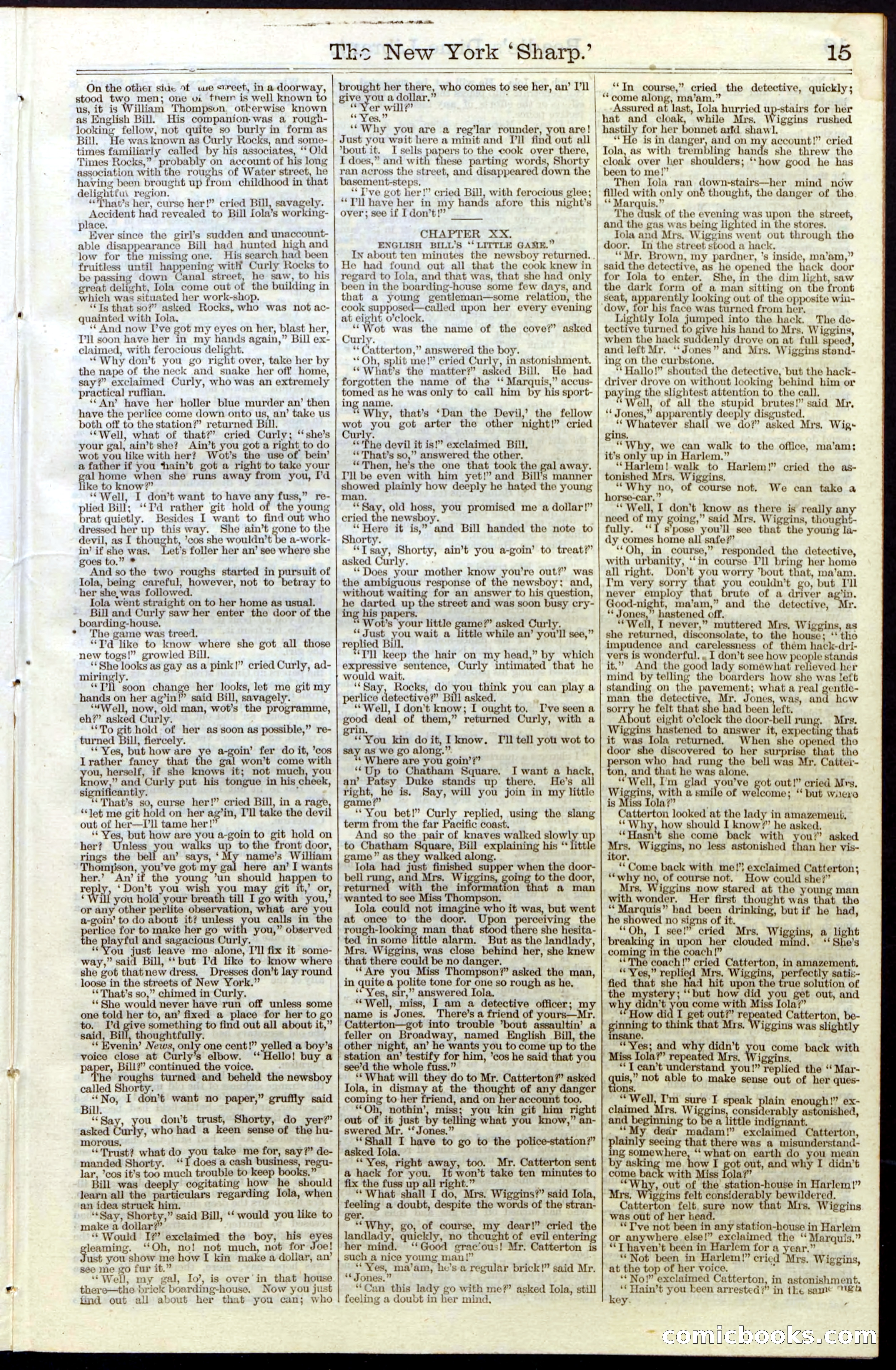
A restored page from Pulp Fiction, 1878. Page through the whole issue in the reader above.
📄 Transcribed text from this page (OCR, searchable)
Machine-transcribed from the original scan — historical spelling and the odd misread are preserved.
——- s er re ee Tk: New York ‘Sharp.’ He 15 a — ee a + KK --- — EE “In course,” cried the detective, quickly; On the other side ot wue street, in a doorway, | brought her there, who comes to see her, an’ Ill | , ‘** come ean ma’am.” 1 » stood two men; one vi freim is well known give you a dollar.” us, it is William Thompson. otherwise known “Yer will?’ | Assured at last, Iola hurried up-stairs for her as English Bill. His companion-was a rough- gee N hat and cloak, while Mrs. Wiggins rushed looking fellow, not quite so burly in form as ‘Why you are a reg’lar rounder, you are! | hastily for her bonnet arfd shawl. Bill. He was known as Curly Rocks, and some- | Just you wait here a minit and [ll find out all “He is in danger, and on my account!” cried times familiarly called by his associates, ‘Old | ’bout it. I sells papers to the cook over there, | Iola, as with trembling hands she threw the Times Rocks,” probably on account of his long | I does,” and with these parting words, Shorty | cloak over her shoulders; ‘*how good he has association with the roughs of Water street, he having been brought up from childhood in that delightfu\ region. “'That’s her, curse her!” cried Bill, savagely. Accident had revealed to Bill fola’s working- place. Ever since the girl’s sudden and unaccount- able disappearance Bill had hunted high and low for the missing one. His search had been fruitless until happening witht Curly Rocks to be passing down Canal street, he saw, to his great delight, Iola come out of the building in which was situated her work-shop. ‘Ts that so?’ asked Rocks, who was not ac- quainted with Iola. ‘‘ And now I’ve got my eyes on her, blast her, I'll soon have her in my hands again,” Bill ex- claimed, with ferocious delight. “Why don’t you go right over, take her by the nape of the neck and snake her off home, say?’ exclaimed Curly, who was an extremely practical ruffian. ‘‘An’ have her holler blue murder an’ then have the perlice come down onto us, an’ take us both off to the station?’ returned Bill. ‘“Well, what of that?’ cried Curly; ‘she’s your gal, ain’t she? Ain’t you got a right, to do wot you like with her? Wot’s the use of bein’ a father if you thain’t got a right to take your gal home when she runs away from you, I'd like to know?” ‘“Well, I don’t want to have any fuss,” re- lied Bill; “‘?’d rather git hold of the young rat quietly. Besides I want to find out who dressed her up this way. She ain’t gone to the devil, as I thought, ’cos she wouldn’t be a-work- in’ if she was. Let's foller her an’ see where she oes to.” * And so the two roughs started in pursuit of Iola, being careful, however, not to betray to her she, was followed. Iola went straight on to her home as usual. Bill and Curly saw her enter the door of the boarding-house. The game was treed. “Td like to know where she got all those new togs!” growled Bill, ‘She looks as gay as a pink!” cried Curly, ad- miringly. “Dil soon change her looks, let me git my hands on her ag’in!” said Bill, savagely. ‘“Well, now, old man, wot’s the programme, eh?” asked Curly. ee. git hold of her as soon as possible,” re- turned Bill, fiercely. ‘** Yes, but how are ye a-goin’ fer do it, ’cos Irather fancy that the eal. won’t come with ou, herself, if she knows it; not much, you hee ” and Curly put his tongue in his chéek, significantly. ‘“That’s so, curse her!” cried Bill, in a rage “let me git hold on her ag’in, I'll take the devil out of her—I’ll tame her!’ ‘‘ Yes, but how are you a-goin to git hold on her? Unless you wa up to the front door, rings the bell an’ says, ‘My name’s William Thompson, A ae te got my here an’ I wants her.’ An’ if the young ’un should happen to reply) ‘Don’t you wish you may git it,’ or, , you hold your breath till I go with you, or any other perlite observation, what are you a-goin’ to do about it? unless you calls in the rlice for to make her go with you,” observed the layful and sagacious Curly. ‘You just leave me alone, I'll fix it some- way,” said Bill, ** but I'd like to know where she got thatnew dress, Dresses don’t lay round loose in the streets of New York.” ‘*That’s so,” chimed in Curly. ‘*She would never have run off unless some one told her to, an’ fixed a place for her to go to. I'd gh something to find out all about it,” said, Bill, thoughtfully. “ Bvenin’ Ne ws, only one cent!” yelled a boy’s voice close at Curly’s elbow. “ Hello! buy a paper, Bill?” continued the voice. : ‘he roughs turned and beheld the newsboy called Shorty. ‘‘No, I don’t want no paper,” gruffly said Bill. ot , you don’t trust, Shorty, do yer?’ asked Curh , who had a keen sense of the hu- morous, “Trust? what do os take -_ for, say?” de- manded Shorty. ‘1 does a cas ess, regu- lar, ’cos it’s ee much trouble to keep books.” Bill was deeply cogitating how he should learn all the particulars regarding Iola, when an idea struck him. “Say, Shorty,” said Bill, ‘‘ would you like to make a dollar?” ‘‘ Would I?’ exclaimed the boy, his ae leaming. ‘‘Oh, no! not much, not for Joe! 5 ust you show me how I kin make a dollar, an’ see me go fur it.” ‘‘Well, my gal, Io’, is over’ in that house there—the brick boarding-house. Now you just find out all about her that you can; who ran across the street, and disappeared down the basement-steps. ‘**]’ve got her!” cried Bill, with ferocious glee; “Tl have her in my hands afore this night’s over; see if I don’t!” CHAPTER XX, ‘ ENGLISH BILL'S “ LITTLE GAME.” In about ten minutes the newsboy returned. . He had found out all that the cook knew in regard to lola, and that was, that she had only been in the boarding-house some few days, and that a young gentleman—some relation, the cook supposed—called upon her every evening at eight o’clock, ‘Wot was the name of the cove?’ asked Curly. ‘**Catterton,” answered the boy. ‘Oh, split me!” cried Curly, in astonishment. “What's the matter?’ asked Bill, Ue had forgotten the name of the ‘‘ Marquis,” accus- tomed as he was only to call him by his sport- ing name. ‘Why, that’s ‘Dan the Devil,’ the fellow kd you got arter the other night!” cried uly. “The devil it is!” exclaimed Bill. “'That’s so,” answered the other. “Then, he’s the one that took the gal away. Tll be even with him yet!” and Bill’s manner showed plainly how deeply he hated the young man. **Say, old hoss, you promised me a dollar!” cried the newsboy. “Here it is,” and Bill handed the note to Shorty. ay say, Shorty, ain’t you a-goin’ to treat?” asked Curly. “Does your mother know you're out?’ was the ambiguous response of the newsboy; and, without waiting for an answer to his question, he darted up the street and was soon busy cry- ing his papers. *Wot’s your little ef’ asked Curly. ** Just you wait a little while an’ you'll see,” replied Bul, ‘T'll keep the hair on my head,” by which expressive sentence, Curly intimated that he would wait. ‘*Say, Rocks, do you think you can play a perlice detective?” Bill asked. - ‘Well, I don’t know; I ought to. [ve seena good deal of them,” returned Curly, with a rin. y ‘You kin doit, I[know, Il tell yott wot to say as we go along.” ‘ Where are you goin’?”’ **Up to Chatham Square. I want a hack an’ Patsy Duke stands up there, He's all taste is. Say, will you join in my little © gam ‘*You bet!” Curly replied, using the slang term from the far Pacific coast. ° And so the pair of knaves walked nr by to Chatham Square, Bill explaining his “ little game” as they walked along. Iola had just finished supper when the door- bell , and Mrs, Wi oing to the door, returned with the t a man wanted to see Miss Thompson, Iola could not imagine who it was, but went at once to the door. Upon perceiving the rough-looking man that stood thats she hesita- ted in some little alarm. But as the landlady, Mrs. Wiggins, was close behind her, she knew that there could be no danger. ‘*Are you Miss Thompson?” asked the man, in quite a polite tone for one so rough as he, ** Yes, sir,” answered Iola. e Well, miss, I am a detective officer; my name is Jones. There’s a friend of yours—Mr. Catterton—got into trouble "bout assaultin’ a feller on Broadway, named English Bill, the other night, an’ he wants you to come up to the station an’ for him, ’cos he said that you see’d the whole fuss.” ‘* What will they do to Mr. Catterton?” asked Iola, in dismay at the bit Lie of any danger coming to her friend, and on her account too. “Oh, nothin’, miss; you kin git him right out of it just by telling what you know,” an- swered Mr. ‘‘ Jones.” ‘Shall I have to go to the police-station?” asked Iola. | “Yes, right away, too. Mr. Catterton sent a hack for you. It won’t take ten minutes to fix the fuss up all right.” ** What shall I do, Mrs. Wiggins?” said Iola, feeling a doubt, despite the words of the stran- ger. ‘Why, go, of course, my dear!” cried the landlady, quickly, no thought of evil enterin her mind. ‘Good grac’ous! Mr. Catterton such a nice young man!” ‘Yes, ma’am, he’s a regular brick!” said Mr. ** Jones.” “Can this lady go with me?’ asked Iola, still feeling a doubt in her mind, ormation ‘dow, for been to me!” Then Iola ran down-stairs—her mind now filled with only on’ thought, the danger of the ** Marquis.” The dusk of the evening was upon the street, and the gas was being lighted in the stores. Tola and Mrs. Wiggins went out through the door. In the street stood a hack. ‘*Mr. Brown, my pardner, ’s inside, ma’am,” said the detective, as he opened the hack door for Iola to enter. She, in the dim light, saw the dark form of a man sitting on the front seat, apparently looking out of the opposite win- his face was turned from her. Lightly Iola jumped into the hack, The de- tective turned to give his hand to Mrs. Wiggins, when the hack suddenly drove on at full speed, and left Mr, ‘“‘Jones” and Mrs. Wiggins stand- ing on the curbstone. “Hallo!” shouted the detective, but the hack- driver drove on without looking behind him or payin x the slightest attention to the call. ‘Well, of all the stupid brutes!” said Mr, ‘* Jones,” apparently deeply disgusted. “Whatever shall we do?’ asked Mrs, Wig “Why, we can walk to the office, ma’am: it’s only up in Harlem.” ‘‘Harlem! walk to Harlem!” cried the as- tonished Mrs. Wiggins. “Why no, of course not. We can take a horse-car. ** Well, I don’t know as there is really an need of m going,” said Mrs, Wiggins, thought- fully. ‘I s’pose you'll see that the young la- dy comes home all safe?” ‘*Oh, in course,” responded the detective, with urbanity, ‘“‘in course Pll bring her home all right. Don’t you worry "bout that, ma’am. I'm very sorry that you couldn’t go, but Tl never employ that brute of a driver ag’in. Good-nigh , ma’am,” and the detective, Mr. ** Jones,” hastened off. ‘Well, I never,” muttered Mrs, Wiggins, as she returned, disconsolate, to the house; ‘ the impudence and carelessness of thém hack-dri- vers is wonderful. . I don’t see how people stands it.” And the good lady somewhat relieved her mind by telling the boarders how she was left standing on the pavement; what a real gentle- man the detective, Mr. Jones, was, and how phe Bl felt that she had been left. About eight o’clock the door-bell . Mrs. Wiggins hastened to answer it, expec that it was lola returned. When she opened tho door she discovered to her surprise that the rson who had rung the bell was Mr. Catter- n, and that he was alone, ra Well, ey glad oaNe t eM SS Mrs. ns, a e of welcome; “ but waco is Miss Tola?” | Catterton looked at the lady in amazement, “Why, how should I know?” he asked. “Hasn't she come back with you?” asked rib Wiggins, no less astonished than her vis- r. ** Come back with me!”} exclaimed Catterton; ‘““why no, of course not. How could she?” Mrs, Wiggins now stared at the young man with wonder, Her first thought was that the been drinking, ** Marquis” had but if he had, he showed no si of it. “Oh, I see!” cried Mrs, W a light brea! in upon her clouded d. ‘* She's coming the coach!” Pe orm res Gpiterton: in amaement es,” re rs. ectly satis- fied that the had hit nibs the tras solution of the m ; ‘but how did you get out, and why t ty come with Miss Iola?’ ‘How did I get out?” ab a Catte be- i ine ¥ that Mrs. Wiggins was slightly “Yes: and wh ‘didn’t you h “Miss Iola?” repeated Mrs, Wiggins “T can’t nd you!” replied the “ Mar- ais," not able to make sense out of her ques- I'm sure I speak enough!” ex- claimed Mrs. Wiggins considerably ore euibed, and beginning to a little indignant. . deir madam!” exclaimed Catterton, append seeing that there was a misunderstand- tout, and why I didn’t ou w : with Miss fola?” “Why, out of the station-house in Harlem!” Mrs, felt considerably bewildered. Catterton felt, sure now that Mrs. Wiggins was out of her ‘*T’ve not been in any station-house in Harlem or anywhere else!” exclaimed the “ Marquis.” “*T haven’t been in Harlem for a year.” “Not been in Harlem!” crie . Wiggins, at the top of her voice. . ** No!” exclaimed Catterton, in astonishment. : ‘‘Hain’t you been arrested?” in tke sam’ "A cey. : 0\(0)(0) ~ (€@) m (C SpE) m