
Pulp Fiction, 1878 · page 14 of 32
Beadle's Dime Library, Vol. III, No. 31 — page 14: what you’re looking at
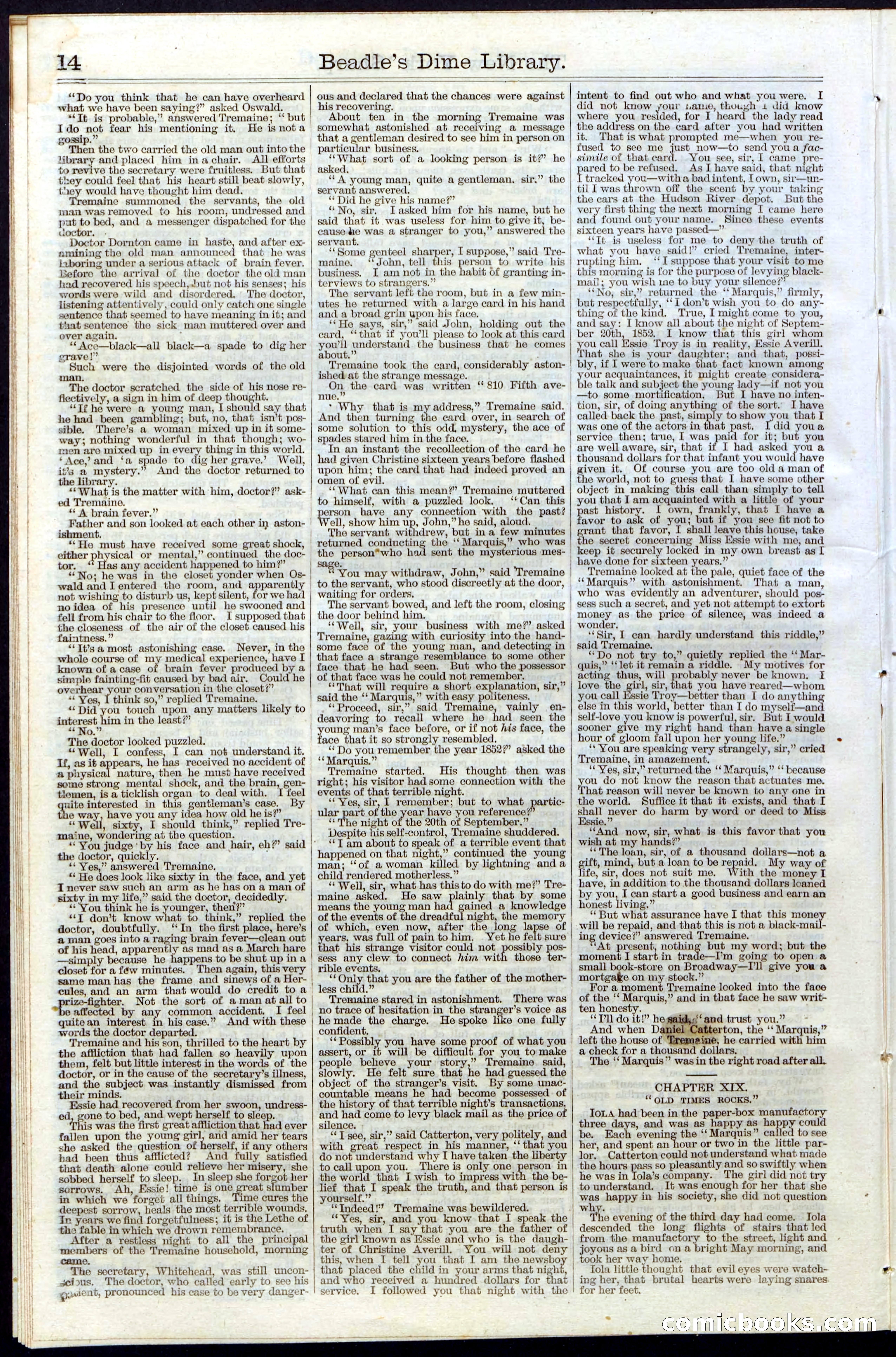
A restored page from Pulp Fiction, 1878. Page through the whole issue in the reader above.
📄 Transcribed text from this page (OCR, searchable)
Machine-transcribed from the original scan — historical spelling and the odd misread are preserved.
es —— —— ee — — a me —— ——— Beadle’s Dime Library. —— what we have been saying?” asked Oswald. “Tt is probable,” answered Tremaine; ‘‘ but Ido not fear his mentioning it. He is nota gossip. ~ Then the two carried the old man out into the library and placed him inachair. All efforts to revive the secretary were fruitless. But that they could feel that his heart still beat slowly, they would have thought him dead. Tremaine summoned the servants, the old man was removed to his room, undressed and put to bed, and a messenger dispatched for the doctor. . Doctor Dornton came in haste, and after ex- amining the old man announced that he was isboring under a serious attack of brain fever. Gefore the arrival of the doctor the old man had recovered his speech,.but not his senses; his words were wild and disordered. The doctor, listening attentively, could only catch one single sentence that seemed to have meaning in it; and that sentence the sick man muttered over and over again. ** Ace—black—all black—a spade to dig her grave!” Such were the disjointed words of the old man. The doctor scratched the side of his nose re- flectively, a sign in him of deep thought. “Tf he were a young man, I should say that he had been gambling; but, no, that isn’t pos- sible. There’s a woman mixed up in it some- way; nothing wonderful in that though; wo- men are mixed up in every thing in this world. ‘Ace,’ and ‘a spade to dig her grave.’ Well, its a mystery.” And the doctor returned to the library. ‘“What is the matter with him, doctor?’ ask- ed Tremaine. ** A brain fever.” Father and son looked at each other in aston- ishment. ‘“‘He must have received some great shock, either ph sical or mental,” continued the doc- tor. ‘ es any accident happened to him?” “No; he was in the closet yonder when Os- wald and I entered the room, and apparently not wishing to disturb us, kept silent, for we had no idea of his presence until he swooned and fell from his chair to the floor. I supposed that the closeness of the air of the closet caused his faintness.” ‘‘Tt?s a most astonishing case. Never, in the whole course of my medical experience, have known of a case of brain fever produced by a simple fainting-fit caused by bad air, Could he overhear your conversation in the closet?” “Yes, I think so,” replied Tremaine. “Did you touch upon any matters likely to interest iin in the least?’ ae No ” The doctor looked puzzled, “Well, I confess, I can not understand it. If, as it appears, he has received no accident of a physical nature, then he must have received some strong mental shock, and the brain, gen- tiemen, is a ticklish organ to deal with. I feel uite interested in this gentleman’s case. the way, have you any idea how old he is?” # ali, sixty, I should think,” replied Tre- maine, wondering at the question. “You judge by his face and hair, eh?” said |’ the doctor, quickly. ‘‘ Yes,” answered Tremaine. “ He does look like sixty in the face, and yet I never saw such an arm as he has on a man of sixty in my life,” said the doctor, decidedly, ” on think he is younger, then?” ‘“‘T don’t know what to think,” replied the doctor, doubtfully. “In the first place, here’s a man goes into a raging brain fever—clean out of his head, apparently as mad as a March hare —simply because he happens to be shut up in a closet for a féw minutes. Then again, this very same man has the frame and sinews of a Her- cules, and an arm that would do credit to a pee Bebicn. Not the sort of a man at all to affected by any common accident, I feel quitean interest in his case.” And with these words the doctor departed. Tremaine and his son, thrilled to the heart by the affliction that had fallen so heavily upon them, felt but little interest in the words of the doctor, or in the cause of the secretary’s illness, and the subject was instantly dismissed from their minds. Essie had recovered from her swoon, undress- ed, gone to bed, and wept herself to sleep. 1is was the first great affliction that had ever fallen upon the young girl, and amid her tears she asked the question of herself, if any others bad been thus afflicted? And fully satisfied that death alone could relieve her misery, she sobbed herself to sleep. In sleep she forgot her sorrows. Ah, Essie! time is one t slumber in which we forget all things. me cures the deepest sorrow, heals the most terrible wounds, Tr years we find forgetfulness; it is the Lethe of the fable in which we drown remembrance, | After a restless night to all the principal members of the Tremaine household, morning came. The secretary, Whitehead, was still uncon- scious. The doctor, who called early to see his gusicnt, pronounced his case to be very danger- “Do you think that he can have overheard ous and declared that the chances were against his recovering. About ten in the morning Tremaine was somewhat astonished at receiving a message that a gentleman desired to see him in person on particular business. ‘What sort of a looking person is it?’ he asked. ‘‘A young man, quite a gentleman. sir.” the servant answered. ‘Did he give his name?” ‘No, sir. Iasked him for his name, but he said that it was useless for him to give it, be- cause be was a stranger to you,” answered the servant. ‘‘Some genteel sharper, I suppose,” said Tre- maine. ‘John, tell this person to write his business. I am not in the habit of granting in- terviews to strangers.” The servant left the room, but in a few min- utes he returned with a large card in his hand and a broad grin upon his face. ‘‘ Hoe says, sir,” said John, holding out the ecard, ‘that if you'll please to look at this card yowll understand the business that he comes about.” Tremaine took the card, considerably aston- ished at the strange message. On the card was written ‘810 Fifth ave- nue,” * Why that is my address,” Tremaine said. And then turning the card over, in search of some solution to this odd, mystery, the ace of spades stared him in the face. In an instant the recollection of the card he had given Christine sixteen years before flashed upon him; the card that had indeed proved an omen of evil. ‘What can this mean?” Tremaine muttered to himself, with a puzzled look. ‘*Can this erson have any connection with the past? ell, show him up, John,” he said, aloud. The servant withdrew, but ina few minutes returned conducting the ‘‘ Marquis,” who was the person“who had sent the mysterious mes- e. we You may withdraw, John,” said ‘Tremaine to the servant, who stood discreetly at the door, waiting for orders, The servant bowed, and left the room, closing the door behind him. ‘‘Well, sir, your business with me?’ asked Tremaine, gazing with curiosity into the hand- some face of the young man, and detecting in that face a strange resemblance to some other face that he had seen. But who the possessor of that face was he could not remember. “That will require a short explanation, sir,” said the “‘ Marquis,” with easy politeness, ‘Proceed, sir,” said Tremaine, vainly en- deavoring to recall where he had seen the young man’s face before, or if not his face, the face that it so strongly resembled. “To you remember the year 1852?” asked the ‘* Marquis.” Tremaine started. His thought then was right; his visitor hadsome connection with the events of that terrible night. ‘Yes, sir, I remember; but to what partic- art of the year have you reference? ‘The night of the 20th of September.” Despite his self-control, Tremaine shuddered. ‘“T am about to speak of a terrible event that happened on that night,” continued the young man; ‘‘of a woman killed by lightning anda child rendered motherless.” “Well, sir, what has this to do with me?” Tre- maine asked. He saw plainly that by some means the young man Seine a knowledge of the events of the dreadf night, the memory of which, even now, after the long lapse of ears, was full of pain tohim. Yet he felt sure hat his strange visitor could not possibly poe sess any clew to connect him with those ter- rible events. ‘*Only that you are the father of the mother- less child.” Tremaine stared in astonishment. There was no trace of hesitation in the stranger’s voice as he made the charge. He spoke like one fully confident. _ ‘* Possibly you have some proof of what you assert, or 16 will be difficult for you to make people beheve your story,” Tremaine said, slowly. He felt’ sure that he had guessed the object of the stranger’s visit. By some unac- countable means he had become possessed of the history of that terrible night’s transactions he had come to levy black mail as the price of silence, . “T see, sir,” said Catterton, very politely, and with great respect in his manner, ‘ that you do not understand why I have taken the liberty to callupon you. There is only one person in the world that I wish to impress with the be- lief that I speak the truth, and that person is yo : “Indeed!” Tremaine was bewildered. “Yes, sir, and you know that I truth when I say that you are the father of the girl known as Essie and who is the daugh- ter of Christine Averill. You will not deny this, when I tell you that I am the newsbo that placed the child in your arms that night, and who received a hundred dollars for that service, I followed you that night with the intent to find out who and what you were. I[ did not know your tame, though 4 did know where you resided, for I heard the lady read the address on the card after you had written it. That is what prompted me—when you re- fused to see me just now—to send you a fac- simile of that oat. You see, sir, [ came pre- pera to be refused. As I have said, that night I tracked esa bad intent, Lown, sir—un- til l was thrown off the scent by your taking the cars at the Hudson River depot. But the very first thing the next morning I came here Sod canal out your name. Since these events sixteen years have passed—” ‘‘Tt is useless for me to deny the truth of what you have said!” cried Tremaine, inter- rupting him. ‘‘ I suppose that your visit to me this morning is for the purpose of levying black- mail; you wish ine to buy your silence?” ‘*No, sir,” returned the ‘* Marquis,” firmly, but respectfully, ‘‘1 don’t wish you to do any- thing of the kind. True, I might come to you, and say: I know all about the night of Septem- ber 20th, 1852. I know that this girl whom you call Essie Troy is in reality, Essie Averill. That she is your daughter; and that, possi- bly, if I were to make that fact known among your acquaintances, it might create considera- ble talk and subject the young lady—if not you —to some mortification. But 1 have no inten- tion, sir, of doing anything of the sort. I have called back the past, simply to show you that I was one of the actors in that past. I did youa service then; true, I was paid for it; but you are well aware, sir, that if I had asked you a thousand dollars for that infant you would have ‘iven it. Of course you are too old a man of the world, not to guess that 1 have some other object in making this call than simply to tell you that I am acquainted with a little of your ast history. I own, frankly, that I have a anh to ask of you; but if you see fit not to ant that favor, I shall leave this house, take the secret concerning Miss Essie with me, and keep it securely locked in my own breast as I have done for sixteen years.” Tremaine looked at the pale, quiet face of the “Marquis” with astonishment, That a man, who was evidently an adventurer, should pos- sess such a secret, and yet not attempt to extort money as the price of silence, was indeed a wonder, ‘Sir, I can hardly understand this riddle,” said Tremaine. | **Do not try to,” quietly replied the ‘‘ Mar- quis,” ‘‘let it remain a riddle. My motives for acting thus, will PER One never be known. f love the girl, sir, that you have reared—whom you call Kssie Troy—better than I do anything else in this world, better than I do myself—and self-love you know is powerful, sir. But I would sooner give my right hand than have a single hour of gloom fall upon her young life.” ‘* You are speaking very strangely, sir,” cried Tremaine, in amazement. ‘Yes, sir,” returned the ‘‘ Marquis,” ‘‘ because you do not know the reason that actuates me. at reason will never be known to any one in the world. Suflice it that it exists, and that I Me never do harm by word or deed to Miss ssie.’ “And now, sir, what is this favor that you wish at my hands?” ‘The loan, sir, of a thousand dollars—not a ift, mind, but a loan to be repaid. My way of ife, sir, does not suit me, ith the money I have, in addition to the thousand dollars loaned by you, I can start a good business and earn an honest living.” ‘* But what assurance have I that this mone will be repaid, and that this is not a black-mail- ing device?” answered Tremaine. ‘At present, nothing but my word; but the moment I startin trade—I’m going to open a small book-store on Broadway—Ill give you a mortgage on my stock.” For a moment Tremaine looked into the face of the ‘‘ Marquis,” and in that face he saw writ- ten honesty. “Pll do it!” heats And when Daniel ¢ tte ‘and trust you.” tterton, the ‘‘ Marquis,” left the house of "Tx he carried with him a check for a thousand dollars. The ‘‘ Marquis” was in the right road after all. CHAPTER XIX. ‘OLD TIMES ROCKS.” IoLA had been in the paper-box manufactory three days, and was as happy as happy could be. Each evening the ‘‘ Marquis” called to see her, and spent an hour or two in the little par- lor, Catterton could not understand what made the hours pass so pleasantly and so swiftly when he was in Tola’s company. The girl did not try to understand. It was enough for her that she was happy in his society, she did not question why. The evening of the third day had come. Iola descended the long flights of stairs that led from the manufactory to the street, light and joyous as a bird on a bright May morning, and took her way home, Tola little thought that evil eyes were watch- ing her, that brutal hearts were laying snares for her feet, : (E(6) JOO mice cS) (E(0)