
Pulp Fiction, 1878 · page 13 of 32
Beadle's Dime Library, Vol. III, No. 31 — page 13: what you’re looking at
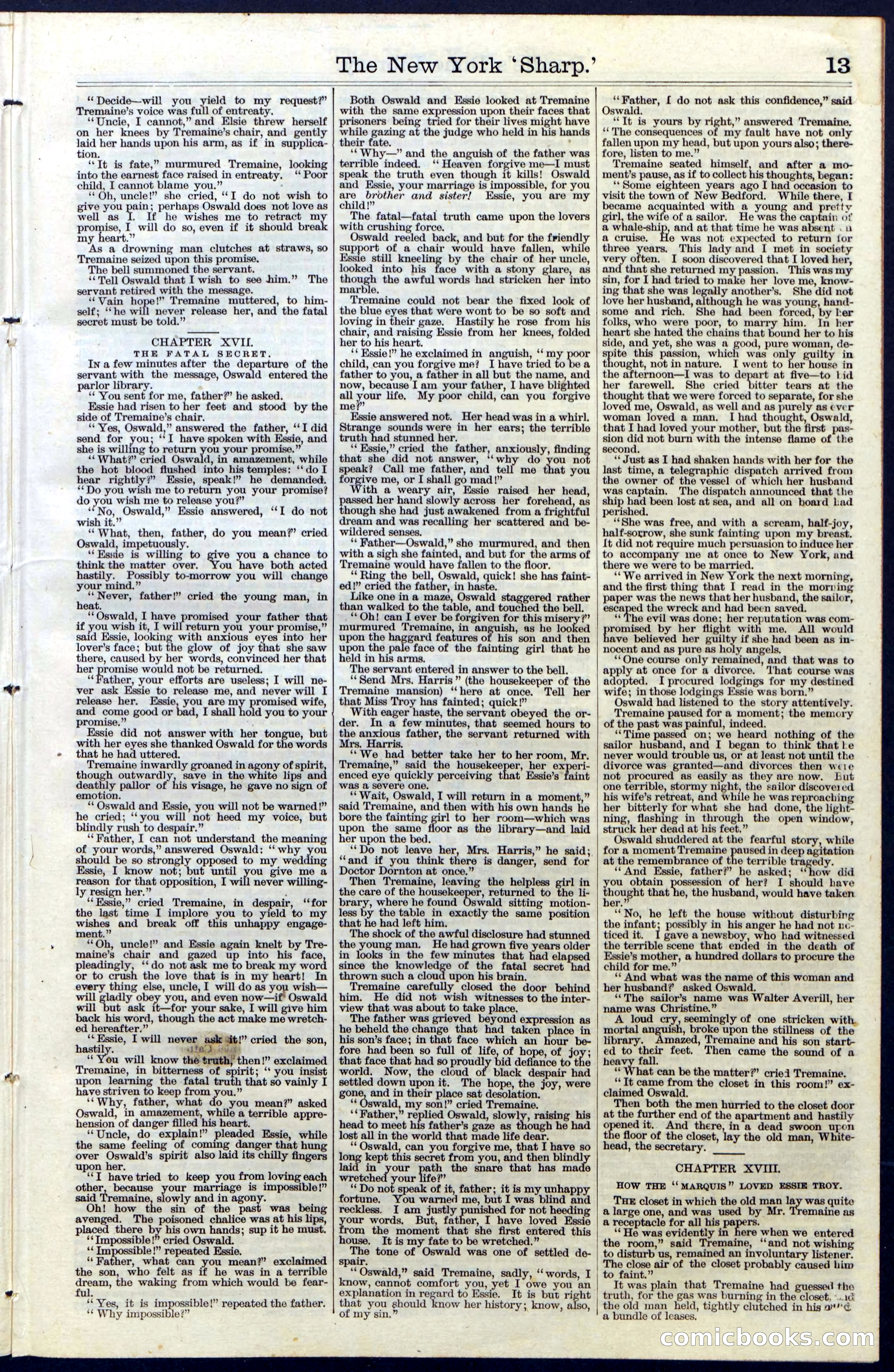
A restored page from Pulp Fiction, 1878. Page through the whole issue in the reader above.
📄 Transcribed text from this page (OCR, searchable)
Machine-transcribed from the original scan — historical spelling and the odd misread are preserved.
“ Decide—will you Sea to my request?” Tremaine’s voice was full of entreaty. ““Uncie, I cannot,” and Elsie threw herself on her knees by Tremaine’s chair, and gently laid her hands upon his arm, as if in supplica- tion. ‘‘Tt is fate,” murmured Tremaine, looking into the earnest face raised in entreaty. ‘“‘ Poor child, I cannot blame you.” ‘Oh, uncle!” she cried, ‘I do not wish to give you a. perhaps Oswald does not love as well as I, If he wishes me to retract m promise, I will do so, even if it should br my heart.” As a drowning man clutches at straws, so Tremaine seized upon this promise. The bell summoned the servant. ‘‘Tell Oswald that I wish to see him.” The servant retired with the message. ‘“Vain hope!” Tremaine muttered, to him- self; ‘‘he will never release her, and the fatal secret must be told.” CHAPTER XVII. THE FATAL SECRET. In a few minutes after the departure of the servant with the message, Oswald entered the parlor library. ‘* You sent for me, father?’ he asked. Essie had risen to her feet and stood by the side of Tremaine’s chair. + 'Tan, Oswald,” answered the father, ‘‘I did send for you; “I have spoken with Essie, and she is willing to return you your promise,” ‘What?’ cried Oswald, in amazement, while the hot blood flushed into his temples: ‘do I hear rightly?’ Essie, speak!” he demanded. ‘Do you wish me to return you your promise? do you wish me to release you?” “No, Oswald,” Essie answered, ‘‘I do not wish it.” ‘““What, then, father, do you mean?’ cried Oswald, impetuously. ‘*Hssie is willing to give you a chance to think the matter over. ou have both acted hastily. Possibly to-morrow you will change your mind,” s ** Never, father!” cried the young man, in eat. ‘‘Oswald, I have promised your father that if you wish it, [ will return you your promise,” said Essie, looking with anxious eyes into her lover’s face; but the glow of joy that she saw there, caused by her words, convinced her that her promise would not be returned. ‘Father, your efforts are useless; I will ne- ver ask Essie to release me, and never will I release her. Essie, you are my Srpmee wife, and come good or bad, I shall hold you to your promise.” Essie did not answer with her tongue, but with her eyes she thanked Oswald for the words that he had uttered. Tremaine inwardly groaned in agony of spirit Shouse outwardly, save in the white lips and deathly pallor of his visage, he gave no sign of emotion. ‘“‘ Oswald and Essie, you will not be warned!” he cried; ‘‘ you will not heed my voice, but blindly rush to despair.” ‘**Father, I can not understand the meaning of your words,” answered Oswald: “‘ why you should be so strongly opposed to my wedding Essie, I know not; but until you give me a reason for that opposition, I will never willing- ly resign her.” ‘‘ Essie,” cried Tremaine, in despair, ‘for the last time I implore you to yield to my wishes and break off this unhappy engage- ment. ‘Oh, uncle!” and Essie again knelt by Tre- maine’s chair and gazed up into his face pleadingly, ‘‘do not ask me to break my word or to crush the love that is in my heart! In every thing else, uncle, I will do as you wish— will Gadly obey you, and even now—if* Oswald will but ask it—for your sake, I will give him back his word, though the act make me wretch- ed hereafter.” ; ‘*Hssie, I will never ask ‘You will know thé truth; then!” exclaimed Tremaine, in bitterness of spirit; ‘“‘ you insist upon learning the fatal truth that so vainly I have striven to keep from you.” ‘‘Why, father, what do you mean?” asked Oswald, in amazement, while a terrible appre- hension of danger filled his heart. ‘Uncle, do explain!” pleaded Essie, while the same feeling of coming danger that hung over Oswald’s spirit also laid its chilly fingers upon her. ‘“T have tried to keep you from loving each other, because your marriage is impossible!” said Tremaine, s owly and in agony. Oh! how the sin of the past was being avenged. The poisoned chalice was at his lips, placed there by his own hands; sup it he must. **Tmpossible!” cried Oswald. “Tm ible!” repeated Essie. “Father, what can you mean?” exclaimed the son, who felt as if he was in a terrible dream, the waking from which would be fear- ful “i Yes, it is impossible!” repeated the father. ‘* Why impossible?” Both Oswald and Essie looked at Tremaine with the same expression upon their faces that prisoners being tried for their lives might have while gazing at the judge who held in his hands their fate. , ‘*Why—” and the anguish of the father was terrible indeed. ‘‘ Heaven forgive me—I must speak the truth even though it kills! Oswald and Essie, your marriage is impossible, for you are brother and sister! Essie, you are my child!” The. fatal—fatal truth came upon the lovers with crushing force. Oswald reeled back, and but for the friendly support of a chair would have fallen, while Essie still kneeling by the chair of her uncle, looked into his face with a stony glare, as though the awful words had stricken her into marble, Tremaine could not bear the fixed look of the blue eyes that were wont to be so soft and loving in their gaze. Hastily he rose from his chair, and raising Essie from her knees, folded her to his heart. ‘* Essie!” he exclaimed in anguish, ‘‘ my oe child, can you forgive me? I have tried to be a father to you, a father in all but the name, and now, because I am your father, I have blighted all ms life, My poor child, can you forgive me Essie answered not. Her head was in a whirl. neha, Da were in her ears; the terrible truth stunned her, ‘‘ Essie,” cried the father, anxiously, findin that she did not answer, ‘‘why do you no speak? Call me father, and tell me that you forgive me, or I shall go mad!” ith a weary air, Essie raised her head, passed her hand slowly across her forehead, as though she had just awakened from a frightful dream and was recalling her scattered and be- wildered senses. ‘* Father—Oswald,” she murmured, and then with a sigh she fainted, and but for the arms of Tremaine would have fallen to the floor. ‘Ring the bell, Oswald, quick! she has faint- ed!” cried the father, in haste. Like one in a maze, Oswald gered rather than walked to the table, and touched the bell. .“*Oh! can I ever be forgiven for this misery?” murmured Tremaine, in anguish, as he topked upon the haggard features of his son and then upon the pale face of the fainting girl that he held in his arms. The servant entered in answer to the bell. ‘Send Mrs. Harris” (the housekeeper of the Tremaine mansion) “here at once. Tell her that Miss Troy has fainted; quick!” With eager haste, the servant obeyed the or- der. In a few minutes, that seemed hours to the anxious father, the servant returned with Mrs. Harris. ‘* We had better take her to her room, Mr. Tremaine,” said the housekeeper, her experi- enced eye quickly perceiving t Essie’s faint was a severe one. ** Wait, Oswald, I will return in a moment,” said Tremaine, and then with his own hands he bore the fainting girl to her room—which was upon the same floor as the library—and laid her upon the bed. ‘*Do not leave her, Mrs. Harris,” he said; ‘and if you think there is danger, send for Doctor Dornton at once.” Then Tremaine, leaving the helpless girl in the care of the housekeeper, returned to the li- brary, where he found Oswald sitting motion- less by the table in exactly the same position that he had left him. The shock of the awful disclosure had stunned the young man. He had grown five years older in looks in the few minutes that had ela since the knowledge of the fatal secret had thrown such a cloud upon his brain. Tremaine carefully closed the door behind him. He did not wish witnesses to the inter- view that was about to take place, The father was grieved beyond expression as he beheld the change that had taken place in his son’s face; in that face which an hour be- fore had been so full of life, of hope, of joy; that face that had so proudl bid detaios to the world. Now, the cloud of black despair had settled down upon it. The hope, the joy, were gone, and in their place sat desolation. “< d, my son!” cried Tremaine. ‘* Father,” replied Oswald, Hor, raising his head to meet his father’s gaze as though he had lost all in the world that made life dear. “Oswald, can you forgive me, that I have so atl kept this secret from you, and then a, laid in your path the snare that has made wretch our life?” **Do no of it, father; it is my unhappy fortune. You warned me, but I was blind and ess. I am justly punished for not heeding ji our words. But, father, I have loved Essie m the moment that she first entered this house, It is my fate to be wretched.” The tone of Oswald was one of settled de- spair. Oswald,” said Tremaine, sadly, “words, I know, cannot comfort you, yet I owe you an explanation in regard to Essie. It is but right that you ghould know her history; know, alto, of my sin.” ) The New York 1 | SR ree ea ‘*Father, [ do not ask this confidence,” said Oswald. “Tt is yours by right,” answered Tremaine. ‘The consequences of my fault have not only fallen upon my head, but upon yours also; there- fore, listen to me.” Tremaine seated himself, and after a mo- ment’s pause, as if to collect his thoughts, began: ‘*Some eighteen years ago I had occasion to visit the town of New Bedford. While there, I became acquainted with a young and pretty girl, the wife of a sailor. He was the captain of a whale-ship, and at that time he was absent . uo a cruise, @ was not expected to return for three years. This lady and I met in society pina often. I soon discovered that I loved her, and that she returned my passion. This was my sin, for I had tried to make her love me, know- ing that she was legally another’s. She did not love her husband, although he was young, hand- some and rich. She had been forced, by her folks, who were poor, to marry him. In her heart she hated the chains that bound her to his side, and yet, she was a good, pure woman, de- _— this passion, which was only guilty in thought, not in nature. I went to her house in the afternoon—I was to depart at five—to Lid her farewell. She cried bitter tears at the thought that we were forced to separate, for she loved me, Oswald, as well and as purely as ever woman loved a man. I had thought, Oswald, that I had loved your mother, but the first pas- sion did not burn with the intense flame of the second. ** Just as I had shaken hands with her for the last time, a telegraphic dispatch arrived from the owner of the vessel of which her husband was captain. The dispatch announced that the ship had been lost at sea, and all on board had perished. ‘*She was free, and with a scream, half-joy, half-sorrow, she sunk fainting upon my breast. [It did not require much persuasion to induce her to accompany me at once to New York, and there we were to be married. ‘“We arrived in New York the next morning, and the first thing that I read in the morning paper was the news that her husband, the sailor, escaped the wreck and had been saved. **'The evil was done; her reputation was com- a by her flight with me, All would ave believed her guilty if she had been as in- nocent and as pure as holy angels. ‘**One course only remained, and that was to apply at once for a divorce. That course was adopted. I procured lodgings for my destined wife; in those lodgings Essie was born.” Oswald had listened to the story attentively. Tremaine paused for a moment; the memory of the past was ee indeed. ‘““Time passed on; we heard nothing of the sailor husband, and I began to think that be never would trouble us, or at least not until the divorce was granted—and divorces then weie not procured as easily as they are now. but one terrible, stormy night, the sailor discovered his wife’s retreat, and while he was reproaching her bitterly for what she had done, the light- ning, flashing in through the open window, struck her dead at his feet.” Oswald shuddered at the fearful story, while for a moment Tremaine paused in deep agitation at the remembrance of the terrible edy. ‘‘And Essie, father?’ he asked; “how did ne obtain oe eis of her? I should have ote oy that he, the husband, would have taken er. ‘“No, he left the house without disturbing the infant; possibly in his anger he had not ne- ticed it. I gave a newsboy, who had witnessed the terrible scene that ended in the death of Essie’s mother, a hundred dollars to procure the child for me.” ‘** And what was the name of this woman and her husband? asked Oswald. “The sailor’s name was Walter Averill, her name was Christine.” A loud , seemingly of one stricken with. mortal an broke upon the stillness of the library. azed, Tremaine and his son start- ed to their feet. Then came the sound of a nai “ t can be the matter?’ cried Tremaine. “Tt came from the closet in this room!” ex- claimed Oswald. Then both the men hurried to the closet door at the further end of the apartment and hastily 7 it. And there, in a dead swoon _upon the floor of the closet, lay the old man, White- head, the secretary. CHAPTER XVIII. HOW THE ‘‘ MARQUIS” LOVED ESSIE TROY. THE closet in which the old man lay was quite a large one, and was used by Mr. Tremaine as a receptacle for all his ag ork ‘‘ He was evidently in here when we entered the room,” said Tremaine, “and not wishing to disturb us, remained an involun listener. The close air of the closet probably caused him to faint.” It was plain that Tremaine had guessed the truth, for the gas was burning in the closet, 16 the old man held, tightly clutched in his a*'"¢ a bundle of leases. EONMIEL MOO KS (EO iA