
Pulp Fiction, 1878 · page 12 of 32
Beadle's Dime Library, Vol. III, No. 31 — page 12: what you’re looking at
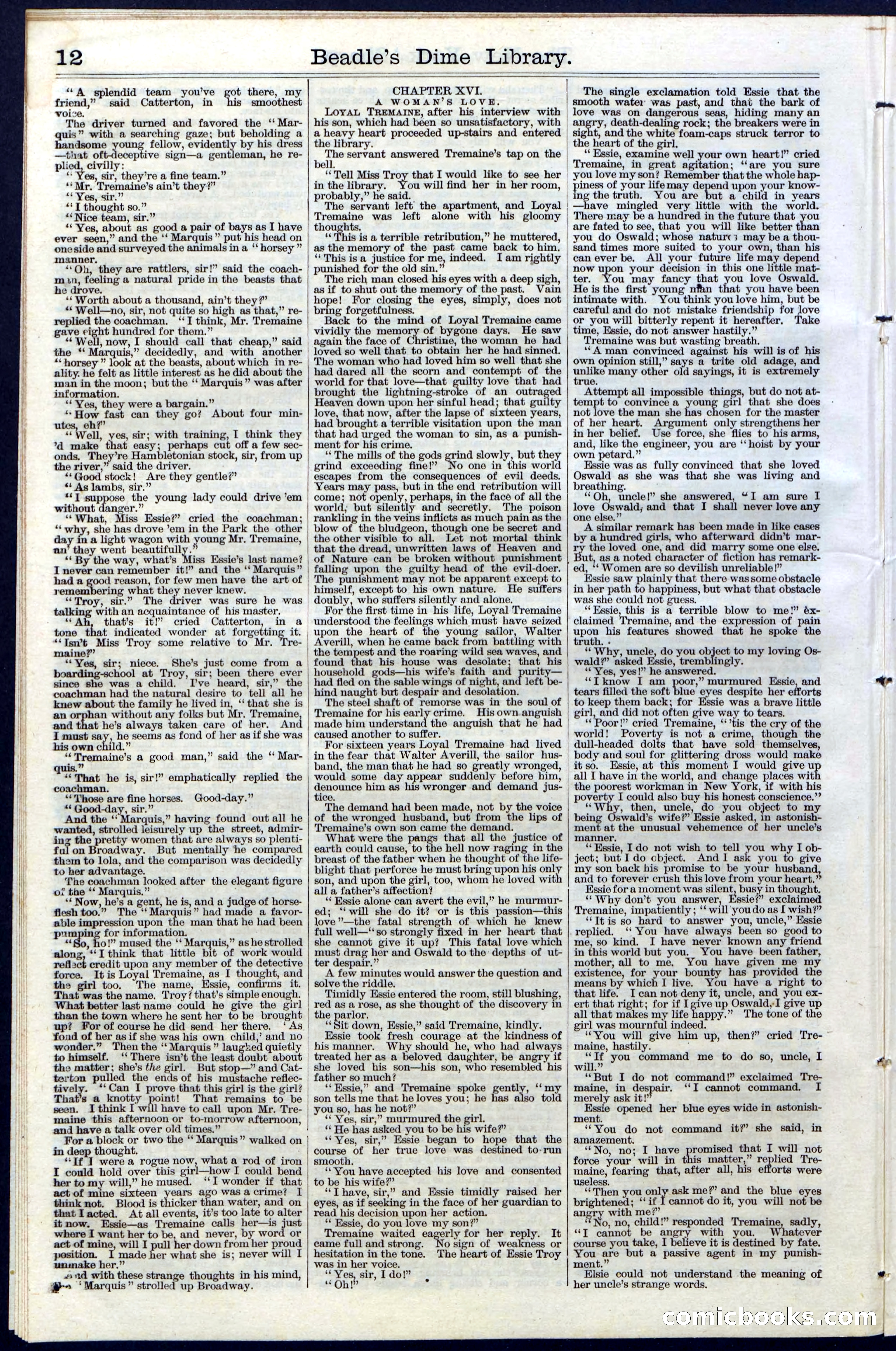
A restored page from Pulp Fiction, 1878. Page through the whole issue in the reader above.
📄 Transcribed text from this page (OCR, searchable)
Machine-transcribed from the original scan — historical spelling and the odd misread are preserved.
e o = = ~~ ge WR, pin 6 Bra rn de Beadle’s Dime ieviwbraty. ns gee eee oe ee ~ = ‘cof splendid team you've got there, my friend,” said Catterton, in smoothest voice. The driver turned and favored the ‘‘ Mar- quis ” with ; type gaze; but beholding a handsome fellow, evidently by his dress —that of ecep ive sign—a gentleman, he re- eri civilly es, sir, ; they're a fine team.” ‘Mr. Tremaine’s ain’t they?” “* Yes, sir.” + % thought so.” *“Nice team, sir.” ‘* Yes, about as a pair of bays as I have ever seen,” and the ‘‘ Marquis” put his head on oneside and surveyed the animals in a ‘ horsey ” manner. ‘‘Oh, they are rattlers, sir!” said the coach- mn, feeling a natural pride i in the beasts that he drove. “Worth about a thousand, ain’t they?” “* Well—no, sir, not quite So high as that,” re- replied the coachman. ‘I think, Mr. Tremaine gave eight hundred for them.” “Well, now, I should call that cheap,” said the *‘ Marquis, ” decidedly, and with another “horsey ” look at the beasts, about which in re- ality: he felt as little interest as he did about the man in the moon; but the “ wre ” was after information. ‘Yes, they were a bar gain. ‘How fast can they go? Reet four min- u eh?” ‘Well, yes, sir; with training, I think they "4 make’ that easy; perhaps cut off a few sec- onds, They’re Hambletonian stock, sir, from up the river,” said the driver. “ Good stock! Are they gentle?” ** As lambs, sir.” “y —— the young lady could drive ’em without danger.’ ‘“What, Miss Essie?’ cried the coachman; aay in she has drove ’em in the Park the other n a light wagon with young Mr. Tremaine, ant’ thee went beautifully. ‘‘ By the way, what’s Miss Essie’s last name? I never —_ remember it!” and the ‘‘ Marquis” had a good reason, for few men have the art of “a mia what the ey never knew. sir.” The driver was sure he was talking pith an acquaintance of his master. ‘Ah, that’s it!” cried Catterton, in tone that indicated wonder at for getting it ‘‘Isn’t Miss Troy some relative to Mr. Tre- maine?” ““Yes, sir; niece. She’s just come from a boarding-school at Troy, sir; been there ever since she was a child. I've heard, sir,” the coachman had the natural desire to tell all he mae about the family he lived in, ‘‘ that she is han without any folks but Mr. Tremaine aah thas he’s always taken care of her. An 1é must say, he seems as fond of her as if she was his own child.” “Tremaine’s a good man,” said the “ Mar- ic 7? quis. “That he is, sir!” emphatically replied the coachman. “Those are re horses. Good-day.” “‘ Good-day, s And the ‘ Gi acrnis: ” having found out all he wanted, strolled leisurely up “the street, admir- ing the e pretty women that are always so plenti- ful on Broadway. But mentally he compared thom to lola, and the comparison was decidedly to her advantage. The coachman looked after the elegant figure of the ** Marquis.” ‘“‘ Now, he’s a gent, he is, and a judge of horse- flesh too.” The “Marquis” had made a favor- able impression upon the man that he had been pumping for information, “to, fic !” mused the ‘‘ Marquis,” as he strolled along. ’“T think that little bit of work would reflsct credit upon any member of the detective force. It is Loyal Tremaine, as I thought, and the 1 too. The name, Essio, confirms it. That was the name. Troy? that’s simple enough. What better last name could he give the girl than the town where he sent her to be brought up? For of course he did send her there. ‘As fond of her as if she was his own child,’ and no wonder.” Then the “ Marquis ” laughed quietly to himself. ‘‘ There isn’t * least doubt about the matter; she’s the girl. But stop—” and Cat- terton pulled the ends of his mustache reflec- cade **Can I prove that this girl is the girl? t’s a knotty point! That remains to be a I think I will have to call upon Mn Tre- maine ‘this afternoon or to-morrow afternoon, and have a talk over old times.” For a block or two the ‘‘ Marquis” walked on in deep thought. “If I were a rogue now, what a rod of iron I could hold over this girl—how I could bend her to my will,” he a ‘‘T wonder if that act of mine sixteen oO was acrime? I think not. Blood is t ickes t water, and on that Tacted. At all events, it’s too late to alter it now. Essie—as Tremaine calls her—is just where I want her to be, and never, by word or act of mine, will I pull her down from her proud sense I made er what she is; never will I er.’ ond with ‘Sided strange thoughts in his mind, *Marquis” strolled up Broadway. CHAPTER XVI. A WOMAN’S LOVE. LOYAL TREMAINE, after his interview with his son, which had been so unsatisfactory, with a heavy heart proceeded up-stairs and entered the library. — servant answered Tremaine’s tap on the ‘‘Tell Miss Troy that I would like to see her in the library. ou will find her in her room, probably,” he said. The servant left the apartment, and Loyal Tremaine was left alone with his gloomy thou hts. his is a terrible retribution,” he muttered, as the memory of the past came back to him, “This is a justice for me ; indeed, I am rightly punished for the old sin.’ The rich man closed his eyes with a deep sigh, as if to shut out the memory of the past. ain hope! For closing the eyes, simply, does not bring forgetfulness. Back to the mind of Loyal Tremaine came vividly the mem re, bygone days. He saw again the face of istine, the woman he had loved so well that to obtain her he had sinned. The woman who had loved him so well that she had dared all the scorn and contempt of the world for that love—that guilty love that had brought the lightning-stroke of an outraged Heaven down upon her sinful head; that guilty love, that now, after the lapse of sixteen years, had brought a terrible visitation upon the man that had urged the woman to sin, as a punish- ment for his crime. ‘‘ The mills of the gods aren slowly, but they grind exceeding fine!” one in this world escapes from the consequences of evil deeds. Years may pass, but in the end retribution will come; not openly perhaps, in the face of all the world, but silently and secretly. The poison rankling i in the veins inflicts as much pain as the blow of the bludgeon, though one be secret and the other visible to all. Let not mortal that the dread, unwritten laws of Heaven and of Nature can be broken without punishment falling upon the guilty head of the evil-doer. The sontehnient may not be apparent except to himself, except to his own nature. He suffers doubly, who suffers silently and alone. For ‘the first time in his life, Loyal Tremaine understood the feelings which must have seized upon the heart of the young sailor, Walter Averill, when he came back from batt ling with the tempest and the roaring wild sea waves, and found that his house was desolate Pn his household his wife’s faith and urity— had fled on the sable wings of night, and left be- hind naught but despair and desolation. The steel shaft of remorse was in the soul of Tremaine for his early crime. His own anguish made him understand the anguish that he had caused another to suffer. For sixteen years Loyal Tremaine had lived in the fear that Walter Averill, the sailor hus- band, the man that he had so greatly wronged, would some day appear suddenly before him, denounce him as his wronger and demand jus- tice The demand had been made, not by the voice of the wronged husband, but from the lips of Tremaine’s own son came the demand. What were the pangs that all the justice of earth could cause, to the hell now raging in the breast of the father when he thought of the life- blight that perforce he must bring upon his card son, and upon the girl, too, whom he loved wit all a father’s affection? ‘‘ Kissie alone can avert the evil,” he murmur- ; ‘‘ will she do it? or is this passion—this love "—the fatal strength of which he knew full well—‘“‘so strongly fixed in her heart that she cannot give it up? This fatal love which must drag her and Oswald to the depths of ut- ter despair.” A few minutes would answer the question and solve the riddle. Timidly Essie entered the room, still blushing, red as a rose, as she thought of the discovery in the parlor. ‘‘Sit down, Essie,” said Tremaine, kindly. Essie took’ fresh’ cour age at the kindness of manner. Why should he, who had always treated her as a beloved daughter, be angry if she loved his son—his son, who resembled his weer tis cages — ‘ act s e,” an emaine spoke gent my son tells me that he loves you; he has die told you 80, has he not?” es, sir,” murmured the girl. “ He has asked you to be his wife?” ‘Yes, sir,” Essie began to hope that the course of her true love was destined to-run smooth, “You have accepted his love and consented to be his wife?” “T have, sir,” and Essie timidly raised her eyes, as if seeking in the face of her guardian to read his decision upon her action. ‘* Essie, do you love my son?” Tremaine waited e came full and strong. hesitation in the tone. was in her voice. s Yes, sir, I do!” ac Oh! ? agerly for her reply. It o sign of weakness or The heart of Essie Troy The single exclamation told Essie that the smooth water was past, and that the bark of love was on dangerous seas, hiding many an em th death-dealing rock; the breakers were in sight, and the white foam-caps struck terror to the heart of the girl. ‘‘ Essie, examine well your own heart!” cried Tremaine, in great agitation; ‘‘are you sure you love my son? Remember that the whole hap- piness of your lifemay depend upon your know- ing the truth. You are but a child in years ave mingled very little with the world. There may be a hundred in the future that are fated to see, that you will like better rst you do Oswald; whose naturc3 may be a hon. sand times more suited to your own, than his can ever be. All your future life may depend — upon your decision in this one little mat- ou may fancy that you love Oswald. Hie i is the first young nfan that you have been intimate with. You think you love him, but be careful and do not mistake friendship for love or you will bitterly repent it hereafter. Take time, Essie, do not answer hastily.” Tremaine was but wasting breath. ‘‘A man convinced against his will is of his own opinion still,” says a trite old adage, and unlike many other old sayings, it is extremely rue. Attempt all impossible things, but do not at- tempt to convince a ea youn girl that she does not love the man she has chosen for the master of her heart. Argument only strengthens her in her belief. Use force, she flies to his arms, and, like the , engineer, you are ‘‘hoist by your own petard,’ Essie was as fully convinced that she loved Oswald as she was that she was living and breathing. ‘Oh, aeehedt she answered, “I am sure I love Oswald; and that I shall never love any one e A similar remark has been made in like cases by a hundred girls, who afterward didn’t mar- the loved one, and did marry some one else, ut, as a noted character of fiction has remark- ed, ‘‘ Women are so devilish unreliable!” Essie saw ey that there was some obstacle in her path to happiness, but what that obstacle was she could not guess. ‘‘Kssie, this is a terrible blow to me!” éx- claimed Tremaine, and the expression of pain upon his features showed that he spoke the « Why, uncle, do you ob ~ye to my loving Os- wald?” asked Essie, jot gt ngly. “Yes, yes!” he answered “Tinow I am iy murmured Essie, and tears filled the soft blue e es despite her efforts to keep them back; for Essie vt a a. little girl and did not often give wa eae oor!” cried Tremaine, ‘’tis hone cry of the world! Pove is not a crime though the dull-headed dolts that have sold themselves, body and soul for glittering dross would make itso. Essie, at this moment I would give Ki all I have in the world, and change places wit the i workman in New York, if with his pove wey, I could also buy his honest conscience.’’ then, uncle, do you object to my bein wald’s wife?” Essie asked, in astonish- ment at the unusual vehemence of her uncle’s manner. ‘Essie, Ido not wish to tell you why I ob- ject; but I do object. And I ask you to give my son back his promise to be your husband, and to forever crush this love from your heart,’ Essie for a moment was silent, bus sy in thought, ‘Why don’t you answer, Essie?’ exclaimed Tremaine, impatiently ; ‘‘ will youdo as [ wish?” “It is so hard to answer you, uncle,” Essie replied. ‘‘ You have always been so good to me, so kind. I have never known any friend in this world but you. You have been father, mother, all to me, You have given me my existence, for your bounty has provided the means by which I live. You have a right to that life. I can not deny it, uncle, and you ex- ert that right; for if Igive up Oswald,I give up all that makes my life happy.” The tone of the girl was mournful indeed. “You will give him up, then?” cried Tre-— maine, hastily. vi If you Celta me to do so, uncle, I “But I do not command!” exclaimed Tre- maine, in despair. ‘“T cannot command, I merely ask it!’ a opened her blue eyes wide in astonish- men “You do not command it?’ she said, in amazement. ‘No, no; I_have Spee that I will not force your will in this matter,” replied Tre- maine, fearing that, after all, his e useless. “Then you 0 brightened: ets angry with me?” o, no, child!” responded Tremaine, sadly, “JT cannot be angry with you. Whatever course you take, I believe it is destined by fate. =o are but a passive agent in my punish- men Elsie could not understand the meaning of her uncle’s strange words. orts were nie ask me?” and the blue eyes cannot do it, you will not be Gomilcboo (c <S (E()