
Pulp Fiction, 1878 · page 11 of 32
Beadle's Dime Library, Vol. III, No. 31 — page 11: what you’re looking at
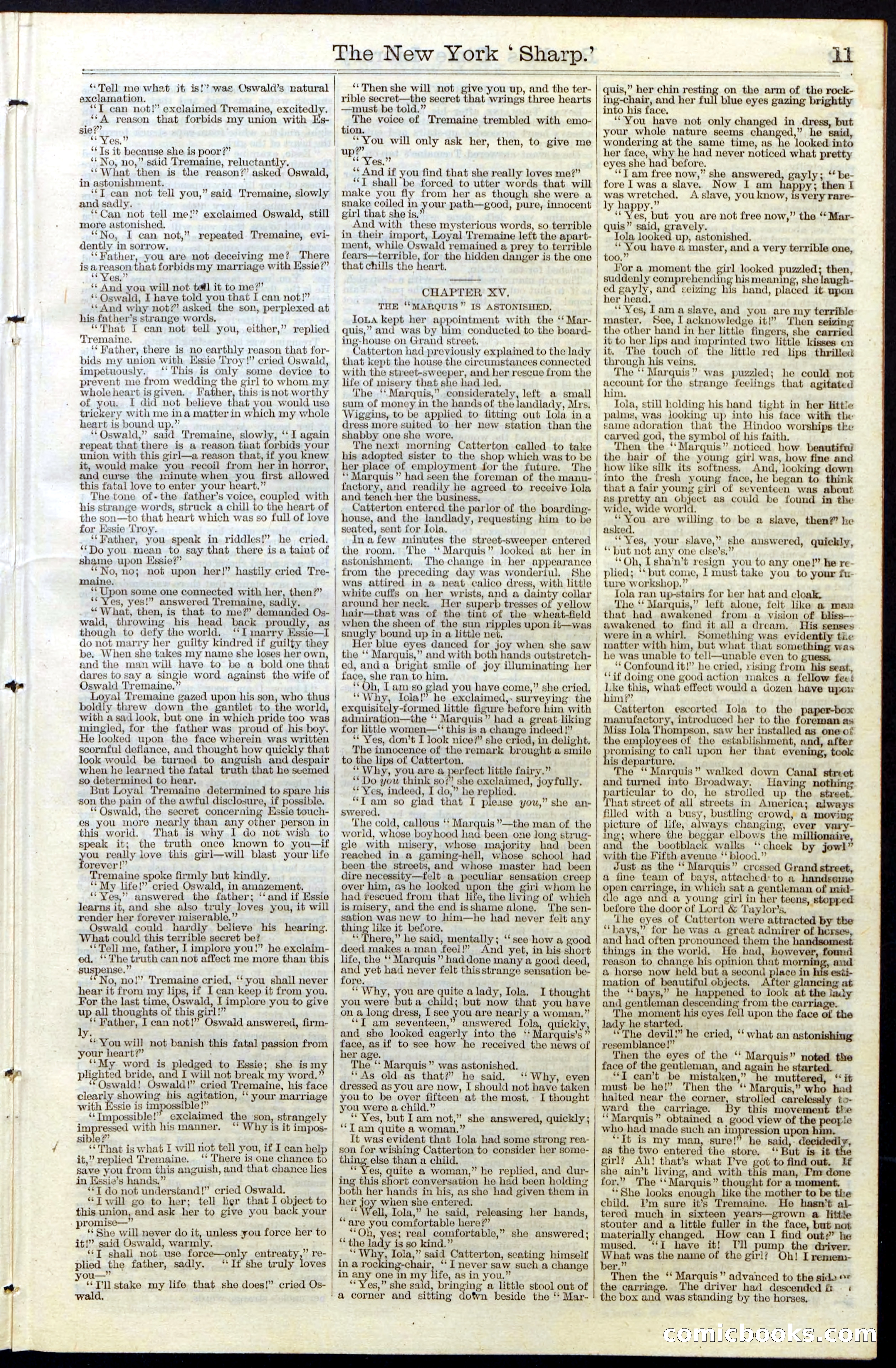
A restored page from Pulp Fiction, 1878. Page through the whole issue in the reader above.
📄 Transcribed text from this page (OCR, searchable)
Machine-transcribed from the original scan — historical spelling and the odd misread are preserved.
- promise— The New York * Sharp.’ * Tell mo what jt is!’ was Oswald’s natural axclamation. ‘*T can not!” exclaimed Tremaine, excitedly. ‘‘A reason that forbids my union with Es- sie?” ts Yes. ” ‘‘ Is it because she is poor?” ‘‘ No, no,” said Tremaine, reluctantly. ‘What then is the reason?’ asked Oswald, in astonishment, . ‘‘T can not tell you,” said Tremaine, slowly and sadly. ‘Can not tell me!” exclaimed Oswald, still more astonished. : ’ ‘“No, I can not,” repeated Tremaine, evi- dently in sorrow. ‘Rather, you are not deceiving me? There is areason that forbids my marriage with Essie?” ‘6 Vos.” ‘* And you will not tall it to me?’ ‘‘ Oswald, I have told you that I can not!” ‘* And why not?’ asked the son, perplexed at his father’s strange words. “That I can not tell you, either,” replied Tremaine. ‘* Father, there is no earthly reason that for- bids my union with Essie Troy!” cried Oswald, impetuously. prevent me from wedding the girl to whom my whole heart is given. lather, this isnot worthy of you. I did not believe that you would uso trickery with me ina matter in which my whole heart is bound up.” ‘‘Oswald,” said Tremaine, BOW * T again repeat that there is a reason that forbids your union with this girl—a reason that, if you knew it, would make you recoil from her in horror and curse the minute when you first allowe this fatal love to enter your heart.” The tone of-the father’s voice, coupled with his strange words, struck a chill to the heart of the son—to that heart which was so full of love for Essie ‘Troy. ‘Father, you speak in riddles!” he cried. ‘“*Do you mean to say that there is a taint of shame upon Essie?” ‘‘ No, no; not upon her!” hastily cried Tre- maine. **Upon some one connected with her, then?” ‘* Yes, yes!” answered Tremaine, sadly, “What, then, is that to me?” demanded Os- wald, throwing his head back proudly, as though to defy the world. ‘I marry Essie—I do not marry her guilty kindred if guilty they be. When she takes my name she loses her own, | and the man will have to be a bold one that | dares to say a single word against the wife of Oswald Tremaine.” Loyal Tremaine gazed upon his son, who thus boldly threw down the gantlet to the world, with asad look, but one in which pride too was mingled, for the father was proud of his boy. He looked upon the face wherein was written scornful defiance, and thought how quickly that look would be turned to anguish and despair when he learned the fatal truth that he seemed so determined to hear, But Loyal Tremaine determined to spare his son the pain of the awful disclosure, if possible. ‘* Oswald, the secret concerning Essie touch- es you more nearly than any other person in this world. That is why I do not wish to speak it; the truth once known to you—if rou really love this girl—will blast your life orever!” Tremaine spoke firmly but kindly. ** My life!” cried Oswald, in amazement, ‘‘ Yes,” answered the father; ‘‘ and if Essie learns it, and she also truly loves you, it will render her forever miserable.” Oswald could hardly believe his hearing. What could this terrible secret be? ‘*Tell me, father, I implore you!” he exclaim- ed, ‘‘ The truth can not affect me more than this suspense.” ‘** No, no!’ Tremaine cried, ‘‘ you shall never hear it from my lips, if I can keep it from you. For the last time, Oswald, I implore you to give up all thoughts of this girl!” ‘* Father, I can not!” Oswald answered, firm- ly. ‘**You will not banish this fatal passion from your heart?’ ‘My word is plonaes to Essie; she is my plighted bride, and I will not break my word,’ ‘Oswald! Oswald!” cried Tremaine, his face clearly showing his agitation, ‘ your marriage with Essie is impossible!” ‘Impossible! exclaimed the ‘son, strangely impressed with his manner. ‘‘ Why is it impos- sible?’ ‘That is what I will not tell you, if I can help it,” replied Tremaine, ‘* There is one chance to save you from this anguish, and that chance lies in Essie’s hands,” ' **T do not understand!” cried Oswald. _ “JT will go to her; tell her that I object to this union, and ask her to give you back your ‘¢ She will never do it, unless you force her to it!” said Oswald, warmly. ‘‘T shall not use force—only entreaty,” re- plied the father, sadly, ‘If she truly loves ? ou—’ ‘‘T’ll stake my life that she does!” cried Os- wald. ‘This is only some device to | ‘Then she will not give you up, and the ter- rible secret—the secret that wrings three hearts —1must be told.” The voice of Tremaine trembled with emo- tion. nou will only ask her, then, to give me es. ‘* And if you find that she really loves me?” **T shall be forced to utter words that will make you fly from her as though she were a snake coiled in your path—good, pure, innocent girl that she is.’ And with these mysterious words, so terrible in their import, Loyal Tremaine left the apart- ment, while Oswald remained a prey to terrible fears—terrible, for the hidden danger is the one that chills the heart. CHAPTER XV, THE ‘*MARQUIS” IS ASTONISHED. JoLA kept her pppoinimnanh with the ‘‘ Mar- quis,” and was by him conducted to the board- ing- house on Grand street. Catterton had previously explained to the lady that kept the house the circumstances connected with the street-sweeper, and her rescue from the life of misery that she had led. The ‘‘ Marquis,” considerately, left a small sum of money in the hands of the landlady, Mrs, Wiggins, to be applied to fitting out Iola ina dress more suited to her new station than the shabby one she wore. The next morning Catterton called to take his adopted sister to the shop which was to be her place of employment for the future. The ‘** Marquis” had seen the foreman of the manu-' factory, and readily he agreed to receive Iola and teach her the business. Catterton entered the parlor of the boarding- house, and the landlady, requesting him to be seated, sent for lola, Ina few minutes the Sareer SISO ER entered the room. The ‘‘ Marquis” looked at her in astonishment. The change in her appearance from the preceding day was wonderiul. She was attired in a neat calico dress, with little white cuffs on her wrists, and a dainty collar around her neck. Her superb tresses of yellow hair—that was of the tint of the wheat-field when the sheen of the sun ripples upon it—was snugly bound up in a little net. Her blue eyes danced for joy when she saw the ‘‘ Marquis,” and with both hands outstretch- ed, anda bright smile of joy iluminating her face, she ran to him, r Oh, Iam so glad you have come,” she cried, **Why, lola!” he exclaimed,. surveying the exquisitely-formed little figure before him with admiration—the ‘ Marquis” had a great liking for little women—“ this is a change indeed!” ** Yes, don’t I look nice?” she cried, in delight, The innocence of the remark brought a smile to the lips of Catterton, ‘Why, you are a perfect little fairy.” ‘* Do you think so?’ she exclaimed, joyfully. ‘Yes, indeed, I do,” he replied. “Tam so glad that I piedie you,” she an- swered. ‘The cold, callous ‘* Marquis”—the man of the world, whose boyhood had been one long strug- gle with misery, whose majority had been reached in a gaming-hell, whose school had been the streets, and whose master had been dire necessity—felt a peculiar sensation creep over him, as he looked wpon the girl whom he had rescued from that life, the living of which is misery, and the end isshame alone, The sen- sation was new to him—he had never felt any thing like it before. st There,” he said, mentally; ‘see how a good deed makes a man feel!” And yet, in his short life, the ** Marquis” had done many a good deed, - yet had never felt this strange sensation be- ore. * Why, pe are quite alady, Iola. I thought you were but a child; but now that you have on a long dress, I see you are nearly a woman,” ‘“‘f am seventeen,” answered Iola, quickly, and she looked eagerly into the ‘ Marquis’s ” face, as if to see how he received the news of her age. The ‘* Marquis ” was astonished. “As old as that?” he said, ‘ Why, even (lressed as you are now, I should not have taken you to be over fifteen at the most, I thought you were a child.” ** Yes, but Iam not,” she answered, quickly; “Tam quite a woman.” It was evident that lola had some strong rea- son for wishing Catterton to consider her some- thing else than a child, “Yes, quite a woman,” he replied, and dur- ing this short conversation he had been holding both her hands in his, as she had given them in her {oy when she entered. ‘** Well, Iola,” he said, releasing her hands, are you comfortable here?” : **Oh, yes; real comfortable,” she answered; ‘* the lady is so kind.” _ “Why, Iola,” said Catterton, seating himself in a rocking-chair, ‘‘ I never saw such a change in any one In my life, as in you.” “Yes,” she said, bringing a little stool out of a corner and sitting dotvn beside the “ Mar- te it A quis,” her chin resting on the arm of the rock- ing-chair, and her f into his face. ‘You have not only changed in dress, but your whole nature seems changed,” he said, wondering at the same time, as he looked into her face, why he had never noticed what pretty eyes she had before. ‘‘T am free now,” she answered, gayly; “ be- fore | was a slave. Now I am happy; then I was wretched, <A slave, you know, is very rare- ly happy.” ‘Yes, but you are not free now,” the ‘* Mar- quis” said, gravely. lola looked up, astonished. ; Hy You have a master, and a very terrible one, 00. lor a moment the girl looked puzzled; then, suddenly cquaprenensing his meaning, she laugh- ed gayly, and seizing his hand, placed it. upon her head. ‘Yes, Lama slave, and you are my terrible master. See, I acknowledge it!” Then seizing the other hand in her little fingers, she carried it to her lips and imprinted two little kisses en it. The touch of the little red lips thrilled through his veins, The ‘‘ Marquis” was puzzled; he could not Sopot for the strange feelings that agitated im, lola, still holding his hand tight in her little palms, was looking up into his face with the same adoration that the Hindoo worships tke carved god, the symbol of his faith. Then the ‘ Marquis” noticed how beautiful the hair of the young girl was, how fine and how like silk its softness. And, looking down into the fresh young face, he began to think that a fair young girl of seventeen was about as pretty an object as could be found in the wide, wide world. ** You are willing to be a slave, then?’ ke asked. ‘Yes, your slave,” she answered, quickly, ** but not any one else’s.” “Oh, I sha’n’t resign you to any one!” he re- plied; ‘‘ but come, I must take you to your fu ture workshop.” Tola ran up-stairs for her hat and cloak. The ‘‘ Marquis,” left alone, felt like a man that had awakened from a vision of bliss—- awakened to find it all a dream. His senses were ina whirl. Something was evidently the matter with him, but what that something was he was unable to tell—unable even to guess ‘“ Confound it!” he cried, rising from his seat. ‘if doing one good action makes a fellow feet ine this, what effect would a dozen have upow im? Catterton escorted Iola to the paper-box manufactory, introduced her to the ioemeenee Miss Iola Thompson, saw her installed as one ot the employees of the establishment, and, after praniseag to call upon her that evening, took departure, The ‘‘ Marquis” walked down Canal street and turned into Broadway. Having nothing articular to do, he strolled up the street. Chat street of all streets in America; always filled with a busy, bustling crowd, a moving picture of life, always changing, ever vary- ing; where the beggar elbows the millionaire, and the bootblack walks ‘cheek by jowl” with the Fifth avenue ‘ blood.” Just as the ‘‘ Marquis” crossed Grand street, a fine team of bays, attached: to a handsome open carriage, in which sat a gentleman of mid- 6 age and a young girl in her teens, stepped before the door of Lord & Taylor’s, =~ ‘the eyes of Catterton were attracted by the ve bare, for he was a great admirer of herses, and had often pronounced them the handsomest things in the world, He had, however, found reason to change his opinion that morning, and a horse now held but a second place in his esti- mation of beautiful objects. After glancing at the “bays,” he happened to look at the lady and gentleman descending from the ec . The moment his eyes fell upon the face of the lady he started. “The devil!” he cried, ‘‘ what an astonishing resemblance!” Then the eyes of the ‘“‘ Marquis” noted the face of the gentleman, and Rane h AC © blue eyes gazing brightly e started. “T can’t be mistaken,” muttered, “ it must be he!” Then the “ uis,” who had halted near the corner, strolled carelessly to- ward the carriage. By this movement the ‘‘Marquis” obtained a good view of the people who had made such an impression upon hon. “It is my man, sure!” he nla, Contioe as the two entered the store. ‘But is it irl? Ah! that’s what I’ve got to find out. If she ain’t living, and with this Pm done for.” The ‘‘ Marquis” thought for a moment. “She looks enough like the mother to be the child. I’m sure it’s Tremaine. He hasn't al- tered much in sixteen years—grown a little stouter and a little fuller in the face, but not materially changed. How can I find out?’ he mused Xt have it! Tll pump the driver. h! Lremem- What was the name of the girl? ber ” Then the “ Marquis” advanced to the side © the carriage. The driver had descended i . + tho box and was standing by the horses. . COMMEOO Saf EO