
Pulp Fiction, 1884 · page 3 of 32
Beadle's New York Dime Library No. 308 — page 3: what you’re looking at
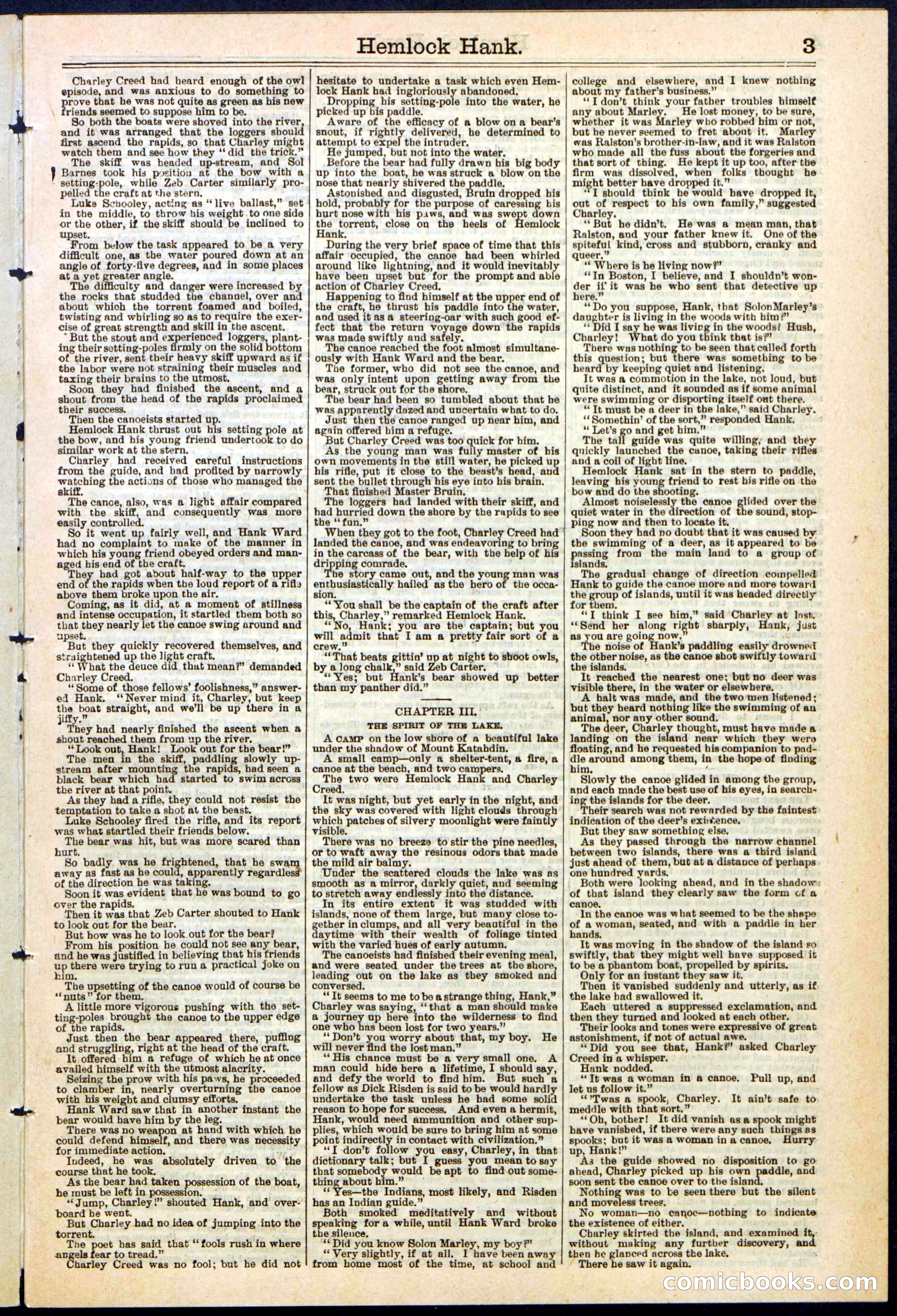
A restored page from Pulp Fiction, 1884. Page through the whole issue in the reader above.
📄 Transcribed text from this page (OCR, searchable)
Machine-transcribed from the original scan — historical spelling and the odd misread are preserved.
Hemlock Hank. Charley Creed had heard enough of the owl episode, and was anxious to do something to pave that he was not quite as green as his new riends seemed to suppose him to be. So both the boats were shoved into the river and it was arranged that the loggers should ! first ascend the rapids, so that Charley might watch them and see how they ‘‘did the trick.” | The skiff was headed up-stream, and Sol | j Barnes took his position at the bow with a getting-pole, while Zeb Carter similarly pro- pelled the craft at the stern, Luke Schooley, acting as “live ballast,” set in the middle, to throw his weight to one side | or the other, if the skiff should be inclined to | upset. | From below the task appeared to be a very difficult one, as the water poured down at an angle of forty-five degrees, and in some places at a yet greater angle. The difficulty and danger were increased by | the rocks that studded the channel, over and | about which the torrent foamed and boiled, | twisting and whirling so as to require the exer- cise of great strength and skill in the ascent. . | * But the stout and experienced meets, Plant of ing their setting-poles firmly on the solid bottom of the river, sent their heavy skiff upward as if the labor were not straining their muscles and taxing their brains to the utmost, Soon they had finished the ascent, and | shout from the head of the rapids proclaimed Then the canoeists started up. Hemlock Hank thrust out his setting pole at the bow, and his young friend undertook to do ' Charley had received careful instructions from the guide, and bad profited by narrowly ae the actions of those who managed the The canoe, also, was a light affair compared with the skiff, and consequently was more easily controlled, fairly well, and Hank Ward | their success. 4 similar work at the stern. sk it went u had no complaint to make of the manner in which his young friend obeyed orders and man- aged his end of the craft. They had got about half-way to the upper end of the rapids when the loud report of a rifle above them broke upon the air, Coming, as it did, at a moment of stillness and intense occupation, it startled them both so that they nearly let the canoe swing around and upset. ‘But they quickly recovered themselves, and straightened up the light craft. ‘‘ What the deuce did that mean?” demanded Charley Creed, “Some of those fellows’ foolishness,” answer- ed Hank. ‘‘ Never mind it, Charley, but keep the boat straight, and we'll be up there in a = jiffy.” : They had nearly finished the ascent when a sbout reached them from up the river. ‘*Look out, Hank! Look out for the bear!” The men the skiff, paddling slowly up- stream after mounting the rapids, had seen a black bear which had started to swim across the river at that point. As they had a rifle, they could not resist the temptation to take a shot at the beast. Luke Schooley fired the rifle, and its report was what startled their friends below. The bear was hit, bu{ was more scared than hurt. So badly was he frightened, that he sw away as fast as he could, apparently regardle of the direction he was taking. Soon it was evident that he was bound to go over the rapids. Then it was that Zeb Carter shouted to Hank to look out for the bear. But how was he to look out for the bear? From his position he could not see any bear, and he was justified in believing that his friends up there were trying to run a practical joke on | im, | The upsetting of the canoe would of course be ‘*nuts” for them, A little more vigorous pushing with the set- ting-poles brought the canoe to the upper edge of the rapids, Just then the bear appeared there, puffing and struggling, right at the head of the craft, It offered him a refuge of which he at once availed himself with the utmost alacrity. Seizing the prow with his pas, he proceeded to clamber in, nearl overturning the canoe with his weight and clumsy efforts, Hank Ward saw that in another instant the | bear would have him by the leg. There was no weapon at hand with which he could defend himself, and there was necessity for immediate action. | Indeed, he was absolutely driven to the course that he took, ; As the bear had taken ession of the boat, he must be left in on. : ! “Jump, Charley!” shouted Hank, and over- board he went. But Charley had no idea of jumping into the : torrent, The t has said that “fools rush in where 4 angels fear to tread.” : ue harley Creed was no fool; but he did not hesitate to undertake a task which even Hem- lock Hank had ingloriously abandoned, Dropping bis setting-pole into the water, he picked up bis paddle. Aware of the efficacy of a blow on a bear’s snout, if rightly delivered, he determined to attempt to expel the intruder, He jumped, but not into the water. Before the bear had fully drawn his big body up into the boat, he was struck a blow on the nose that nearly shivered the paddle, Astonished and disgusted, Bruin dropped his hold, probably for the purpose of caressing bis hurt nose with his paws, and was swept down the torrent, close on the heels of Hemlock Hank. During the very brief space of time that this affair occupied, the canoe had been whirled around like lightning, and it would inevitably have been upset but for the prompt and able action of Charley Creed. Happening to find himself at the upper end of the craft, he thrust his paddle into the water, and used it asa steering-oar with such good ef- fect that the return voyage down the rapids was made swiftly and safely. The canoe reached the foot almost simultane- ously with Hank Ward and the bear. The former, who did not see the canoe, and was only intent upon getting away from the bear, struck out for the shore. The bear had been so tumbled about that he was apparently dazed and uncertain what to do. Just then the canoe ranged up near him, and again offered bim a refuge. But Charley Creed was too quick for him. As the young man was fully master of bis own movements in the still water, he picked up his rifle, put it close to the beast’s head, and sent the bullet through bis eye into his brain. That finished Master Bruin, The loggers had landed with their skiff, and had hurried down the shore by the rapids to see the ‘* fun.” When they got to the foot, Charley Creed had landed the canoe, and was endeavoring to bring in the carcass of the bear, with the help of his dripping comrade. he story came out, and the young man was enthusiastically hailed as the hero of the occa- sion. “You shall be the captain of the craft after seas ee remarked Hemlock Hank, “No, Hank; you are the captain; but you will admit that I am a pretty fair sort of a crew. “That beats gittin’ up at night to shoot owls, by a long chalk,” said Zeb Carter. “Yes; but Hank’s bear showed up better than my panther did.” CHAPTER III, THE SPIRIT OF THE LAKE. A camp on the low shore of a beautiful lake under the shadow of Mount Katahdin. A small camp—only a shelter-tent, a fire, a canoe at the beach, and two campers. be two were Hemlock Hank and Charley reed, It was night, but yet early in the night, and the sky was cove with light clouds through ls patches of silvery moonlight were faintly visible. There was no breeze to stir the pine needles, or to waft away the resinous odors that made the mild air balmy. Under the scattered clouds the lake was as smooth as a mirror, darkly quiet, and seeming to stretch away endlessly into the distance. In its entire extent it was studded with islands, none of them large, but many close to- gethee in clumps, and all very beautiful in the aytime with their wealth of foliage tinted with the varied hues of early autumn. The canoeists had finished their evening meal, and were seated under the trees at the shore leading out on the lake as they smoked and conversed. ‘Tt seems to me to be astrange thing, Hank,” Charley was saying, ‘that a man should make a suey up here into the wilderness to find one who has been lost for two years.” “Don’t you worry about that, my boy. He will never find the lost man.” ‘“‘His chance must be a very small one. A man could hide here a lifetime, I should say, and defy the world to find him. But such a fellow as Dick Risden is said to be would hardly undertake the task unless he had some solid reason to oo for success, And even a hermit, Hank, would need ammunition and other sup- plies, which would be sure to bring him at some point indirectly in contact with civilization.” ‘I don’t follow you easy, Charley, in that “ge mean to say dictionary talk; but I guess + find out some- that somebody would be apt thing about him.” ‘*'Yes—the Indians, most likely, and Risden has an Indian guide.” Both smoked meditatively and without speaking fora while, until Hank Ward broke the silence, ** Did you know Solon Marley, my boy?” “Very slightly, if at all. I have been away from home most of the time, at school and WO college and elsewhere, and I knew nothing about my father’s business.” ‘*T don’t think your father troubles himself any about Marley. He lost money, to be sure, whether it was Marley who robbed him or not, but he never seemed to fret about it. Marley was Ralston’s brother-in-law, and it was Ralston who made all the fuss about the forgeries and that sort of thing. He kept it up too, after the firm was dissolved, when folks thought he might better have dropped it.” “IT should think he would have dropped it out of respect to his own family,” suggested Charley. **But he didn’t. He was a mean man, that Ralston, and your father knew it. One of the spiteful kind, cross and stubborn, cranky and queer,” ** Where is he living now?” **In Boston, I believe, and I shouldn’t won- der if' it was he who sent that detective up here.” “Do you suppose, Hank, that SolonMarley’s daughter is living in the woods with him?” ‘* Did I say he was 2 Na in the woods? Hush, Charley! hat do you think that is?” There was nothing to be seen that called forth this question; but there was something to be heard by keeping quiet and listening. It was a commotion in the lake, not loud, but quite distinct, and it sounded as if some animal were swimming or disporting itself out there. “Tt must be a deer in the lake,” said Charley. ‘* Somethin’ of the sort,” responded Hank. * Let’s go and get him.” The tall guide was quite willing; and they quickly launched the canoe, taking their rifles and a coil of light line. Hemlock Hank sat in the stern to paddle, leaving his young friend to rest bis rifle on the bow and do the shooting. Almost noiselessly the canoe glided over the quiet water in the direction of the sound, stop- ping now and then to locate it. Soon they bad no doubt that it was caused by the swimming of a deer, as it appeared to be assing from the main land to a group of siands. The gradual change of direction compelled Hank to guide the canoe more and more toward the group of islands, until it was headed directly for them. “T think I see him,” said Charley at Inst. “Send her along right sharply, Hank, just as you are going now, rex: he noise of Hank’s paddling easily drowned the other noise, as the canoe shot swiftly toward the islands. It reached the nearest one; but no deer was visible there, in the water or elsewhere. A halt was made, and the two wen listened; but they heard nothing like the swimming of an animal, nor any other sound. The deer, Charley thought, must have made a. landing on the island near which they wero floating, and he requested his companion to pad- dle around among them, in the hope of finding him, Slowly the canoe glided in among the group, and each made the best use of his eyes, in search- ing the islands for the deer. | heir search was not rewarded by the faintest indication of the deer’s existence, But they saw something else. As they passed through the narrow channel between two islands, there was a third island just ahead of them, but at a distance of perhaps one hundred yards. Both were looking ahead, and in the shadow: of that island they clearly saw the form cf a canoe. In the canoe was what seemed to be the shape of a woman, seated, and with a paddle in her hands. It was moving in the shadow of the island so swiftly, that pag A well bave supposed it to be a phantom t, propelled by spirits. Only for an instant they saw it. Then it vanished suddenly and utterly, as if the lake bad swallowed it. Each uttered a suppressed exclamation, and then they turned and looked at each other. Their looks and tones were expressive of great astonishment, if not of actual awe. “Did you see that, Hank?’ asked Charley Creed in a whisper. Hank nodded. “Tt was a woman in a@ canoe. Pull up, and let us follow it.” : “Twas a spook, Charley. It ain’t safe to meddle with that sort,” ‘‘Oh, bother! It did vanish asa k might bave vanished, if there were any such things as spooks; but it was a woman inacanoe, Hurry up, Hank!” A3 the guide showed no disposition to go ahead, Charley picked up his own dle, and soon sent the canoe over to the islan Nothing was to be seen there but the silent and moveless trees. No woman—no canoe—notbing to indicate the existence of either. Charley skirted the island, and examined = without making any further discovery, an tben he glanced across the lake, There he saw it again. ' ‘ MICOOOKS (0) (C G (0)