
Pulp Fiction, 1884 · page 4 of 32
Beadle's New York Dime Library No. 308 — page 4: what you’re looking at
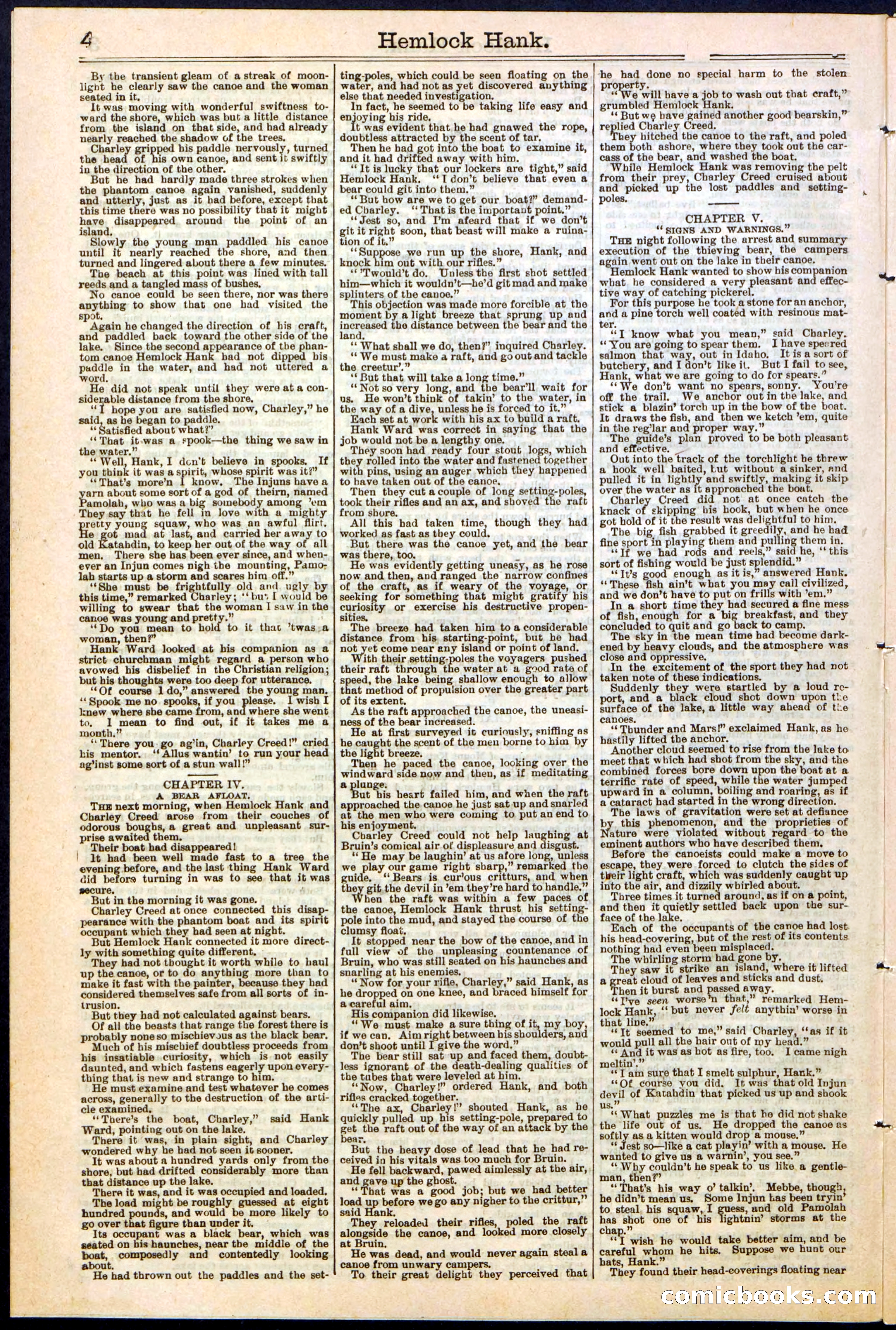
A restored page from Pulp Fiction, 1884. Page through the whole issue in the reader above.
📄 Transcribed text from this page (OCR, searchable)
Machine-transcribed from the original scan — historical spelling and the odd misread are preserved.
4 _ Hemlock Hank. By the transient gleam of a streak of moon- light be clearly saw the canoe and the woman seated in it. It was moving with wonderful swiftness to- ward the shore, which was but a little distance from the island on that side, and had already nearly reached the shadow of the trees, Charle gripped his paddle nervously, turned the h of his own canoe, and sent it swiftly in the direction of the other. But he had hardly made three strokes when the phantom canoe again vanished, suddenly and utterly, just as it had before, except that this time there was no possibility that it might have disappeared around the point of an island, Slowly the young man paddled his canoe until it nearly reached the shore, and then turned and lingered about there a few minutes. The beach at this point was lined with tall reeds and a tangled mass of bushes, No canoe could be seen there, nor was there anything to show that one had visited the spot, Again he changed the direction of his craft, and paddled back toward the other side of the lake. Since the second appearance of the phan- tom canoe Hemlock Hank bad not dipped bis puddle in the water, and had not uttered a word. He did not speak until they were at a con- re distance from the shore, “*T hope you are satisfied now, Charley,” he said, as he began to paddle, “« Satisfied about what?” ‘That it-was a spook—the thing we saw in the water.” ‘Well, Hank, I dcn't believe in spooks. If you think it was a spirit, whose spirit was it?” ‘‘That’s more’n | know, The Injuns havea yarn about some sort of a god of theirn, named amolah, who was a big somebody among ’em They say that he fell in love with a mighty Beery young squaw, who was an awful flirt. e ot mad at last, and carried her away to old Katahdin, to keep ber out of the way of all men, There she has been ever since, and when- ever an Injun comes nigh the mounting, Pamo- lah starts up a storm and scares bim off.” ‘*She must be frightfully old and ugly by this time,” remarked Charley; *‘ bus [ would be willing to swear that the woman I saw in the canoe was young and pretty. ‘‘Do you mean to hold to it that ’twas.a woman, then?” Hank Ward looked at bis companion as a strict churchman might regard a person who avowed his disbelief in the Christian religion; but his thoughts were too deep for utterance, “Of course 1 do,” answered the young man. ‘*Spook me no mou, you please. I wish I knew where she came from, and where she went to. 1 mean to find out, if it takes me a month,” ‘There you. go ag’in, Charley Creed!” cried his mentor. ‘* Allus wantin’ to run your head ag’inst some sort of a stun wall!” CHAPTER IV. A BEAR AFLOAT. Tue next morning, when Hemlock Hank and Charley Creed arose from their couches of odorous boughs, a great and unpleasant sur- prise awaited them. Their boat had disap ed! pear ' 1t had been well made fast to a tree the evening before, and the last thing Hank Ward did before turning in was to see that it was secure, But in the morning it was gone. Charley Creed at once connected this disa pearance with the phantom boat and its spirit occupant which they had seen at night. But Hemlock Hank connected it more direct- ly with something quite different, They bad not thought it worth while to haul up the canoe, or to do anything more than to make it fast with the painter, because they bad considered themselves safe from all sorts of in- trusion. But they had not calculated against bears. Of all the beasts that range the forest there is probably none so mischievous as the black bear. Much of his mischief doubtless proceeds from his insatiable curiosity, which is not easily daunted, and which fastens eagerly upon every- thing that is new and strange to him. He must examine and test whatever he comes across, generally to the destruction of the arti- cle examined, ‘‘There’s the boat, Charley,” said Hank Ward, pointing out on the lake. There it was, in plain sight, and Charley wondered why be had not seen it sooner. It was about a hundred yards only from the shore, but had drifted considerably more than that distance up the lake. Thera it was, and it was occupied and loaded. The load might be roughly guessed at eight hundred nds, and would be more likely to go over that figure than under it. — Its occupant was a black bear, which was seated on bis haunches, near the middle of the Bont, : ly and contentedly looking abou He had thrown out the paddles and the set- ting poles, which could be seen floating on the water, and had not as yet discovered anything else that needed investigation. In fact, he seemed to be taking life easy and enjoying his ride, t was evident that he had gnawed the rope, doubtless attracted by the scent of tar. Then he had got into the boat to examine it, and it had drifted away with him. ‘It is lucky that our lockers are tight,” said Hemlock Hank, ‘‘I don’t believe that even a bear could git into them.” ‘** But how are we to get our boat?” demand- ed Charley. ‘‘ That is the important point.” ** Jest so, and I’m afeard that if we don’t git it right soon, that beast will make a ruina- tion of it.” ‘*Suppose we run up the shore, Hank, and knock him out with our rifles.” ‘“°Twould’t do. Unless the first shot settled him—which it wouldn’t—he’d git mad and make splinters of the canoe.” This objection was made more forcible at the moment by alight breeze that sprung up and tasreaeee be distance between the bear and the and. ‘** What shall we do, then?” inquired Charley. ** We must make a raft, and go out and tackle the creetur’.” ‘* But that will take a long time.” ** Not so very long, and the bear’ll wait for us. He won’t think of takin’ to the water, in the way of a dive, unless he is forced to it.” Each set at work with his ax to build a raft. Hank Ward was correct in saying that the job would not be a lengthy one. They soon had ready four stout logs, which they rolled into the water and fastened together with pins, using an auger which they happened to have taken out of the canoe, Then they cut acouple of long setting-poles, took their rifles and an ax, and shoved the raft from shore, All this had taken time, though they had worked as fast as they could, But there was the canoe yet, and the bear was there, too. " He was evidently getting uneasy, as he rose now and then, and ranged tke narrow confines of the craft, as if weary of the voyage, or seeking for something that might gratify his coreg yi or exercise his destructive propen- sities, The breeze had taken him to a considerable distance from his. starting-point, but he had not yet come near eny island or point of land. ith their setting-poles the voyagers pushed their raft through the water at a good rate of speeds the lake being shallow enough to allow that method of propulsion over the greater part of its extent. ‘ As the raft approached the canoe, the uneasi- ness of the bear increased. He at first surveyed it curiously, sniffing as he cangnt the scent of the men borne to him by the light breeze. Then he paced the canoe, looking over the bean oai side now and then, as if meditating a plunge. But his heart failed him, and when the raft approached the canoe he just sat up and snarled at the men who were coming to put an end to his enjoyment. Charley Creed could not help laughing at Bruin’s comical air of displeasure and disgust. ‘‘He may be laughin’ at us afore long, unless we play our game right sharp,” remarked the guide, ‘Bears is cur’ous critturs, and when they git, the devil in ’em they’re hard to handle,” hen the raft was within a few paces of the canoe, Hemlock Hank thrust his setting- pole into the mud, and stayed the course of the clumsy float, : It stopped near the bow of the canoe, and in full view of the unpleasing countenance of Bruin, who was still seated on his haunches and snarling at his enemies, “ Now for your rifle, Charley,” said Hank, as he el ig on one knee, and braced himself for a careful aim. His companion did likewise. ‘We must make a sure thing of it, my boy, if we can. Aim right between his shoulders, and don’t shoot until I give the word,” The bear still sat up and faced them, doubt- less ignorant of the death-dealing qualities of the tubes that were leveled at him. *‘Now, Charley!” ordered Hank, and both rifles cracked together. “The ax, Charley!” shouted Hank, as _ he quickly pulled up his setting-pole, prepared to get the raft out of the way of an attack by the ar. But the heavy dose of lead that he had re- ceived in his vitals was too much for Bruin. He fell backward, pawed aimlessly at the air, and gave up the ghost. “That was a good job; but we had better baad u betore we go any nigher to the crittur,” sai nD They reloaded their rifles, poled the raft alongside the canoe, and looked more closely at Bruin. t He was dead, and would never again steala canoe from unwary campers. To their great delight they perceived that a nen he had done no special harm to the stolen bah a= Sh “We will have a job to wash out that craft,” grumbled Hemlock Hank. ‘‘ But we bave gained another good bearskin,” goo Charley Creed. hey hitched the canoe to the raft, and poled them both ashore, where they took out the car- cass of the bear, and washed the boat. While Hemlock Hank was removing the pelt from their prey, Charley Creed cruised about and picked up the lost paddles and setting- poles. -——_—__-— CHAPTER V. “SIGNS AND WARNINGS.” THE night following the arrest and summary execution of the thieving bear, the campers again went out on the lake in their canoe, Hemlock Hank wanted to show his companion what he considered a very pleasant and effec- tive way of catching pickerel. For this purpose he took a stone for an anchor, and a pine torch well coated with resinous mat- ter. “T know what you mean,” said Charley. ‘You are going to spear them. I have specred salmon that way, out in Idaho. It is a sort of butchery, and I don’t like it. But I fail to see, Hank, what we are going to do for spears.” ‘‘We don’t want no spears, sonny. You're off the trail. We anchor out in the lake, and stick a blazin’ torch up in the bow of the boat. It draws the fish, and then we ketch ’em, quite in the reg’lar and proper way.” The guide’s plan proved to be both pleasant and effective. _ Out into the track of the torchlight he threw a hook well baited, tut without a sinker, and pulled it in Deny and swiftly, making it skip over the water as it approached the boat. Charley Creed did not at once catch the knack of skipping bis hook, but when he once got hold of it the result was ap hi to him. The big fish grabbed it gree ily and he had fine sport in playing them and pulling them in. ‘‘If we had rods and reels,” said he, ‘* this sort of fishing would be just splendid.” ‘It’s good enough as it is,” answered Hank. “These fish ain't what you may call civilized, and we don’t have to put on frills with ’em.” In a short time they had secured a fine mess of fish, enough for a big breakfast, and they concluded to quit and go back to camp. The sky in the mean time had become dark- ened by heavy clouds, and the atmosphere was close and oppressive. In the excitement of the sport they had not taken note of these indications. Suddenly they were startled by a loud re- rt, and a black cloud shot down upon the surface of the lake, a little way ahead of tle canoes. ‘¢Tbunder and Mars!” exclaimed Hank, as he hastily lifted the anchor. Another cloud seemed to rise from the lake to. meet that which had shot from the sky, and the combined forces bore down upon the boat at a terrific rate of speed, while the water jumped upward in a column, boiling and roaring, as if a cataract had started in the wrong direction. The laws of gravitation were set at defiance by this phenomenon, and the proprieties of ature were Violated without regard to the eminent authors who have described them, Before the canoeists could make a move to escape, they were forced to clutch the sides of tleir light craft, which was suddenly caught up into the air, and dizzily whirled about. Three times it turned around, as if on a point, and then it tag settled back upon the sur- face of the lake. Each of the occupants of the canoe had lost. his bead-covering, but of the rest of its contents. nothing had even been misplaced. The whirling storm had gone by, They saw it strike an island, where it lifted a great cloud of leaves and sticks and dust. hen it burst and pared away. “I've seen worse’n that,” remarked Hem- lock Hank, ‘‘ but never felt anythin’ worse in that line,” - “Tt seemed to me,” said Charley, ‘‘as if it would pull all the hair out of my head.” ‘¢ And it was as hot as fire, too. I came nigh meltin’,” ‘*T am sure that I smelt sulphur, Hank.” “Of course you did. It was that old Injun devil of Katahdin that picked us up and shook us. ‘“ What puzzles me is that he did not shake the life out of us. He dropped the canoe as softly as a kitten would drop a mouse,” * Jest so—like a cat playin’ with a mouse. He wanted to give us a warnin’, you see.” “Why couldn’t he speak to us like a gentle- man, then?” “That's his way o’ talkin’, Mebbe, though, he didn’t mean us, Some Injun bas been tryin to steal, his squaw, I guess, and old Pamolah ightnin’ storms at the ee shot one of his chap. | ““T wish he would take better aim, and be careful whom he hits. Suppose we hunt our hats, Hank.” : They found their head-coverings floating near - Gomicbooks —_- ~ oe a aN . >