
Pulp Fiction, 1884 · page 2 of 32
Beadle's New York Dime Library No. 308 — page 2: what you’re looking at
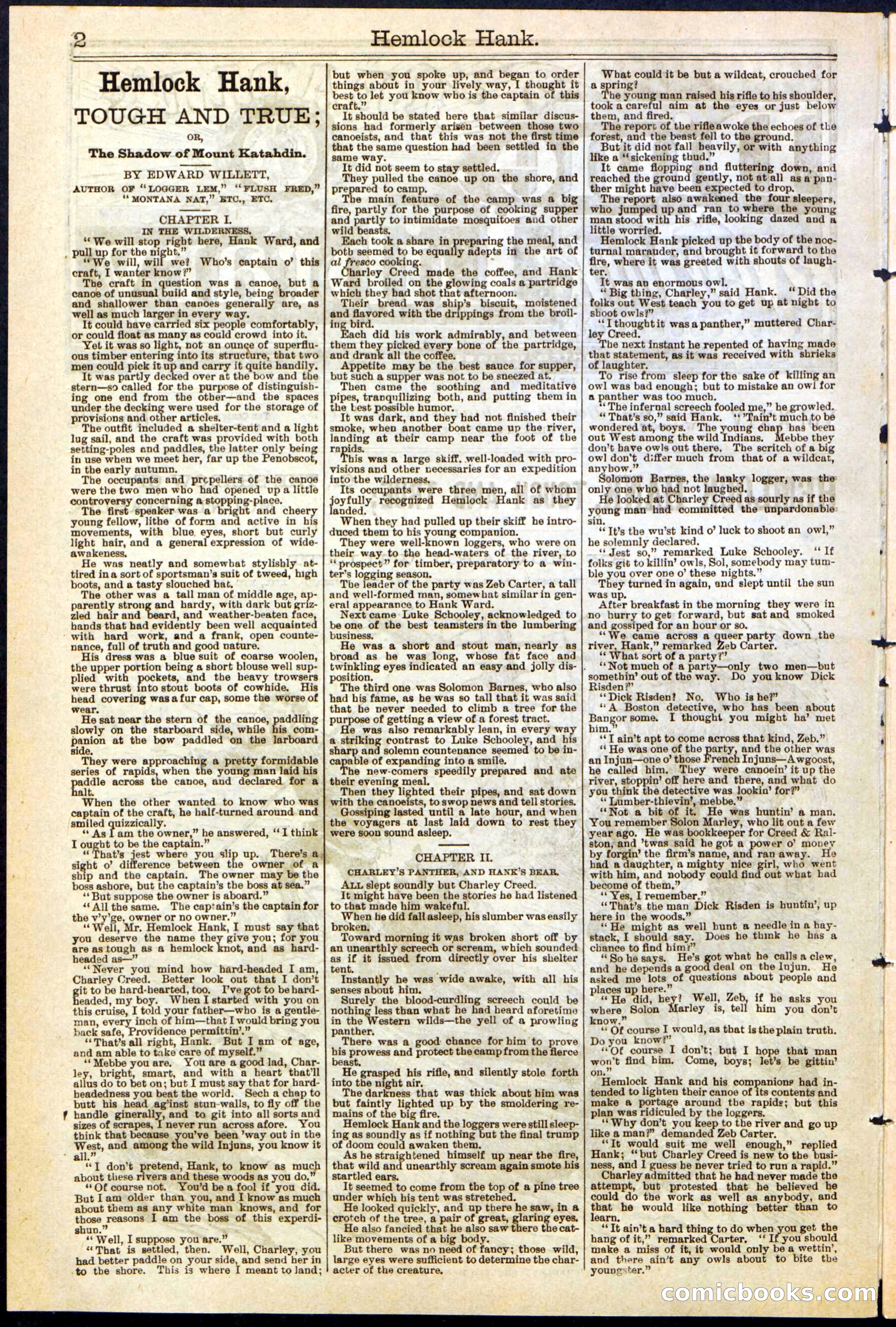
A restored page from Pulp Fiction, 1884. Page through the whole issue in the reader above.
📄 Transcribed text from this page (OCR, searchable)
Machine-transcribed from the original scan — historical spelling and the odd misread are preserved.
a Hemlock Hank. Hemlock Hank, TOUGH AND TRUE; R, The Shadow of Mount Katahdin. BY EDWARD WILLETT, AUTHOR OF “LOGGER LEM,” “FLUSH FRED,” ‘*MONTANA NAT,” BTC., ETC. CHAPTER IL. IN THE WILDERNESS, “We will stop right here, Hank Ward, and . pull up for the night,” “We will, will we? Who’s captain o’ this craft, I wanter know?” The craft in question was a canoe, but a canoe of unusual build and style, being broader and shallower than canoes generally are, as well as much larger in every way. It could have carried six people comfortably, or could float as many as could crowd into it. Yet it was so light, not an ounce of superflu- ous timber entering into its structure, that two men could pick it up and carry it quite handily. It was partly decked over at the bow and the stern—so called for the purpose of distinguish- ing one end from the other—and the spaces under the decking were used for the storage of provisions and other articles. The outfit included a shelter-tent and a light lug sail, and the craft was provided with both setting-poles and paddles, the latter only being in use when we meet her, far up the Penobscot, in the early autumn. The occupants and prcpellers of the canoe were the two men who had opened up a little controversy concerning a stopping-place. The first speaker was a bright and cheery young fellow, lithe of form and active in his movements, with blue eyes, short but curly light hair, and a general expression of wide- awakeness., He was neatly and somewhat stylisbly at- tired ina sort of sportsman’s suit of tweed, high boots, and a tasty slouched hat. The other was a tall man of middle age, ap- parently ee hardy, with dark but griz- zled hair and , and weather-beaten face hands that had evidently been well acquainted ‘with hard work, and a frank, open counte- nance, full of truth and good nature. His dress was a blue suit of coarse woolen, the upper portion being a short blouse well sup- plied with kets, and the beavy trowsers were thrust into stout boots of cowhide. His head covering wasafur cap, some the worse of wear. He sat near the stern of the canoe, paddling slowly on the starboard side, while com- ee at the bow paddled on the larboard 8 They were Bpproscaney a pretty formidable series of rapids, when the young man laid his ddle across the canoe, and declared for a t. When the other wanted to know who was captain of the craft, he half-turned around and | smiled guizzically. ‘* As | am the owner,” he answered, “I think I ought to be the captain.” ns Phat’s jest where you slip up. There's sight o’ difference between the owner of a ship and the captain. The owner may be the boss ashore, but the captain’s the boss at sea.” ‘* But suppose the owner is aboard.” ‘‘Allthe same. The captain’s the captain for the v’y’ge, owner or no owner.” ‘Well, Mr. Hemlock Hank, I must say that you deserve the name ay you; for you are as tough as a hemlock knot, and as hard- headed as—” ‘‘Never you mind how hard-headed I am, Charley Creed. Better look out that I don’t it to be hard-hearted, too, I’ve got to be hard- Fania’: my boy. WhenI started with you on this cruise, I told your father—who is a gentle- man, every inch of him—that I would bring you back safe, Providence permittin’.” ‘‘That’s all right, Hank. But I am of age, and am able to take care of myself.” ‘‘Mebbe you are, You are a good lad, Char- ley, bright, smart, and with a heart that'll allus do to bet on; but I must say that for hard- beadedness you beat the world. Sech a chap to butt his head. stun-walls, to fly off the f handle ginerally, and to git into all sorts and sizes of scrapes, I never run acrossafore. You think that because ’ve been ’way out in the ee and among the wild Injuns, you know it ‘“‘T don’t pretend, Hank, to know as much about these rivers and these woods as you do, **Of course not. You’d bea fool if you did. But Iam older than you, and I know as much about them as any white man knows, and for those reasons I am the boss of this experdi- hu.” . ‘‘ Well, I suppose you are.” “That is settled, then. Well, Charley, you had better paddle on your side, and send her in -to the shore. This is where I meant to land; with the canoe but when you spoke up, and began to order things about in your lively way, I thought it best to let you know who is the captain of this craft.” It should be stated here that similar discus- sions had formerly arisen between those two canoeists, and that this was not the first time that the same question had been settled in the same way. It did not seem to stay settled. They pulled the canoe up on the shore, and a to camp. e main feature of the camp was a big fire, partly for the purpose of cooking supper and dant Re intimidate mosquitoes and other wine ah te k a share in preparing th al, and ach took a share in ng the meal, an botb seemed to be equally adepts in the art of al oO ok ; ley Creed made the coffee, and Hank Ward broiled on the glowing coals a partridge which they bad shot that afternoon. Their bread was ship’s biscuit, moistened = = with the drippings from the broil- ng bird. ch did bis work admirably, and between them they picked every bone of the partridge, and drank all the coffee. Appetite may be the best sauce for supper, but such a supper was not to be sneezed at. Then came the soothing and meditative pipes, tranquilizing both, and putting them in the best possible humor, It was dark, and they had not finished their smoke, when another boat came up the river, at at their camp near the foot of the rapids. his was a large skiff, well-loaded with pro- visions and other necessaries for an expedition into the wilderness. Its occupants were three men, all of whom hoe recognized Hemlock Hank as they anded. When they had pulled up their skiff he intro- duced them to his young companion. They were well-known loggers, who were on their way. to the head-waters of the river, to ‘* prospect” for timber, preparatory to a win- ter’s logging season, The leader of the party was Zeb Carter, a tall and well-formed man, somewhat similar in gen- eral appearance to Hank Ward. Next came Luke Schooley, scepp ledges: to be one of the best teamsters in the lumbering business. He was a short and stout man, nearly as broad as he was long, whose fat face and twinkling eyes indicate position, The third one was Solomon Barnes, who also had his fame, as he was so tall that it was said that he never needed to climb a tree for the pu of getting a view of a forest tract. e was also remarkably lean, in every wa a serking contrast to Luke Schooley, and his s and solemn countenance seemed to be in- oe le of expanding into a smile. he new-comers speedily prepared and ate their evening meal. Then they gr their pipes, and sat down ts, to swop news and tell stories. ing lasted until a late hour, and when the voyagers at last laid down to rest they were soon sound asleep. CHAPTER II. CHARLEY’S PANTHER, AND HANK’S BEAR. ALL slept soundly but Charley Creed. It might have been the stories he had listened to that made him wakeful. When he did fallasleep, his slumber was easily broken, Toward morning it was broken short off by an unearthly screech or scream, which sounded as if it issued from directly over his shelter tent. : Instantly he was wide awake, with all his senses about him. Surely the blood-curdling screech could be nothing less than what he had heard aforetime in the Western wilds—the yell of a prowling panther, There was a good chance for him to prove rom ete and protect the camp from the flerce as He d his rifle, and silently stole forth into the night air. 7 The darkness that was thick about him was but faintly lighted up by the smoldering re- mains of the big fire. _ Hemlock Hank and the loggers were still sleep- ing as soundly as if nothing but the final trump of doom could awaken them. As he straightened himself up near the fire, that wild and unearthly scream again smote his startled ears, It seemed to come from the top of a pine tree under which bis tent was stretched. _ He looked quickly, and up there he saw, in a crotch of the tree, a of great, glaring eyes. He also fancied that he also saw there the cat- like movements of a big body. But there was no need of fancy; those wild, large eyes were sufficient to determine the char- acter of the creature, an easy and jolly dis- |. What couldit be but a wildcat, crouched for a spring? he young man raised his rifle to his shoulder, took a careful aim at the eyes or just below them, and fired. The report of the rifleawoke the echoes of the forest, and the beast fell to the ground. But it did not fall heavily, or with anything like a “sickening thud.” It came flopping and fluttering down, and reached the ground gently, not at all asa pan- ther might have been expected to drop, The report also awakened the four sleepers, who jumped up and ran to where the young man stood with his rifle, looking dazed and a little worried. Hemlock Hank picked up the body of the noc- turnal marauder, and brought it forward tothe are, where it was greeted with shouts of laugh- < It was av enormous owl, “ Big thing, Charley,” said Hank. “ Did the folks out West teach you to get up at night to shoot owls?” “IT thoughtit was a panther,” muttered Char- nN pane he next instant he repented of having made that statement, as it was received with sbrieks of laughter. To rise from sleep for the sake of killing an owl was bad enough; but to mistake an ow! for a panther was too much. ** The infernal screech fooled me,” he growled. “That’s so,” said Hank, ‘*’Tain’t much to be wondered at, boys. The young chap has been out West among the wild Indians. ebbe they don’t bave owls out there, The scritch of a big owl don’t differ much from that of a wildcat, anybow.” Solomon Barnes, the lank only one who had not laughed. . He looked at Charley Creed as sourly as if the young man had committed the unpardonable sin, ‘‘ Tt’s the wu’st kind o’ luck to shoot an owl,” he solemnly declared. ‘* Jest so,” remarked Luke Schooley. “ If folks git to killin’ owls, Sol, somebody may tum- ble you over one o’ these nights.” They turned in again, and slept until the sun was up. After breakfast in the morning the no hurry to get forward, but sat an and gossiped for an hour or so. ‘““We came across a queer party down the river, Hank,” remarked Zeb Carter. ‘What sort of a party?” **Not much of a party—only two men—but somethin’ out of the way. Do youknow Dick Risden?” ; ‘**Dick Risden? No. Who is he?” ‘“A Boston detective, who has been about Bangor some. I thought you might ha’ met him.” ‘*T ain’t apt to come across that kind, Zeb.” ‘‘ He was one of the party, and the other was an Injun—one o’ those French Injuns—A wgoost, he called him, They were canoein’ it up the river, soppy off here and there, and what do you think the detective was lookin’ for?” ‘« Lumber-thievin’, mebbe.” “Not a bit of it. He was huntin’ a man. You remember Solon Marley, who lit out a few year ago. He was bookkeeper for Creed & Ral- ston, and twas said he got a power o’ money by f ’the firm’s name, and ran away. He had a daughter, a mighty nice girl, who went with him, and nobody could find out what bad become of them,” ‘** Yes, I remember.” “That’s the man Dick Risden is buntin’, up here in the woods.” “He might as well bunt a needle in a hay- stack, I should say. Does he think he has a chance to find him?” *Sohesays. He’s got what he calls a clew, and he depends a good deal on thelnjun. He asked me lots of questions about people and laces up here. ‘“ He Bid, hey? Well, Zeb, if he asks you where Solon Marley is, tell him you don’t know.” ** Of course I would, as that is the plain truth. Do you know?” ‘“Of course I don’t; but I hope that man won't find him, Come, boys; let’s be gittin’ dD. Hemlock Hank and his companions had in- tended to lighten their canoe of its contents and make @& portage around tbe rapids; but this plan was ridiculed a the loggers, ‘* Why don’t you keep to the river and go up like a man?” demanded Zeb Carter. “It would suit me well enough,” replied Hank; ‘but Charley Creed is new to the busi- ness, and I guess be never tried to run a rapid.” Charley admitted that he had never made the attempt, but protested that he believed he could do the work as well as anybody, and ~ he would like nothing better than to earn. . “It ain’t a hard thing to do when yon get the hang of it,” remarked Carter, ‘‘ If you should make a miss of it, it would only be a wettin’, and there ain’t any owls about to bite the youngster.” logger, was the were in smoked (aCe) O0\6) AMIS ‘SCO